
Why Commercial Bids Require Detailed Takeoffs
Learn why commercial bids require detailed takeoffs for accurate estimates. Master the process and boost your project's profitability today!

A detailed takeoff is the precise measurement and quantification of all materials, labor, and equipment required for a construction project, and it forms the non-negotiable foundation of every accurate commercial bid. Without it, your cost estimate is a guess. Commercial construction bids involve dozens of trades, complex specifications, and tight margins where a single measurement error can cost you the job or the profit. Understanding why commercial bids require detailed takeoffs means understanding the direct chain from quantity accuracy to bid confidence to project profitability. The contractors who win more work and protect their margins are the ones who treat the takeoff as a discipline, not a formality.
Why detailed takeoffs drive bid accuracy and project costing
A quantity takeoff produces a list of quantities that feed directly into the estimate, and you cannot have an accurate estimate without an accurate takeoff. That connection is mechanical. Every line item in your bid traces back to a measured quantity multiplied by a unit cost. Get the quantity wrong and every downstream number is wrong too.
The most common errors in commercial takeoffs come from unit confusion. Measuring drywall in linear feet instead of square feet, for example, produces a quantity that looks plausible but generates a cost estimate that is off by a factor tied to panel width. On a 50,000-square-foot office fit-out, that kind of error can mean tens of thousands of dollars in material cost variance. The estimator who catches it before bid submission wins the job at the right number. The one who doesn’t either loses the bid by being too high or wins it and loses money.
Estimating errors reduce bid win rates by up to 30%, while inaccurate bids on winning projects reduce profit by 3% on average. A 3% margin hit sounds small until you apply it to a $2 million commercial contract, where it represents $60,000 in lost profit on a single project. That is the financial argument for investing time in the takeoff before the bid goes out.
- Verify unit types against spec book requirements before measuring (square feet, linear feet, cubic yards)
- Cross-reference plan sheets with elevation drawings to catch quantity discrepancies
- Apply waste factors by material type: drywall typically runs 10%, tile 15%, concrete 5%
- Separate labor quantities from material quantities to apply correct crew rates
Pro Tip: Build a takeoff checklist by CSI division for every commercial project type you bid. A retail tenant improvement checklist will differ from a warehouse shell checklist. Reusing a division-specific template cuts setup time and reduces the chance of missing a scope item.
How scope definition prevents bid misses and change orders
Scope definition is the process of identifying exactly which trades and work items fall within your bid, and unclear scope definition is the source of most cost overruns, change orders, and disputes on commercial projects. A takeoff that measures quantities accurately but measures the wrong scope is just as damaging as one with math errors.

Commercial projects often involve incomplete or evolving drawing sets at bid time. An architect may issue addenda mid-bid that change wall types, ceiling heights, or mechanical routing. If your takeoff is based on the original issue drawings and you miss the addendum, your quantities are wrong before the project starts. The resulting change orders are not just a cost problem. They damage your relationship with the general contractor and reduce your chances of being invited back.
The specification book is as important as the drawing set. Specs define material grades, installation methods, and performance requirements that directly affect labor hours and material costs. A takeoff that ignores the spec book produces quantities that are technically correct in count but wrong in cost because the labor rate for installing a standard acoustic ceiling tile is not the same as installing a specialty rated assembly.
Here is a structured approach to scope definition before starting any commercial takeoff:
- Confirm the drawing set revision date and verify you have the latest addenda from the general contractor or owner.
- Read the Division 01 general requirements in the spec book to identify contractor-furnished items, owner-furnished items, and exclusions.
- Map the trade boundaries: identify which CSI divisions fall in your scope and which belong to other subcontractors.
- Flag any scope gaps where the drawings and specs conflict or where work is shown but not specified, and issue an RFI before bid day.
- Document your scope inclusions and exclusions in writing as part of your bid submission to protect against post-award scope disputes.
Scope gaps surface as bid misses or costly change orders, and both outcomes hurt your business. The five steps above take time upfront, but they prevent the kind of post-award surprises that turn a profitable project into a break-even one.
Manual vs. digital vs. AI takeoffs: which method wins on commercial bids?
The method you use to perform takeoffs directly affects both the accuracy of your quantities and the speed at which you can respond to bid invitations. Commercial general contractors often issue bid invitations with two to three week windows. If your takeoff process consumes most of that time, you have no room to review quantities, level subcontractor bids, or sharpen your pricing.
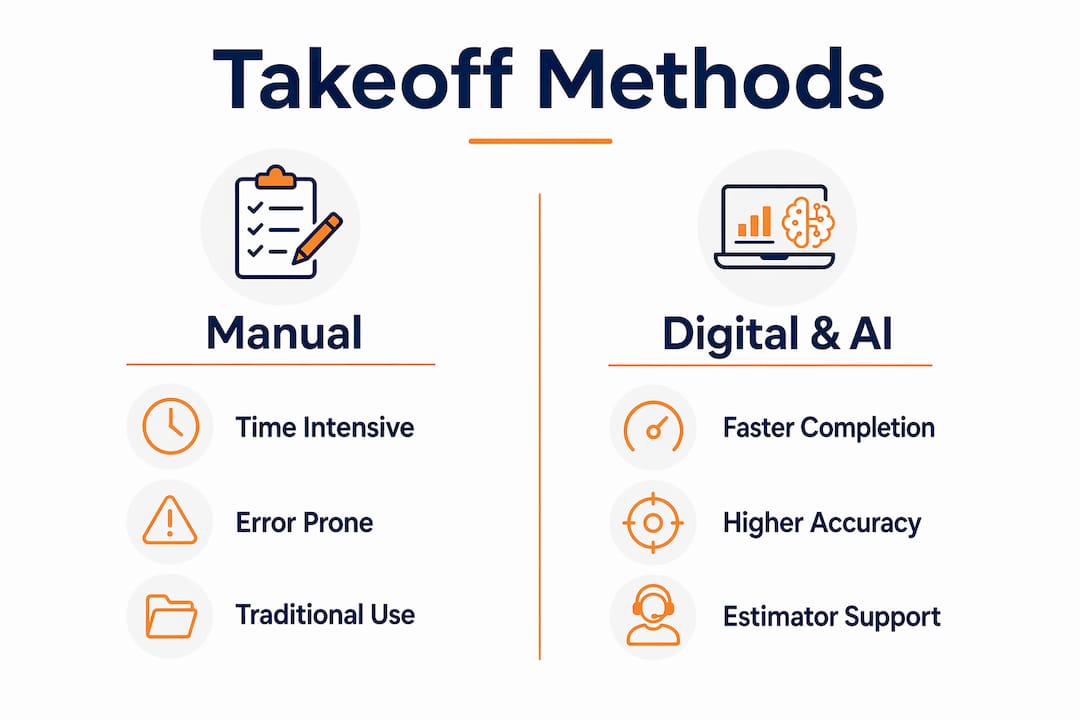
| Method | Time to complete | Error risk | Best use case |
|---|---|---|---|
| Manual (paper and scale) | Baseline (2x to 3x slower) | High: math and transcription errors | Small, simple projects only |
| Digital software (Bluebeam, PlanSwift) | 60 to 70% faster than manual | Low: auto-calculation reduces math errors | Most commercial bid types |
| AI-powered tools | Under 1 hour for preliminary quantities | Very low: flags missed scope items | Complex, large-scale commercial projects |
Manual takeoffs take 2 to 3 times longer than digital methods and are more prone to errors that reduce bid win rates by up to 30%. That time penalty is not just an efficiency problem. It is a competitive disadvantage. While your estimator is scaling drawings by hand, a competitor using digital takeoff software is already reviewing quantities and building the estimate.
AI-powered takeoff software can generate preliminary quantities in under an hour for estimator review, and these tools analyze plans automatically to flag scope items that a human might miss on a first pass. The practical benefit on a complex commercial bid is that the estimator spends time on judgment calls, not counting studs. That shift in how estimator time is used produces better bids, not just faster ones.
Pro Tip: Use AI or digital tools to generate your first-pass quantities, then have an experienced estimator review the output against the spec book. The combination of software speed and human judgment produces the most reliable commercial bid quantities.
Combining human estimator judgment with digital tools enables accurate, competitive bids while managing project risks more effectively than either approach alone.
How detailed takeoffs improve subcontractor bid management
A completed takeoff does more than feed your own estimate. It generates the scope packages you send to subcontractors, and the quality of those packages determines the quality of the bids you receive back. Vague scope packages produce vague bids. Precise scope packages with quantities attached produce competitive, comparable bids that are easier to level.
Accurate quantity takeoffs allow contractors to allocate resources effectively, reducing delays and improving project profitability. When a general contractor sends a mechanical subcontractor a scope package that includes measured linear footage of ductwork, equipment schedules, and a clear list of inclusions and exclusions, that subcontractor can price the work accurately. When the package is a PDF of drawings with no scope narrative, the subcontractor builds in contingency to cover uncertainty, and that contingency comes out of your budget.
The downstream benefits of detailed takeoffs in subcontractor management include:
- Faster bid leveling because all subs are pricing the same defined scope
- Fewer scope clarification calls during the bid period, which saves estimator time
- Cleaner apples-to-apples comparisons when reviewing sub bids for award
- Stronger negotiating position because you know the quantities and can challenge outliers
Clients report saving $20,000 to $100,000 per project by receiving more competitive bids faster when scope packages are built from detailed takeoff quantities. That range reflects project size, but the mechanism is consistent: better scope packages produce better sub bids, and better sub bids produce better project outcomes.
Inaccurate takeoffs often lead to procurement errors, scheduling delays, and loss of client trust. When a subcontractor receives a scope package built on bad quantities, they either over-order materials or run short mid-project. Both outcomes create delays, and delays on commercial projects carry liquidated damages clauses that hit the general contractor first and flow down to the sub responsible.
Key takeaways
Detailed takeoffs are the single most important input in commercial bid preparation because they determine the accuracy of every cost, scope, and schedule decision that follows.
| Point | Details |
|---|---|
| Takeoffs drive estimate accuracy | Every bid line item traces back to a measured quantity; errors compound through the entire estimate. |
| Scope definition prevents change orders | Confirming trade boundaries and drawing revisions before measuring eliminates the most common source of post-award disputes. |
| Digital tools cut time and errors | Digital takeoff software reduces completion time by 60 to 70% and lowers math error rates compared to manual methods. |
| AI flags missed scope items | AI-powered tools generate preliminary quantities in under an hour and identify items human estimators might overlook. |
| Better takeoffs produce better sub bids | Quantity-backed scope packages result in comparable, competitive subcontractor bids and faster bid leveling. |
The takeoff is where the project is actually won or lost
I have reviewed hundreds of bid post-mortems over the years, and the pattern is consistent. Projects that go sideways financially almost always trace back to a takeoff that was rushed, incomplete, or built on the wrong drawing set. The estimator knew the unit costs. The labor rates were current. The markup was right. But the quantities were off, and everything downstream was wrong as a result.
The mistake I see most often is treating the takeoff as a task to get through rather than a process to get right. Estimators under deadline pressure will skip the spec book review, assume the drawings are current, and measure what is visible without checking for scope boundaries. That approach produces a bid number fast. It does not produce a reliable one.
What actually works is building the takeoff process into your bid schedule as a protected block of time. If you have a 14-day bid window, the takeoff should consume the first five days. The estimate, sub bid collection, and final pricing happen in the remaining nine. Contractors who invert that ratio, spending most of their time on pricing and rushing the takeoff, consistently produce bids that are either too high to win or too low to profit from.
The other thing I would push back on is the idea that digital tools replace estimator judgment. They do not. They free it. When a tool handles the counting, the estimator can focus on the questions that actually require experience: Is this spec calling for a labor-intensive installation method? Does this scope overlap with another trade? Is the waste factor on this material type higher than standard given the project geometry? Those are the questions that separate a good bid from a great one.
— Jennifer
How Won2build supports accurate takeoffs and bid management
Won2build gives commercial subcontractors a single login to manage every phase of the bid workflow, from initial takeoff through final submission. The platform’s takeoff and estimating tools connect quantity measurements directly to bid tracking, so the numbers you measure are the numbers that build your estimate, with no manual re-entry and no transcription errors.
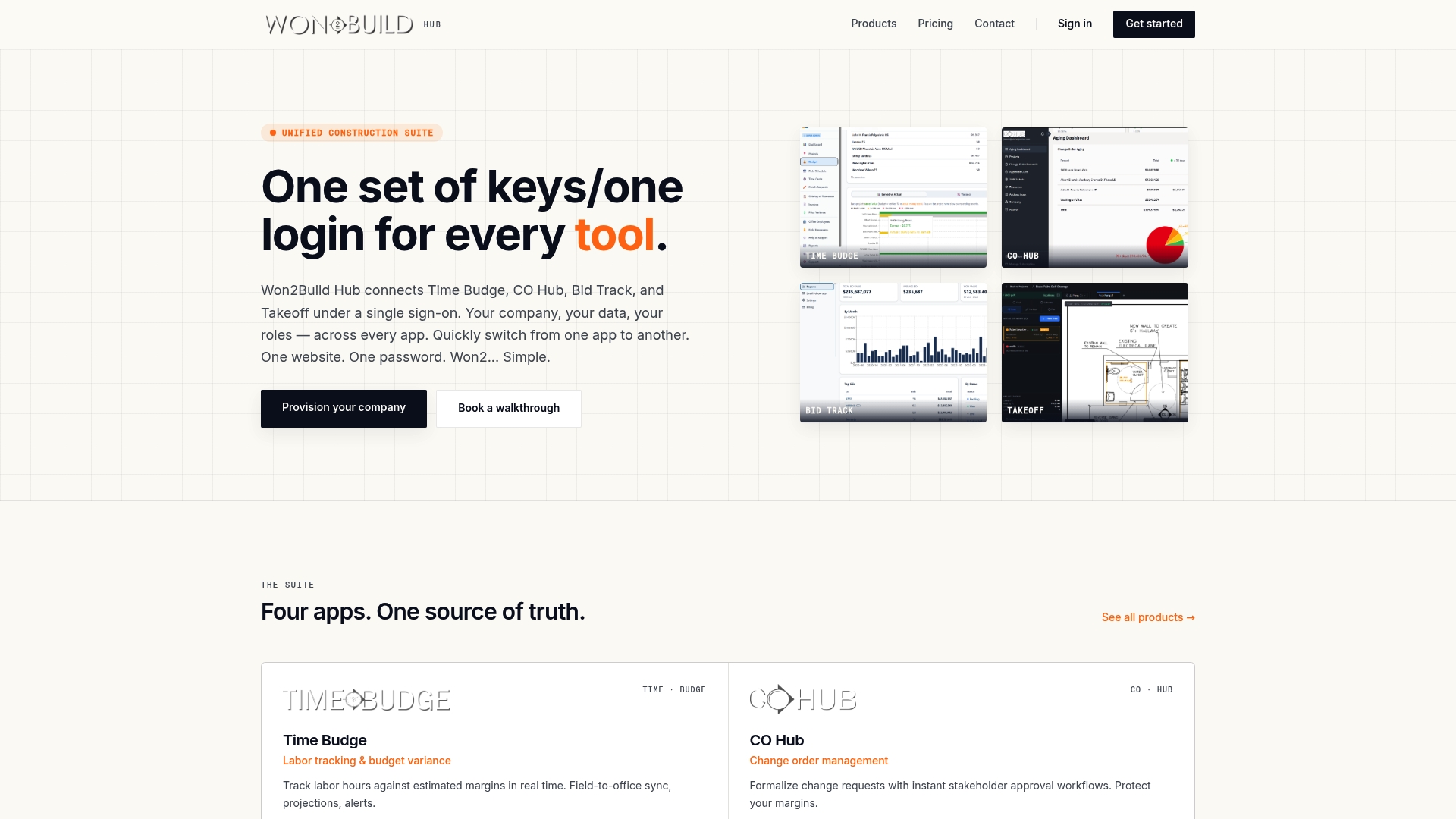
Beyond takeoffs, Won2build includes bid tracking, time card and budget management, and change order management in one integrated system. Subcontractors using Won2build report faster bid preparation and better visibility into project costs from the first measurement to the final invoice. If you are bidding commercial work and still managing takeoffs in spreadsheets or disconnected tools, Won2build is built specifically for the workflow you are running every day.
FAQ
What is a detailed takeoff in construction bidding?
A detailed takeoff is the systematic measurement of all materials, labor, and equipment quantities required for a construction project, and it serves as the foundation for every accurate cost estimate and commercial bid.
How does takeoff accuracy affect bid win rates?
Estimating errors reduce bid win rates by up to 30%, according to industry data. Accurate takeoffs produce competitive bid numbers that reflect actual project costs rather than inflated contingencies.
What is the difference between a takeoff and an estimate?
A takeoff produces the quantities. An estimate applies unit costs to those quantities to generate a total project cost. You cannot produce a reliable estimate without completing the takeoff first.
How much faster are digital takeoffs than manual methods?
Digital takeoff software reduces completion time by 60 to 70% compared to manual methods, and it eliminates the math errors that are common in hand-scaled measurements on complex commercial drawings.
Why do scope gaps cause change orders on commercial projects?
Scope gaps occur when trade boundaries are undefined or drawing sets are incomplete at bid time. When the awarded scope does not match what was priced, the difference surfaces as a change order, which adds cost and creates disputes between the contractor and the owner.
Recommended
One login for estimating, bid tracking, change orders, and labor.
The Hub is free. Pay only for the apps you turn on.
Create your free Hub account- How to Compare Plan Revisions and Control Estimate ChangesA practical guide for commercial subcontractors on comparing plan revisions, catching scope changes, and keeping estimates and change orders in step.
- Drywall Takeoff Basics: A Step-by-Step Guide for SubsLearn drywall takeoff basics: how to measure walls and ceilings, deduct openings, convert to sheets, set waste and finish levels, and avoid costly misses.
- How to Reduce Profit Fade on Subcontractor JobsProfit fade usually starts in the field and hides until closeout. Here is how subcontractors can catch it weekly and protect the margin they bid.