
Construction Timecard Best Practices for Subcontractors
Discover essential construction timecard best practices to control labor costs, ensure compliance, and boost profit margins for subcontractors.

Construction timecard best practices are defined as a system combining granular cost coding, GPS geofencing, multi-layer approval workflows, and automated payroll integration to control labor costs and protect profit margins. Labor accounts for 35–45% of total project costs, making it the highest-variance category on any project. Contractors who track labor by cost code achieve profit margins 2–4 percentage points higher than those relying on summary timesheets. The Fair Labor Standards Act (FLSA) adds a compliance layer that makes accurate timekeeping a legal obligation, not just a financial preference. Platforms like Won2build are built specifically to help subcontractors meet these demands without adding administrative overhead.
1. Construction timecard best practices start with precise cost coding
Cost coding is the foundation of every reliable construction timecard system. A cost code assigns each hour worked to a specific scope item, such as framing, drywall, or mechanical rough-in. Without that assignment, labor data becomes a lump sum that tells you nothing useful about where money was spent or lost.
Mismatched cost codes between field time tracking and office accounting cause 23% of payroll allocation errors. That figure represents real dollars misapplied to the wrong budget line, which distorts job costing and makes future estimates less reliable. The fix is straightforward: use 10–15 cost codes aligned to estimate line items so field entries map directly to your accounting system without manual translation.
Common cost code categories for subcontractors include:
- Framing (rough carpentry, structural steel)
- Drywall (hanging, taping, finishing)
- Mechanical (HVAC rough-in, ductwork)
- Electrical (conduit, panel work, trim-out)
- Site work (excavation, grading, concrete)
- General conditions (supervision, site cleanup)
Pro Tip: Set your full cost code list before the project kickoff meeting. Adding codes mid-project forces retroactive corrections and creates the exact administrative overhead you are trying to avoid.
2. What role does GPS geofencing play in reliable construction time tracking?
GPS geofencing is a virtual boundary around a jobsite that triggers automatic clock-in and clock-out events when a worker enters or exits. Properly configured geofencing reduces fraudulent clock-ins by 94%, which is the single largest measurable impact any timekeeping control delivers. That reduction directly cuts ghost hours, the industry term for pay claimed for time not actually worked on site.

The size of the geofence matters as much as its existence. Recommended radii are 200–500 feet for residential projects and 500–1,500 feet for commercial sites. A boundary set too tight, say 50–100 feet, generates false negative alerts when workers are legitimately on site but outside the narrow perimeter. Those false alerts frustrate crews and erode trust in the system.
Including parking lots and site access points inside the geofence boundary prevents false negatives and protects crew morale. A worker who parks 300 feet from the trailer and gets flagged as absent will not stay cooperative with the timekeeping process for long.
Pro Tip: Walk the full site perimeter before configuring your geofence. Mark the farthest point a worker legitimately reaches during their shift, including the parking area, and set your boundary 50–100 feet beyond that point.
3. Which verification and approval workflows prevent timecard fraud?
A single approver reviewing their own crew’s timecards creates an obvious conflict of interest. The stronger control is a three-way reconciliation: GPS or badge entry data, foreman-approved timecards, and scheduled shift records are compared before payroll closes. Any discrepancy triggers a review rather than an automatic approval.
Second human sign-off on manual timecard edits creates an immutable audit trail that prevents unauthorized time padding. This control requires no new hardware. It is a process change that assigns a project manager or payroll administrator as the second approver on any manual edit a foreman submits.
Segregation of duties is the governing principle here. Foremen approve field hours. Project managers review exceptions and manual edits. Payroll administrators close the period. No single person controls all three steps.
Hard-stop exceptions worth flagging before payroll close include:
- Clock-in without a corresponding GPS event
- Hours exceeding the scheduled shift by more than 30 minutes without a supervisor note
- Duplicate entries for the same worker on the same day
- Cost code entries that do not match the active scope for that project phase
- Overtime hours on days with no approved schedule extension
Experts recommend reconciling GPS events, foreman approvals, and scheduled shifts before every payroll close to catch anomalies before they become payroll errors.
Pro Tip: Configure automated alerts to flag anomalies the morning after each shift. Catching a missed punch at 7 a.m. the next day is far easier than reconstructing a week of records on Friday afternoon.
4. How does automated payroll integration improve timecard management?
Manual payroll entry from paper timecards is where most wage violations originate. Overtime miscalculations affect 31% of contractors audited by the Department of Labor. That statistic reflects the complexity of managing multiple pay rate tiers, prevailing wage requirements, and state-specific overtime rules simultaneously.
Mid-size subcontractors typically manage 4–7 pay rate tiers per workforce. Each tier may carry different overtime thresholds depending on the project type, union agreement, or state law. Rule-based automation applies the correct rate based on cost code, project type, and hours worked, removing the manual calculation step entirely.
Key benefits of direct payroll integration include:
- Elimination of double data entry between field time tracking and accounting software
- Automatic overtime calculation based on project-specific and state-specific rules
- Prevailing wage compliance for public works projects tracked by cost code and classification
- Audit-ready records with timestamps and approver signatures attached to each entry
- Reduced payroll close time when cost codes sync directly to your accounting system
Pro Tip: Choose a platform that syncs cost codes and pay rules automatically between field and office. Manual translation between two systems is where errors enter, and where administrative hours disappear.
5. What are the best daily and weekly timecard review practices?
Daily review is not optional for subcontractors managing multiple crews. Automated anomaly alerts reviewed each morning catch missed punches, unusual hours, and overtime flags before they compound into a week’s worth of corrections. A single missed punch caught on Tuesday takes two minutes to fix. The same error caught on Friday payroll close takes twenty.
Combining timecard submission with daily field reports is one of the most underused efficiency moves in construction labor tracking. When a foreman submits their daily report, they confirm hours at the same time. That single workflow produces two outputs: a validated timecard and a documented record of work completed. Both feed directly into billing and budget tracking.
Weekly reviews serve a different purpose. They confirm that labor costs are tracking against the budget for each cost code, not just that hours were recorded. A cost code running 15% over budget in week two is a recoverable problem. The same overrun discovered at project close is not.
Useful practices for daily and weekly review cycles include:
- Review anomaly alerts before the crew starts their next shift
- Require foreman and worker sign-off on timecards before the weekly payroll run
- Compare actual hours per cost code against the labor budget weekly
- Use real-time budget tracking to flag cost codes trending over budget before they breach it
- Archive validated timecards with approval signatures for FLSA compliance
Pro Tip: Set a Friday noon deadline for all timecard approvals. That window gives payroll administrators time to resolve exceptions before the weekend without working after hours.
6. How do you manage construction timecards across multiple jobsites?
Managing timecards across multiple active projects multiplies every error risk. A worker assigned to two sites in one week needs their hours split by project and cost code, not lumped into a single daily total. When that split happens manually, it introduces the exact misallocation errors that cost coding is designed to prevent.
The practical answer is a centralized platform where each project carries its own cost code list, geofence, and approval chain. Field workers clock in to a specific project, not just a general time bucket. That single structural choice eliminates most cross-project allocation errors before they reach payroll.
Electronic time tracking solves the multi-site problem by tying each punch to a project ID automatically. The field worker selects their project and cost code at clock-in. The system records the GPS event, timestamps the entry, and routes it to the correct project’s approval queue. No manual sorting required.
Subcontractors running three or more active projects simultaneously see the largest return from this structure. The administrative time saved on sorting and correcting cross-project entries alone justifies the switch from paper or spreadsheet timecards.
7. Why crew buy-in determines whether timekeeping practices actually work
Every technical control in this list fails if the crew does not use it correctly. A geofence does nothing if workers clock in from the parking lot before walking to the site. Cost codes are useless if workers select the wrong one because the list is confusing or the interface is slow.
Time capture must be quick at the start and end of each shift to maintain crew acceptance. If clocking in takes more than 30 seconds, workers find workarounds. Those workarounds produce the inaccurate data you are trying to prevent.
Framing timekeeping around accurate pay rather than surveillance changes the crew’s relationship with the process. Workers who understand that the system protects their overtime pay and prevents paycheck errors become advocates for it. Workers who see it as monitoring become resistors.
Running a pilot with a single crew framed around fairness and accurate pay lowers resistance and improves adoption. Start with your most cooperative foreman. Fix the friction points before rolling out to the full workforce. That sequence produces a system the crew trusts rather than tolerates.
Key takeaways
Effective construction timecard management requires cost coding, geofencing, multi-layer approvals, and automated payroll integration working together as a single system.
| Point | Details |
|---|---|
| Cost coding drives profitability | Use 10–15 codes aligned to estimate line items to reduce payroll allocation errors and improve job costing. |
| Geofencing cuts fraud | A properly sized geofence reduces fraudulent clock-ins by 94% and protects crew morale when boundaries include parking areas. |
| Multi-layer approvals prevent ghost hours | Three-way reconciliation of GPS data, foreman approvals, and scheduled shifts catches anomalies before payroll closes. |
| Automation reduces wage violations | Rule-based payroll integration applies correct pay rates automatically, reducing the overtime miscalculation risk that affects 31% of audited contractors. |
| Daily review stops errors from compounding | Reviewing anomaly alerts each morning and combining timecard submission with daily reports keeps labor data accurate and billing reliable. |
The friction nobody talks about
The hardest part of implementing solid timekeeping practices is not the technology. It is the moment a foreman realizes the system caught an error he made, and he has to explain it to a project manager. That friction is real, and it is the reason so many subcontractors run technically capable systems that nobody uses correctly.
My honest view: the approval workflow is where most implementations quietly fail. Companies configure the geofencing and the cost codes correctly, then leave manual edits on a single-approver system because adding a second approver feels like bureaucracy. That shortcut is exactly where ghost hours survive.
The pilot program approach changed how I think about rollouts entirely. Starting with one crew and framing the whole thing around “we want to make sure you get paid correctly for every hour” removes the adversarial dynamic. Workers who have been shorted on overtime before respond to that framing immediately. They become the system’s best advocates.
The other thing worth saying plainly: daily review is not a nice-to-have. A missed punch caught the next morning takes two minutes. The same error caught at payroll close on Friday takes twenty minutes and a phone call. The math on that is obvious, but most project managers still treat daily review as optional until they have a painful payroll correction experience.
Build the review into the foreman’s morning routine, not the PM’s Friday afternoon. That is where the habit actually sticks.
— Jen Reese
Time Budge by Won2build handles the heavy lifting
Won2build’s Time Budge is built specifically for subcontractors who need cost coding, geofencing, approval workflows, and payroll integration in one place without managing four separate tools.
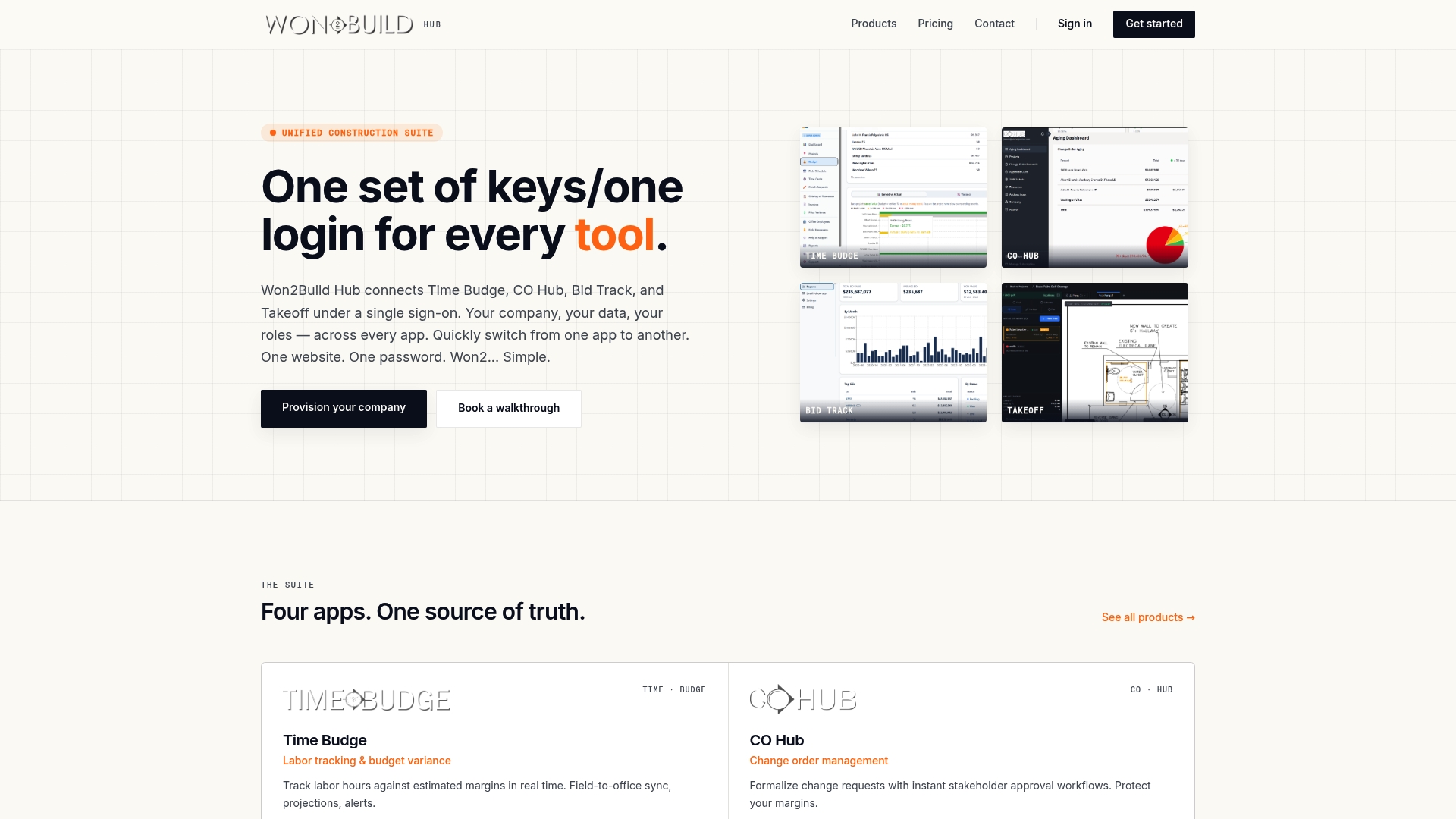
Time Budge applies the practices covered in this article automatically. Cost codes sync directly to your accounting system. Geofence boundaries are configurable per project. Anomaly alerts fire before payroll closes. The second-approver workflow is built in, not bolted on. For subcontractors managing multiple active projects, the single sign-on access across Won2build’s full suite means labor tracking and job costing connect directly to your bid estimates and change order records. No double entry. No data gaps between field and office.
FAQ
What are construction timecard best practices?
Construction timecard best practices are a system of cost coding, GPS geofencing, multi-layer approvals, and automated payroll integration that reduces labor cost errors and protects profit margins. Contractors using detailed cost-code tracking achieve profit margins 2–4 percentage points higher than those using summary timesheets.
How many cost codes should a subcontractor use?
Use 10–15 cost codes aligned to your estimate line items. More codes create field confusion; fewer codes produce data too broad to act on for job costing or future estimating.
How does GPS geofencing improve timecard accuracy in construction?
A properly configured geofence reduces fraudulent clock-in events by 94% by verifying physical site presence at the time of each punch. Setting the boundary to include parking areas and site access points prevents false negatives that frustrate crews.
Why does manual timecard editing create compliance risk?
Manual edits without a second approver leave no audit trail, making unauthorized time padding difficult to detect. The FLSA requires accurate records, and a single-approver system on manual edits is the most common gap found in Department of Labor audits of construction contractors.
How often should construction timecards be reviewed?
Review automated anomaly alerts daily, before the next shift starts. Run a full cost-code-versus-budget comparison weekly to catch labor overruns while they are still correctable.
Recommended
One login for estimating, bid tracking, change orders, and labor.
The Hub is free. Pay only for the apps you turn on.
Create your free Hub account- 7 Concrete Takeoff Steps Estimators Use to Avoid Ordering ShortfallsFollow seven concrete takeoff steps to calculate cubic yards, size rebar and formwork, convert volumes to supplier units, and verify quantities before bid...
- Are E-Signature Change Orders Legal and Worth the Switch?E-signature change orders streamline your workflow, ensuring faster approvals, fewer disputes, and quicker invoicing—discover the benefits now!
- How to Link Takeoff to Estimate for Accurate BidsLink your takeoff quantities to your estimate for accurate bids. Discover the seamless integration method that reduces errors and saves time.