
Real-Time Budget Tracking Benefits for Construction Teams
Discover the benefits of real time budget tracking for construction teams. Improve financial monitoring and manage costs effectively!

Real-time budget tracking is defined as linking project budgets directly to live transaction data so that cost overruns are flagged mid-month, not weeks after the damage is done. For construction project managers, this shift from monthly reporting to continuous financial monitoring is the difference between catching a labor overrun on day 12 and discovering it on day 45. Tools like Premier Construction Software and Aimsio have made live job costing standard practice for contractors who want to protect margins. The benefits of real time budget tracking go well beyond convenience. They change how you manage crews, vendors, and change orders on every project.
1. What are the top benefits of real-time budget tracking?
Real-time financial monitoring gives construction teams an early warning system that traditional monthly close cycles cannot match. When labor hours and material costs post the same day they occur, your budget vs. actuals report reflects reality, not last month’s reality.
Here is what that delivers in practice:
- Early overrun detection. Detecting spend mid-month gives you time to act before the overrun compounds. A framing crew running 8% over budget in week two is a scheduling conversation. The same overrun discovered at month-end is a margin loss.
- Accurate live job costing. Same-day entry of labor hours, materials, and subcontractor invoices means your cost-to-date number is always current. Premier Construction Software and Aimsio both support this model with field-to-office data sync.
- Faster feedback loops. Real-time visibility reduces feedback lag from 45–60 days to 24–48 hours. That compression alone changes how fast your team can respond to a problem.
- Better cost-to-complete forecasts. When you know what you have spent and what work remains, your finish-margin forecast is grounded in current data, not assumptions from last month’s report.
- Cash flow control. Live expense monitoring shows you exactly where cash is moving across active jobs, which matters when you are managing multiple projects with overlapping draw schedules.
Pro Tip: Set up your job cost codes before the project starts. Consistent coding from day one is what makes real-time comparisons meaningful when you need them most.
The advantages of budget tracking in real time compound over a project’s life. A small course correction in week three costs far less than a recovery plan in week ten.

2. How does real-time tracking improve decision making?
Live budget data changes the quality of every decision you make on a project. When your Cost Performance Index (CPI) and Estimate at Completion (EAC) update as work progresses, you are managing with current numbers, not historical ones.
Live CPI and EAC metrics allow immediate course corrections that improve both forecasting accuracy and final project profitability. A CPI below 1.0 on a concrete pour in week four tells you the job is burning more cost per unit of work than planned. You can adjust crew size, renegotiate material delivery, or submit a change order before the variance grows.
Automated alerts make this manageable at scale. Alerts trigger when cost deviations exceed 5%, which means your attention goes to the variances that actually matter, not every minor fluctuation in a daily report.
The best real-time tracking systems reduce noise by focusing managerial attention using automated alerts, enabling efficient oversight across multiple active projects.
Real-time data also lets you prioritize crews and purchasing based on where the budget pressure is right now. If electrical is running tight and framing has slack, you can shift resources with confidence. That kind of decision used to require a project controls meeting. Now it requires a dashboard check.
3. What challenges does it solve for multi-site projects?
Multi-site construction projects have a specific financial problem: fragmented purchasing and inconsistent cost coding produce variance data that looks alarming but means nothing. Real-time budget tracking solves this only when the data feeding it is clean and standardized.
| Challenge | Without real-time tracking | With real-time tracking |
|---|---|---|
| Cost code consistency | Manual entry varies by site | Controlled dropdowns enforce uniform codes |
| Overrun detection | Discovered at month-end close | Flagged within 24–48 hours |
| Spending visibility | Siloed by location | Consolidated across all sites |
| Variance analysis | Delayed and often misleading | Current and comparable |
Standardizing cost-code mapping and using controlled entry points prevents the misleading variance noise that plagues multi-site portfolios. When every site uses the same codes, a variance in Phoenix means the same thing as a variance in Atlanta.
Centralized spending visibility is the other major gain. A project manager overseeing five active sites cannot physically be everywhere. A consolidated real-time dashboard gives you the same oversight without the travel. You see which sites are on track and which need attention before the weekly call.
Pro Tip: Use dropdown-only cost code entry across all sites. Free-text fields create inconsistencies that corrupt your real-time comparisons and make variance reports unreliable.
4. What software features make real-time tracking work?
The difference between a system that delivers genuine real-time financial monitoring and one that just feels modern comes down to a few specific technical features. Knowing what to look for saves you from investing in tools that update overnight and call it real time.
Key features to evaluate:
- Event-driven data syncing. Syncing data every 15 minutes instead of overnight batch processing is what makes financial decisions timely and accurate. Overnight batches mean your morning dashboard reflects yesterday.
- Automated transaction coding. Costs should code to the right job and cost code at the point of entry, not after a manual review cycle.
- Live dashboards. Budget vs. actuals, variance by cost code, CPI, and EAC should all be visible without running a report.
- Integration with time tracking and procurement. Labor hours from the field and purchase orders from procurement need to flow into the same budget without manual re-entry. Won2build’s Time Budge product handles real-time labor tracking with direct job cost integration.
- Change order connectivity. When a change order is approved, the budget should update automatically. Managing this in a separate spreadsheet breaks the real-time loop.
The goal is a system where field activity and financial data move together. Any gap between what happens on site and what appears in the budget is a gap where overruns hide.
5. How can construction teams maximize these benefits?
Frequent dashboard updates do not improve project margins on their own. Without governance for prompt action on overruns, real-time visibility is just a faster way to watch costs climb. The teams that get the most from live budget data build formal response processes around it.
Here is how to structure that:
- Establish a governance loop. When an alert fires above your variance threshold, a named person owns the response. Define who acts, what they can authorize, and how fast they must respond.
- Enforce cost code discipline. Standardized entry rules are not optional. One site entering costs differently from the others corrupts your consolidated view.
- Align earned value updates with project cadence. EAC metrics stay actionable only when field progress updates match the rhythm of the work. Monthly updates on a fast-moving project defeat the purpose.
- Shorten decision cycles, not just reporting cycles. The goal is faster action, not faster data. Build your project budget setup to support decisions, not just documentation.
- Review material inventory alongside budget data. Real-time inventory updates improve working capital management and prevent surprise procurement costs from hitting the budget unannounced.
Pro Tip: Tie your weekly project review directly to the live dashboard. If your team is still pulling static reports for the Monday meeting, you are not using real-time data. You are just using faster old data.
The teams that treat real-time budget data as a management tool, not a reporting tool, are the ones who close projects at or above their target margin.
Key takeaways
Real-time budget tracking turns construction cost management from a monthly review into a continuous control system that protects margins at every stage of a project.
| Point | Details |
|---|---|
| Early overrun detection | Flagging overruns mid-month gives teams time to act before losses compound. |
| Faster feedback loops | Reducing lag from 45–60 days to 24–48 hours accelerates every corrective decision. |
| Automated alerts | Variance alerts above 5% direct management attention to the issues that matter most. |
| Governance over dashboards | Formal response protocols turn live data into margin protection, not just visibility. |
| Standardized cost codes | Consistent coding across sites makes real-time comparisons accurate and reliable. |
Why real-time finance is a culture shift, not just a software upgrade
I have worked with construction teams that bought the right software, set up the dashboards, and still closed projects 10–12% over budget. The data was live. The decisions were not.
The real impact of real-time budget tracking shows up when a project manager sees a concrete subcontractor running 7% over in week three and calls a scope conversation that afternoon, not at the next monthly review. I have seen that single conversation save $40,000 on a mid-size commercial job. The tool made it possible. The culture made it happen.
Real-time finance shifts the rhythm from monthly reporting to continuous engagement, which means budgets become active tools rather than passive records. That shift requires department heads and field supervisors to own their numbers weekly, not just when the PM asks. Most teams underestimate how much that changes the job.
The contractors I have seen get the most from live financial monitoring are the ones who treat a variance alert the same way they treat a safety flag. It demands an immediate response, a named owner, and a documented resolution. That discipline is what separates teams that use real-time data from teams that just display it.
— Jen Reese
See how Won2build puts this into practice
Won2build is built specifically for construction subcontractors who need live cost visibility across labor, change orders, and bid estimates without managing four separate systems.
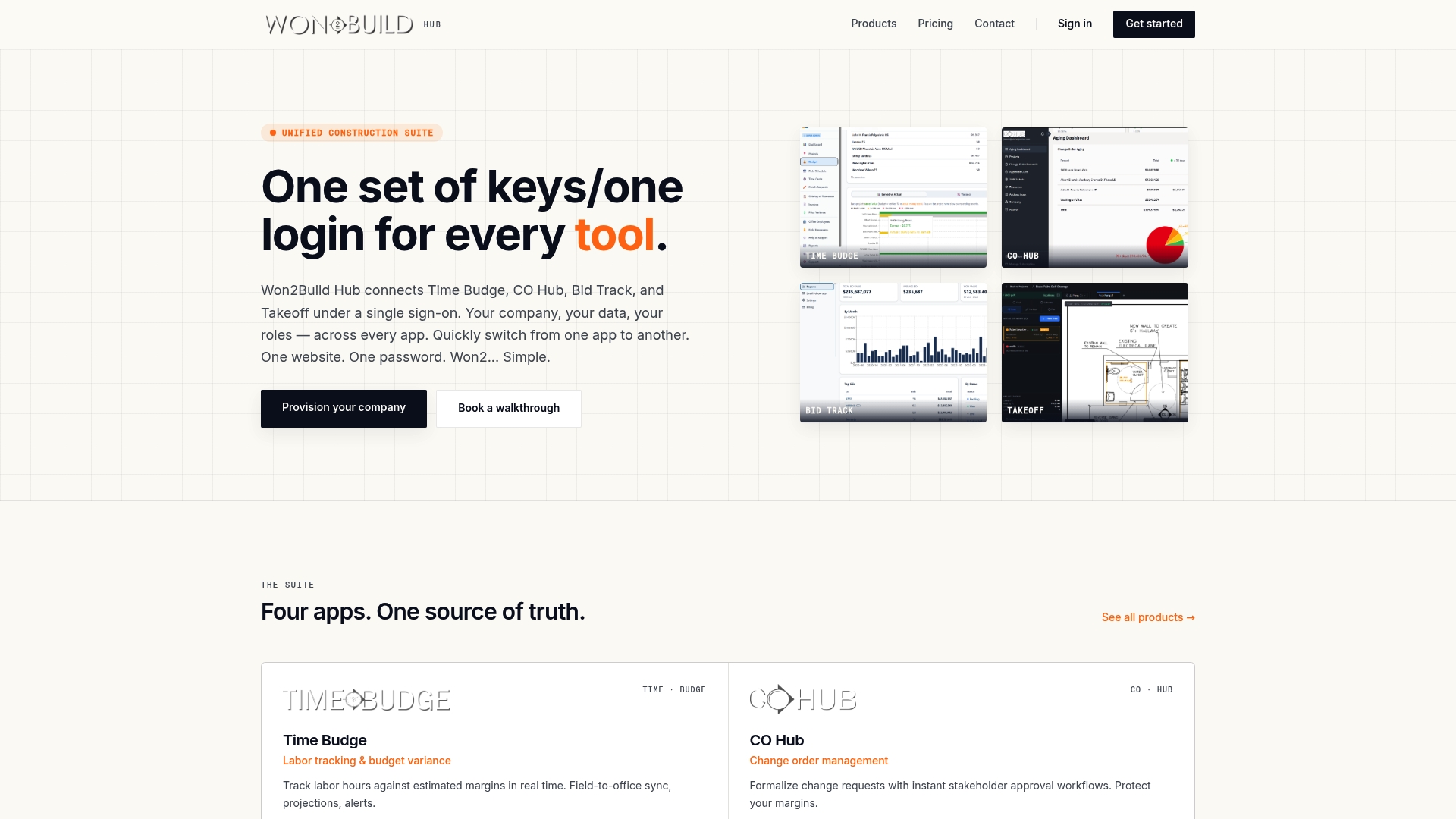
The CO Hub change order tool keeps every approved change order connected to your live budget, so scope additions never fall through the cracks. The Takeoff software gives you accurate digital plan measurements that feed directly into your cost estimates, reducing the gap between bid and actual from the start. Bid Track manages your estimating pipeline so your forecasts are grounded in current market costs. All four applications run under a single sign-on, which means your field data and office data stay synchronized without manual re-entry or duplicate records.
FAQ
What is real-time budget tracking in construction?
Real-time budget tracking links project budgets to live transaction data so that labor, material, and subcontractor costs appear in your budget within hours of being incurred. This replaces the traditional monthly close cycle with continuous financial visibility.
How fast does real-time tracking detect overruns?
Real-time systems reduce the feedback lag from 45–60 days to 24–48 hours. Automated alerts trigger when cost deviations exceed 5%, so overruns surface while there is still time to act.
What is the difference between CPI and EAC in construction budgeting?
The Cost Performance Index measures how efficiently a project is spending its budget relative to work completed. The Estimate at Completion projects the total cost at finish based on current performance. Both metrics are only useful when updated with current field data.
Do I need special software for real-time budget tracking?
You need software that supports event-driven data syncing, automated cost coding, and live dashboards. Overnight batch-processing systems do not deliver true real-time monitoring, even if they market themselves that way.
Why do some teams see no improvement after adopting real-time tracking?
Frequent data updates without formal governance protocols do not improve margins. Teams need defined response processes for when alerts fire, including named owners and authorized actions, to turn visibility into financial control.
Recommended
One login for estimating, bid tracking, change orders, and labor.
The Hub is free. Pay only for the apps you turn on.
Create your free Hub account- 7 Concrete Takeoff Steps Estimators Use to Avoid Ordering ShortfallsFollow seven concrete takeoff steps to calculate cubic yards, size rebar and formwork, convert volumes to supplier units, and verify quantities before bid...
- Are E-Signature Change Orders Legal and Worth the Switch?E-signature change orders streamline your workflow, ensuring faster approvals, fewer disputes, and quicker invoicing—discover the benefits now!
- How to Link Takeoff to Estimate for Accurate BidsLink your takeoff quantities to your estimate for accurate bids. Discover the seamless integration method that reduces errors and saves time.