
Stop 2% Quantity Errors, Subcontractors: 7 Step PDF Takeoff Accuracy
Use a seven-step QA checklist, 2026 AI benchmarks, and Won2Build workflow to eliminate scale errors, cut review time, and protect your bid margin.

Consistent, bid-grade PDF takeoff accuracy comes from four disciplined habits: verifying the plan set before you touch a ruler, calibrating scale on every single sheet, keeping net measurements traceable back to their source detail, and routing any low-confidence AI-extracted quantity to a human reviewer. Skip the first step and every measurement after it inherits the error.
TL;DR:
- Accurate scale verification on every sheet, including known vertical and horizontal dimensions, prevents widespread measurement errors that can impact bid margins.
- Using vector, searchable PDFs scanned at 300 DPI improves extraction reliability, especially compared to low-resolution raster files that degrade OCR accuracy.
- Route items below 85 to 90 percent confidence scores for manual review, and scrutinize high-value or high-variance line items to avoid costly over- or under-estimation.
- Consistent traceability of quantities back to their source sheet and detail saves time during change orders and dispute resolution.
- Building disciplined habits around plan validation, calibration, and review reduces bid errors more effectively than software upgrades alone.
Table of Contents
- Why PDF Takeoff Accuracy Matters More Than Most Estimators Admit
- What Causes Most PDF Takeoff Errors, and How Do You Catch Them?
- How Do PDF Takeoff Tools Improve Measurement Precision?
- Where Does AI Help Most, and Where Does It Still Need a Human Check?
- A Step-by-Step Takeoff and QC Workflow You Can Adopt This Week
- Won2Build’s View on Keeping Takeoffs Traceable Through Bid and Change Order
- The Real Lesson Buried in the AI Takeoff Numbers
- How Won2Build Keeps Your Takeoffs Bid-Ready
- Sources
- FAQ
Why PDF Takeoff Accuracy Matters More Than Most Estimators Admit
A missed dimension or a bad scale calibration doesn’t just cost you a few square feet. It moves your bid price directly, and on tight-margin commercial work, a 2% quantity error can wipe out the profit you built into the job. Errors compound the fastest on large projects and repetitive linear runs like conduit, duct, or piping, where a small per-unit miss multiplies across thousands of feet.
The gap between manual and AI-assisted takeoff has narrowed sharply. One 2026 benchmark of automated systems found composite accuracy slightly above independent professional estimators on standardized blueprint tests, showing notable improvements in coverage and precision construction blueprint benchmark. Separately, a 50-project comparison found manual takeoffs averaged 18.4 hours per project against 2.6 hours for AI-assisted takeoff with a review pass, with AI often landing closer to as-built quantities on long linear runs. That time savings only holds up when someone actually checks the output.
What Causes Most PDF Takeoff Errors, and How Do You Catch Them?
Most takeoff mistakes trace back to four repeat offenders: an outdated plan set, an unverified scale, a scanned PDF nobody checked for clarity, and quantities that got mixed with waste factors before anyone could audit them. Fix those four and you eliminate the majority of costly rework.
Scale drift is the sneaky one. ConstructConnect’s guidance on scale verification recommends checking both a known horizontal and vertical dimension on every sheet, not just the first one in the set, because scale settings can shift between pages even within the same PDF.
Run this seven-step check before you price anything:
- Confirm you’re working from the current plan set, including the latest revisions and addenda.
- Calibrate scale on every sheet using a known horizontal dimension.
- Re-verify with a known vertical dimension to catch aspect ratio errors.
- Flag any scanned or raster page and check its resolution before measuring.
- Take off net quantities only, with no waste factor applied yet.
- Tag every quantity to its sheet number and detail callout.
- Run final QC against the original specifications before export.
Pro Tip: Keep a signed release log that locks the plan set you’re measuring against. If a superseded sheet slips into your working folder, you’ll never notice until the bid is already submitted.
How Do PDF Takeoff Tools Improve Measurement Precision?
Good takeoff software earns its keep through three specific features: built-in calibration tools that force a scale check per sheet, markups linked directly to a bill of quantities so nothing gets typed twice, and quantity tags that preserve a clear line back to the drawing detail. Without that linkage, you’re trusting memory, and memory is exactly what causes rework three weeks into a job.
PDF type matters more than most estimators realize. Vector, searchable PDFs let software read line weights and text directly, so extraction is faster and more reliable. Scanned or raster PDFs depend on image quality, and pages below roughly 200 DPI degrade optical character recognition and symbol detection badly enough to throw off counts. Industry guidance on automated PDF takeoff recommends scanning at 300 DPI whenever a vector file isn’t available.
Unit hygiene closes the loop:
- Keep linear feet, square feet, and each-count items in separate fields, never blended.
- Label every quantity by trade and sheet reference at the point of measurement.
- Export raw counts before any waste percentage gets applied, so the audit trail stays clean.
Where Does AI Help Most, and Where Does It Still Need a Human Check?
AI-assisted takeoff is genuinely strong on repetitive, orthogonal geometry: door and window counts, fixture schedules, straight duct and conduit runs. It’s noticeably weaker on irregular façades, curved assemblies, and finish quantities that depend on interpreting a detail rather than counting a symbol. One evaluation of an AI takeoff platform found the software tended to underestimate area-based quantities while nearly matching human counts on discrete items, with accuracy varying depending on finish type and geometry complexity finish type and geometry complexity.
That split is exactly why a confidence-score routing policy matters more than blind trust in the output. A workable framework:
- Auto-approve extractions scoring above roughly 85 to 90% confidence.
- Route anything below that threshold to mandatory manual review.
- Force manual review on any single line item worth more than $10,000 or over 2% of the total bid, regardless of confidence score, following guidance on building an AI takeoff QA workflow.
Teams that run this well log every correction and adjust their thresholds after 50 to 100 reviewed takeoffs, tightening the system as they learn where it actually fails on their own drawing sets.
A Step-by-Step Takeoff and QC Workflow You Can Adopt This Week
Run the process in this order and you’ll catch most errors before they reach a bid: verify the plan set, calibrate scale on every sheet, separate quantities by unit type, run AI extraction if you use it, apply waste and assumptions as a separate step, route anything under your confidence threshold to a second set of eyes, then do a final QC pass before export.
- Confirm the plan set is current and sign off on the revision it’s based on.
- Calibrate scale sheet by sheet, checking horizontal and vertical dimensions.
- Measure net quantities only, tagged by trade, sheet, and detail reference.
- Run AI-assisted extraction where applicable, keeping raw output separate from adjustments.
- Apply waste factors and pricing assumptions in a distinct step, never blended into the net count.
- Route low-confidence or high-dollar items to a senior estimator for manual review.
- Export the final bill of quantities with every line traceable to its source sheet.
A practical sampling ratio: have a second reviewer spot-check 10 to 15% of AI-generated line items on a typical job, and 100% of anything flagged below your confidence threshold.
Pro Tip: Export your BoQ with sheet references still attached, not stripped out for a “clean” pricing sheet. When a change order dispute comes up six months later, that traceability is what saves the argument.

Won2Build’s View on Keeping Takeoffs Traceable Through Bid and Change Order
Won2Build Hub was built around a problem most estimators know well: a quantity gets measured correctly in one tool, then retyped, mistyped, or lost entirely by the time it reaches the bid or a change order. The suite’s single sign-on connects Takeoff, Bid Track, CO Hub, and Time Budge so a measured quantity flows forward instead of getting re-entered at every stage.
That matters most when a change order hits. A quantity pulled from Takeoff carries its sheet reference into Bid Track for pricing, and if the scope shifts mid-project, CO Hub can trace the change back to the original measurement instead of starting from a guess. That chain is what protects margin when a dispute surfaces months after the original bid.
The Real Lesson Buried in the AI Takeoff Numbers
Most advice on takeoff accuracy treats AI as either a miracle fix or a liability to avoid. Neither holds up. The benchmark data shows automated systems beating average human estimators on standardized geometry, but the underestimation pattern on area quantities proves the technology still misreads context a trained eye catches instantly.

The conventional advice, “trust the software” or “just double check everything,” misses the actual lever: a confidence threshold paired with a dollar cutoff. That combination is what separates estimators who save real review hours from those who either rubber stamp AI output or waste time re-checking things that were already right.
If you’re prioritizing one change this month, it’s not buying better software. It’s building the habit of calibrating scale on every sheet, every time, before a single quantity gets pulled. That single discipline prevents more bid errors than any tool upgrade, because a perfectly extracted quantity from a miscalibrated sheet is still wrong.
— Jen Reese
How Won2Build Keeps Your Takeoffs Bid-Ready
If you’re piecing together scale checks, quantity logs, and bid pricing across separate spreadsheets and standalone software, you’re doing manually what an integrated workflow handles by design. Won2Build is the alternative to juggling disconnected tools for takeoff, bidding, and change orders. It’s a single subcontractor-focused suite where a measured quantity moves from Takeoff into Bid Track and CO Hub without a single re-entry.
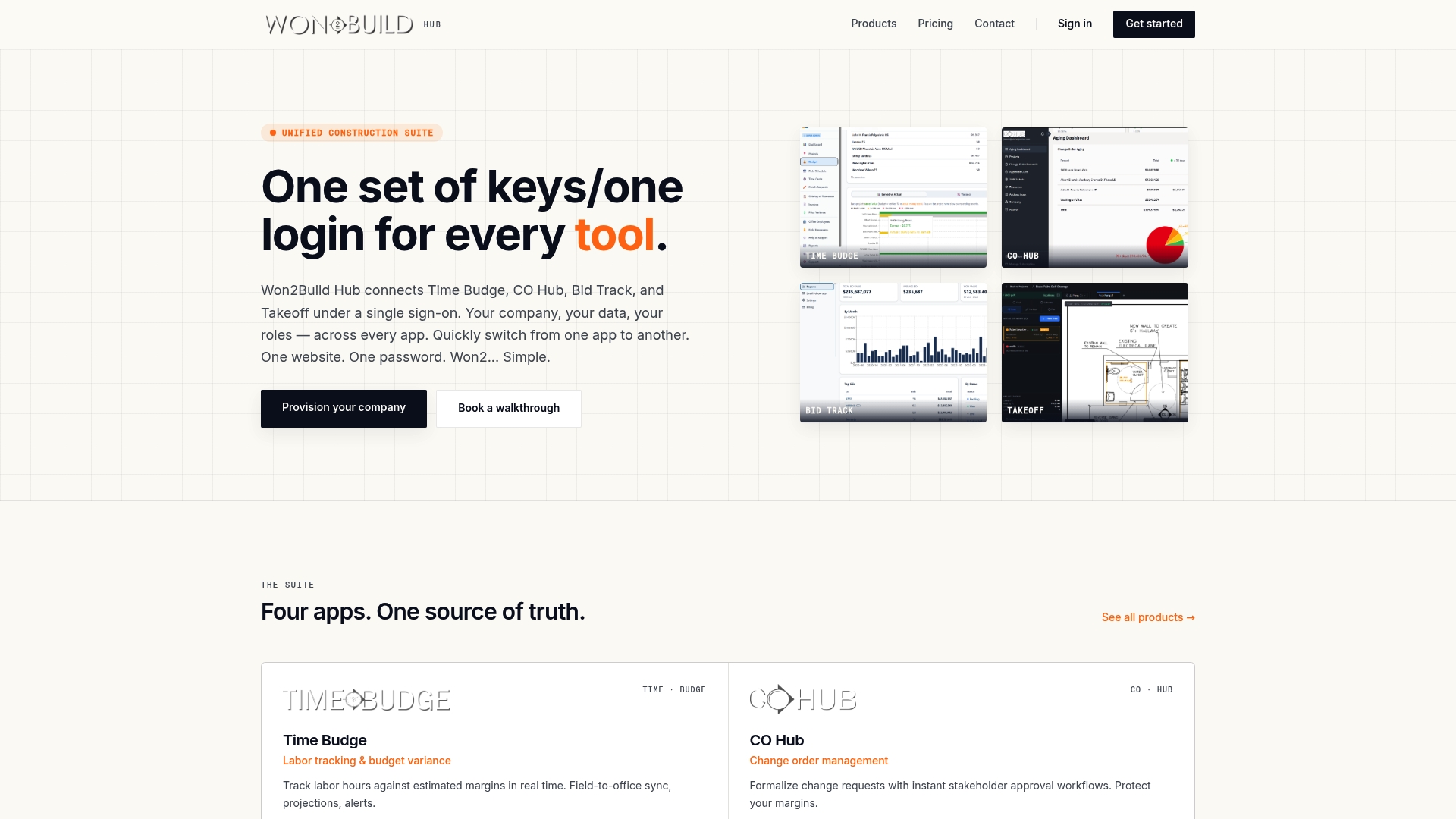
That traceability is the whole point. Every line item keeps its sheet reference from the moment it’s measured to the moment it shows up on a change order, so when a dispute comes up, you’re not reconstructing the math from memory. Time Budge, Bid Track, and CO Hub each carry a published monthly rate, and the full pricing breakdown is on the Won2Build pricing page. If accurate, auditable takeoffs matter to your bottom line, that’s the place to start comparing plans against what you’re using now.
Sources
FAQ
What Is the Best Software for Takeoff for Contractors?
The best fit depends on whether you need a standalone measurement tool or one connected to bidding and change orders. Subcontractors who want quantities to flow directly into pricing and CO tracking without re-entry often prefer an integrated suite like Won2Build’s Takeoff module, paired with Bid Track and CO Hub.
What Is the Most Accurate Method of Estimating?
The most accurate approach combines verified digital PDF takeoff with a structured QC pass, not manual measurement alone or AI output taken at face value. Benchmark data shows AI-assisted takeoff with human review can outperform manual-only methods on both speed and accuracy, especially on repetitive counts and linear runs.
What Is the Best Free Construction Takeoff Software?
Free takeoff tools typically handle basic scaling and area measurement but lack the calibration verification, traceability tagging, and BoQ linkage that catch costly errors on complex bids. They work for quick, low-stakes estimates, but subcontractors bidding on competitive commercial work generally need software with built-in QC routing and audit trails.
How Accurate Is AI Compared to Manual Takeoff?
A 2026 benchmark found AI-assisted systems reached 81.6% composite accuracy against 77.6% for independent professional estimators on standardized blueprint tests. AI tends to excel at counts and repetitive geometry, but it can underestimate area-based quantities, which is why manual review still belongs in the workflow.
What Causes the Biggest PDF Takeoff Errors?
The leading causes are measuring from an outdated plan set, skipping per-sheet scale verification, and working from a low-resolution scanned PDF that degrades symbol detection. A seven-step QC checklist that verifies drawings, calibrates scale, and separates net quantities from waste catches most of these before they reach a bid.
Recommended
One login for estimating, bid tracking, change orders, and labor.
The Hub is free. Pay only for the apps you turn on.
Create your free Hub account- Managers: Make Mobile Field Workflows Resilient for 72 Hour OutagesPlaybook for field managers: offline first mobile workflows, resilient sync and conflict handling, compliance first AI guardrails, and practical pilot steps.
- Daily Signed Records: Force Account Tracking for Managers & InspectorsField checklist for project managers and inspectors to keep force account tracking audit-ready: use daily signed records for labor, equipment, and...
- Stop Timecard to Report Drift: Labor Cost Codes for SubcontractorsFix the timecard to report chain with labor cost codes that tie crews to budgets. Includes a 6 code starter and a burdened rate example.