
Why Accurate Takeoffs Matter for Construction Projects
Discover why accurate takeoffs matter for construction projects. Avoid costly errors and ensure precise budget planning with better takeoffs.

Accurate takeoffs are defined as precise measurements of materials, labor units, and work scope required to plan and execute a construction project. A quantity takeoff feeds directly into cost estimation, procurement schedules, and subcontractor coordination. Get it wrong, and the financial consequences compound fast. A 1% quantity error can produce an 8–12% bid variance, which translates to $250,000 in lost margin on a $5M project. That is why accurate takeoffs matter from the first line of the estimate, not as a final quality check.
Why accurate takeoffs matter for project budgets
Takeoff errors do not stay contained. They spread downstream into procurement, scheduling, and cash flow before anyone catches them. Quantity takeoffs define exact materials, labor units, and scope needed for a project, and that data feeds every cost system from initial bid to final billing. When the foundation is wrong, every system built on top of it is wrong too.
The financial stakes are not theoretical. Disciplined takeoff processes prevent 20–30% of construction cost overruns by eliminating material shortages and cutting budget-inflating waste. That range represents real margin protection on every project you bid.
Errors found late are the most expensive kind. Fixing takeoff errors during construction costs 3 to 5 times more than correcting them during pre-construction. The extra cost comes from emergency material orders, change orders, and scope creep management that could have been avoided entirely.

Margin erosion is the quieter risk. When your bid carries hidden quantity errors, you either win the job and lose money, or you pad contingency so heavily that you lose the bid to a competitor with better data. Neither outcome supports growth.
Pro Tip: Takeoff errors compound non-linearly. A 1% quantity error does not produce a 1% bid problem. It produces an 8–12% bid variance because errors multiply across labor rates, equipment costs, and overhead allocations. Catch errors at the source, not at the invoice.
How do manual and digital takeoffs compare in accuracy?
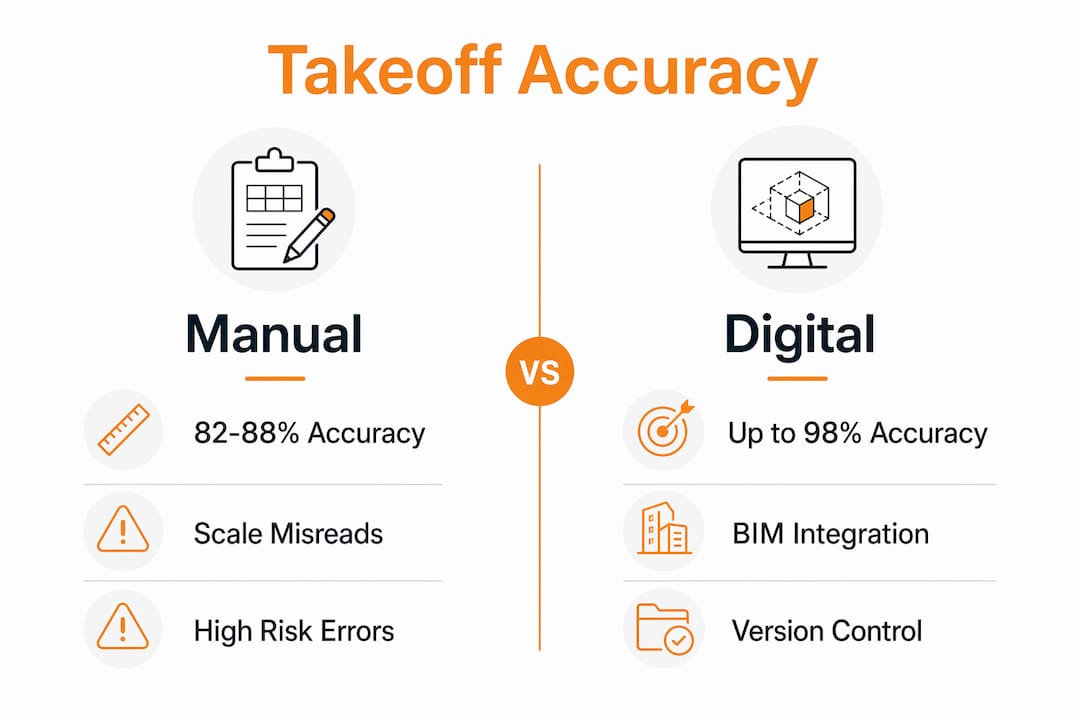
Manual takeoffs carry structural risks that digital methods eliminate. Scale misreads in manual measurement can cause 12–18% bid inaccuracies, and incomplete bid documents trigger significant rework hours. An estimator working from printed drawings who misreads a scale bar by a fraction introduces an error that multiplies across every related quantity in the estimate.
The accuracy gap between manual and digital methods is significant. BIM models at LOD 300–500 achieve up to 98% accuracy in quantity extraction. That level of precision reduces reliance on contingency buffers and gives estimators real confidence when submitting competitive bids.
Tools like Revit and Navisworks automate quantity extraction and improve revision tracking. When drawings change, a BIM-linked tool updates quantities automatically. A manual process requires the estimator to catch every revision, re-measure affected areas, and reconcile the changes without missing anything.
| Factor | Manual takeoffs | Digital and BIM-integrated takeoffs |
|---|---|---|
| Accuracy range | 82–88% (scale misread risk) | Up to 98% with LOD 300–500 BIM |
| Revision handling | Manual re-measurement required | Automated quantity updates |
| Error detection | Late, often during construction | Early, during pre-construction |
| Contingency buffer needed | Higher, to cover uncertainty | Lower, due to verified quantities |
| Labor hours per takeoff | High | Significantly reduced |
Pro Tip: Version control is the most underrated accuracy tool in digital takeoffs. Centralized data means every team member works from the same drawing revision. Without it, field crews and estimators can be operating from different plan sets without knowing it.
What are the best practices for improving takeoff accuracy?
Accuracy in construction takeoffs starts with the source documents. Always begin from the most current drawings or BIM model. Using superseded plans is the single most common cause of quantity errors on commercial projects. Confirm drawing revision dates before measuring anything.
Organizing by trade before you start measuring prevents double-counting and missed scope. A concrete subcontractor who measures formwork, reinforcement, and pour volume as separate line items catches gaps that a single-pass measurement misses. Structure drives discipline.
Cross-checking quantities with a second estimator or a peer review process catches errors that the original estimator cannot see. Fresh eyes find scale errors, missed addenda, and unit conversion mistakes. On large bids, the time invested in a second review pays back many times over.
Common pitfalls that erode takeoff accuracy include:
- Working from preliminary drawings without confirming they are the issued-for-construction set
- Skipping addenda review before finalizing quantities
- Using inconsistent units across trades (mixing linear feet and square feet in the same estimate)
- Failing to account for waste factors specific to the material type
- Not documenting assumptions, which creates disputes when scope questions arise later
Documentation is a risk management tool, not just an administrative task. When a commercial bid requires detailed takeoffs, the written record of how quantities were derived supports change order claims and dispute resolution. Undocumented assumptions become liabilities when a project goes sideways.
Pro Tip: Build a standard takeoff checklist for each trade you estimate. A checklist forces you to address every scope item before submitting. It also creates a training tool for junior estimators and a quality control record for project audits.
How do accurate takeoffs improve bidding and project management?
Precise quantity data produces bids that win without requiring excessive contingency. When your quantities are verified, you do not need to inflate your bid to cover uncertainty. That makes your price more competitive while protecting your margin. Accurate takeoffs improve bid win rates, support change order claims, and clarify contractual scope, giving you a structural advantage over estimators relying on rough counts.
Procurement benefits directly from takeoff precision. Accurate timing and quantity data reduce over-ordering, cut material financing costs, and lower the risk of supplier shortfalls. A subcontractor who orders the right amount of material at the right time avoids both the carrying cost of excess stock and the premium cost of emergency reorders.
Scope clarity reduces disputes. When the takeoff defines exactly what is included and what is not, subcontractor coordination becomes cleaner. Gaps in scope definition are the most common source of change order disputes on commercial projects. A well-documented takeoff closes those gaps before they become claims.
| Impact area | Effect of accurate takeoffs |
|---|---|
| Bid competitiveness | Lower contingency needed; more competitive pricing |
| Change order support | Documented quantities back scope change claims |
| Material procurement | Right quantities ordered at the right time |
| Cash flow | Fewer emergency orders and unplanned costs |
| Project predictability | Fewer surprises in cost and schedule |
Integrating takeoff data into project management and accounting systems creates a feedback loop. Actual costs get compared against estimated quantities in real time. That comparison reveals where estimates were off and improves the accuracy of future bids. Improving bid accuracy in 2026 depends on this kind of systematic learning, not just better measurement tools.
Inaccurate takeoffs increase rework risk, disputes, and margin leakage, making growth difficult and reducing project predictability. The inverse is also true. Accurate takeoffs create a foundation for repeatable, profitable project delivery.
Key Takeaways
Accurate takeoffs are the single most important input in construction cost estimation because every downstream decision, from procurement to billing, depends on the quality of that initial quantity data.
| Point | Details |
|---|---|
| Errors compound fast | A 1% quantity error produces an 8–12% bid variance, not a 1% one. |
| Late fixes cost far more | Correcting takeoff errors during construction costs 3 to 5 times more than fixing them pre-construction. |
| Digital tools close the gap | BIM-integrated takeoffs at LOD 300–500 reach up to 98% accuracy, reducing contingency needs. |
| Documentation protects margin | Written quantity assumptions support change order claims and reduce scope disputes. |
| Accuracy drives bid wins | Verified quantities let you price competitively without padding bids with excess contingency. |
The accuracy problem most estimators underestimate
I have reviewed hundreds of bid packages over the years, and the pattern is consistent. Estimators who lose money on jobs rarely made one large error. They made a series of small ones that nobody caught until the project was already underway.
The non-linear compounding effect of quantity errors is the part that surprises people most. A 1% miss on concrete volume does not stay a 1% problem. It ripples into formwork, reinforcement, pour scheduling, and labor allocation. By the time you total the impact, a small measurement error has become a significant budget problem.
Digital tools have changed what is possible. BIM-linked takeoff software and platforms like Won2build’s Takeoff application have made high-accuracy quantity extraction accessible to subcontractors who previously relied entirely on manual methods. The shift is not just about speed. It is about building a process where errors are caught before they cost money.
The estimators I respect most treat the material takeoff process as a discipline, not a task. They use checklists, peer reviews, and version-controlled drawings as standard practice. They document their assumptions. And they track actual versus estimated quantities after every project to sharpen the next bid.
The technology is available. The question is whether your process is built to use it consistently.
— Jen Reese
Won2build Takeoff: built for subcontractor accuracy
Construction subcontractors need takeoff tools that connect directly to estimating and change order workflows. Won2build’s Takeoff software handles digital plan quantification and feeds that data into the broader Won2build Hub suite, which includes Bid Track for bid pipeline management and CO Hub for change order control. Single sign-on means your quantity data moves between applications without re-entry or version conflicts.
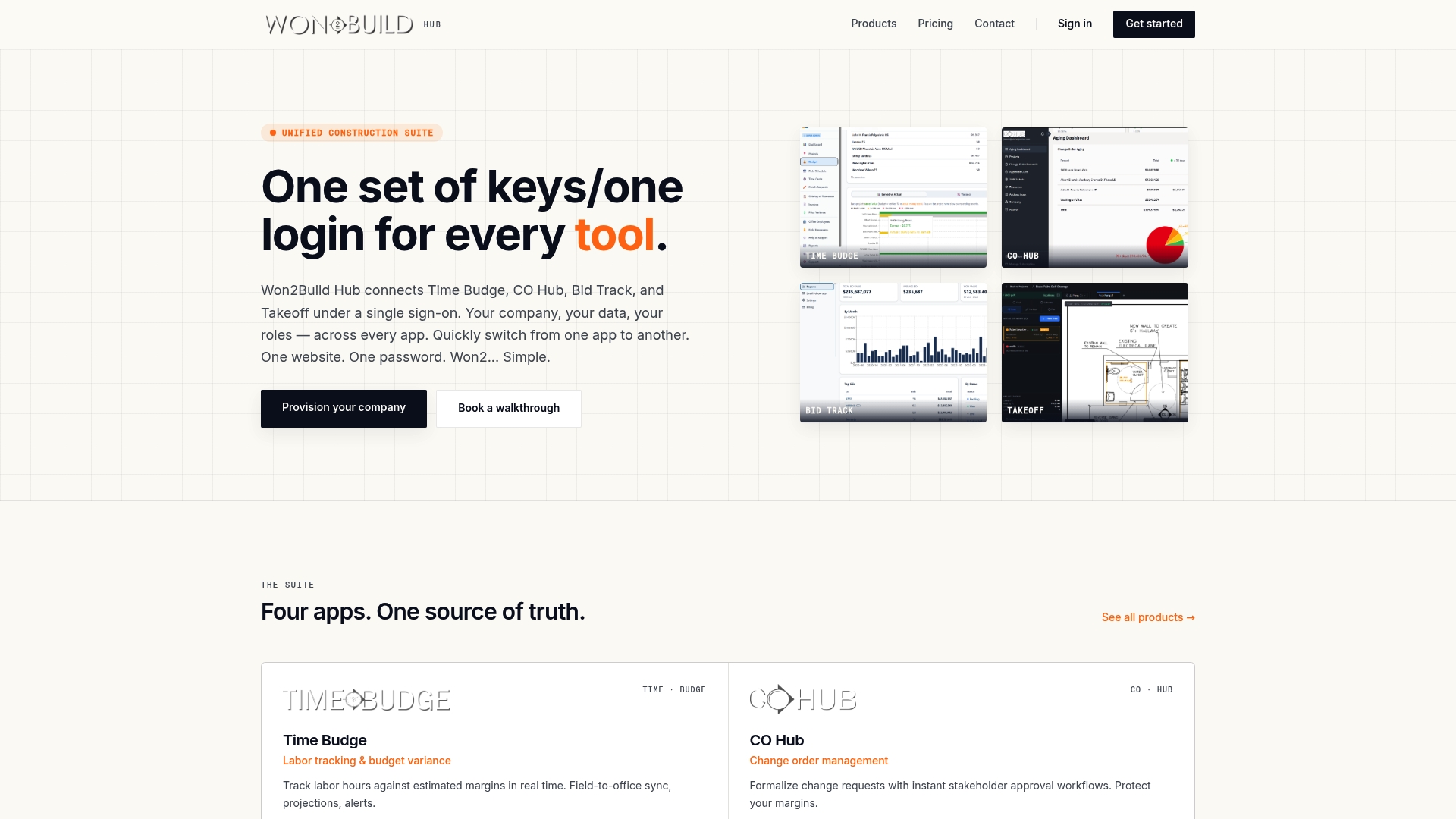
Subcontractors who use Won2build report fewer data gaps between field and office, tighter bid accuracy, and faster response to scope changes. If your current process relies on manual measurement or disconnected spreadsheets, Won2build gives you a connected alternative built specifically for the way subcontractors work.
FAQ
What is a construction quantity takeoff?
A quantity takeoff is a detailed count of all materials, labor units, and scope items required to complete a construction project. It forms the basis for cost estimates, procurement plans, and subcontractor bids.
How does a 1% quantity error affect a bid?
A 1% quantity error can produce an 8–12% bid variance. On a $5M project, that translates to up to $250,000 in potential cost exposure.
Why are manual takeoffs less accurate than digital ones?
Scale misreads in manual measurement can cause 12–18% bid inaccuracies. Digital and BIM-integrated tools eliminate scale errors and automate revision tracking, reaching up to 98% accuracy at LOD 300–500.
When is the cheapest time to fix a takeoff error?
Pre-construction is the only cost-effective time to fix quantity errors. Correcting them during construction costs 3 to 5 times more due to change orders, emergency orders, and schedule disruption.
How do accurate takeoffs support change order claims?
Documented quantity assumptions from the original takeoff establish the baseline scope. When scope changes occur, that baseline is the evidence that supports a valid change order claim and protects your contract margin.
Recommended
One login for estimating, bid tracking, change orders, and labor.
The Hub is free. Pay only for the apps you turn on.
Create your free Hub account- 7 Concrete Takeoff Steps Estimators Use to Avoid Ordering ShortfallsFollow seven concrete takeoff steps to calculate cubic yards, size rebar and formwork, convert volumes to supplier units, and verify quantities before bid...
- Are E-Signature Change Orders Legal and Worth the Switch?E-signature change orders streamline your workflow, ensuring faster approvals, fewer disputes, and quicker invoicing—discover the benefits now!
- How to Link Takeoff to Estimate for Accurate BidsLink your takeoff quantities to your estimate for accurate bids. Discover the seamless integration method that reduces errors and saves time.