
How to Improve Commercial Bid Accuracy in 2026
Discover effective strategies to improve commercial bid accuracy in 2026. Reduce variance, increase win rates, and boost your margins today!

Commercial bid accuracy is defined as the closeness of your estimated project costs to the actual costs incurred once work is complete. Most contractors operate with a 12–18% variance from estimate to final cost. That gap is not inevitable. Structured processes, AI-powered takeoff tools like Won2Build Takeoff, and tiered review systems can compress that variance to 3–5%, which translates directly into fewer cost overruns, stronger margins, and a measurable edge in competitive bidding. Contractors who implement these practices report 40% fewer cost overruns and 23% higher bid win rates. The strategies below show you exactly how to get there.
How to improve commercial bid accuracy from the ground up
Bid accuracy is not primarily a math problem. It is a process sequencing problem: scope before takeoff, takeoff before pricing, pricing before submission. When contractors skip or rush any of these steps, errors compound through every downstream calculation.
Start with a locked scope definition
Before you count a single linear foot of conduit or a single sheet of drywall, the project scope must be fully defined and clarified. Request RFIs on ambiguous drawings, confirm specification sections that apply to your trade, and document what is explicitly excluded from your work. Scope gaps discovered during takeoff cost you time. Scope gaps discovered after award cost you money.
Build a clean, line-by-line material takeoff
Skipping a clean material takeoff is the single biggest estimating mistake a contractor can make. Quantities drive material cost, labor hours, equipment needs, and scope definitions simultaneously. Organize your takeoff by CSI divisions so every cost category is traceable and auditable. Tools like Won2Build Takeoff and PlanSwift speed up digital plan quantification while reducing manual counting errors.

Calibrate against historical data
Your own past projects are your most reliable cost benchmark. Build an internal database of unit costs and labor productivity rates from completed work, segmented by project type, size, and region. Historical bid-to-actual tracking reduces estimating errors by 35% and ranks as the highest-impact improvement available to contractors. Without this data, you are guessing. With it, you are calibrating.
Pro Tip: Create a simple spreadsheet that logs estimated versus actual cost per CSI division for every completed project. After ten projects, patterns in your over- and under-estimates become unmistakable.
How do digital tools and AI enhance takeoff and estimating precision?
AI-powered quantity takeoff platforms have changed what is achievable in commercial estimating. These tools use computer vision and machine learning to read digital plans, identify assemblies, and generate first-pass quantities with approximately 94% accuracy. That accuracy level is high enough to be genuinely useful and low enough to require human review, which is exactly the right balance.
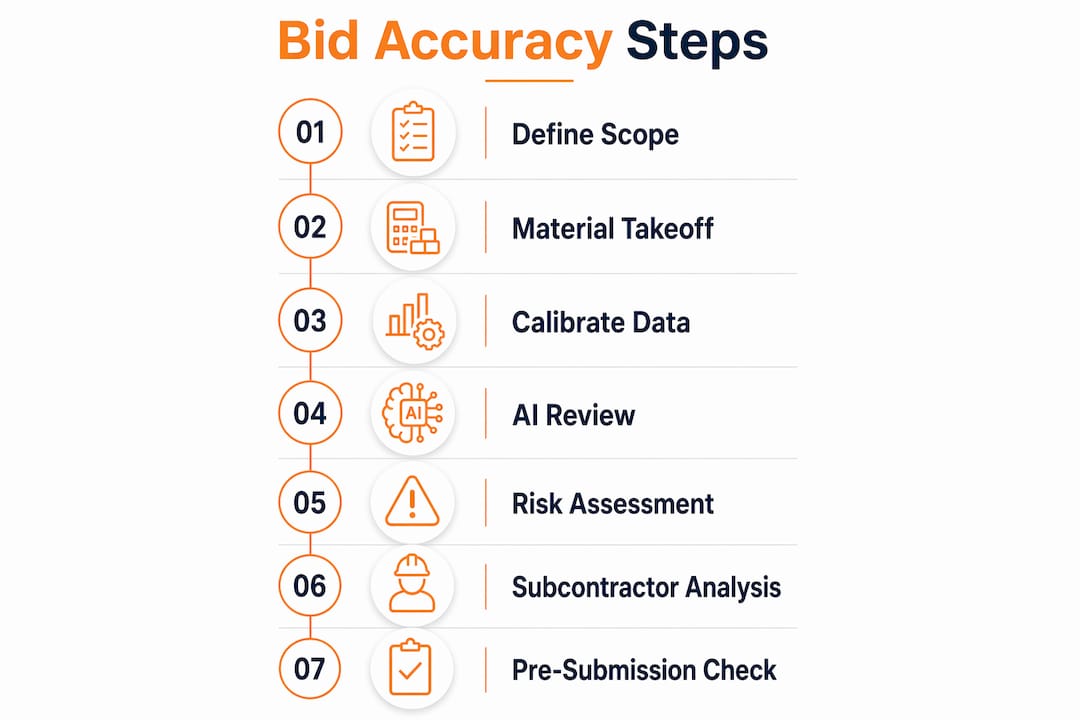
The most effective workflow is hybrid. AI handles the first pass; your estimator reviews outliers, checks ratios, and validates scope completeness. This approach catches the errors that pure automation misses while eliminating the fatigue-driven mistakes that pure manual takeoff produces. AI combined with human validation consistently achieves the highest accuracy in construction estimating.
| Workflow type | Error rate | Time per takeoff |
|---|---|---|
| Manual only | High (human fatigue) | Longest |
| AI only | Moderate (scope gaps) | Fastest |
| AI plus human review | Lowest | Moderate |
Modern platforms also integrate regional cost databases and historical pricing, so your unit costs automatically reflect current market conditions rather than last year’s numbers. Won2Build Takeoff connects directly to your bid pipeline, so quantities flow into pricing without re-entry. That single-source data path eliminates the transcription errors that plague firms still copying numbers between spreadsheets.
Pro Tip: After every AI-generated takeoff, run a ratio check: compare square footage of each material category against your historical averages for that project type. A 30% deviation is a flag, not a final answer.
For a broader view of how construction visualization tools reduce costly mistakes before a shovel hits the ground, the connection between visual accuracy and estimating precision is worth understanding.
What role does risk assessment play in bid accuracy?
Risk is not a single number you add to the bottom of your estimate. It is a structured analysis that separates what you know from what you do not. A formal risk register scores each identified risk by likelihood and financial impact, then assigns it to a specific contingency category rather than a generic percentage.
Data-driven contingency buffers vary by risk tier: 15–20% for high-variance categories, 8–12% for medium-variance, and 3–5% for low-variance work. Applying a flat 10% to everything simultaneously over-prices low-risk scopes and under-prices high-risk ones. Neither outcome serves you well in a competitive market.
The distinction between risk types matters just as much as the percentages. Separating unknown-unknown risks from known-unknown risks is critical to clear project accounting. Known unknowns, such as owner allowances for finish selections, belong in a separate line item from true contingency. Mixing them obscures your actual risk exposure.
Here is a practical four-step process for structuring risk in every bid:
- Build a risk register listing every identified uncertainty, from soil conditions to subcontractor availability.
- Score each item by likelihood (1–5) and financial impact (1–5) to produce a priority ranking.
- Assign each high-priority risk a specific financial or contractual coverage plan before submission.
- Review your contingency buffers annually against actual project outcomes to recalibrate your scoring model.
“Transparent contingency line items do not make you look uncertain. They make you look like a contractor who has done this before and knows what can go wrong.”
AI tools are also transforming risk assessment by identifying patterns across large project datasets that human reviewers would never catch manually.
How do you level subcontractor bids to close accuracy gaps?
Subcontractor bids are not interchangeable numbers on a spreadsheet. Two bids for the same scope can differ by 20% because of different assumptions, not different prices. Reconciling those differences is where bid leveling earns its value.
Start by building a scope matrix that lists every work item in your specification against each sub’s bid. Mark each cell as included, excluded, or ambiguous. This grid immediately surfaces the gaps that would otherwise hide inside a lump-sum number. Discrepancies between internal estimates and subcontractor bids arise primarily from differing assumptions and risk tolerances, not from pricing errors.
Effective bid leveling requires these practices:
- Document every inclusion and exclusion in writing before adjusting any number. Clear documentation of inclusions and exclusions is what makes comparisons defensible.
- Reconcile your internal estimate against each sub bid line by line, then explain every variance above 5% before accepting or rejecting it.
- Track historical bid patterns from your preferred subs to understand where they consistently price high or low by trade.
- Use negotiation leverage on documented gaps rather than across-the-board pressure, which erodes relationships without improving accuracy.
Won2Build’s Bid Track platform stores historical sub bids alongside actuals, giving you the trend data to negotiate from a position of knowledge rather than instinct.
What pre-submission checks prevent costly bid errors?
The final review before submission is not a formality. It is the last opportunity to catch errors that compound into real losses. A three-tier review process catches 94% of errors before submission, compared to 67% for a single estimator working alone. That 27-point gap represents real money on real projects.
Structure your pre-submission review in three distinct passes:
- Self-check by the lead estimator. Verify every Excel extension, confirm that all subcontractor quotes are current and signed, and check that every exclusion in your sub bids is either covered elsewhere or explicitly excluded from your proposal.
- Peer review by a second estimator. This person checks math independently, validates that unit costs match your current database, and looks for scope items that appear in the drawings but not in the estimate.
- Management review. The project executive or chief estimator sanity-checks the total against cost-per-square-foot benchmarks for comparable projects and reviews the risk register before signing off.
Pro Tip: Build a one-page bid checklist that every estimator signs before submission. Include line items for: extension verification, subcontractor quote confirmation, exclusion review, contingency approval, and benchmark comparison. The act of signing creates accountability that verbal confirmation never does.
Common errors that slip through single-estimator reviews include outdated unit costs carried forward from a previous bid, subcontractor quotes that expired before bid day, and contingency amounts that were set early in the process and never updated after scope changes. A two-step QA approach with anomaly scans and mathematical integrity checks catches both wrong quantities and math errors before they reach the owner.
Key takeaways
Improving commercial bid accuracy requires disciplined process sequencing, AI-assisted takeoffs with human validation, tiered risk contingencies, and a three-tier review system applied consistently on every bid.
| Point | Details |
|---|---|
| Process sequencing drives accuracy | Define scope before takeoff, complete takeoff before pricing, and review before submission. |
| AI plus human review is the gold standard | AI achieves ~94% first-pass accuracy; human validation closes the remaining gap. |
| Tiered contingencies beat flat rates | Apply 15–20% for high-variance scopes and 3–5% for low-variance to price risk correctly. |
| Bid leveling requires documentation | Scope matrices and written inclusions/exclusions make sub bid comparisons defensible. |
| Three-tier review catches 94% of errors | Self-check, peer review, and management sign-off together outperform any single-reviewer process. |
Why I stopped treating bid accuracy as a math problem
I spent the first several years of my estimating career convinced that accuracy was about getting the numbers right. Better spreadsheets, faster takeoffs, sharper pencils. What I eventually learned, the hard way on a $4 million mechanical project that came in 16% over budget, is that accuracy is about process discipline, not arithmetic skill.
The estimate that burned us was mathematically correct. Every extension checked out. The problem was that we priced the scope we assumed, not the scope that was actually in the drawings. We skipped a thorough scope review because the bid cycle was short and the client was familiar. That shortcut cost us more than any math error ever had.
What I have seen work consistently is treating every bid as if you have never worked for that client before. Fresh eyes on scope. Fresh validation of unit costs against recent actuals. No assumptions carried forward from the last job. The contractors who improve the fastest are not the ones who buy the best software. They are the ones who build a culture where every estimator knows the process is non-negotiable, regardless of schedule pressure.
AI tools have genuinely changed what is possible in takeoff speed and cost benchmarking. But I have watched firms adopt AI and get worse results because they stopped doing human validation. The technology amplifies your process. If your process is weak, the amplification works in the wrong direction.
The most underrated practice in commercial estimating is the post-bid review. Sitting down six months after project completion and comparing your estimate line by line against actual costs is uncomfortable and time-consuming. It is also the single activity most likely to make your next bid more accurate than your last one.
— Jen Reese
How Won2Build helps you bid with more confidence
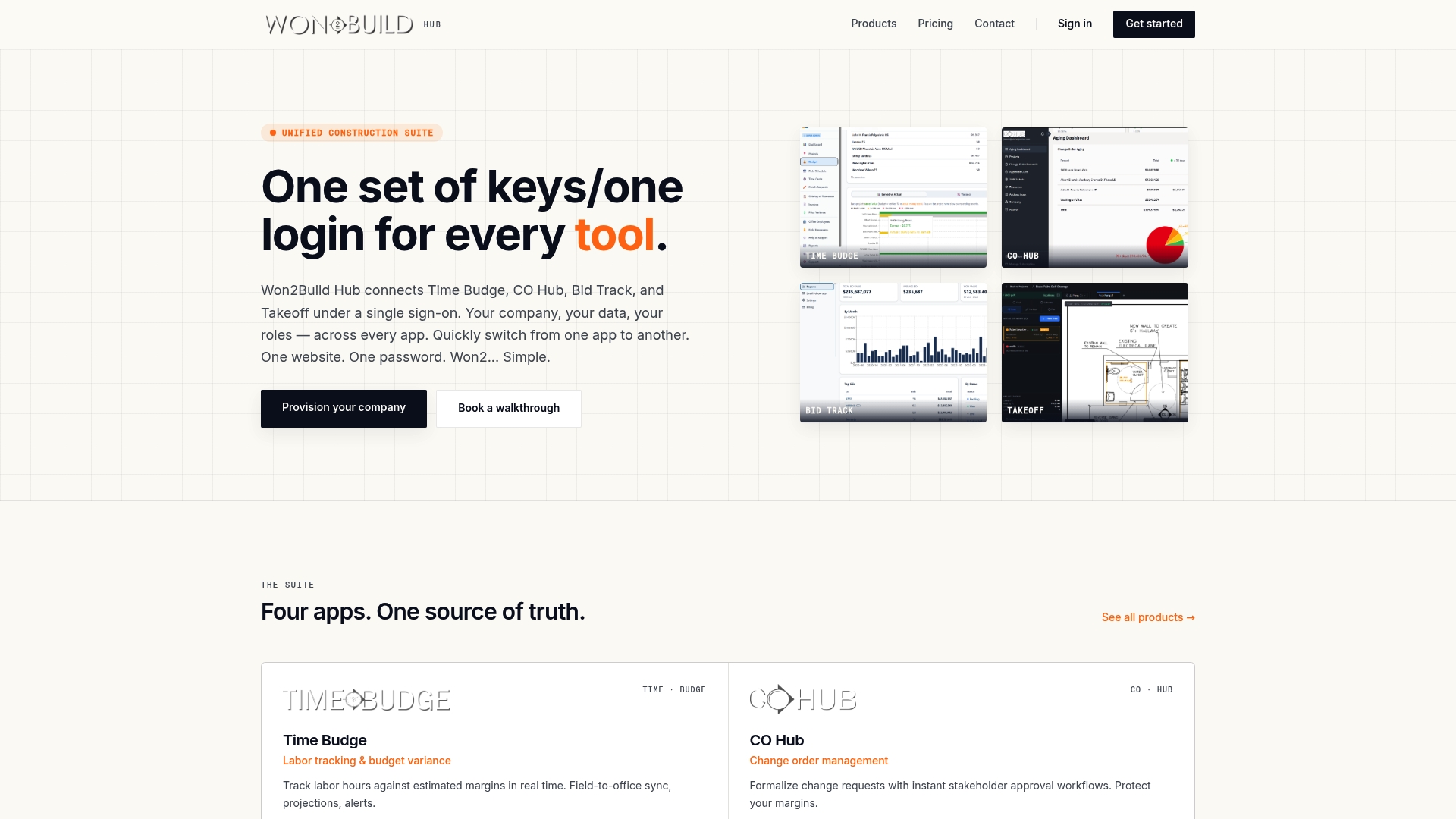
Won2Build is built specifically for commercial subcontractors who need accuracy and speed in the same workflow. The Takeoff tool delivers fast digital quantity takeoffs directly from plan files, feeding clean quantities into your pricing without manual re-entry. Bid Track manages your full bid pipeline, stores historical sub bids for leveling, and tracks estimated versus actual costs over time so your benchmarks stay current. Time Budge captures real labor productivity data from the field, giving your future estimates a foundation in what your crews actually produce. CO Hub keeps contingency usage and change order documentation transparent from bid through closeout. All four tools share a single login through Won2Build Hub, so data moves between estimating, field, and office without duplication or loss.
FAQ
What is a realistic bid accuracy target for commercial contractors?
Structured processes and AI tools can reduce estimating variance from the industry average of 12–18% down to 3–5%. Reaching that range requires disciplined takeoffs, tiered contingency modeling, and consistent post-bid reviews.
How does a three-tier review process improve bid accuracy?
A three-tier review catches 94% of errors before submission by separating self-check, peer review, and management oversight into distinct passes. Each reviewer looks for different error types, which is why the combined catch rate far exceeds a single-estimator review.
Why do subcontractor bids vary so much for the same scope?
Variances between sub bids stem primarily from differing assumptions about scope, risk, and site conditions rather than from pricing differences. A scope matrix that documents inclusions and exclusions for each bid is the most direct way to normalize those differences.
What contingency percentage should I use for a commercial renovation bid?
Typical contingency for remodels and renovations ranges from 8–15%, compared to 5–8% for new construction with fully designed plans. Apply category-specific buffers by risk tier rather than a single flat percentage across all scope items.
How does historical data improve future bid accuracy?
Tracking bid-to-actual costs line by line after project completion reduces estimating errors by 35% over time. This data recalibrates your unit costs, labor productivity rates, and contingency assumptions based on real project outcomes rather than published benchmarks.
Recommended
One login for estimating, bid tracking, change orders, and labor.
The Hub is free. Pay only for the apps you turn on.
Create your free Hub account- How to Compare Plan Revisions and Control Estimate ChangesA practical guide for commercial subcontractors on comparing plan revisions, catching scope changes, and keeping estimates and change orders in step.
- Drywall Takeoff Basics: A Step-by-Step Guide for SubsLearn drywall takeoff basics: how to measure walls and ceilings, deduct openings, convert to sheets, set waste and finish levels, and avoid costly misses.
- How to Reduce Profit Fade on Subcontractor JobsProfit fade usually starts in the field and hides until closeout. Here is how subcontractors can catch it weekly and protect the margin they bid.