
Commercial Construction Addendum: What Contractors Need to Know
Discover what a commercial construction addendum is and how it impacts contracts and bidding, ensuring you make informed decisions as a contractor.

A commercial construction addendum is a written change to the bid or contract documents issued before anyone signs the contract. That timing detail is the whole game: an addendum modifies the deal while it’s still up for competitive bidding, while a change order modifies a contract that’s already executed.
That distinction drives how each document gets priced and approved.
- Addendum: issued pre-signature, during bidding or negotiation, and priced under competitive conditions where every bidder sees the same change.
- Change order: issued post-signature, negotiated one-on-one (or unilaterally) with the awarded contractor, often under time pressure.
Standard frameworks like the AIA contract documents and federal procurement rules under FAR and FHWA both draw this same line. Won2build built its bid and change order tools around that split because getting it backward costs subcontractors real money.
Key Takeaways
A commercial construction addendum modifies bid documents before contract signature, while a change order modifies them after, and that timing difference drives pricing, approval, and risk.
| Point | Details |
|---|---|
| Timing defines the document | Addenda happen pre-signature under competitive bidding; change orders happen post-award through negotiation. |
| Every addendum needs cross-references | Cite exact drawing sheets and spec sections to prevent ambiguous pricing disputes. |
| Acknowledgment makes it binding | Bidders must sign and submit acknowledgment, or risk disqualification on sealed bids. |
| Distribution logs prevent disputes | Timestamped records of who received and acknowledged each addendum protect both sides later. |
| Won2Build centralizes the process | Bid Track and Takeoff keep addendum-driven pricing and drawing updates synced across your team. |
Table of Contents
- What Is a Commercial Construction Addendum, Exactly?
- When Should You Expect to See an Addendum?
- How Does an Addendum Differ From a Change Order?
- What Should Every Addendum Include?
- Who Signs an Addendum, and How Does It Become Binding?
- What Mistakes Turn an Addendum Into a Dispute?
- What Does a Sample Addendum Look Like?
- How Do You Track Addenda Without Losing Money on Bid Day?
- Sources
What Is a Commercial Construction Addendum, Exactly?
An addendum is a written modification or supplement attached to the contract documents before anyone signs. It doesn’t replace the original bid package. It amends it, and every bidder is expected to fold the change into their number before submission.
Addenda commonly cover a narrow set of things: corrected or reissued drawings, clarified specifications, approved material substitutions, unit-pricing adjustments, and revised deadlines or phasing. Construction glossaries describe addenda as the standard mechanism owners, architects, and general contractors use to fix errors or omissions discovered mid-bid.
Here’s a scenario that plays out on almost every commercial job: an architect catches a structural conflict on sheet S-4 two weeks before bids are due. Rather than reissue the entire drawing set, the architect issues Addendum No. 3, replacing sheet S-4 and adding a line clarifying that the beam size increased. Every bidder receiving that addendum has to reprice the affected scope before submitting. Miss it, and your number is wrong before you even sign anything.
When Should You Expect to See an Addendum?
Addenda show up any time the design or scope needs a fix before award. The most common triggers include:
- An architect issuing a design clarification mid-bid because a detail was ambiguous or missing.
- An owner mandating a spec change across the board, like swapping a specified manufacturer for material availability reasons.
- A mandatory substitution issued to every bidder at once, so nobody gets a pricing edge.
- A scope reduction before award, often when the owner’s budget check comes back over target.
Most solicitations publish a hard cutoff for addenda, sometimes a set number of days before bid opening. In a sealed-bid public project, missing an addendum acknowledgment can disqualify your bid outright. Your options when one lands are limited: price it into your number, submit a written question through the proper channel, or formally note an exception with your reasoning documented.
How Does an Addendum Differ From a Change Order?
The core difference is timing, and timing changes everything else downstream: pricing context, who has to approve it, and what commercial leverage each party has.
An addendum lands before signature, so it gets priced under competitive bidding. Every contractor bidding the job sees the identical change and prices it the same way. A change order lands after signature, so pricing happens through negotiation or an equitable adjustment process, often with far less price competition working in the owner’s favor.
The same scope increase can land very differently depending on which document carries it. Add 500 square feet of scope during bidding, and five contractors compete to price it fairly. Add it after award, and you’re negotiating from a position where the contractor already has the job locked in, which usually means a higher price.
| Feature | Addendum | Change order |
|---|---|---|
| Timing | Before contract execution | After contract execution |
| Pricing context | Competitive bidding | Negotiated or equitable adjustment |
| Approval path | Included in bid package before signature | Requires field approval, bilateral or unilateral |
| Typical form | Addendum in bid pack | AIA G701 or SF 30 under FAR Part 43 |
Public agencies like VDOT require formal change order documentation through forms like C-10, with itemized pricing and signatures, precisely because post-award changes need a different paper trail than pre-award ones.
What Should Every Addendum Include?
A usable addendum isn’t complicated, but skipping any of these fields is how disputes start:
- Title and number that clearly cross-references the original solicitation or contract, so nobody confuses Addendum 2 with Addendum 3.
- Description of the change, with exact drawing sheet numbers or spec section references, and precise replacement language when text is being swapped out.
- Commercial fields, including known pricing impact, unit price or allowance adjustments, and any schedule or milestone shifts.
- Administrative fields: who issued it, the date, the full distribution list, an acknowledgment or signature block, and a line stating all other terms remain in force.
That last line matters more than it looks. Without it, you leave room for someone to argue the addendum quietly overrode unrelated contract terms.
Pro Tip: Always cross-reference the exact drawing sheet and specification section number in your addendum language. “See revised electrical drawings” invites arguments. “Replace Sheet E-2, Section 26 05 00 as noted” doesn’t.
Who Signs an Addendum, and How Does It Become Binding?
The issuer, usually the architect, owner, or general contractor, signs and distributes the addendum to every bidder on record. Bidders typically acknowledge receipt right on their bid form, listing each addendum number they’ve incorporated into their price.
- If awarded the job, your signed acknowledgment gets folded into the final contract package, often referenced by number in the signature block.
- Some owners require the addendum itself to be physically attached to the executed contract so it reads as one unified agreement.
- On public work, follow the issuing agency’s prescribed acknowledgment form and cutoff exactly. FHWA guidance outlines how federal-aid highway projects standardize this process, and state DOTs often mirror it.
Skip the acknowledgment step, and you risk a bid rejection before the job even starts.
What Mistakes Turn an Addendum Into a Dispute?
Most addendum disputes trace back to the same handful of drafting failures. Vague cross-references top the list. “See revised plans” tells a bidder nothing about which sheet changed or what to price. Missing signatures, incomplete distribution lists, and forgetting to update the schedule after a scope change all follow close behind. Omitting the line confirming unchanged terms stay in effect is a smaller mistake with outsized consequences later.

Best practice comes down to a short discipline: version control on every issue, a distribution log showing exactly who received what and when, explicit references to drawing and spec numbers, clear pricing instructions on how to bid the change, and retained proof of acknowledgment. Industry guidance treats addenda as risk-mitigation tools precisely because concise, well-referenced language heads off ambiguity before it becomes a claim.
Pro Tip: Keep timestamped receipts for every addendum you distribute, and require every subcontractor bid to include a signed acknowledgment for each addendum number. That paper trail is what saves you in a dispute.
What Does a Sample Addendum Look Like?
A minimal, usable addendum needs surprisingly few moving parts:
- Heading: “Addendum No. 3 to Contract/Bid No. [reference]”
- Description: “Replace Sheet S-4 with revised structural drawing dated [date]. Beam size at Grid Line C increased to W12x26.”
- Commercial impact: “Bidders shall include this change in base bid pricing.”
- Issuer and date: name, title, date issued.
- Acknowledgment line: signature block confirming receipt and incorporation into the bid.
For a fuller version you can adapt directly, the construction bid submission checklist walks through exactly where addendum acknowledgments belong in your bid package, and clause-sample repositories like LawInsider offer language you can borrow for consistency.
How Do You Track Addenda Without Losing Money on Bid Day?
A workable addendum process is five steps, run the same way on every bid:
- Receive and verify the addendum against the original bid package.
- Update your bid documents and reprice any affected scope immediately.
- Distribute the change to your estimating team and adjust the working estimate.
- Record your acknowledgment inside the bid submission itself.
- If awarded, attach the addendum to the final signed contract package.
The tools that support this don’t need to be complicated, but they do need to be centralized:
- A single document repository so field and office see the same version of every sheet.
- A distribution log tracking who got what and when, which research on project communication ties directly to lower litigation risk.
- A bid packet checklist that forces an addendum check before submission.
A single distribution-log entry might read: “Addendum 3, issued 3/12, sent to multiple bidders, most acknowledged as of bid date.” That kind of record is what separates a clean bid from a disqualified one.
What Happens When Contractors Ignore Addenda?
I’ve seen the same story play out too many times: a bidder misses a late addendum, prices the old drawing set, and either loses money on an underbid job or gets disqualified for an unacknowledged change. Neither outcome is recoverable after the fact.
Pro Tip: Require a signed addendum acknowledgment on every bid submission, no exceptions, even for changes you think are minor.
How Won2Build Keeps Addenda From Slipping Through the Cracks
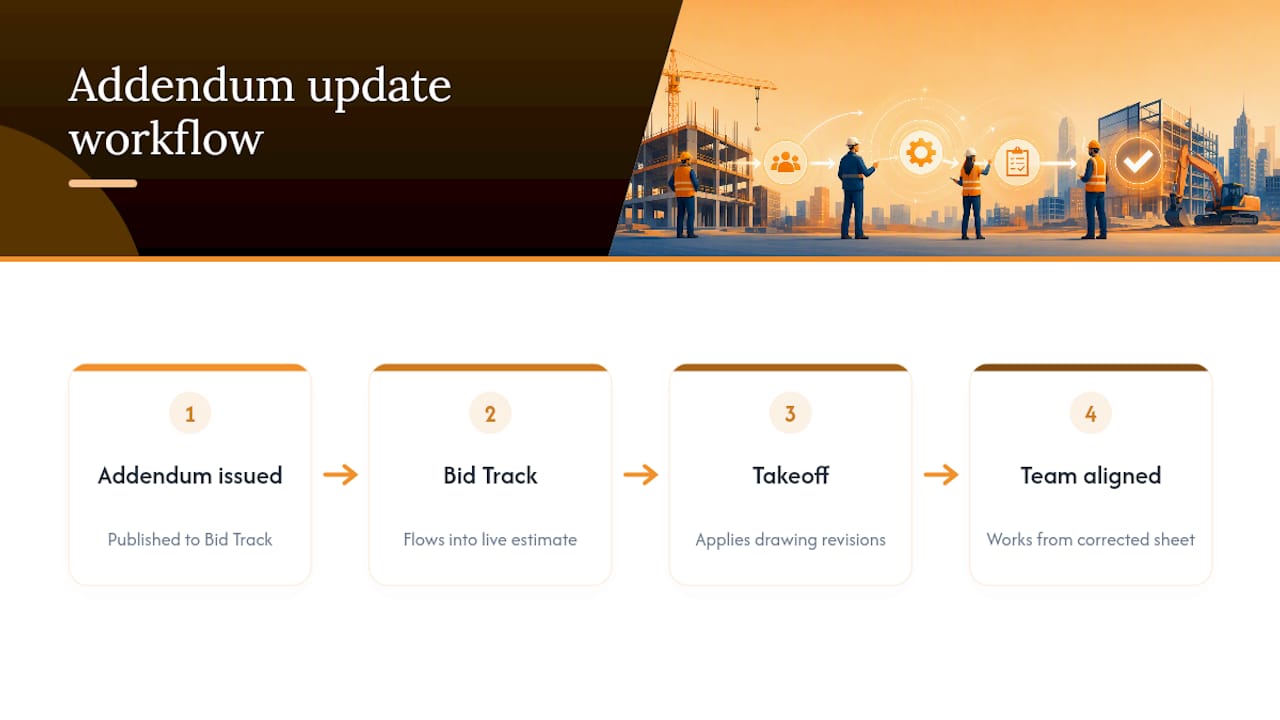
Missing an addendum usually isn’t a knowledge problem. It’s a document control problem: sheets living in three inboxes, an estimator working off yesterday’s version, no clean record of who acknowledged what. Bid Track centralizes your bid documents and pricing in one place, so an addendum update flows straight into your live estimate instead of getting buried in email. Paired with Takeoff for updated drawing revisions, your team works from the same corrected sheet the moment it’s issued. If you’re managing bids across the whole Won2build Hub suite, a free trial shows you exactly where addendum tracking fits into your current workflow. Start there before your next bid deadline hits.
Sources
Addenda function as risk-mitigation tools when they reference affected clauses clearly, while federal and state procurement guidance shows how differently post-award changes are handled once a contract is signed.
- Changes and Extra Work — FHWA
- FAR part 43 (contract modifications)
- VDOT change order guidance (IIM-CD-2024-04-01)
- Construction Contract Addendum Benefits & Tools — RedTeam Blog
Consult your project’s issuing authority directly for agency-specific acknowledgment forms and cutoffs, especially on public work.
Recommended
One login for estimating, bid tracking, change orders, and labor.
The Hub is free. Pay only for the apps you turn on.
Create your free Hub account- 7 Concrete Takeoff Steps Estimators Use to Avoid Ordering ShortfallsFollow seven concrete takeoff steps to calculate cubic yards, size rebar and formwork, convert volumes to supplier units, and verify quantities before bid...
- Are E-Signature Change Orders Legal and Worth the Switch?E-signature change orders streamline your workflow, ensuring faster approvals, fewer disputes, and quicker invoicing—discover the benefits now!
- How to Link Takeoff to Estimate for Accurate BidsLink your takeoff quantities to your estimate for accurate bids. Discover the seamless integration method that reduces errors and saves time.