
Construction Bid Submission Checklist for Subcontractors
Ensure your success with our comprehensive construction bid submission checklist. Avoid disqualifications and submit winning bids every time!

A construction bid submission checklist is a structured list of verifications every subcontractor must complete before submitting a bid to confirm accuracy, compliance, and full responsiveness to solicitation requirements. Missing even one item, such as an unsigned addendum or a missing non-collusion affidavit, can disqualify an otherwise competitive bid. The industry term for this process is “bid responsiveness,” and owners evaluate it before they ever look at your price. This guide breaks down every critical checkpoint, from document verification to final submission timing, so your next bid lands clean and complete.
1. What belongs on a construction bid submission checklist?
A complete bid submission checklist covers six core categories: document verification, scope confirmation, pricing accuracy, subcontractor quote validation, compliance forms, and submission logistics. Each category functions as a gate. A bid that clears all six has the best chance of being deemed fully responsive.
Document verification confirms that every required form is present, signed, and dated. This includes the base bid form, unit price schedules, bid bonds, and acknowledgment of all issued addenda. Owners issue addenda to correct errors or add scope, and failing to acknowledge them is one of the most common disqualification triggers.

Scope of work confirmation means reading the specifications one final time to verify that your bid includes every required line item and clearly states any exclusions. Ambiguous scope language costs money after award, not before.
Pricing accuracy covers unit prices, allowances, contingency amounts, applicable taxes, and bond premiums. Every number on the bid form must match your internal estimate. A transposition error on a unit price can flip a winning bid into a losing one.
- Confirm bid bond percentage matches solicitation requirements (typically 5–10% of the total bid)
- Verify all unit prices carry through to the bid total correctly
- Check that sales tax treatment matches the project’s tax-exempt status
- Confirm insurance certificate limits meet the owner’s minimum thresholds
- Acknowledge every addendum by number and date
Pro Tip: Print the solicitation’s bid form instructions and check each requirement off physically. Digital checklists are fast, but a printed sheet forces you to slow down and read every line.
2. How to manage subcontractor bids within your checklist
Prequalifying subcontractors before you accept their quotes is the single most effective way to protect your bid from scope gaps and post-award disputes. Price alone does not tell you whether a sub can perform. Capacity, bonding ability, safety record, and current workload all affect project outcomes.
Bid leveling is the process of comparing subcontractor quotes on an equal scope basis. Without it, you are comparing apples to oranges. A quote that looks $15,000 cheaper may simply exclude mobilization, cleanup, or a required submittal. The bid leveling process requires a standardized scope sheet that every sub fills out, so you can verify inclusions and exclusions line by line.
- Send a defined scope sheet with every invitation to bid
- Require subs to confirm inclusions and exclusions in writing
- Build a leveling spreadsheet that normalizes all quotes to the same scope
- Flag any sub whose price is more than 15% below the next lowest quote
- Conduct a clarification call before accepting any outlier quote
- Document all verbal clarifications in writing before bid day
Cash flow considerations belong in this step too. Subcontractor cash flow follows predictable cycles, and a sub who cannot fund mobilization will slow your project. When you review quotes, ask about payment terms and mobilization requirements. A 13-week cash flow forecast converts a sub’s finances from a reactive bank balance into a decision tool, and it tells you whether they can sustain the work through your payment cycle.
Pro Tip: Ask each subcontractor to confirm in writing whether their quote includes or excludes prevailing wage, if applicable. This one question prevents the most common scope dispute on public projects.
3. Common submission mistakes and how a checklist prevents them
Non-collusion affidavits, DBE forms, and signed addenda are the most frequent causes of bid disqualification. These are administrative items, not pricing items, which means they get overlooked when estimators are focused on numbers. A second-person review of all compliance forms is not optional. It is the only reliable way to catch what the estimator’s eyes skip after 40 hours on a bid.
The most damaging mistakes fall into three categories.
Missing or incomplete documentation includes unsigned bid forms, missing notarizations, and unacknowledged addenda. Each of these is a hard disqualifier on public projects. Private owners may allow cure periods, but public agencies rarely do.
Submission logistics errors include uploading the wrong file version to an electronic portal, submitting in the wrong file format, or missing the deadline by minutes. Submitting 1–2 hours before the deadline eliminates the risk of portal failures and internet outages. Saving a timestamped confirmation of submission protects you if an owner claims they did not receive your bid.
Price inconsistencies occur when the unit prices on the schedule do not multiply out to the totals on the bid form. Owners catch these errors and may reject the bid or use the unit prices to correct the total, which can work against you.
“Rushing the pre-bid checklist to meet a deadline is the single biggest source of cost overruns. The time invested in a thorough review before submission is always less costly than correcting errors after award.” — Daily Trust Preconstruction Checklist
A bid preparation guide from the cleaning subcontractor specialty illustrates this point well. Even in a narrow trade, the same administrative pitfalls, missed certifications, unsigned forms, and wrong file formats, cause disqualifications at the same rate as in general contracting. The checklist is universal.
4. How to run a final bid review before submission
A final review by someone other than the estimator is the best practice that most subcontractors skip. Estimators develop blind spots after spending days inside a number. A fresh reviewer catches math errors, scope gaps, and missing forms in minutes.
The final review is a distinct workflow step, not a quick scan. It requires a defined checklist of its own.
- Verify all arithmetic from unit prices through to the bid total
- Confirm the scope of work matches the specifications and drawings
- Check that every subcontractor quote is integrated at the correct value
- Verify contingency allowances are included where the solicitation requires them
- Confirm all compliance forms are present, signed, and notarized where required
- Cross-check the bid against every addendum issued during the bid period
- Confirm the submission method, file format, and portal login credentials
- Submit 1–2 hours early and save the timestamped confirmation
The commercial bid estimating process for subcontractors treats the final review as a separate phase, not a closing task. That distinction matters. When the review is a phase, it gets scheduled time and a dedicated reviewer. When it is a task, it gets squeezed into the last 20 minutes before the deadline.
Pro Tip: Assign the final review to your project manager or a senior estimator who was not involved in building the number. Brief them on the project scope first, then hand them the checklist. Their questions will surface the gaps.
RFIs and clarifications also belong in the final review. RFIs with clear contractor-proposed solutions resolve 40% faster than open-ended queries. If you submitted RFIs during the bid period, confirm that the owner’s responses are reflected in your pricing before you submit.
Key takeaways
A fully responsive bid requires verified documents, leveled subcontractor quotes, accurate pricing, complete compliance forms, and a fresh-eyes final review submitted at least one hour before the deadline.
| Point | Details |
|---|---|
| Document verification is the first gate | Confirm every form is signed, dated, and addenda are acknowledged before anything else. |
| Bid leveling prevents scope gaps | Normalize all subcontractor quotes to the same scope sheet before accepting any price. |
| Administrative forms cause most disqualifications | Non-collusion affidavits, DBE forms, and certifications require a dedicated second-person review. |
| Submit early and save proof | Submitting 1–2 hours before the deadline and saving a timestamped confirmation protects you from portal disputes. |
| Final review is a separate phase | Assign a reviewer who did not build the estimate and give them scheduled time, not leftover minutes. |
Why I treat the bid checklist as a project phase, not a formality
By Jen Reese
The first time I watched a bid get disqualified, the number was the best on the board. The sub had spent three weeks pricing a complex mechanical scope, and the owner threw it out because the non-collusion affidavit was not notarized. Three weeks of work, gone in 30 seconds.
That experience changed how I think about bid checklists. A checklist is not a formality you run through at the end. It is a project phase with its own schedule, its own reviewer, and its own deadline. The estimating team should finish their work at least two hours before the submission deadline. The checklist reviewer takes over from there.
The other thing I have learned is that checklists need to be project-specific. A public school project in a state with strict DBE requirements has a different checklist than a private industrial job. Copying last month’s checklist without updating it for the new solicitation is how you miss a project-specific form. I keep a master checklist as a template and require the estimator to mark every item as applicable or not applicable before the review starts. That one step forces them to read the solicitation instructions one more time, and it catches more errors than any other single practice I have used.
Treat the checklist as a living document. After every bid, note what you almost missed. Those near-misses are your best training material.
— Jen Reese
Won2build tools that support your bid submission workflow
Bid errors cost subcontractors real money, and most of them are preventable with the right workflow. Won2build’s Bid Track software is built specifically for subcontractors managing multiple bids at once. It tracks bid deadlines, organizes subcontractor quotes, and keeps your pipeline visible so nothing falls through the cracks on submission day.
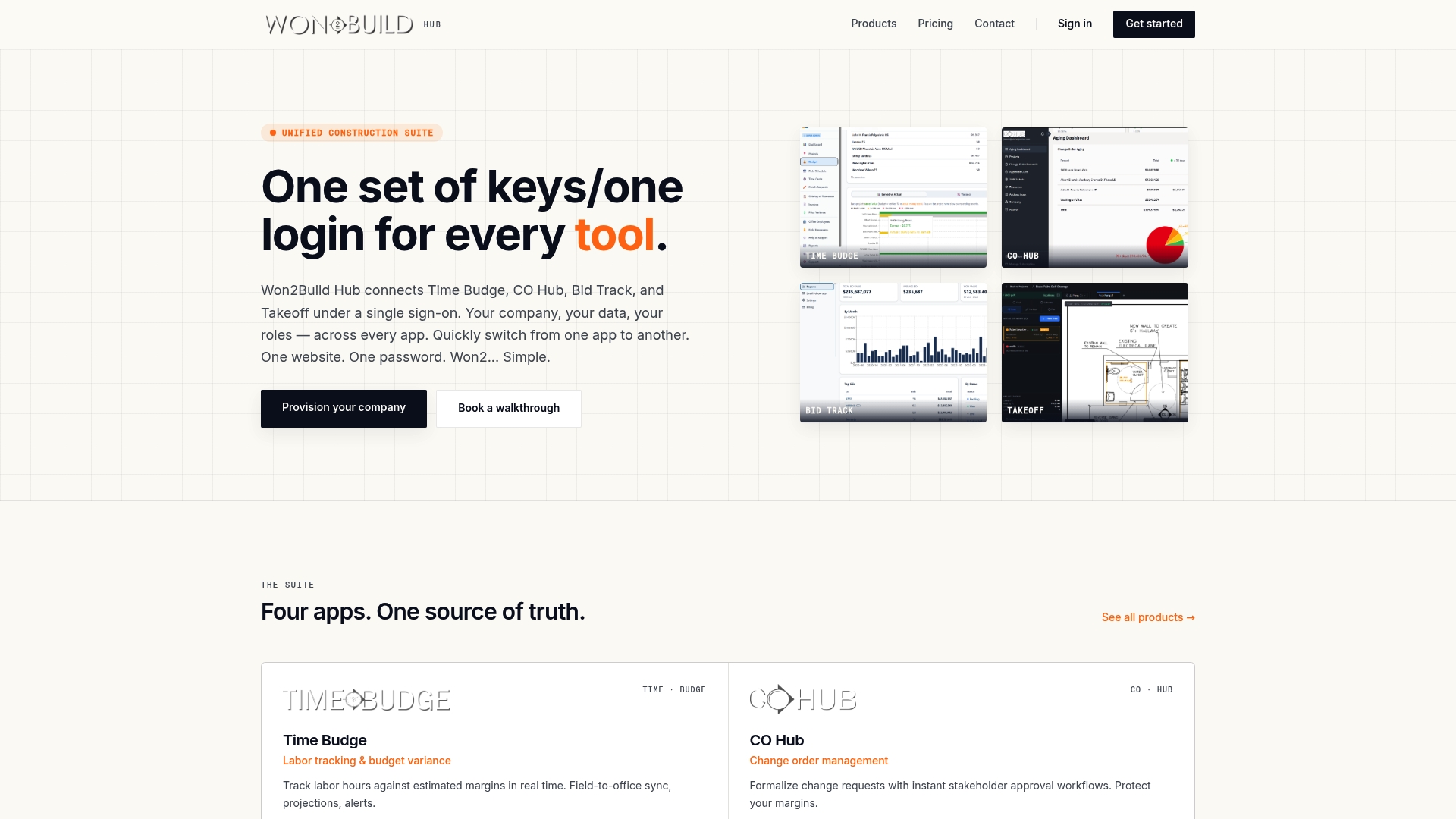
Won2build’s Takeoff tool connects digital plan quantification directly to your estimate, so the numbers that go into your bid form come from a verified takeoff, not a manual transfer. That connection removes one of the most common sources of pricing error. Together, Bid Track and Takeoff give subcontractors a connected workflow from first measurement to final submission, with real-time data shared between field and office. If you want fewer disqualifications and tighter numbers, these tools are worth a close look.
FAQ
What is a subcontractor bid checklist?
A subcontractor bid checklist is a structured list of verifications a subcontractor completes before submitting a bid, covering documents, pricing, compliance forms, and submission logistics. Its purpose is to confirm the bid is fully responsive to the owner’s solicitation requirements.
What causes most bid disqualifications?
Missing or unsigned administrative forms, such as non-collusion affidavits, DBE certifications, and unacknowledged addenda, are the most common causes of bid disqualification on public construction projects.
How early should I submit a construction bid?
Submit at least 1–2 hours before the deadline to allow time to resolve portal errors or internet issues, and always save a timestamped confirmation of your submission as proof of timely delivery.
What is bid leveling and why does it matter?
Bid leveling is the process of comparing subcontractor quotes on an equal scope basis using a standardized scope sheet. It prevents you from accepting a low quote that simply excludes required work, which protects your margin after award.
How does cash flow affect bid pricing for subcontractors?
Subcontractor cash flow directly affects bid pricing because mobilization costs, retention holdbacks, and payment cycle gaps must be funded from working capital. A 13-week cash flow forecast helps subcontractors price these risks accurately rather than absorbing them after award.
Recommended
One login for estimating, bid tracking, change orders, and labor.
The Hub is free. Pay only for the apps you turn on.
Create your free Hub account- Managers: Make Mobile Field Workflows Resilient for 72 Hour OutagesPlaybook for field managers: offline first mobile workflows, resilient sync and conflict handling, compliance first AI guardrails, and practical pilot steps.
- Daily Signed Records: Force Account Tracking for Managers & InspectorsField checklist for project managers and inspectors to keep force account tracking audit-ready: use daily signed records for labor, equipment, and...
- Stop Timecard to Report Drift: Labor Cost Codes for SubcontractorsFix the timecard to report chain with labor cost codes that tie crews to budgets. Includes a 6 code starter and a burdened rate example.