
Commercial Bid Estimating Process Explained for Subcontractors
Discover the commercial bid estimating process explained. Master each step to win profitable contracts and enhance your estimating accuracy.

The commercial bid estimating process is the structured workflow where estimators quantify every scope element, price all direct and indirect costs, and assemble a defensible final number before submitting to a general contractor or owner. This process is distinct from a rough budget. A bid is a contractual offer. An estimate is the internal calculation that supports it. The two documents serve different audiences and carry different legal weight. Tools like RSMeans for cost benchmarking, SpecLens for bid leveling, and MeltPlan for process guidance have become standard references for U.S. commercial estimators working under tight deadlines and competitive pressure. Getting this workflow right is the difference between winning profitable work and buying a job.
What are the core steps in the commercial bid estimating process?
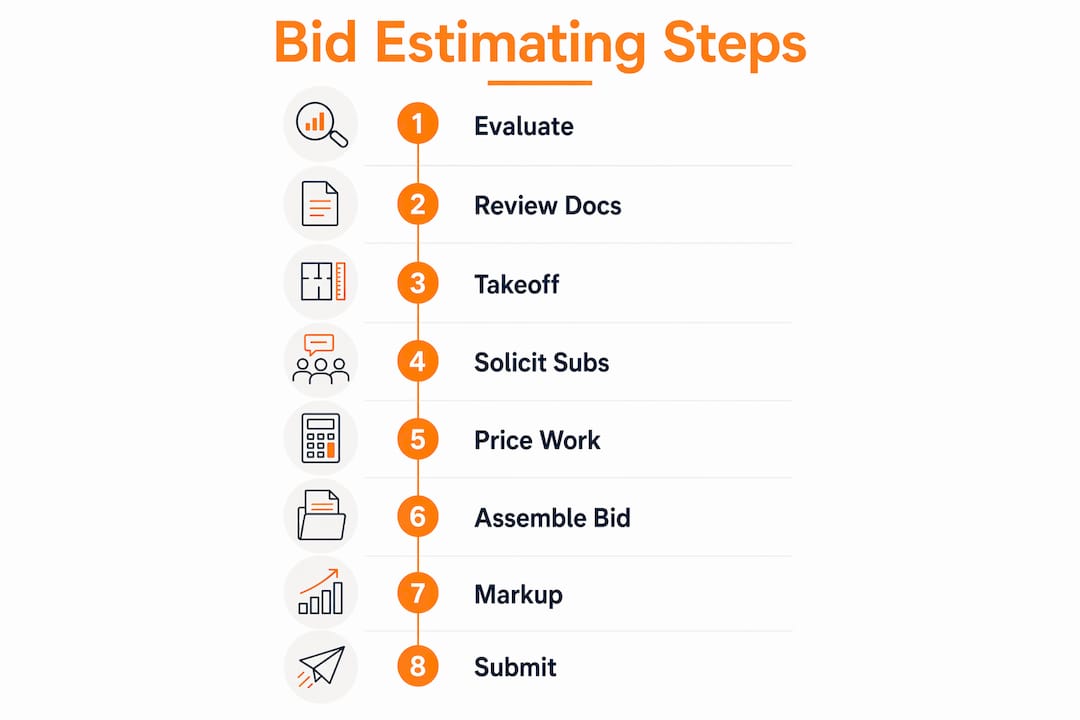
The commercial bid estimating process follows a defined sequence. Skipping or rushing any step creates gaps that surface as cost overruns or lost bids.
Step 1: Bid/no-bid decision. Before committing estimating hours, evaluate the project against your capacity, bonding limits, geographic reach, and relationship with the GC. A weak bid/no-bid filter wastes resources on projects you cannot win or should not take.

Step 2: Document and scope review. Pull every drawing set, specification section, addendum, and geotechnical report. Assign CSI division codes to each scope area so your quantity takeoff aligns with how you will later level subcontractor bids. Missing a spec section here creates a scope gap that costs money later.
Step 3: Quantity takeoff. Measure every item you will self-perform or price directly. Organize counts by CSI division. Aligning takeoff organization with bid leveling structure using CSI divisions makes scope gap calls faster and less adversarial during bid day.
Step 4: Subcontractor solicitation. Send bid invitations to every trade you will not self-perform. Getting at least 3 sub quotes per trade package is standard practice on commercial projects. Fewer quotes reduce competition and weaken your ability to defend the number.
Step 5: General conditions and self-performed work pricing. Price superintendent time, temporary facilities, site safety, insurance, and all labor and materials for work your crew handles directly. General conditions are often underestimated because they feel indirect, but they are real costs that erode margin when ignored.
Step 6: Bid day assembly. Sub proposals arrive hours before the bid deadline. You log each one, level for scope gaps, select the lowest leveled number per trade, and plug it into your summary sheet. Speed and accuracy compete directly on bid day.
Step 7: Overhead, profit, and contingency. Apply your markup after all direct and indirect costs are confirmed. Contingency goes in before markup, not after.
Step 8: Final review and submission. Cross-check every line, confirm bond requirements, and submit through the required channel, whether sealed envelope, online portal, or direct delivery.
Pro Tip: Build a bid day checklist that lists every trade package, the number of quotes received, and the leveled winner. This single document becomes your audit trail if the award is challenged.
How does subcontractor bid solicitation and bid leveling work?
Bid leveling is the process of normalizing subcontractor proposals against a common scope baseline so you are comparing actual cost, not just price. A low bid can be misleading when it excludes critical scope items like fire alarms or final cleaning. Without leveling, you award based on a number that will grow the moment the sub reads the contract.
Building the scope baseline
The bid leveling matrix starts with a comprehensive scope baseline as the row driver. Every line item your spec requires for that trade goes into the matrix before you receive a single proposal. This baseline is not negotiable. It reflects what the contract demands, not what subs choose to include.
Mapping inclusions, exclusions, and unclear items
Once proposals arrive, map each sub’s scope against your baseline. Mark every line as included, excluded, or unclear. Exclusions often appear as silence. A sub who does not mention an item has not necessarily priced it. Explicit extraction and normalization of silent exclusions prevents contract disputes after award.
Using plug numbers
When a sub excludes a scope item, you add a plug number to their total. A plug is a documented cost estimate for the missing item, sourced from a comparable quote, historical data, or a vendor budget. Undocumented plug numbers create audit challenges. Every plug must carry its source, scope description, and the vendor or data point behind it.
Here is what a simplified bid leveling matrix looks like for a single trade package:
| Scope item | Sub A | Sub B | Sub C |
|---|---|---|---|
| Labor and material | Included | Included | Included |
| Startup and testing | Included | Excluded | Included |
| As-built drawings | Included | Included | Excluded |
| Plug for missing items | $0 | $4,200 | $1,800 |
| Leveled total | $87,000 | $91,200 | $89,800 |
Sub A wins on leveled total, not raw price. Without leveling, Sub B would have appeared $3,200 cheaper.
Pro Tip: Send a Bid Clarification Request (BCR) to any sub whose scope is unclear before bid day. Getting written confirmation of what is in or out eliminates the “I thought that was included” conversation after award.
Key risks to watch in bid leveling:
- Accepting the lowest number without checking scope coverage
- Using undocumented plugs that cannot survive an owner audit
- Failing to send BCRs when scope language is ambiguous
- Leveling only the top two quotes instead of all three
Bid leveling normalizes proposals on the same scope, making the comparison defensible and the award decision clear.
What cost components and markups are essential in commercial bid estimating?
Every commercial bid carries the same fundamental cost structure. Understanding each layer prevents margin erosion and supports a defensible number.
Direct costs
Direct costs include labor, materials, and equipment for all self-performed work. Labor pricing requires current wage rates, burden rates (taxes, insurance, benefits), and realistic productivity factors. Material pricing should come from current supplier quotes, not last year’s purchase orders. Equipment costs are either owned (depreciation plus operating cost) or rented (current market rate).
Indirect costs and general conditions
General conditions cover all project-level costs that are not tied to a specific scope item. Superintendent salary, project manager time, temporary power, site trailers, dumpsters, and safety programs all live here. These typically run 8 to 15 percent of direct construction cost depending on project duration and complexity.
Overhead and profit
Industry benchmarks target 10% overhead plus 10% net profit, commonly called the 10-10 rule, with combined markups often reaching 20 to 30 percent depending on competitiveness and scope risk. That means on a $2 million direct cost project, you are adding $400,000 to $600,000 in overhead and profit before contingency. Adjust this range based on how competitive the market is and how much risk the project carries.
Contingency
Contingency ranges from 5% to 15% of construction cost, with higher percentages applied to complex, fast-track, or design-incomplete projects. Contingency is not profit. It covers scope uncertainty, design gaps, and unforeseen conditions. Apply it before markup, not as a substitute for it.
Cost benchmarks for validation
For context, RSMeans 2026 data show hard-cost ranges for single-story suburban office construction running roughly $150 to $250 per square foot, excluding soft costs which add another 15 to 25 percent. Use these benchmarks to sanity-check your estimate totals before submission.
One practice that protects your firm: keep your internal cost estimate separate from the external bid form. The internal document carries your detailed assumptions, labor rates, and markup structure. The external form shows only final totals and clarifications. Accidentally submitting internal cost detail to an owner exposes your margin structure and weakens your negotiating position.
How to prepare and submit the final bid package
The final bid package is the document set you deliver to the GC or owner. Its quality signals your professionalism before the project starts.
Your submission should include:
- Estimate summary sheet organized by CSI division with subtotals for each trade and self-performed scope
- Basis of Estimate document that records all assumptions, exclusions, design gaps, and scope boundaries. A Basis of Estimate defends your number and ensures consistency if the project is rebid or value-engineered
- Exclusions list that explicitly names every item not included in your price. Silence is not an exclusion. Write it down
- Alternates and unit prices as required by the bid documents. Price these separately and clearly so the owner can evaluate them without affecting your base bid
- Bid bond if required. Confirm the bond amount and form before bid day. A missing bond disqualifies the bid regardless of price. Learn more about bid bond requirements before you submit
- Final cross-check comparing your summary sheet totals against your detailed estimate to catch transposition errors or missing trade packages
On bid day, last-minute sub revisions are common. Log every revision with a time stamp and confirm which version you used in your final number. Submitting a bid built on a superseded sub quote creates a scope gap before the project even starts.
Key takeaways
A defensible commercial bid requires scope normalization through bid leveling, accurate cost layering from direct costs through markup, and a complete submission package that documents every assumption.
| Point | Details |
|---|---|
| Bid leveling is non-negotiable | Normalize every sub quote against a scope baseline before selecting the lowest leveled number. |
| Get at least 3 quotes per trade | Competitive coverage protects your margin and makes the estimate auditable. |
| Separate internal and external documents | Keep detailed cost assumptions internal; submit only final totals and clarifications to owners. |
| Apply contingency before markup | Contingency covers scope risk; markup covers overhead and profit. Never substitute one for the other. |
| Document every plug number | Undocumented plugs fail audits and weaken award recommendations. |
What I’ve learned about bid leveling after years of watching estimates go wrong
I have reviewed hundreds of commercial bids, and the pattern is consistent. The estimates that lose money are almost never wrong on labor rates or material pricing. They are wrong on scope. A sub prices low by leaving out fire alarm testing, or final cleaning, or as-built drawings, and the estimator awards on raw price without leveling. Six months later, the project is in dispute and the margin is gone.
The uncomfortable truth about the commercial bid estimating process is that most firms underinvest in bid leveling relative to takeoff. Estimators spend days measuring quantities and hours on leveling. That ratio should be closer to equal. Scope normalization is where the real risk lives.
I also see firms treat the Basis of Estimate as a formality. It is not. When a project goes sideways and the owner claims your price included something you excluded, your Basis of Estimate is your defense. Write it like a legal document, not a checklist.
Technology helps, but it does not replace judgment. AI-assisted tools can flag scope gaps faster than a manual matrix, but someone still has to decide whether a missing line item is a real exclusion or a formatting choice by the sub. That call requires experience and a well-built scope baseline.
The firms that win consistently are not the ones with the lowest overhead. They are the ones with the tightest process. Bid leveling, documented plugs, clean exclusion lists, and a submission package that answers questions before the owner asks them. That combination wins bids and protects margins.
— Jen Reese
How Won2Build makes the bid estimating process faster and more accurate
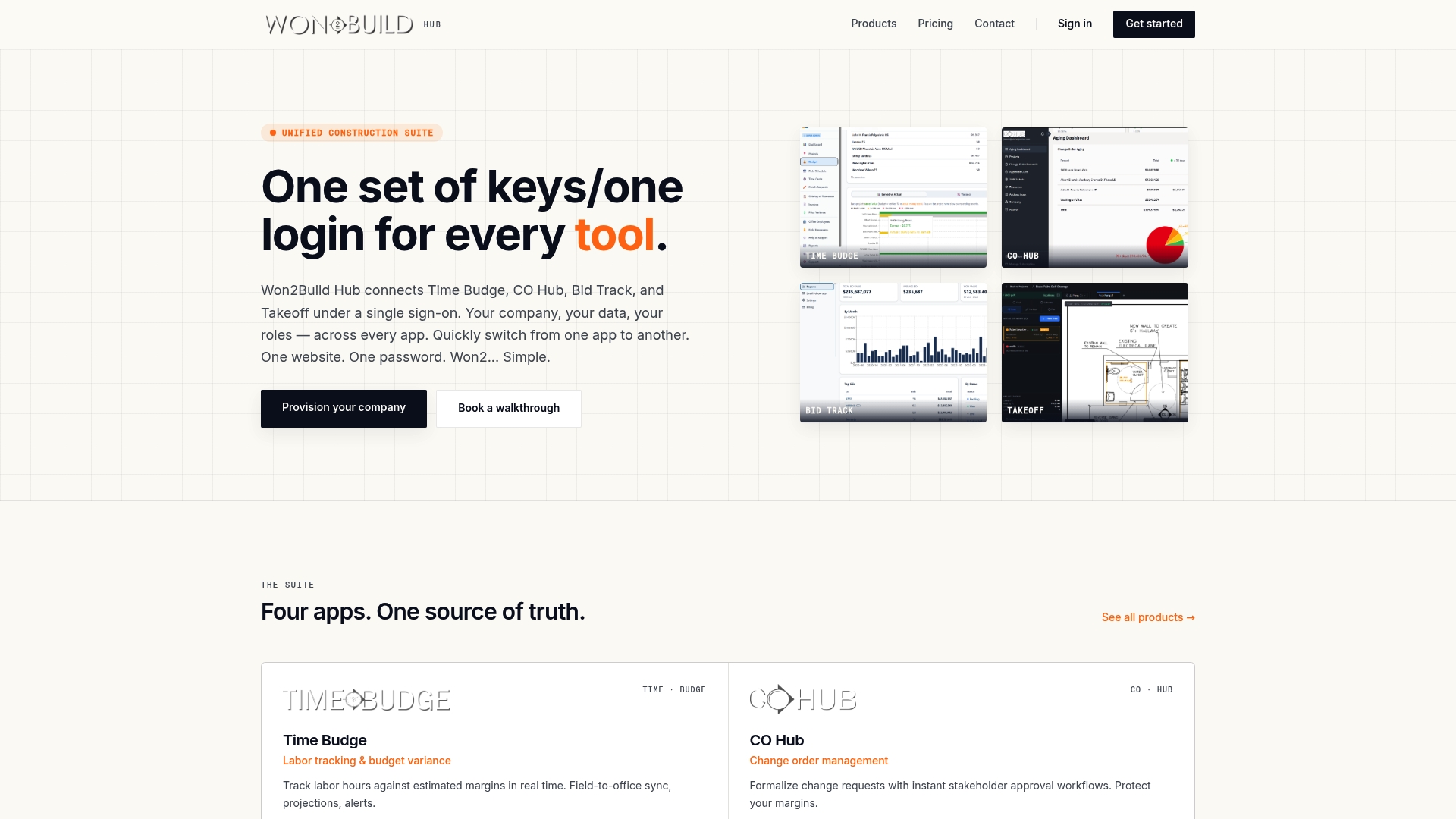
Won2Build is built specifically for commercial subcontractors who need to move from takeoff to bid submission without losing data between tools. The Bid Track application manages your entire subcontractor bid pipeline, from invitation through leveling and award, so nothing falls through on bid day. The Takeoff tool handles digital plan quantification, letting you measure directly from uploaded drawings and push counts straight into your estimate. CO Hub tracks change orders after award, protecting the margin you worked to build during estimating. All four applications run under a single login, so your field team and office estimators share the same live data without double entry or version conflicts. If you are ready to tighten your bid process, explore the Won2Build Hub to see how the full suite works together.
FAQ
What is the commercial bid estimating process?
The commercial bid estimating process is the structured workflow where estimators review project documents, perform quantity takeoffs, solicit subcontractor quotes, level bids for scope, and assemble a final priced submission. Each step builds on the last to produce a competitive and defensible bid.
How many subcontractor quotes should you get per trade?
Standard practice on commercial projects is to get at least three subcontractor quotes per trade package. Fewer quotes reduce competition and make the estimate harder to defend during audits or award reviews.
What is bid leveling and why does it matter?
Bid leveling normalizes subcontractor proposals against a common scope baseline by mapping inclusions, exclusions, and unclear items line by line. It matters because a low raw price can hide missing scope that becomes a cost liability after award.
What contingency percentage should a commercial estimate carry?
Contingency typically ranges from 5% to 15% of construction cost, with higher percentages applied to complex or design-incomplete projects. Contingency covers scope uncertainty and unforeseen conditions, and it is applied before overhead and profit markup.
What should a final commercial bid package include?
A complete bid package includes an estimate summary sheet organized by CSI division, a Basis of Estimate document, an explicit exclusions list, any required alternates and unit prices, and a bid bond if specified. Every assumption that affects your price should appear in writing before submission.
Recommended
One login for estimating, bid tracking, change orders, and labor.
The Hub is free. Pay only for the apps you turn on.
Create your free Hub account- Construction Software ROI: How Subcontractors Measure ItA practical way for commercial subcontractors to calculate construction software ROI: full costs, real benefits, a worked example and the mistakes that inflate it.
- How to Compare Plan Revisions and Control Estimate ChangesA practical guide for commercial subcontractors on comparing plan revisions, catching scope changes, and keeping estimates and change orders in step.
- Drywall Takeoff Basics: A Step-by-Step Guide for SubsLearn drywall takeoff basics: how to measure walls and ceilings, deduct openings, convert to sheets, set waste and finish levels, and avoid costly misses.