
Bid Management for Construction Subcontractors: 2026 Guide
Unlock profitable work with effective bid management for construction subcontractors. Discover strategies to boost your win rates in 2026.
Bid management is the structured, end-to-end system construction subcontractors use to identify, evaluate, prepare, and follow up on bids to win profitable work. It goes far beyond estimating. Bid management governs the full bid lifecycle, from opportunity screening and proposal writing to submission timing and post-bid analysis. Construction teams that apply disciplined bid management report average win rates around 45% in 2026. That number reflects what happens when go/no-bid frameworks, coordinated proposal teams, and post-bid reviews replace ad hoc estimating.
What is bid management in construction?
Bid management is a formal system, not a single task. It covers every phase from the moment an invitation to bid arrives to the final debrief after a win or loss. Many construction teams mistake bid management for estimating alone. That mistake costs them visibility into active bids, lost-bid reasons, and the data needed to improve over time.
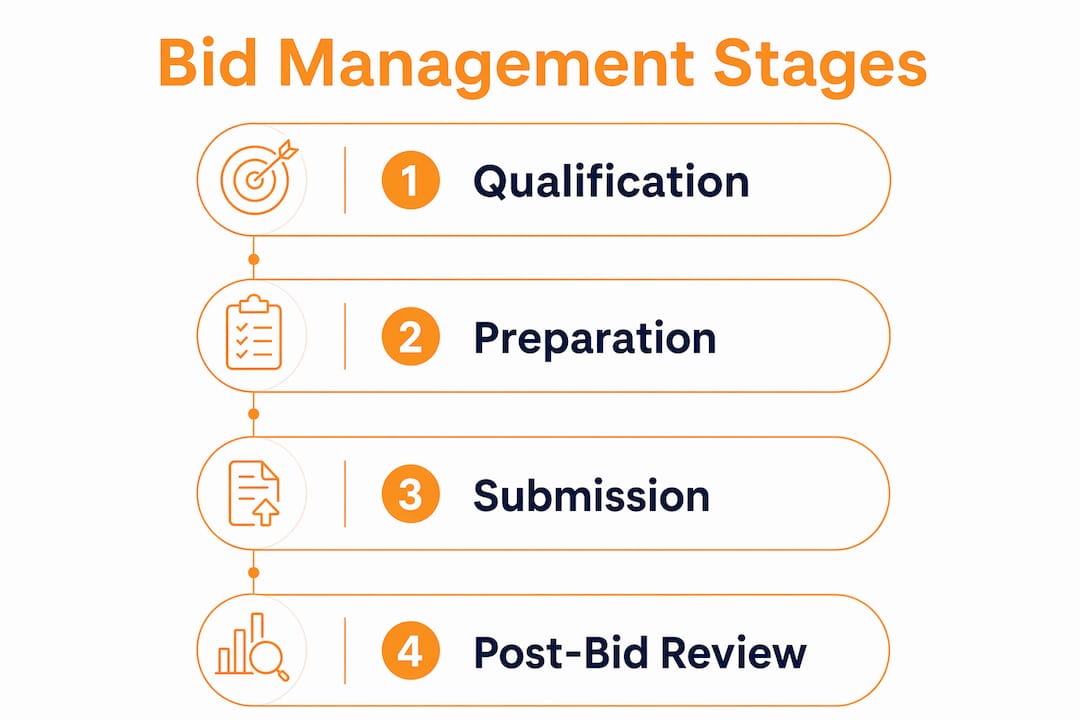
The system has four core phases: opportunity qualification, proposal preparation, submission, and post-bid review. Each phase has defined inputs, outputs, and owners. When one phase is skipped or rushed, the entire process breaks down. A team that produces accurate estimates but skips post-bid analysis will keep repeating the same pricing mistakes without knowing it.
Selective bidding drives win rates across all phases, not just cost estimating. That means the decision to pursue a bid matters as much as the number you put on it. Subcontractors who chase every opportunity dilute their estimating resources and end up with thin proposals on projects they were never well-positioned to win.
How do construction teams qualify and select the right bids to pursue?
The go/no-bid decision is the most important filter in the entire process. Getting it wrong wastes estimating hours on projects with low margins, difficult clients, or no realistic path to winning.
A formal Go/No-Bid evaluation scores five criteria, each rated 1–5:
- Project fit — Does the scope match your trade specialty and past project experience?
- Client payment history — Has this GC or owner paid subcontractors on time in the past?
- Competitive position — Do you have a realistic advantage over likely competitors?
- Current capacity — Does your team have the labor and equipment to execute if you win?
- Margin potential — Does the project scope support your target gross margin?
A minimum score of 15 out of 25 is required to qualify a bid for pursuit. That threshold exists for a reason. A project scoring 12 might look attractive on paper, but it signals at least two significant risk areas. Pursuing it anyway burns estimating time and often leads to either losing or winning work you cannot profitably deliver.
The scoring also protects your team from the “we need the volume” trap. Chasing low-margin work to keep crews busy is a short-term fix that erodes profitability over time. Disciplined go/no-bid scoring prevents that pattern before it starts.
Pro Tip: Score every bid before assigning estimating resources. If it does not hit 15/25, decline it in writing and move on. The time saved goes directly into better proposals on higher-scoring opportunities.
Reviewing your bid leveling strategies alongside go/no-bid scoring gives you a clearer picture of where you stand competitively before committing resources.
What are the best practices for preparing a compelling bid proposal?
A strong proposal does not happen the night before the deadline. It requires a defined team, clear role assignments, and internal milestones set well ahead of the submission date.

A well-run bid assigns clear ownership and internal deadlines before the official due date. That structure allows time for quality reviews, compliance checks, and scope clarifications. Without it, proposals go out with errors, missing attachments, or pricing that has not been reviewed by a second set of eyes.
The core proposal team for a subcontractor typically covers four functions:
- Estimating — Produces the scope breakdown, quantity takeoffs, and pricing
- Technical — Reviews scope accuracy and flags constructability issues
- Legal/compliance — Confirms bonding, insurance, and contract terms meet requirements
- Finance — Validates margins and cash flow assumptions
Each role needs a deadline, not just the final submission date. When the estimator finishes takeoffs two days before the internal review deadline, the technical reviewer has time to catch scope gaps. That sequence prevents the last-minute scramble that produces compliance errors and rushed pricing.
Proposals that win address the client’s specific challenges, not just the scope of work. If the project involves a tight schedule or a complex phasing requirement, your proposal should acknowledge it directly and explain how your team handles it. Generic proposals that restate the RFP without adding insight rarely win competitive bids.
Detailed quantity takeoffs are the foundation of a credible proposal. Vague scope descriptions signal to the client that your team has not fully read the plans.
Pro Tip: Set your internal submission deadline 48 hours before the official due date. Use that buffer for a final compliance review, not additional estimating. Proposals submitted with errors or missing documents are often disqualified before pricing is even reviewed.
How should bids be submitted and followed up to improve win rates?
Submission timing and follow-up are two of the most overlooked factors in winning construction bids. Most subcontractors treat submission as the finish line. It is not.
Submitting bids with buffer time ahead of official deadlines reduces the risk of errors, portal failures, or last-minute disqualifications. A bid submitted 24 hours early can be corrected if a document is missing. A bid submitted at 4:58 PM on deadline day cannot.
Follow-up is where most subcontractors leave wins on the table. Following up 2–3 days after submission significantly increases your chances of winning and is the step most teams skip entirely. A brief, professional call accomplishes three things:
- Confirms the client received your complete submission
- Gives you a chance to clarify any scope questions before award
- Signals that your team is engaged and professional, not just a number on a spreadsheet
A simple follow-up script works well: “Hi, this is [name] from [company]. I wanted to confirm you received our bid for [project name] and ask if you have any questions about our scope or pricing.” That call takes two minutes. It separates your proposal from the stack.
Pro Tip: Log every follow-up call with a date, contact name, and outcome. That data becomes part of your post-bid record and helps you identify which clients respond to follow-up and which prefer email.
The benefits of bid tracking software become obvious at this stage. Tracking submission dates, follow-up calls, and client responses in one place prevents bids from falling through the cracks.
Why is post-bid analysis essential for long-term competitiveness?
Post-bid analysis is the phase that separates teams that improve from teams that repeat the same mistakes. Most subcontractors skip it entirely after a loss. That is the wrong call.
Tracking bid outcomes and specific reasons for loss, such as being 12% over market rate on labor, gives you the data to recalibrate your estimating. Without that data, you are guessing at why you lost. With it, you can adjust labor rates, subcontractor pricing, or scope assumptions before the next similar bid goes out.
A structured post-bid review captures four data points for every bid:
| Data Point | What to Record |
|---|---|
| Bid outcome | Win, loss, or no award |
| Reason for loss | Pricing, scope gap, qualifications, or timing |
| Variance from award | How far your price was from the winning number |
| Client feedback | Any comments from the GC or owner after award |
That table becomes your estimating calibration tool. If you lost three bids in a row on electrical work because your labor rate was 10–15% above the winning number, that is a signal to review your crew productivity assumptions or subcontractor pricing. If you lost on scope, that points to a takeoff process issue.
Bid management as a lifecycle system requires ongoing review to scale. Teams that treat each bid as a standalone event never build the institutional knowledge that makes estimating faster and more accurate over time. Digital tools that support bid tracking and analysis make this process far less manual and far more consistent.
Key Takeaways
Disciplined bid management, covering qualification, proposal preparation, submission timing, and post-bid review, is the single most reliable driver of win rate improvement for construction subcontractors.
| Point | Details |
|---|---|
| Go/No-Bid scoring | Score every opportunity against five criteria; require 15/25 minimum before committing estimating resources. |
| Team role clarity | Assign estimating, technical, legal, and finance roles with internal deadlines before the official due date. |
| Early submission | Submit bids at least 24 hours early to allow final compliance checks and avoid disqualification. |
| Post-submission follow-up | Call the client 2–3 days after submission to confirm receipt and answer scope questions. |
| Post-bid data tracking | Record win/loss reasons and price variances after every bid to calibrate future estimates. |
Why I stopped treating bid management as just estimating
The most common mistake I see subcontractors make is treating bid management as a synonym for estimating. They invest in estimating software, hire experienced estimators, and still wonder why their win rate stays flat. The answer is almost always in the phases surrounding the estimate, not in the estimate itself.
Go/no-bid discipline is where most teams bleed. I have watched subcontractors spend 40 hours estimating a project that scored a 10/25 on any honest evaluation. They won it, lost money on it, and then complained that the market was too competitive. The market was not the problem.
The follow-up call is the other gap I see constantly. Subcontractors spend days on a proposal and then go silent after submission. That silence reads as indifference to the client. A two-minute call changes that perception entirely. It is the cheapest competitive tactic available, and almost nobody uses it consistently.
Post-bid analysis is where the real compounding happens. Teams that track why they lose get better at estimating, faster at qualifying, and more selective about which clients they pursue. That selectivity is what win rate discipline actually looks like in practice. It is not about bidding less. It is about bidding smarter on the right work.
— Jen Reese
Won2build’s tools for managing your bid pipeline
Construction subcontractors who want to put these practices into action need more than a spreadsheet. Won2build’s Bid Track software gives your team a dedicated pipeline for managing estimates, tracking bid status, and recording outcomes in one place. It connects directly with Won2build’s Takeoff app for digital plan quantification, so your estimating data flows into your bid records without double entry.
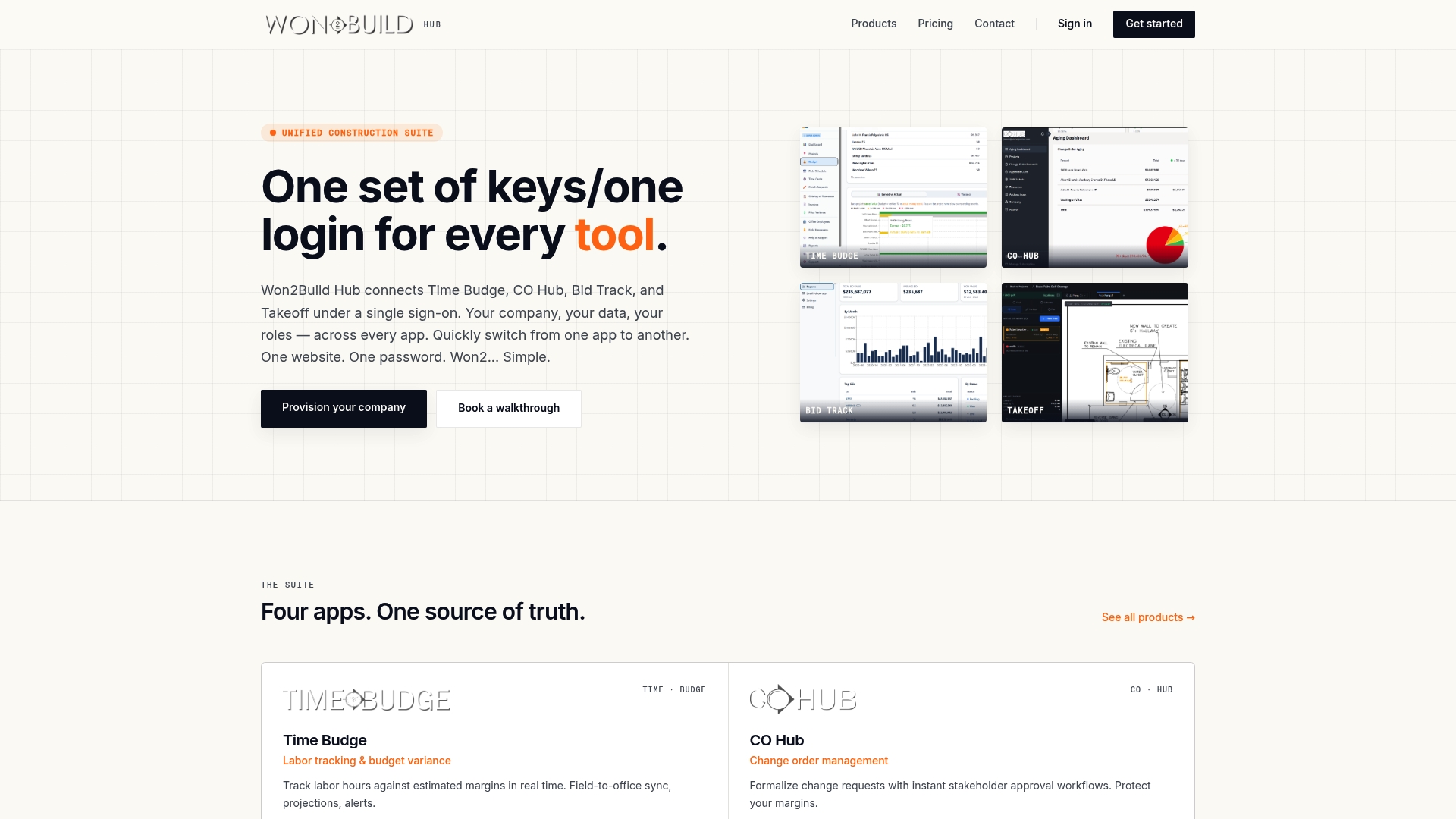
Won2build also includes CO Hub for change order management and Time Budge for labor tracking, all under a single sign-on. That means the data your estimators produce during bidding stays connected to the data your field team uses during execution. For subcontractors focused on protecting margins and improving win rates, that connection is where the real value shows up.
FAQ
What is bid management in construction?
Bid management is the structured process of evaluating, preparing, submitting, and reviewing bids across their full lifecycle. It covers go/no-bid decisions, proposal preparation, submission timing, and post-bid analysis.
What is a good win rate for construction subcontractors?
Construction teams using disciplined bid management report average win rates around 45% in 2026. Teams without a formal system typically win far less often because they pursue low-fit opportunities and skip follow-up.
How does a go/no-bid scoring system work?
A go/no-bid system scores five criteria, including project fit, client payment history, and margin potential, each rated 1–5. A minimum score of 15 out of 25 is required to qualify a bid for pursuit.
Why does post-bid analysis matter?
Post-bid analysis identifies specific reasons for losing, such as pricing above market rate or scope gaps, and feeds that data back into your estimating process. Without it, the same mistakes repeat across multiple bids.
What bid management software do construction subcontractors use?
Won2build’s Bid Track is built specifically for construction subcontractors and covers estimating, bid pipeline tracking, and outcome recording. It integrates with Won2build’s Takeoff and CO Hub apps under a single sign-on platform.
Recommended
One login for estimating, bid tracking, change orders, and labor.
The Hub is free. Pay only for the apps you turn on.
Create your free Hub account- 7 Concrete Takeoff Steps Estimators Use to Avoid Ordering ShortfallsFollow seven concrete takeoff steps to calculate cubic yards, size rebar and formwork, convert volumes to supplier units, and verify quantities before bid...
- Are E-Signature Change Orders Legal and Worth the Switch?E-signature change orders streamline your workflow, ensuring faster approvals, fewer disputes, and quicker invoicing—discover the benefits now!
- How to Link Takeoff to Estimate for Accurate BidsLink your takeoff quantities to your estimate for accurate bids. Discover the seamless integration method that reduces errors and saves time.