
Why Subcontractors Overbid Projects: A 2026 Guide
Discover why subcontractors overbid projects and how understanding this can help you navigate the construction bidding landscape more effectively.

Overbidding in construction is defined as the practice of inflating bid prices beyond direct cost estimates to cover financial risks, payment delays, and operational uncertainties. Understanding why subcontractors overbid projects reveals a rational response to a broken payment system, not a sign of incompetence. Bid inflation is a rational reaction to unforeseeable risks and payment delays rather than inefficiency. The industry term for this practice is “bid padding,” and it costs U.S. subcontractors real competitive ground every bidding cycle.
Why subcontractors overbid projects: the financial root cause
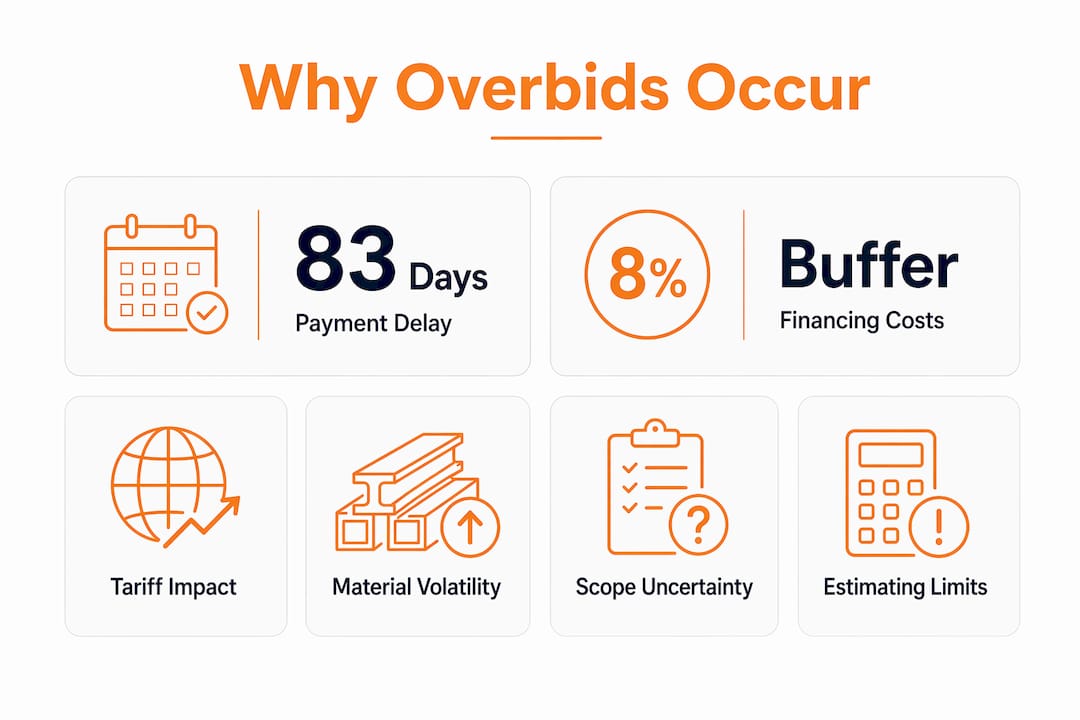
The single biggest driver of bid padding is the gap between when subcontractors perform work and when they actually get paid. 73% of contractors include an 8% bid buffer to cover funding gaps caused by industry-standard payment delays averaging 83 days. That 8% is not a guess. It is a calculated financing cost built into the bid to keep payroll running, suppliers paid, and the business solvent while waiting on receivables.

Retainage compounds the problem significantly. Owners and general contractors routinely hold back 5–10% of each payment until project completion, with retainage collections lasting 6–12 months. A subcontractor finishing a $500,000 scope in march may not collect the final $50,000 until october or later. That withheld capital has to come from somewhere, and it typically comes from the next bid.
Material cost volatility adds another layer of uncertainty. 41% of contractors raised bids due to tariffs, and 39% accelerated material purchases to lock in prices before further increases. When steel, copper, or lumber prices can shift 10–20% between bid day and project start, subcontractors price that risk into the number rather than absorb it later.
Pro Tip: Break out your financing cost as a separate line item in your estimate. Knowing your exact cost of capital for a 90-day payment cycle makes your buffer defensible and precise, not arbitrary.
The result is a feedback loop. Long payment cycles force bid padding. Padded bids lose contracts to lower competitors. Lower competitors underprice risk and then recover through change orders. The lowest bid rarely reflects the lowest final cost, and that dynamic pressures every subcontractor in the market to make a difficult choice on every single bid.
How do scope misalignment and estimating limits inflate bids?
Unclear project scopes are a direct cause of bid padding. When a subcontractor cannot determine exactly what work is required, the safest move is to price high or decline entirely. Limited estimating capacity accounts for 27% of bid rejections, with scope misalignment causing 26% of declines. Together, these two factors explain more than half of all bid rejections in the industry.
The breakdown of common bid rejection causes tells a clear story:
- Estimating capacity (27%): Small and mid-size subcontractors lack the staff to price every opportunity thoroughly. Rushed estimates produce padded numbers as a safety net.
- Scope misalignment (26%): Work falls outside the subcontractor’s specialty, or the scope is too vague to price with confidence.
- Trust issues (13%): A history of slow payment or disputes with a specific GC pushes subcontractors to price in a relationship risk premium.
- Job site distance (13%): Travel, mobilization, and scheduling costs for remote sites add real dollars that estimators often round up conservatively.
Bid packages that lack supplementary conditions, insurance requirements, or clear drawing references force subcontractors to guess at hidden obligations. Failure to cross-reference hierarchical bid documents and supplementary conditions causes missing scope elements that destroy profit margins after award. Subcontractors who have been burned by this once learn to pad every ambiguous bid.
The estimating capacity problem is structural. A two-person estimating team handling 15 active bids cannot give each one the attention it deserves. The result is a standard markup applied across the board rather than a precise cost build-up. That standard markup is almost always higher than a detailed estimate would produce.
Pro Tip: Before pricing any bid, request a scope clarification meeting with the GC. A 30-minute call can eliminate the ambiguity that adds 5–10% to your number.
What market conditions push subcontractors to bid high?
The 2026 construction market has introduced a new layer of pricing pressure that goes beyond traditional cost uncertainty. Contractors now price a “risk premium” into bids to account for labor shortages, material volatility, and regulatory changes that were not factors five years ago. This shift is not isolated to one trade or region. It is a market-wide behavioral change.
“Owners rewarding only the lowest bid encourage subcontractors to shave risk allowances, fostering a culture of overbidding or underbidding.” — Ontario Construction News
The owner-driven focus on lowest price creates a perverse incentive structure. Subcontractors who price risk accurately lose bids to competitors who underprice it. Those competitors then recover costs through aggressive change order management, which drives up the final project cost anyway. The cycle repeats, and every participant adjusts their behavior accordingly.
Four market behaviors now directly influence bid levels in 2026:
- Tariff-driven material escalation. With 39% of contractors accelerating purchases and 41% raising bids outright, tariff uncertainty has become a standard pricing variable, not an exception.
- Labor market tightness. Skilled trade shortages mean subcontractors price labor at replacement cost, not current payroll cost, to protect against mid-project turnover.
- Strategic capacity management. Overbids can signal a subcontractor’s disinterest or limited capacity. Inflating a bid is sometimes a tactic to avoid work without formally declining an invitation.
- Regulatory and insurance cost increases. New compliance requirements and rising general liability premiums add indirect costs that many estimators bundle into a single overhead markup rather than itemizing.
The strategic overbid is worth understanding separately. A subcontractor at full capacity who receives a new bid invitation faces a choice: decline and damage the relationship, or submit a high number and let the price do the talking. Overbidding can be a silent strategy for managing workload without refusing invitations outright. GCs who see a pattern of outlier bids from a specific sub should read that as a capacity signal, not a pricing error.
How can subcontractors bid more accurately and stay competitive?
Reducing bid padding without sacrificing profitability requires replacing guesswork with data. Granular analysis of indirect costs, like financing gaps and retainage, lets firms justify pricing with real numbers rather than arbitrary buffers. The subcontractors winning the most work in 2026 are not the ones bidding lowest. They are the ones who know their actual costs down to the line item.
The table below compares a traditional padding approach against a data-driven bid build-up:
| Bid approach | Method | Outcome |
|---|---|---|
| Flat percentage markup | Apply 8–15% overhead across all costs | Competitive on easy jobs, overpriced on complex ones |
| Itemized indirect costs | Calculate financing, retainage, and mobilization separately | Tighter number, easier to defend to GC |
| Digital takeoff and tracking | Use software to quantify scope and track bid pipeline | Fewer errors, faster turnaround, better win rate |
| Scope clarification first | Request GC meeting before estimating | Eliminates ambiguity padding before the number is built |
Digital tools improve bid precision and pipeline management, enabling subcontractors to avoid guesswork and unnecessary padding. Software that connects takeoff quantities directly to cost databases removes the manual estimation errors that typically inflate numbers by 3–7%.
Cross-referencing all contract documents before estimating is non-negotiable. The commercial bid estimating process requires reviewing the prime contract, general conditions, supplementary conditions, and all drawing sets before a single cost is entered. Missing one document can mean missing a $30,000 scope item that shows up as a dispute after award.
Pro Tip: Build a bid checklist that includes every document type required for a complete scope review. Run it on every bid, regardless of how familiar you are with the GC or project type.
Key takeaways
Subcontractors overbid projects primarily to cover financial risks created by long payment cycles, retainage, and scope uncertainty. Replacing flat markups with itemized cost analysis is the most direct path to leaner, more competitive bids.
| Point | Details |
|---|---|
| Payment delays drive padding | Industry-standard 83-day payment cycles force subcontractors to finance operations, creating the typical 8% bid buffer. |
| Scope clarity reduces risk premiums | Unclear bid packages cause estimators to pad for ambiguity. Requesting scope clarification before bidding cuts this cost. |
| Market conditions add new risk layers | Tariff volatility and labor shortages have made risk premiums a standard 2026 pricing variable, not an exception. |
| Strategic overbids signal capacity limits | Some subcontractors inflate bids to avoid work without declining. GCs should treat outlier bids as a capacity signal. |
| Data-driven estimating wins more work | Itemizing indirect costs and using digital takeoff tools produces tighter bids that are easier to defend and more likely to win. |
The uncomfortable truth about bid padding in construction
I have spent years watching subcontractors lose contracts they should have won, and the pattern is almost always the same. They padded the bid because they did not trust the payment terms, the scope was unclear, or they had been burned before. Every one of those reasons is legitimate. None of them are excuses for leaving money on the table.
The real problem is that most subcontractors treat the 8% buffer as a fixed cost of doing business rather than a variable they can reduce. Understanding the true cost of capital changes that. When you know that a 90-day payment delay on a $200,000 contract costs you roughly $4,000 in financing, you can price that precisely instead of rounding up to $16,000 and hoping for the best.
Technology adoption matters, but only when it is paired with contract discipline. I have seen firms invest in takeoff software and still overbid because they never fixed their document review process. The software tells you what the work costs. The contract review tells you what the work actually includes. You need both.
The industry feedback loop is real and it is self-reinforcing. Owners push for lowest price. Subcontractors either underprice and recover through change orders or overprice and lose the bid. Neither outcome serves the project. The subcontractors who break this cycle are the ones who can show their math, defend their number, and walk away from work that does not pencil out. That takes discipline and data in equal measure.
— Jen Reese
How Won2build helps subcontractors bid smarter
Bid padding shrinks when your estimating process is built on real data. Won2build’s Bid Track gives subcontractors a full estimating and bid pipeline platform that replaces flat markups with itemized cost builds. CO Hub protects your margins after award by managing change orders before they become disputes. The Takeoff tool lets you quantify materials and labor directly from digital plans, cutting the scope gaps that force conservative padding.
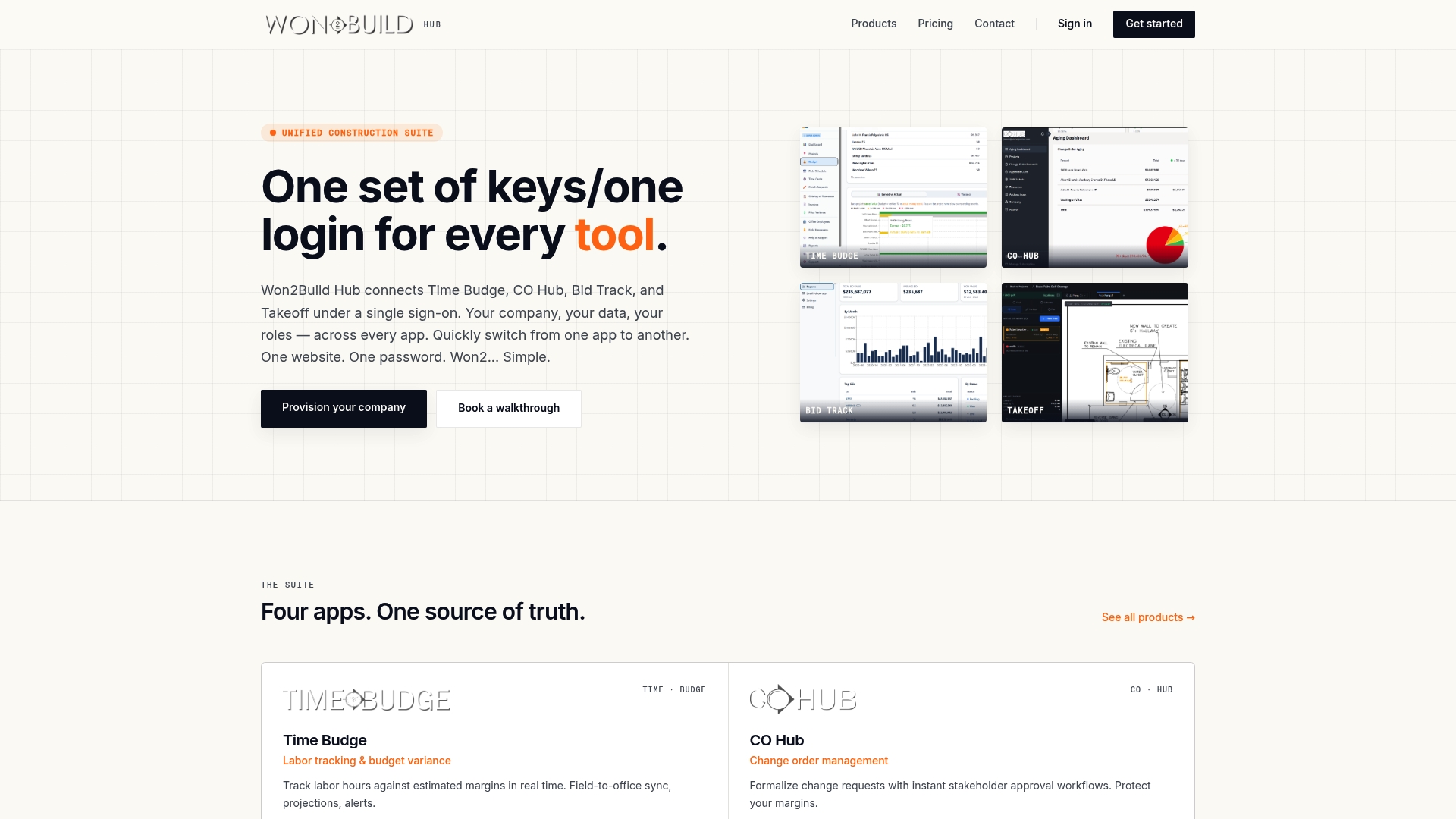
Won2build connects all four applications under a single sign-on, so your field data, change orders, and bid estimates stay synchronized in real time. Subcontractors who know their exact costs bid leaner and win more. Explore Won2build to see how accurate estimating changes your win rate.
FAQ
Why do subcontractors add an 8% buffer to bids?
The 8% buffer covers financing costs created by payment delays averaging 83 days and retainage held for 6–12 months. It is a calculated cost of capital, not arbitrary padding.
What causes subcontractors to lose bids from overbidding?
Overbidding typically results from unclear scopes, limited estimating capacity, and flat overhead markups applied without itemizing actual indirect costs. Competitors who price more precisely win those contracts.
How does scope misalignment lead to higher bids?
When bid packages are incomplete or vague, subcontractors price the unknown risk into their number. Scope misalignment accounts for 26% of bid rejections and is a direct cause of inflated estimates.
Can overbidding be intentional?
Yes. Some subcontractors inflate bids to signal limited capacity or disinterest without formally declining. GCs should treat consistent outlier bids from a specific sub as a workload signal.
What is the fastest way to reduce bid padding?
Itemize every indirect cost, including financing gaps and retainage, rather than applying a flat markup. Pair that with a thorough contract document review and digital takeoff tools to eliminate scope-driven guesswork.
Recommended
One login for estimating, bid tracking, change orders, and labor.
The Hub is free. Pay only for the apps you turn on.
Create your free Hub account- 7 Concrete Takeoff Steps Estimators Use to Avoid Ordering ShortfallsFollow seven concrete takeoff steps to calculate cubic yards, size rebar and formwork, convert volumes to supplier units, and verify quantities before bid...
- Are E-Signature Change Orders Legal and Worth the Switch?E-signature change orders streamline your workflow, ensuring faster approvals, fewer disputes, and quicker invoicing—discover the benefits now!
- How to Link Takeoff to Estimate for Accurate BidsLink your takeoff quantities to your estimate for accurate bids. Discover the seamless integration method that reduces errors and saves time.