
Construction Bid Leveling: A Practical 2026 Guide
Learn what construction bid leveling is and how it ensures fair comparisons between subcontractor bids, protecting your project budget.

Construction bid leveling is the process of normalizing subcontractor bids so a general contractor can compare them on an equal scope basis. Without it, choosing the lowest number on a spreadsheet is a gamble. Bid leveling accounts for what each sub included, what they left out, and what their qualifications say about their ability to deliver. It is the foundation of sound commercial bid estimating and the single most reliable way to protect your project budget before a contract is signed.
What is construction bid leveling and how does it differ from bid tabulation?
Construction bid leveling is a normalization process. It adjusts each submitted bid to reflect what the true cost would be if every subcontractor covered the exact same scope. Bid tabulation, by contrast, is simply data collection. A bid tabulation records submitted prices in a spreadsheet without adjusting for scope differences. Leveling goes further by identifying gaps, applying plug numbers for missing items, and producing a normalized total that allows a genuine apples-to-apples comparison.

The distinction matters because two bids that look $50,000 apart may actually be within $5,000 of each other once scope is equalized. One sub may have excluded temporary power, site cleanup, or a specific material spec. Another may have included items that fall outside the defined scope. Mapping scope items from one sub to equivalent items in another is the core technical task in bid leveling, and skipping it is how projects end up with costly change orders.
Bid leveling also incorporates qualifiers. Subs routinely attach conditions to their bids, such as exclusions for rock excavation, specific payment terms, or lead times on materials. Reading every line and every attachment before building a comparison matrix is not optional. Jumping directly to totals without reading qualifiers is one of the most common and costly mistakes in the bid leveling process.
| Factor | Bid tabulation | Bid leveling |
|---|---|---|
| Purpose | Record submitted prices | Normalize bids to equal scope |
| Scope adjustments | None | Plug numbers added for gaps |
| Qualifiers reviewed | Rarely | Always |
| Output | Price list | Normalized comparison matrix |
| Audit defensibility | Low | High when documented |
What are the key steps in the bid leveling process?
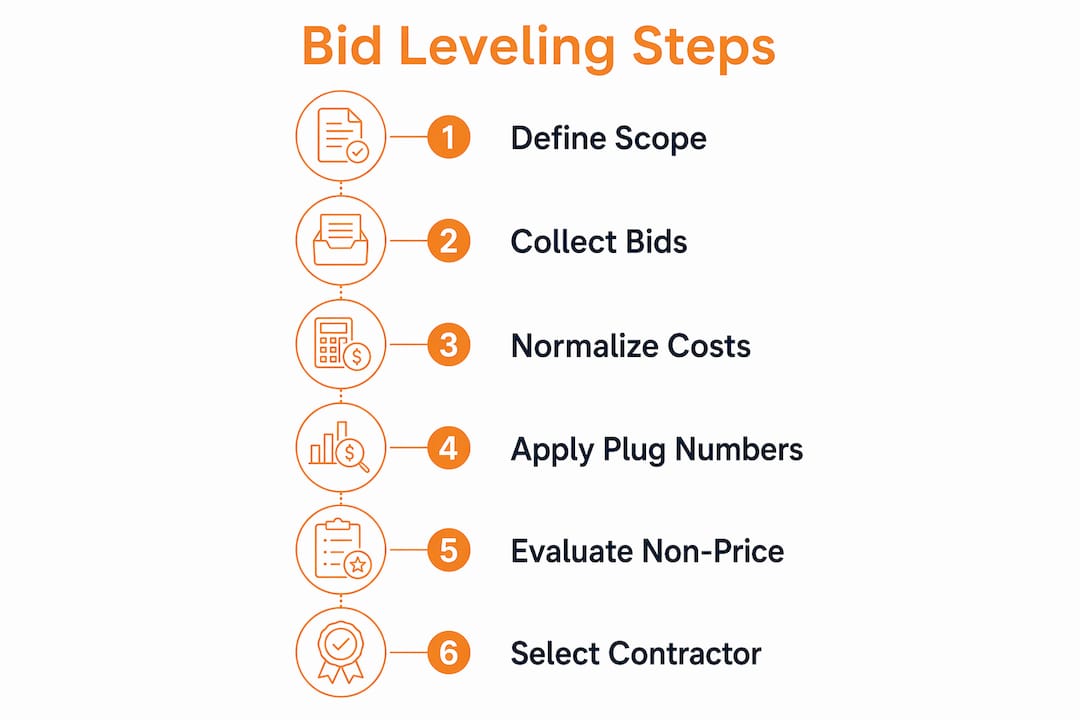
The bid leveling process follows a clear sequence. Skipping any step creates gaps that show up later as disputes or budget overruns.
-
Build a master scope baseline. The master scope baseline is the most important document in the entire process. It defines every item that must be covered, drawn from the project specifications, drawings, and bid package. Every sub’s bid gets measured against this document.
-
Read every bid completely. Review each submission line by line, including all attachments, qualifiers, and exclusion lists. Flag any item that is unclear, missing, or conditionally priced.
-
Document inclusions and exclusions. For each bid, record what is explicitly included, what is explicitly excluded, and what is simply not mentioned. Unmentioned items are treated as excluded until confirmed otherwise.
-
Apply plug numbers for missing scope. A plug number is an estimated cost added to a bid to account for a scope item that sub did not price. Plug numbers must be documented with the scope covered, the source of the estimate, and the vendor it affects. Undocumented plug numbers are the primary reason audits overturn bid-leveling decisions.
-
Issue clarification requests. Send written requests to subs for any ambiguous scope items before finalizing the comparison. Document all responses.
-
Calculate normalized bid totals. The normalized bid equals the submitted price plus plug numbers plus any price adjustments from clarifications. This formula, normalized bid = submitted price + plug numbers + adjustments, gives you a true cost comparison.
-
Build the comparison matrix. Lay out all normalized totals alongside the key scope notes, qualifiers, and non-price factors in a single document. This becomes your award recommendation.
Pro Tip: Establish a plug number sourcing hierarchy before you start. Use actual historical costs first, then published rate guides like RSMeans, then in-house takeoffs, and only use judgment estimates as a last resort. Document which source you used for every plug.
How do non-price factors influence the contractor selection decision?
Price is not the only variable that determines project success. Non-price factors often contribute 20–40% of the total award score on complex packages. That weighting reflects the real risk that a low-priced sub with a poor safety record or no relevant project history creates for the general contractor.
The most common non-price criteria used in construction bid analysis include:
- Schedule fit. Can the sub mobilize on the required start date and meet the project milestone schedule?
- Safety record. What is their Experience Modification Rate (EMR)? A high EMR signals elevated risk on site.
- Prior performance. Have they completed similar scope on time and within budget on past projects?
- Financial stability. Can they bond the work and sustain cash flow through the project duration?
- References. What do past general contractors say about their communication, quality, and problem-solving?
These factors must be weighted and scored consistently across all bidders. Standardized evaluation criteria prevent disputes during selection and make the recommendation defensible to owners and auditors. A weighted scoring sheet with defined point values for each criterion is the standard tool for this step.
“Bid leveling is an exercise in assessing total project value, not just unit cost. Clear, standardized criteria save significant conflict during selection.” — Autodesk Digital Builder
Integrating non-price scores into the bid leveling recommendation means your final matrix shows both the normalized price and the qualitative score side by side. A sub who is $15,000 higher but scores significantly better on schedule fit and safety may represent the lower-risk choice. You can also compare residential construction bids using similar frameworks when the project type shifts.
What tools and software support modern bid leveling?
Bid leveling is the most labor-intensive task in construction bid analysis. AI-assisted bid management platforms now reduce that burden by flagging scope gaps automatically and suggesting plug values based on historical data. The shift from manual spreadsheets to purpose-built software is the most significant change in construction bidding methods over the past three years.
Key features to look for in bid leveling software:
- Dynamic comparison matrices that update in real time as clarifications come in
- Automated gap identification that flags line items present in some bids but missing in others
- Plug number tracking with source documentation built into the workflow
- Audit trail generation that records every change, clarification, and adjustment
Autodesk’s construction cloud tools support bid management at the general contractor level with integration into project scheduling and document control. SpecLens offers AI-driven bid leveling with automated scope gap detection. Buildern highlights best prices per line and allows direct transformation of leveled bids into purchase orders, which reduces the risk of data loss between estimating and procurement. MeltPlan focuses on subcontractor bid workflows with step-by-step leveling guides built into the platform.
Won2build’s Bid Track application manages the full bid pipeline for subcontractors, from initial estimate through award. It integrates directly with Won2build’s Takeoff tool for digital quantity takeoff, which means scope quantities flow directly into the bid without manual re-entry. The single sign-on architecture across Won2build’s suite eliminates the double-entry problem that creates errors in manual bid leveling workflows.
Key Takeaways
Bid leveling produces a defensible award recommendation by normalizing scope, documenting plug numbers, and scoring non-price factors alongside price.
| Point | Details |
|---|---|
| Leveling vs. tabulation | Bid leveling normalizes scope; tabulation only records submitted prices. |
| Master scope baseline | Build this document first. Every bid gets measured against it. |
| Plug number documentation | Document scope, source, and affected vendor for every plug to survive an audit. |
| Non-price factors | Weight schedule fit, safety, and performance at 20–40% of the total award score on complex packages. |
| Software advantage | Purpose-built tools flag scope gaps and generate audit trails that manual spreadsheets cannot. |
Why bid leveling is harder than it looks
Bid leveling looks straightforward on paper. In practice, it is where projects get won or lost before a single shovel hits the ground. I have watched estimators spend hours building a comparison matrix, only to realize they never read the exclusion lists attached to three of the five bids. The normalized totals were fiction.
The most common mistake I see is using bid leveling to confirm a decision that was already made. An estimator favors a sub they have worked with before, and the leveling process gets shaped around justifying that choice. That is not analysis. It is a liability. When an owner or auditor reviews the award, undocumented adjustments and inconsistent scoring criteria are the first things they find.
The master scope baseline is the discipline that prevents this. When every bid gets measured against the same document, personal preference has nowhere to hide. The numbers either support the recommendation or they do not. I have seen detailed scope baselines prevent contractor disputes that would have cost weeks of project time to resolve.
Plug numbers deserve more respect than they typically get. Most estimators treat them as rough estimates and move on. The right approach is to treat every plug like a mini-estimate: define the scope, identify the source, and document the logic. RSMeans, historical project data, or a quick in-house takeoff all produce defensible numbers. A judgment estimate with no backup does not.
Bid leveling done right is not just a procurement exercise. It is the clearest picture you will get of what a project actually costs before you commit to a contract.
— Jen Reese
How Won2build simplifies your bid leveling workflow
Accurate bid leveling requires organized data, clear scope documentation, and a reliable audit trail. Won2build’s Bid Track handles the bid pipeline from initial estimate through award, keeping every clarification, adjustment, and normalized total in one place. It connects directly to Won2build’s digital takeoff tool, so scope quantities feed into your estimates without manual re-entry.
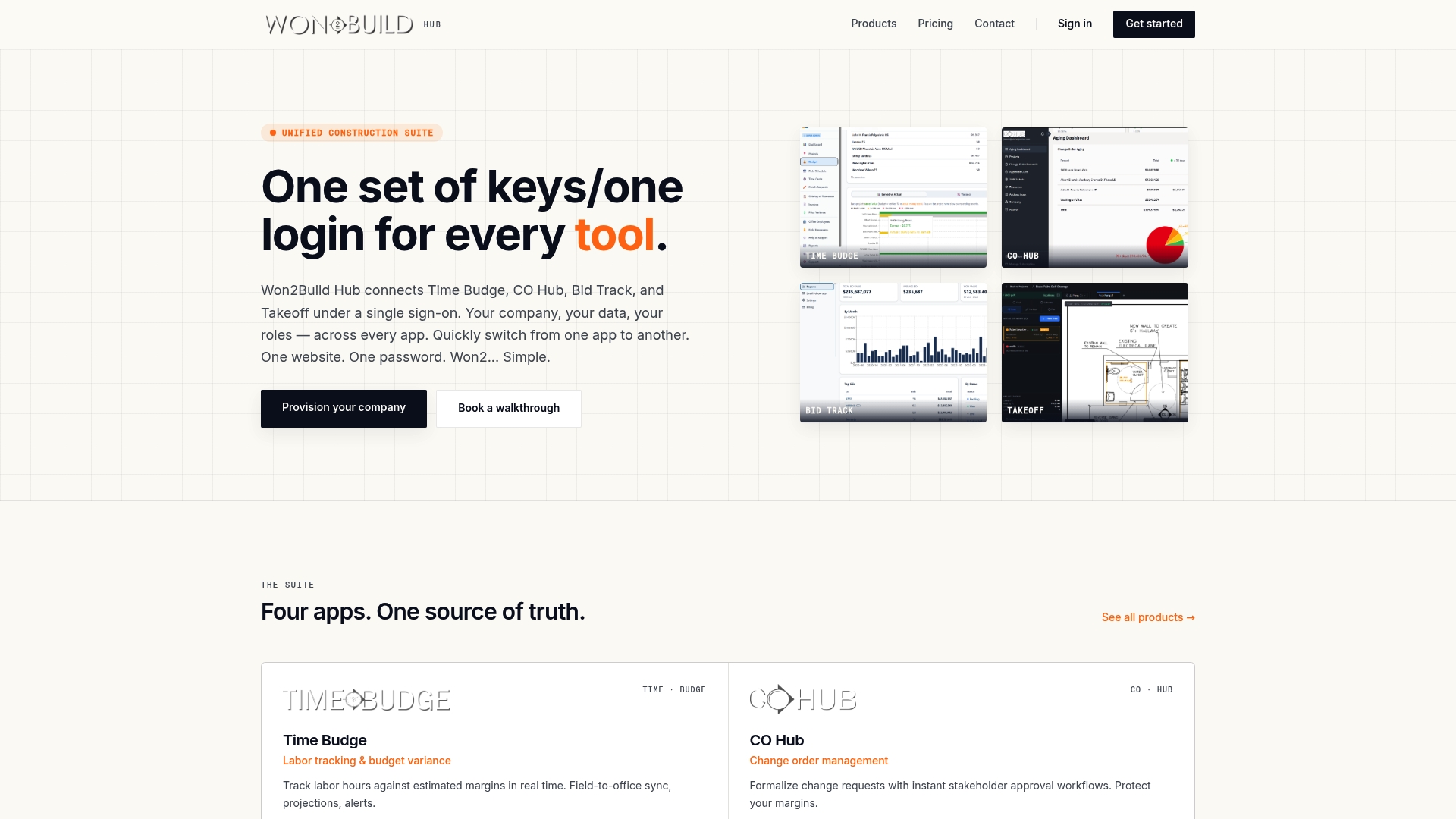
Won2build is built specifically for construction subcontractors who need field and office data to stay in sync. The single sign-on suite means your estimating, takeoff, and change order data all live in the same system. If you want to reduce errors in your bid leveling process and build documentation that holds up to owner review, Won2build is worth a closer look.
FAQ
What is construction bid leveling in simple terms?
Bid leveling is the process of adjusting subcontractor bids to cover the same scope so you can compare them fairly. It adds plug numbers for missing items and accounts for qualifiers before selecting a contractor.
How is bid leveling different from bid tabulation?
Bid tabulation records submitted prices without adjustment. Bid leveling normalizes those prices by adding plug numbers and clarifications so every bid reflects the same scope.
What is a plug number in bid leveling?
A plug number is an estimated cost added to a bid to cover a scope item that subcontractor did not price. It must be documented with the scope, the cost source, and the vendor it applies to.
How do non-price factors affect bid leveling?
Non-price factors such as safety records, schedule fit, and prior performance are weighted alongside price, often at 20–40% of the total award score on complex packages.
What software tools support construction bid leveling?
Platforms like Autodesk, SpecLens, Buildern, and Won2build’s Bid Track support bid leveling with features like automated gap detection, dynamic comparison matrices, and built-in audit trails.
Recommended
One login for estimating, bid tracking, change orders, and labor.
The Hub is free. Pay only for the apps you turn on.
Create your free Hub account- 7 Concrete Takeoff Steps Estimators Use to Avoid Ordering ShortfallsFollow seven concrete takeoff steps to calculate cubic yards, size rebar and formwork, convert volumes to supplier units, and verify quantities before bid...
- Are E-Signature Change Orders Legal and Worth the Switch?E-signature change orders streamline your workflow, ensuring faster approvals, fewer disputes, and quicker invoicing—discover the benefits now!
- How to Link Takeoff to Estimate for Accurate BidsLink your takeoff quantities to your estimate for accurate bids. Discover the seamless integration method that reduces errors and saves time.