
Types of Commercial Construction Takeoffs Explained
Discover the types of commercial construction takeoffs and learn how mastering them can secure your project's success and profitability.

Commercial construction takeoff is the measurement process used to quantify every material, labor hour, equipment need, and associated cost required to complete a project. Construction takeoffs fall into five primary categories: Quantity, Material, Labor, Equipment, and Cost, each serving a distinct function in the estimating chain. Getting these right is the difference between a winning bid and a money-losing contract. This article breaks down each of the main types of commercial construction takeoffs, explains how they interact, and shows you how to choose the right method for every phase of your project.
1. what are the types of commercial construction takeoffs?
The five core types of construction takeoffs are Quantity Takeoff (QTO), Material Takeoff (MTO), Labor Takeoff, Equipment Takeoff, and Cost Takeoff. Each one answers a different question: how much work exists, how much material to buy, how many hours to plan, what equipment to schedule, and what the total cost will be. Takeoff categories are defined by their purpose in estimating and procurement, not just by the data they collect. Understanding this distinction prevents the most common and costly estimating mistakes in commercial construction.

2. quantity takeoff (QTO): the foundation of every estimate
A Quantity Takeoff is an engineering-based measurement of the net physical work required by the design documents. It captures the full project scope in measurable units: square feet (SF) for flooring, linear feet (LF) for framing, cubic yards (CY) for concrete, and each (EA) for fixtures or equipment. QTO does not account for waste, packaging, or purchasing constraints. It answers one question only: how much work does the design call for?
QTO is the starting point for every downstream takeoff type. Without accurate net quantities, every subsequent calculation, from material orders to labor hours, inherits the same error. Estimators use QTO during early-phase bidding to define scope before pricing begins.
- Measure directly from architectural and structural drawings
- Use consistent units throughout (do not mix SF and SY in the same scope)
- Document all assumptions, especially for areas not fully detailed in drawings
- Cross-reference specifications to catch scope items not visible in plan views
Pro Tip: When performing a QTO on a large commercial floor plate, break the building into zones by floor and trade. This makes scope gaps easier to spot and simplifies the handoff to the MTO phase.
3. how material takeoffs differ from quantity takeoffs
A Material Takeoff is a procurement document, not an engineering measurement. It converts QTO data into the actual quantities you order from a supplier, expressed in vendor packaging units with waste factors applied. Conflating QTO and MTO is one of the most common sources of procurement errors and cost overruns in commercial construction.
Here is a concrete example. A QTO might show 4,200 SF of drywall as the net design quantity. An MTO converts that figure into 4x8 sheets, adds a 10% waste factor, and rounds up to the nearest full bundle. The order quantity is now 515 sheets, not 131 sheets calculated from raw SF alone. Ordering from the QTO figure directly results in a shortage on site.
| Factor | Quantity Takeoff (QTO) | Material Takeoff (MTO) |
|---|---|---|
| Purpose | Measure net design scope | Define purchase quantities |
| Units | SF, LF, CY, EA | Sheets, bags, rolls, bundles |
| Waste included | No | Yes |
| Vendor packaging | Not considered | Required |
| Used for | Bidding and scope definition | Procurement and ordering |
MTO accuracy depends on including waste allowances and standard commercial packaging details that QTO deliberately excludes. Skipping this step is a budget and schedule risk, not just a paperwork issue.
Pro Tip: Build a waste factor library by trade and material type. Drywall, tile, and roofing each carry different standard waste percentages. Storing these in a reference document speeds up every future MTO and keeps your assumptions consistent across bids.
4. labor takeoffs: estimating workforce hours accurately
A Labor Takeoff estimates the total workforce hours required to complete each scope item, based on productivity rates and crew assumptions. It takes the quantities from the QTO and applies a labor unit (hours per SF, hours per LF, hours per EA) to produce a total hour count by trade. That hour count then drives crew scheduling, cost projections, and project sequencing.
Labor takeoffs are the most complex of all construction quantity takeoff types. Productivity rates vary significantly based on crew size, site conditions, work sequence, and trade-specific factors. A concrete crew pouring a slab on grade performs at a different rate than the same crew pouring an elevated deck with formwork. Applying a single blanket rate across both conditions produces an inaccurate estimate.
Accurate labor takeoffs require:
- Separate productivity rates for each work condition (ground level, elevated, confined space)
- Crew composition assumptions documented alongside the rate
- Adjustment factors for project-specific constraints like phasing or occupied buildings
- Review by a field superintendent or foreman who has performed the work
This is why experienced estimators, not junior staff, should own the labor takeoff. The numbers look simple on paper, but the judgment behind each rate reflects years of field observation.
5. equipment takeoffs: planning machinery and duration
An Equipment Takeoff identifies every piece of machinery required for the project, the duration of use, and the associated cost. It covers owned equipment, rented equipment, and operator costs where applicable. Common line items include cranes, excavators, concrete pumps, aerial lifts, and compaction equipment.
Equipment takeoffs are often treated as an afterthought, but they directly affect project scheduling and subcontractor pricing. A missed crane pick or an underestimated pump rental can add thousands of dollars to a job that was bid tight. Equipment costs also interact with labor takeoffs: longer equipment durations often signal longer labor durations, and vice versa.
The best practice is to build the equipment takeoff in parallel with the labor takeoff, using the same scope breakdown structure. This makes it easier to spot mismatches between planned labor hours and planned equipment availability.
6. cost takeoff: turning quantities into a budget
A Cost Takeoff is the final step in the estimating process. It applies unit prices, overhead allocations, and contingency percentages to all quantified labor, material, and equipment data to produce a detailed budget estimate. Cost Takeoff converts all takeoff data into line items with dollar values, including subcontractor pricing and allowances.
The Cost Takeoff is what you submit as a bid. Every upstream error in QTO, MTO, or labor takeoffs compounds here. A 5% error in material quantities becomes a 5% error in the material cost line, which may represent tens of thousands of dollars on a large commercial project.
Key components of a complete Cost Takeoff include:
- Unit costs sourced from current supplier quotes, not historical averages
- Overhead and profit markups applied consistently by trade
- Contingency lines sized to the level of design completeness
- Subcontractor allowances for scopes not yet fully priced
- Escalation factors for projects with long procurement lead times
Bid accuracy at the Cost Takeoff stage depends entirely on the quality of the data feeding into it. Garbage in, garbage out applies here more than anywhere else in estimating.
7. manual vs. digital takeoff methods: what the data shows
Manual takeoffs, performed with paper drawings, a scale ruler, and a calculator, remain common but carry a measurable cost. Manual takeoffs take 2–3 times longer than digital methods and can reduce project win rates by up to 30%. That time penalty is not just an efficiency problem. It limits how many bids your team can turn around in a given period, which directly caps revenue potential.
Digital takeoff software addresses this by enabling 2D and 3D measurement directly from uploaded plan files, with formula-driven quantity calculations and cloud-based collaboration. Tools like Forma Takeoff improve calculation confidence, consistency, and bid competitiveness by reducing manual transcription errors and enabling real-time plan updates.
| Method | Speed | Error Rate | Collaboration | Best For |
|---|---|---|---|---|
| Manual (paper and scale) | Slow | High | None | Small, simple projects |
| Digital (2D software) | Fast | Low | Limited | Most commercial projects |
| AI-assisted software | Fastest | Lowest | Real-time cloud | High-volume or complex bids |
AI-assisted takeoff tools go one step further. Estimator Weston Burnett notes that AI tools reduce mechanical measurement workload, freeing estimators to focus on scope review and competitive pricing strategy. That shift matters because the value an experienced estimator adds is in judgment, not in counting squares on a drawing.
“The firms winning the most commercial work are not the ones with the most estimators. They are the ones whose estimators spend the least time measuring and the most time thinking.” — Weston Burnett, Estimator
For subcontractors evaluating estimating software benefits, the return on investment comes from bid volume and accuracy, not just time saved per takeoff.
Pro Tip: When selecting commercial takeoff software, prioritize cloud collaboration and plan version control. On large commercial projects, drawing sets change frequently. A tool that does not track plan revisions will cause your quantities to drift from the current design without warning.
Key takeaways
Accurate commercial construction estimating requires five distinct takeoff types, each feeding the next, with digital tools providing the greatest gains in speed and bid win rates.
| Point | Details |
|---|---|
| QTO defines net scope | Measure design quantities in SF, LF, CY, and EA before any other takeoff begins. |
| MTO is a procurement document | Always apply waste factors and vendor packaging units to avoid material shortages. |
| Labor takeoffs require field judgment | Use trade-specific productivity rates reviewed by experienced field personnel. |
| Cost Takeoff depends on upstream accuracy | Errors in QTO or MTO compound directly into your final bid number. |
| Digital tools cut time and errors | Manual methods take 2–3 times longer and reduce win rates by up to 30%. |
Where most estimators get this wrong
I have reviewed hundreds of commercial bids over the years, and the single most common mistake is not a math error. It is treating the Quantity Takeoff and the Material Takeoff as the same document. Estimators pull net SF from the drawings, hand it to procurement, and wonder why they are short on site three weeks into the job. The waste factor and packaging conversion step gets skipped because it feels like extra work. It is not extra work. It is the work.
The second pattern I see constantly is labor takeoffs built by people who have never swung a hammer. Productivity rates copied from a reference manual without adjustment for site conditions are fiction. I would rather see an estimator with 15 years of field experience build a labor takeoff on a napkin than watch a junior estimator apply RSMeans rates to a project they have never walked.
My honest recommendation is to use AI-assisted software for the measurement work and put your best people on the labor and cost review. The technology handles the counting. Your experienced estimators handle the judgment. That division of labor is where the real efficiency gain lives. Won2build’s Takeoff application is built around exactly this principle: automate the mechanical work so your team can focus on the decisions that actually win jobs.
— Jen Reese
Take your takeoff process further with Won2build
Won2build’s Takeoff application gives commercial subcontractors a purpose-built digital plan quantification tool that connects directly to bid estimates, change orders, and labor tracking within a single platform. No double entry. No version control headaches. No disconnected spreadsheets.
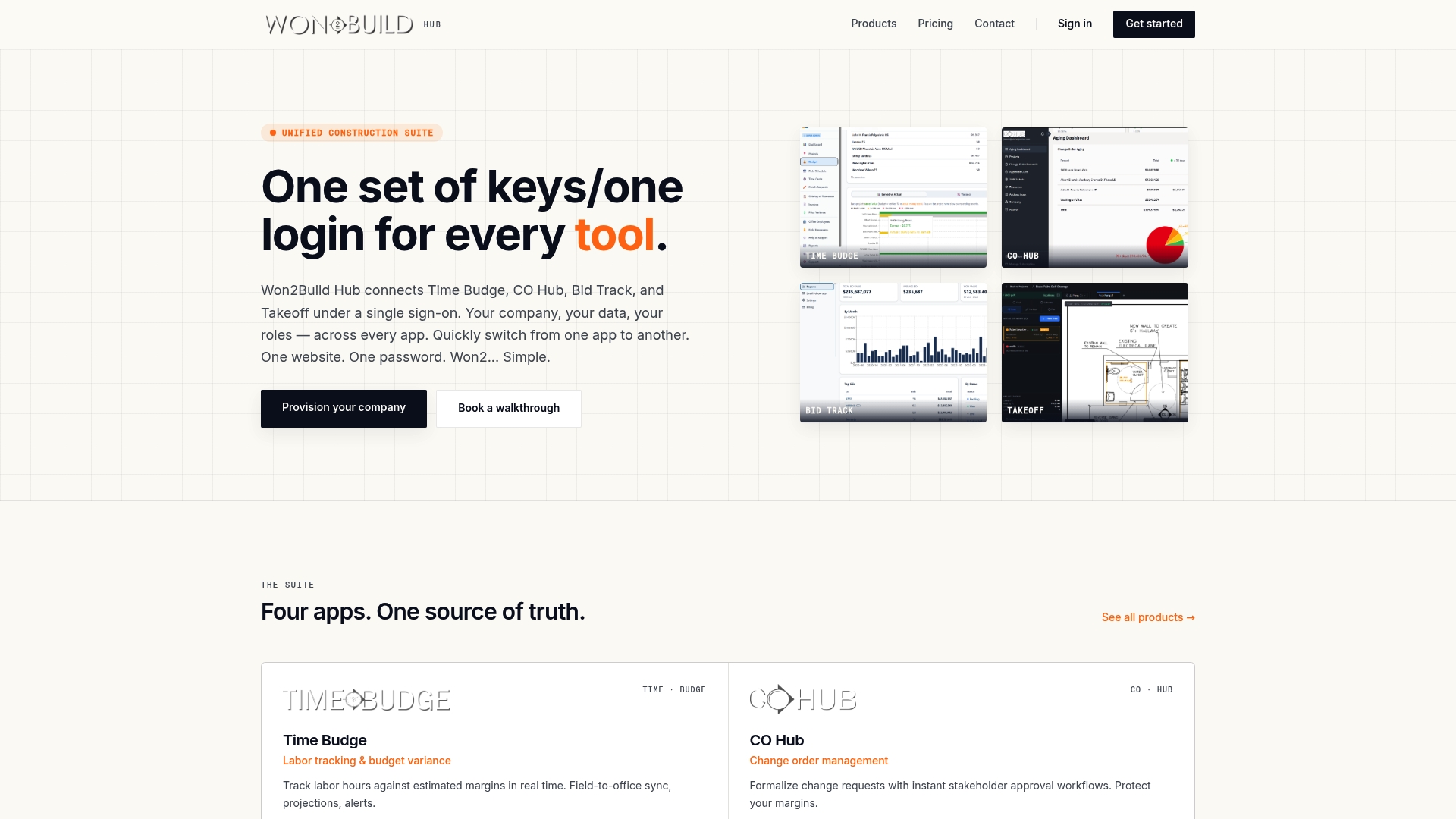
The Won2build Takeoff software supports 2D digital measurement, real-time cloud collaboration, and direct data flow into your bid and cost tracking workflows. For subcontractors managing multiple commercial projects simultaneously, that integration protects margins and keeps field and office on the same numbers. Explore Won2build Takeoff and see how faster, more accurate quantity takeoffs translate directly into better bid outcomes.
FAQ
What is a commercial construction takeoff?
A commercial construction takeoff is the process of measuring and quantifying all materials, labor hours, equipment, and costs required for a commercial project from design documents. It forms the basis of every bid estimate and procurement plan.
What are the main types of construction takeoffs?
The five main types are Quantity Takeoff (QTO), Material Takeoff (MTO), Labor Takeoff, Equipment Takeoff, and Cost Takeoff. Each serves a distinct function in the estimating and procurement process.
How does a quantity takeoff differ from a material takeoff?
A QTO measures net design quantities in engineering units, while an MTO converts those quantities into purchasable amounts with waste factors and vendor packaging applied. Confusing the two leads to ordering errors and cost overruns.
How long does a commercial construction takeoff take?
Manual takeoffs take 2–3 times longer than digital methods. On large commercial projects, a full manual takeoff can consume several days, while digital software reduces that to hours.
What software is used for commercial construction takeoffs?
Digital takeoff platforms including construction measurement tools like Won2build Takeoff and Forma Takeoff support 2D and 3D measurement, cloud collaboration, and direct integration with estimating workflows for faster, more accurate results.
Recommended
One login for estimating, bid tracking, change orders, and labor.
The Hub is free. Pay only for the apps you turn on.
Create your free Hub account- 7 Concrete Takeoff Steps Estimators Use to Avoid Ordering ShortfallsFollow seven concrete takeoff steps to calculate cubic yards, size rebar and formwork, convert volumes to supplier units, and verify quantities before bid...
- Are E-Signature Change Orders Legal and Worth the Switch?E-signature change orders streamline your workflow, ensuring faster approvals, fewer disputes, and quicker invoicing—discover the benefits now!
- How to Link Takeoff to Estimate for Accurate BidsLink your takeoff quantities to your estimate for accurate bids. Discover the seamless integration method that reduces errors and saves time.