
Unskilled Labor: Why the Term Is Losing Ground
Explore why the term 'unskilled labor' is outdated, and discover more accurate labels that reflect the true value of these essential jobs.

“Unskilled labor” describes jobs that require no formal degree or license, mostly filled through short on-the-job training. The term is technically still in use by government agencies, but it’s a bad description of the actual work, and most labor researchers now treat it as outdated.
- The label originated in early-1900s labor classifications, not in any real measure of difficulty.
- It often undersells physical stamina, judgment, and technical know-how that these jobs actually demand.
- Better terms exist: “entry-level,” “low-education requirement,” or “competency-based” roles.
Key Takeaways
The term “unskilled labor” undercounts real competencies in entry-level jobs, and shifting to competency-based language directly improves pay accuracy and hiring outcomes.
| Point | Details |
|---|---|
| The term is outdated | BLS no longer uses “unskilled” as an official classification, relying instead on education and training measures. |
| History carries bias | Early-1900s classifications disproportionately grouped marginalized workers into “unskilled” categories, shaping wage patterns still visible today. |
| Real skill exists | Jobs like food prep and construction labor demand tacit technical knowledge, stamina, and judgment despite requiring no degree. |
| Labels affect pay | Vague classifications weaken bargaining power and obscure which jobs actually resist automation. |
| Better language works | Competency-based job postings with clear pay ranges improve retention and align wages to actual job difficulty. |
Table of Contents
- What Does “Unskilled Labor” Actually Mean?
- What Jobs Get Labeled “Unskilled,” and What Do They Actually Pay?
- Why Do Experts Call “Unskilled Labor” a Misleading Term?
- Is There Real Skill Involved in “Unskilled” Jobs?
- How Does the “Unskilled” Label Affect Pay and Policy?
- What Should Replace the Term “Unskilled Labor”?
- What Can Workers in These Roles Do to Advance?
- A Publisher’s Take on the “Unskilled Labor” Debate
- Frequently Asked Questions
- Sources
What Does “Unskilled Labor” Actually Mean?
The Social Security Administration has historically defined unskilled work as tasks needing little to no judgment, learnable in 30 days or less. The Bureau of Labor Statistics doesn’t use “unskilled” as an official category anymore. Instead, it classifies jobs by typical entry-level education, on-the-job training length, and work experience in a related occupation.
Three measurement approaches dominate how agencies actually sort these roles:
- Entry-level education: no degree, a high school diploma, or none required at all.
- On-the-job training: short-term (days), moderate-term (months), or long-term (over a year).
- Job-content analysis: what tasks the role actually demands, regardless of credentials.
A concrete number helps here. The BLS reports that food preparation workers need no formal educational credential and typically learn through short-term training, yet the occupation still carries a defined median wage and documented skill expectations. That’s a data-driven classification system, not a judgment about worth.
What Jobs Get Labeled “Unskilled,” and What Do They Actually Pay?
Retail clerks, food prep workers, warehouse pickers, personal care aides, and construction laborers make up the bulk of jobs typically stamped with this label. None of them require a college degree. Most require weeks, not years, of training. But “short training” and “no skill” are not the same thing, and the pay data tells a more complicated story than the label suggests.
Some jobs in this category defy the low-pay stereotype entirely. MoneyTalksNews points to plant operators, train conductors, and specialized field technicians who earn well above minimum wage with no degree at all, driven by physical risk, labor shortages, and technical demands the “unskilled” label completely ignores.
- Food prep, retail, and warehousing: no degree, weeks of training, moderate pay.
- Construction labor: no degree, but often certification-heavy for equipment and safety.
- Personal care aides: no degree, but licensure requirements vary by state.
Why Do Experts Call “Unskilled Labor” a Misleading Term?
The word has a history worth knowing. Early US workforce categories, documented by the MIT Sloan background note, were sorted into “unskilled” categories that lumped together farm labor, factory work, and domestic service. Those categories weren’t neutral. They disproportionately captured jobs held by Black workers and women, and the label helped justify paying them less.
The classification “unskilled” functioned less as a technical measure of job difficulty and more as a social tool that lowered the perceived value of work performed by marginalized groups, a legacy still visible in wage patterns today.
That history has practical consequences right now:
- Undervaluation of real competencies, from equipment handling to customer de-escalation.
- Weaker bargaining power in wage negotiations and union organizing.
- Policy blind spots that treat these jobs as interchangeable and low-priority for training investment.
- Status bias that makes hiring managers and the public assume the work requires no judgment at all.
Is There Real Skill Involved in “Unskilled” Jobs?
Walk a warehouse floor or a hotel kitchen for a shift and the “no skill” framing falls apart fast. These roles demand tacit technical knowledge (knowing exactly how a fryer or forklift behaves under pressure), situational judgment (de-escalating an angry customer without a script), physical stamina, and reliability that keeps entire operations running.
Most people learn these competencies through on-the-job training, informal mentorship from senior coworkers, short certificate programs, or licensure where the state requires it. None of that shows up on a resume the way a college degree does, which is part of the problem.
- On-the-job training remains the dominant pathway, often unpaid in its first days.
- Apprenticeships exist for trades-adjacent roles like construction labor.
- Short certificates (forklift operation, food handling) add credibility fast.
- State licensure applies to some personal care and food service roles.
Pro Tip: If you’re writing job postings, swap vague requirements like “must be a self-starter” for specific competencies: “must safely operate a pallet jack” or “must handle 50+ customer interactions per shift.” Competency-based language attracts better-matched applicants and holds up better in pay disputes.
How Does the “Unskilled” Label Affect Pay and Policy?

Classification isn’t just semantics. It shapes pay-setting, unionization campaigns, and the policy debates built around minimum wage and training funding. A job labeled “unskilled” gets treated as replaceable, which weakens a worker’s negotiating position before a conversation about raises even starts.
Automation adds another layer to this. BLS projects food preparation employment to decline about 3% between 2024 and 2034, but plenty of jobs in this category, home health aides, construction labor, skilled trades support, resist automation because they require adaptability in unpredictable physical environments that robots still struggle with.
- Pay-setting: vague labels make it easier to justify wage stagnation.
- Automation risk: physically variable, judgment-heavy roles are harder to automate than repetitive tasks.
- Policy stakes: reclassification debates directly affect minimum-wage floors, training program funding, and benefit eligibility.
The pandemic sharpened this tension. Millions of workers in roles long dismissed as “low-skill” were suddenly reclassified as essential, often while earning median hourly wages in the low teens, a contradiction that fueled a lot of the current pushback against the “unskilled” label itself.
What Should Replace the Term “Unskilled Labor”?
Language shapes hiring outcomes more than most employers realize. “Entry-level,” “low-education requirement,” and “competency-based” all describe the same jobs without the baggage, and they tend to attract applicants who feel respected rather than dismissed before the interview even starts.
A stronger job posting checklist looks like this:
- List specific competencies required, not vague traits.
- State shift requirements and physical demands plainly.
- Include the training timeline, whether that’s two days or two months.
- Publish a real pay range, not “competitive salary.”
Economists who study labor markets argue that competency-based hiring criteria improve retention because pay and expectations actually match the difficulty of the job, instead of both being anchored to an outdated label.
What Can Workers in These Roles Do to Advance?
If you’re in a role labeled “unskilled,” the fastest path forward is making your actual skills visible on paper, because most employers won’t do it for you.
- Document specific accomplishments: units processed, safety record, training you delivered to newer hires.
- Pursue short credentials your employer will pay for or reimburse, like forklift certification or food safety licensing.
- Track measurable outcomes tied to your work, not just hours logged.
- Check state-run workforce training programs and BLS occupation pages for wage benchmarks before your next negotiation.
- Community college certificate programs: often $500 to $2,000, completed in weeks.
- Employer-sponsored apprenticeships: usually free, paid while training.
- State workforce development grants: vary by state, worth checking before paying out of pocket.
What Does This Mean for Construction Subcontractors?
Construction labor gets dismissed as “unskilled” more than almost any other category, despite demanding equipment operation, blueprint literacy, and safety judgment that take real time to build. That mismatch between actual skill and job title creates real pay disputes on job sites.
- Track hours and task types with detailed time and labor records.
- Document scope changes through T&M tickets rather than verbal agreements.
- Tag workers by verified skill level, not just job title, when building labor cost estimates.
A Publisher’s Take on the “Unskilled Labor” Debate
We build software for subcontractors who watch this terminology problem play out daily: a crew member with three years of blueprint-reading experience gets quoted the same rate as someone on their first shift, because both fall under the same generic labor line. That gap is what drives our focus on documentation. If you want to dig deeper into how job classification affects bids and pay, our bid management guide breaks down where skill gets lost in the numbers.
Getting labor costs right starts with knowing exactly what a worker’s time is actually worth, not what an outdated label assumes it’s worth. Won2Build’s CO Hub helps subcontractors document scope changes and skill-based labor through detailed T&M tickets, so pay conversations are backed by records instead of guesswork. Pair that with Bid Track to make sure your estimates value labor accurately from the start, not as an afterthought buried in a generic line item.
Frequently Asked Questions
What does “unskilled labor” mean exactly? It refers to jobs requiring no formal education credential and typically short-term on-the-job training, based on how BLS and SSA historically measured entry requirements, not a judgment about job difficulty.
Is “unskilled labor” still an official government term? No. The BLS classifies jobs by entry-level education and training duration rather than using “unskilled” as a formal category.
Why do people say “unskilled labor” is a myth? Because many jobs under that label require real technical knowledge, physical stamina, and judgment, competencies the term simply doesn’t measure.
What are examples of jobs often called unskilled? Food preparation, retail sales, warehousing, personal care aides, and general construction labor are common examples, most requiring no degree but real on-the-job training.
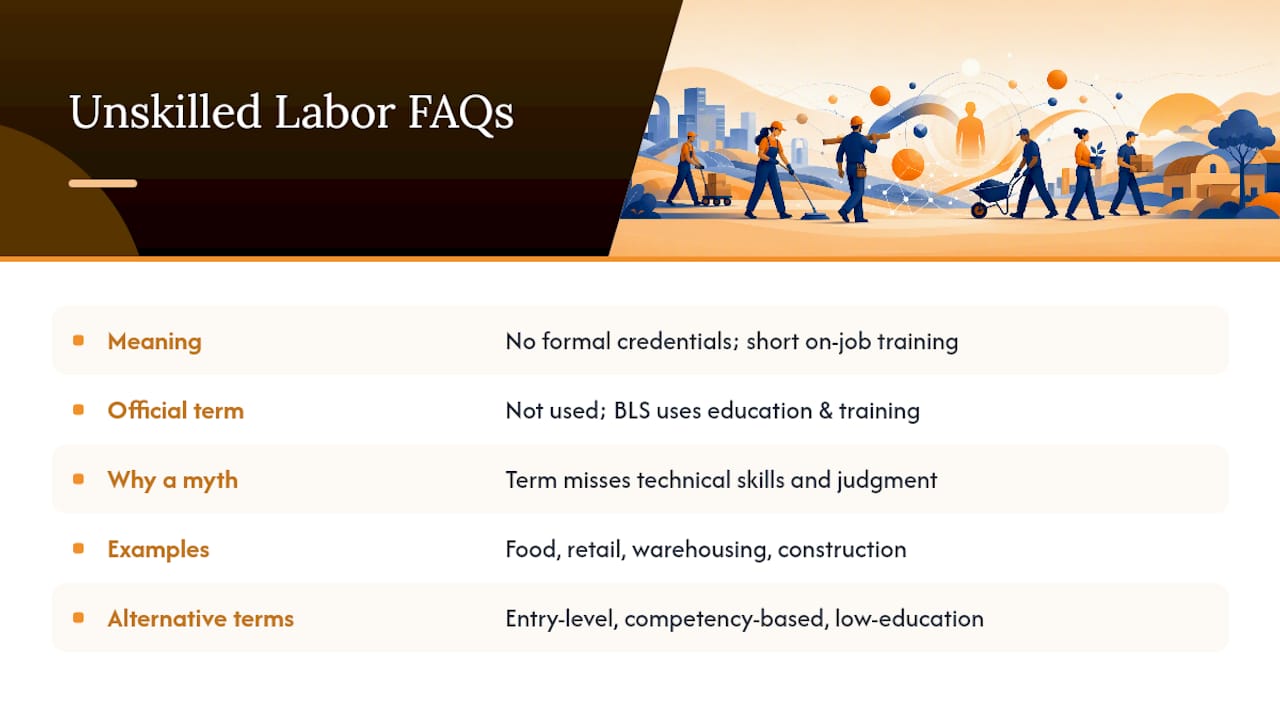
What should replace the term “unskilled labor”? “Entry-level,” “competency-based,” or “low-education requirement” describe the same jobs more accurately and without the historical baggage.
Sources
- A Background Note on “Unskilled” Jobs in the United States - Past, Present, and Future
- Food Preparation Workers : Occupational Outlook Handbook
Recommended
One login for estimating, bid tracking, change orders, and labor.
The Hub is free. Pay only for the apps you turn on.
Create your free Hub account- 7 Concrete Takeoff Steps Estimators Use to Avoid Ordering ShortfallsFollow seven concrete takeoff steps to calculate cubic yards, size rebar and formwork, convert volumes to supplier units, and verify quantities before bid...
- Are E-Signature Change Orders Legal and Worth the Switch?E-signature change orders streamline your workflow, ensuring faster approvals, fewer disputes, and quicker invoicing—discover the benefits now!
- How to Link Takeoff to Estimate for Accurate BidsLink your takeoff quantities to your estimate for accurate bids. Discover the seamless integration method that reduces errors and saves time.