
Labor Productivity Tracking in Commercial Work: 2026 Guide
Discover the role of labor productivity tracking in commercial work. Learn key metrics and methods to enhance efficiency and protect margins.

Labor productivity tracking is defined as the measurement of value delivered relative to labor hours spent on a commercial construction project. This is not the same as tracking hours worked or dollars spent. The role of labor productivity tracking in commercial work is to give project managers a real-time control mechanism, not just a financial report. When you know how many units your crew installed per hour this week, you can act before a small variance becomes a budget-breaking overrun. This guide covers the core metrics, measurement methods, and practical applications that commercial construction managers need to protect margins and keep projects on schedule in 2026.
Why is labor productivity tracking essential for commercial construction efficiency?
Labor productivity tracking protects cash flow and controls schedule by exposing when labor is not converting into planned progress. That distinction matters more than most managers realize. Tracking hours tells you what you spent. Tracking productivity tells you what you got for it.
When productivity issues go undetected until month-end reports arrive, the damage compounds fast. A crew running at 70% of planned productivity for three weeks creates a schedule gap that cannot be recovered without overtime, added headcount, or scope negotiation. None of those options are cheap. Catching productivity drops early gives you the window to make small corrections instead of expensive ones.
The distinction between labor tracking and productivity tracking is worth stating clearly:
- Labor tracking records hours worked and cost codes. It answers: “How much did we spend?”
- Productivity tracking links those hours to units installed or milestones completed. It answers: “What did we get for what we spent?”
- Production tracking measures total output volume. It answers: “How much did we build?” but ignores how efficiently you built it.
Most specialty contractors measure cost without linking it to value delivered. That gap is where late issue detection hides. A foreman can spend 400 hours on a task that should have taken 300, and a cost report alone will not flag it until the job is nearly done.
Pro Tip: Set a weekly productivity review meeting with your foremen before the payroll cycle closes. That timing gives you one last chance to verify field unit counts against hours before the data locks.
How to effectively measure labor productivity on commercial construction sites
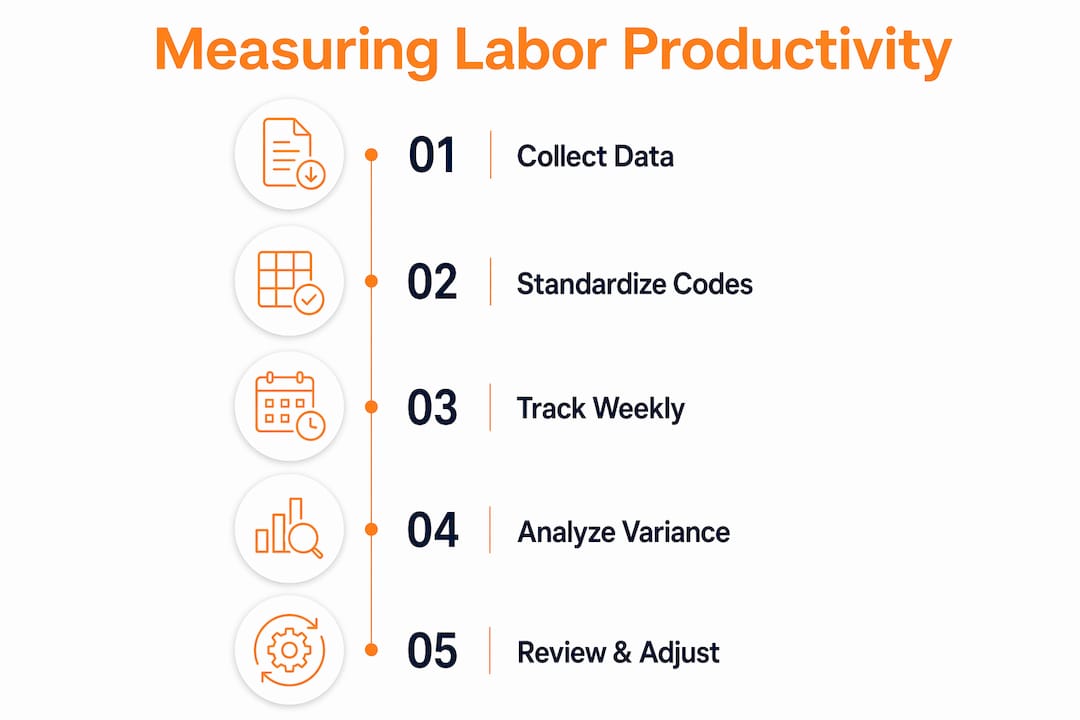
Accurate measurement starts with the right cadence. Weekly measurement using 6–15 labor cost codes tied to field unit counts and time tracking gives you enough data to spot real variances without drowning in noise. Monthly reviews support financial reporting, but operational control requires faster feedback loops. Weekly is the minimum for effective productivity management.
The measurement process follows a clear sequence:
- Define your cost codes. Assign 6–15 labor cost codes that map to specific work activities, such as conduit installation, panel terminations, or framing runs. Each code should represent a measurable unit of output.
- Capture field unit counts weekly. Foremen or field supervisors count installed quantities at the end of each week. This is the “value delivered” side of the equation.
- Align time entries to the same cost codes. Every hour worked must be coded to the same activity as the unit count. Misaligned coding destroys the diagnostic value of the data.
- Calculate the productivity factor. Divide labor hours by units installed to get hours per unit. Compare that figure to your estimate or benchmark.
- Flag abnormal variances immediately. Normal week-to-week variation is expected. A variance that exceeds your threshold signals a real problem worth investigating.
Field data must be captured timely by crews with consistent coding to preserve diagnostic accuracy. Reconstructing data in the office a week later introduces errors and eliminates your ability to intervene while the work is still active.
| Measurement Element | Recommended Practice | Why It Matters |
|---|---|---|
| Reporting cadence | Weekly | Enables intervention before variance compounds |
| Number of cost codes | 6–15 per project | Balances detail with manageability |
| Unit of measure | Installed quantities (units, LF, SF) | Ties labor hours to real value delivered |
| Data capture timing | Same week as work performed | Preserves real-time diagnostic accuracy |
| Variance review | Compare to estimate benchmark | Identifies abnormal performance early |

Standards like ASTM E2691 provide a formal framework for measuring work productivity in construction. Using a recognized standard gives your data credibility in contract disputes and stakeholder reporting. Electronic time tracking for construction removes the manual coding errors that undermine field data quality.
Pro Tip: Build your cost code structure during the estimating phase, not after mobilization. When your estimate codes match your field tracking codes, variance analysis takes minutes instead of hours.
How do you interpret labor productivity data?
Raw numbers are not information. Work performance information is generated by analyzing productivity data against baselines, revealing variances and forecasting project trends. That analysis step is where most teams fall short.
The PMBOK framework distinguishes between work performance data (raw field counts and hours), work performance information (analyzed variances and trends), and work performance reports (formatted summaries for stakeholders). Most teams stop at data. The teams that protect their margins move all the way to information.
“The real value of productivity tracking lies in transforming variance signals into action, catching issues early to prevent margin erosion over time.” — The Birm Group
Three questions drive useful interpretation:
- Is this variance real or noise? A single bad week can reflect weather, material delays, or crew changes. Two or three consecutive weeks of the same variance signal a systemic problem.
- What is the root cause? Percent Plan Complete (PPC) measures weekly commitments completed and, when combined with variance explanations, points directly to causes: rework, access issues, crew skill gaps, or sequencing problems.
- What does this mean for the forecast? A productivity factor running 15% below estimate on a task that is 30% complete will not self-correct. Project that forward and quantify the cost and schedule impact now.
Data trustworthiness is the foundation of all interpretation. If foremen know that their unit counts will be scrutinized, they report accurately. If the data is never used, accuracy degrades. The discipline of weekly review creates the accountability loop that keeps field data honest.
Applying labor productivity tracking to improve commercial construction outcomes
Productivity metrics do more than flag problems. They inform every major operational decision on a commercial project. The applications span crew management, scheduling, cost control, and contract protection.
Crew allocation and sequencing. When you track productivity by crew and cost code, you can see which foremen consistently hit benchmark and which ones need support. That data informs crew assignment decisions on future phases. It also reveals sequencing bottlenecks: if one trade’s productivity drops every time another trade is working in the same area, the schedule needs adjustment.
Cash flow protection. Labor is typically the largest cost variable on a commercial project. When productivity drops without detection, you burn through your labor budget faster than your billing schedule recovers. Subcontractor time tracking that links hours to cost codes and installed quantities gives you the data to bill accurately and defend your position in payment disputes.
Contract claims and risk management. Documented productivity records are your strongest evidence in a delay or disruption claim. If an owner-caused disruption dropped your crew’s productivity from 1.2 hours per unit to 2.1 hours per unit for six weeks, that record quantifies your damages. Without it, you are negotiating from memory.
The following comparison shows the difference between teams that track productivity and those that track only cost:
| Capability | Cost Tracking Only | Productivity Tracking |
|---|---|---|
| Issue detection timing | Month-end report | Weekly variance review |
| Root cause identification | Limited | Tied to specific cost codes and crews |
| Forecast accuracy | Low | High, based on current performance factors |
| Contract claim support | Weak | Strong, with documented unit and hour records |
| Crew management decisions | Gut-based | Data-supported |
Technology tools accelerate every part of this process. Won2build’s Time Budge application captures field hours against cost codes in real time, while construction measurement tools give managers the unit count data needed to complete the productivity calculation. Real-time data synchronization between field and office means your weekly review uses current numbers, not last week’s approximations.
Key Takeaways
Effective labor productivity tracking converts field data into decisions that protect margins, schedules, and contract positions on commercial construction projects.
| Point | Details |
|---|---|
| Define productivity correctly | Measure value delivered per labor hour, not just hours worked or dollars spent. |
| Track weekly, not monthly | Weekly reviews catch variances while work remains active and correctable. |
| Align cost codes to field counts | Hours and unit counts must share the same cost codes to produce valid productivity data. |
| Interpret beyond raw numbers | Use variance analysis and PPC to identify root causes, not just report outcomes. |
| Document for contract protection | Productivity records are your strongest evidence in delay and disruption claims. |
What I’ve learned about productivity tracking that most guides skip
I have spent years watching commercial construction teams invest in time tracking software and still miss their labor budgets. The problem is almost never the tool. It is the discipline gap between capturing data and acting on it.
Most teams treat productivity reports like a scoreboard. They look at the number, feel good or bad about it, and move on. The teams that actually protect their margins treat every variance as a question that demands an answer before the next week starts. That shift in mindset is harder to implement than any software rollout.
The other thing I have seen consistently: field data accuracy collapses when foremen do not believe the data will be used fairly. If a crew reports a bad week and gets blamed without context, they will start smoothing the numbers. Build a culture where variance explanations are expected and coaching follows, not punishment. PPC works exactly this way: the number on the whiteboard is less important than the conversation it starts.
My practical advice is to start with three to five cost codes on your next project, not fifteen. Get the habit right first. Accurate data on five codes beats approximate data on fifteen every time. Once your team trusts the process, expand the scope.
— Jen Reese
Won2build’s tools for labor productivity tracking
Commercial construction managers who want real-time visibility into labor productivity need tools that connect field data to office reporting without manual rekeying.
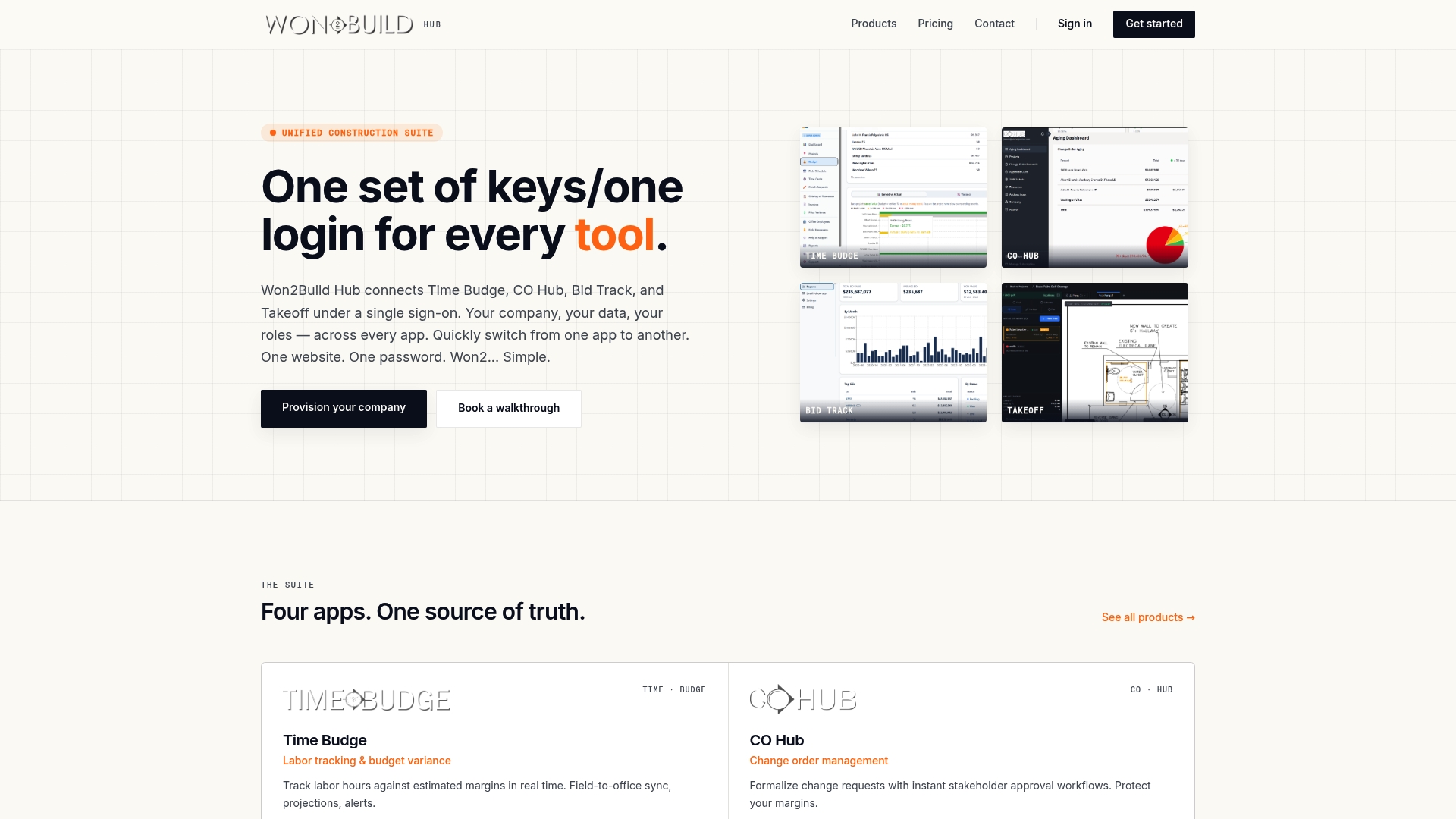
Won2build’s suite connects time capture, cost code management, and project budgeting in one platform. The Time Budge application records field hours against specific cost codes as work happens, eliminating the office reconstruction delays that destroy diagnostic accuracy. For teams building out their estimating and planning process, Won2build’s Bid Track supports accurate labor productivity forecasts from the bid phase forward, so your field benchmarks are grounded in realistic estimates from day one. When change orders shift scope and labor allocation, CO Hub keeps the productivity baseline current. The result is a connected workflow where field performance and project financials stay in sync throughout the job.
FAQ
What is labor productivity tracking in construction?
Labor productivity tracking measures the value delivered per labor hour on a construction project, typically by linking installed quantities to time entries under matching cost codes. It differs from simple hour tracking by connecting effort to output.
How often should productivity be measured on a commercial project?
Weekly measurement is the minimum effective cadence for operational control. Monthly reviews support financial reporting but arrive too late to allow corrections on active work.
What is PPC and how does it relate to productivity?
Percent Plan Complete (PPC) measures the percentage of weekly commitments a crew completes. PPC combined with variance analysis identifies root causes of productivity shortfalls, moving teams from scorekeeping to problem-solving.
Why do productivity problems often go undetected until late in a project?
Most teams track cost without linking it to value delivered. That gap means a crew can spend significantly more hours than planned on a task and the overrun only surfaces at month-end, when correction is expensive or impossible.
How does productivity tracking support contract claims?
Documented weekly productivity records showing hours per unit before and during a disruption event quantify the impact with precision. That documentation is far stronger evidence in a delay claim than verbal accounts or reconstructed estimates.
Recommended
One login for estimating, bid tracking, change orders, and labor.
The Hub is free. Pay only for the apps you turn on.
Create your free Hub account- 7 Concrete Takeoff Steps Estimators Use to Avoid Ordering ShortfallsFollow seven concrete takeoff steps to calculate cubic yards, size rebar and formwork, convert volumes to supplier units, and verify quantities before bid...
- Are E-Signature Change Orders Legal and Worth the Switch?E-signature change orders streamline your workflow, ensuring faster approvals, fewer disputes, and quicker invoicing—discover the benefits now!
- How to Link Takeoff to Estimate for Accurate BidsLink your takeoff quantities to your estimate for accurate bids. Discover the seamless integration method that reduces errors and saves time.