
Why Commercial Subcontractors Need Bid History
Discover why commercial subcontractors need bid history to improve win rates. Learn how documented relationships lead to more successful bids.

Bid history is the systematic record of every bid a commercial subcontractor has submitted, including outcomes, pricing, and follow-up notes. It functions as a strategic asset that separates subcontractors who win work consistently from those who bid blindly and lose often. Understanding why commercial subcontractors need bid history starts with one fact: subcontractors known to general contractors (GCs) achieve 40–50% win rates versus 10–15% on cold bids. That gap does not come from luck. It comes from documented relationships, tracked performance, and evidence-based pricing built over time.
Why commercial subcontractors need bid history to win more work
Bid history, also called a bid log or bid record, is the industry term for a structured database of past bid submissions. Each entry typically captures the project name, GC contact, scope, submitted price, outcome, and reason for the result. Without this record, every new bid starts from zero.
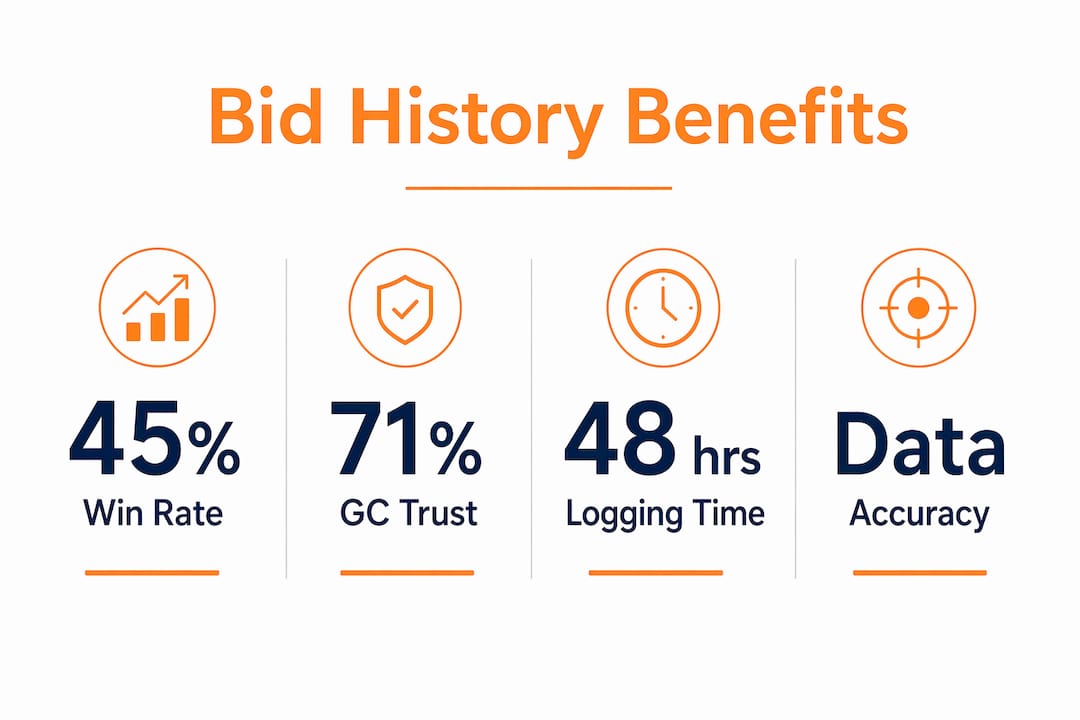
The win rate gap tells the whole story. Subcontractors with tracked bid history who maintain active GC relationships win 40–50% of their bids. Cold bidders, those without documented history or established contacts, win only 10–15%. That is a 30–35 percentage point difference on the same projects. Consistent documentation is the variable that explains most of that gap.
Bid history also prevents the most common estimating mistake: pricing based on gut feel rather than data. When you can pull up three similar projects from the past 18 months, you know exactly what labor, materials, and overhead actually cost on comparable scopes. That knowledge produces bids that are competitive without being reckless.

| Metric | With bid history | Without bid history |
|---|---|---|
| Typical win rate | 40–50% | 10–15% |
| Estimating accuracy | High (data-driven) | Low (assumption-based) |
| GC relationship strength | Documented and trackable | Inconsistent |
| Follow-up effectiveness | Timely and informed | Reactive or absent |
| Resource planning | Forecast-ready | Reactive |
Pro Tip: Record the outcome of every bid within 48 hours of receiving a decision. Delayed logging leads to missing details that make the data useless for future analysis.
How does bid history affect subcontractor relationships with GCs?
GCs do not select subcontractors on price alone. 71% of GCs identify past performance as the most critical factor in subcontractor selection. That means your bid record is also your reputation record.
Bid history gives you the documentation to back up that reputation. When a GC asks why you priced a scope a certain way, or whether you have handled a similar project before, your bid log provides the answer. Subcontractors who can speak to past performance with specifics earn trust faster than those who rely on memory or general claims.
Poor follow-up after submission is one of the most damaging mistakes in commercial subcontractor bidding. Silence after submission signals disinterest or unpreparedness to GCs. A bid log that records submission dates, follow-up contacts, and GC responses turns follow-up from a guessing game into a managed process.
The risks of inconsistent tracking compound over time:
- Lost context on why a bid was won or lost, making it impossible to repeat successes
- Missed follow-up windows that cost you the relationship, not just the bid
- Inability to demonstrate a track record when a new GC asks for references or history
- Repeated pricing errors because past cost data was never captured
“One poorly executed project can erode years of relationship capital. Bid history assists in risk assessment and avoidance by giving subcontractors a clear record of which GCs, project types, and scopes have produced profitable outcomes.”
Tracking commercial project leads alongside your bid history also helps you qualify opportunities before investing estimating time. Not every lead deserves a full bid. Your historical data tells you which ones do.
Best practices for maintaining bid history effectively
Digital bid tracking systems outperform manual spreadsheets on every measurable dimension. Structured bid logs enable subcontractors to handle 20–40 active bids simultaneously while maintaining 30–50% win rates. Spreadsheets break down at that volume. They do not send reminders, flag stale bids, or generate pipeline reports automatically.
The most effective bid history systems capture qualitative data, not just win/loss outcomes. Win/loss data is only useful when detailed reasons are recorded for losses. Price is often not the true cause of a loss. Scope misalignment, late submission, or a GC’s existing relationship with another sub are common reasons that never show up in a simple win/loss column.
Follow these steps to build a bid history system that actually improves your results:
- Choose a digital platform over spreadsheets. A purpose-built system for bid tracking software captures structured data automatically and reduces manual entry errors.
- Record every bid, not just the ones you win. Lost bids contain the most useful data for improving future estimates and go/no-bid decisions.
- Log qualitative outcomes. Note the reason for every loss: was it price, scope, timing, or relationship? That detail drives better decisions next time.
- Use your bid log for go/no-bid analysis. Historical bid data prevents wasting effort on unwinnable bids by showing which GCs, project types, and geographies produce results for your company.
- Review your pipeline weekly. A bid log that is not reviewed regularly becomes a graveyard of outdated entries. Weekly review keeps your pipeline current and your follow-up timely.
- Analyze bid-to-award timelines. Bid logs enable accurate forecasts of resource needs by showing how long projects typically take from submission to award. That data prevents over-commitment.
Pro Tip: Set a calendar reminder to review your full bid log at the end of each month. Look for patterns in your losses. If you are consistently losing bids to the same GC, that is a relationship problem, not a pricing problem.
How does bid history support pricing strategy and GC negotiations?
Documented pricing history establishes credible benchmarks that GCs respect. Verifiable pricing history builds credibility and reduces negotiation friction. When you can show a GC that your labor rate for a specific trade has been consistent across six similar projects, your number carries weight that a one-off estimate does not.
Bid history also reveals competitive landscape patterns before you submit. Historical awards indicate bidder counts and price ranges, allowing better economic viability assessment before you invest estimating hours. Knowing that a particular GC typically receives eight bids on a project type, and that the winning range falls within a specific band, changes how you approach your number.
The pricing benefits of a strong bid record include:
- Defensible cost breakdowns. Past bids show GCs that your pricing reflects actual project costs, not arbitrary markups.
- Faster award decisions. Documented pricing methodologies demonstrate professionalism and reduce the back-and-forth that slows awards.
- Profitable floor identification. Your bid history shows the minimum price at which you have won work and still maintained margin. That floor protects you from underbidding under pressure.
- Negotiation confidence. When a GC pushes back on your number, historical data gives you a factual basis to hold your position or explain an adjustment.
Subcontractors who track bid win rates systematically are also better positioned to identify which project types generate the highest margins. That insight shifts your bidding focus toward work that is worth winning, not just work that is available.
Key Takeaways
Commercial subcontractors who maintain systematic bid history win significantly more work, build stronger GC relationships, and price with confidence because their decisions are grounded in documented evidence rather than assumption.
| Point | Details |
|---|---|
| Win rate advantage | Tracked bid history supports 40–50% win rates versus 10–15% on cold bids. |
| GC relationship building | 71% of GCs rank past performance as their top subcontractor selection factor. |
| Qualitative data matters | Recording loss reasons, not just outcomes, drives better go/no-bid decisions. |
| Pipeline capacity | Digital bid logs support managing 20–40 active bids simultaneously. |
| Pricing credibility | Documented pricing history reduces negotiation friction and speeds award decisions. |
Bid history changed how I think about subcontractor bidding
I have reviewed bid strategies across dozens of commercial subcontracting operations, and the pattern is consistent. The subcontractors who struggle most are not the ones with bad estimators. They are the ones treating every bid as a standalone event with no connection to what came before.
The shift happens when you start treating your bid log as intelligence, not paperwork. Once you can see that you win 60% of bids with a specific GC but only 8% with another, you stop spreading your estimating hours evenly. You concentrate effort where the data says you have an edge.
The other mistake I see constantly is ignoring qualitative loss data. Subcontractors record “lost” and move on. But the reason for the loss is where the real value sits. Was it scope? Was it a relationship the GC already had? Was it a timing issue on your end? Those answers reshape your next bid in ways that a win/loss percentage never can.
Consistency in follow-up is the piece most subcontractors underestimate. A bid log that tracks submission dates and follow-up contacts turns a vague intention into a managed process. GCs notice who follows up and who goes silent. That observation influences the next invitation to bid, often more than the price on the last one did.
The subcontractors I have seen build durable pipelines all share one habit. They treat bid history as a living document, not an archive. They review it, question it, and use it to make the next decision better than the last.
— Jen Reese
Won2build Bid Track: built for subcontractor bid history
Won2build’s Bid Track gives commercial subcontractors a purpose-built system to capture, organize, and analyze every bid in one place. It replaces disconnected spreadsheets with a structured pipeline that tracks submission dates, GC contacts, pricing history, and outcomes automatically.
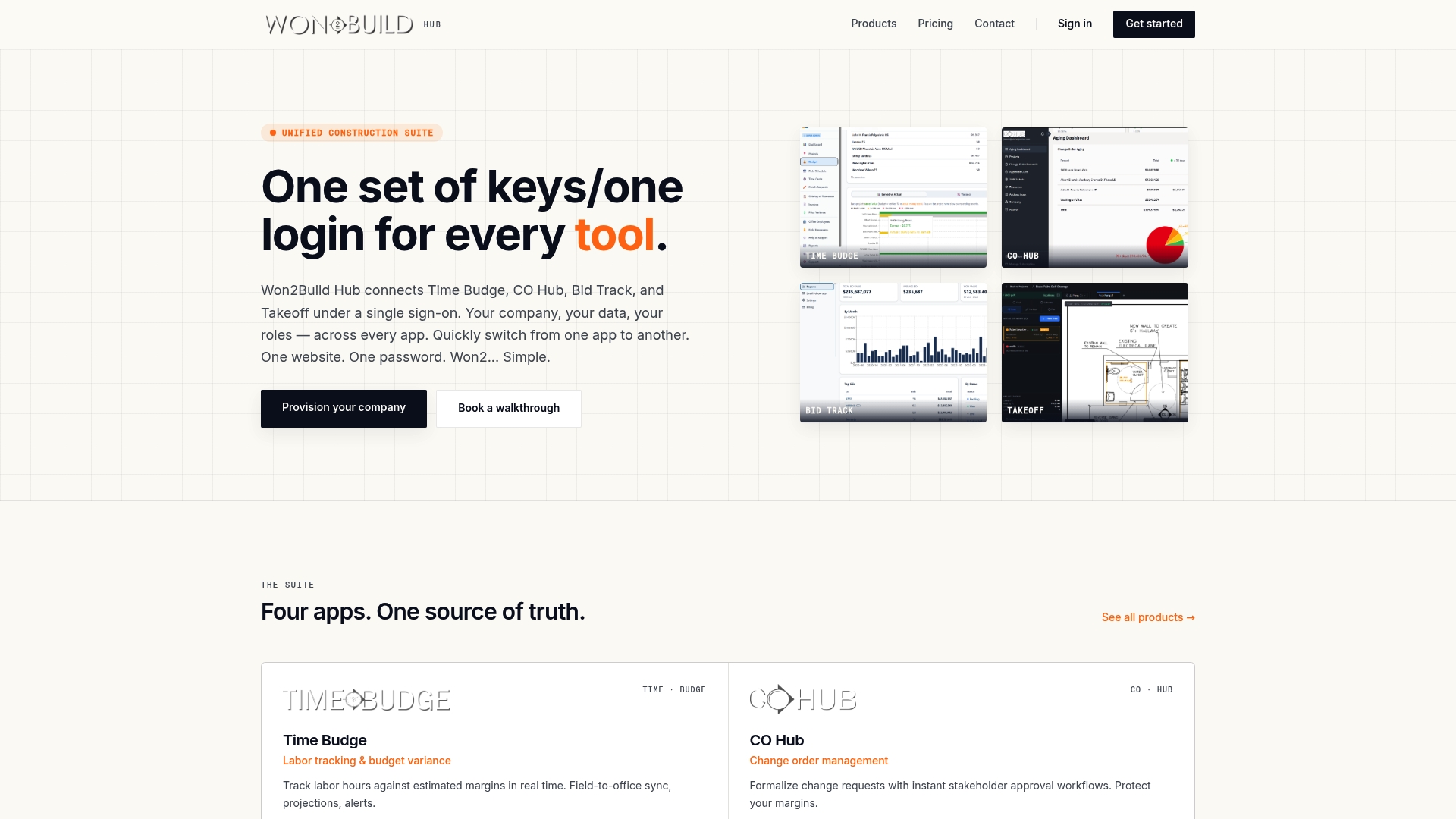
Bid Track connects directly with Won2build’s other tools, including CO Hub for change order management, so your bid data flows into project execution without re-entry. Subcontractors using Bid Track gain real-time pipeline visibility, faster follow-up, and a documented pricing record that supports stronger GC negotiations. If you are ready to turn your bid history into a competitive advantage, Bid Track is where that process starts.
FAQ
What is bid history for commercial subcontractors?
Bid history is a structured record of every bid a subcontractor has submitted, including project details, pricing, GC contacts, and outcomes. It functions as a strategic database for improving future bidding decisions.
How does bid history improve win rates?
Subcontractors with tracked bid history and established GC relationships achieve 40–50% win rates compared to 10–15% on cold bids. The record enables data-driven pricing and consistent follow-up that GCs respond to.
Why do GCs care about a subcontractor’s bid history?
71% of GCs rank past performance as their top selection factor. A documented bid history gives subcontractors the evidence to demonstrate reliability, pricing consistency, and professional follow-up.
Should I track bids I lose, not just the ones I win?
Tracking lost bids is more valuable than tracking wins alone. Loss reasons reveal whether pricing, scope, timing, or relationships drove the outcome, and that detail directly improves your next go/no-bid decision.
How many bids can a digital bid tracking system handle?
Structured bid logs support managing 20–40 active bids simultaneously while maintaining competitive win rates. Manual spreadsheets cannot match that volume without significant errors and missed follow-ups.
Recommended
One login for estimating, bid tracking, change orders, and labor.
The Hub is free. Pay only for the apps you turn on.
Create your free Hub account- Managers: Make Mobile Field Workflows Resilient for 72 Hour OutagesPlaybook for field managers: offline first mobile workflows, resilient sync and conflict handling, compliance first AI guardrails, and practical pilot steps.
- Daily Signed Records: Force Account Tracking for Managers & InspectorsField checklist for project managers and inspectors to keep force account tracking audit-ready: use daily signed records for labor, equipment, and...
- Stop Timecard to Report Drift: Labor Cost Codes for SubcontractorsFix the timecard to report chain with labor cost codes that tie crews to budgets. Includes a 6 code starter and a burdened rate example.