
Why Commercial Subcontractors Track Bid Win Rates
Discover why commercial subcontractors track bid win rates. Learn how this key metric improves competitiveness and optimizes bidding strategies.

Bid win rate is defined as the percentage of submitted bids that result in awarded contracts. Commercial subcontractors track bid win rates because this single metric reveals whether their pricing is competitive, their targeting is accurate, and their estimating resources are being used well. Without it, you are spending real money preparing bids with no way to measure whether that effort is paying off. Tools like Won2build’s Bid Track, MeltPlan, and Tribble exist specifically to close that gap. The industry term for this metric is “win ratio,” and it sits at the center of any serious bid analytics program.
Why commercial subcontractors track bid win rates
Tracking bid success tells you more than whether you won or lost. It tells you why. A subcontractor submitting 40 bids per year and winning 6 has a 15% win ratio. That number alone says very little. The real question is whether those 6 wins came from competitive open bids or from preferred general contractor relationships where you were practically guaranteed the work.
Blending preferred GC wins with competitive bid wins distorts your aggregate win rate and leads to false conclusions about your pricing and estimating health. If 4 of those 6 wins were relationship awards, your true competitive win rate is closer to 5%. That is a pricing or fit problem, not a volume problem.
The importance of bid win rates becomes clear when you separate signal from noise. A segmented win rate analysis by project type, client, delivery method, and bid source shows exactly where your estimating effort is generating returns and where it is being wasted. Construction CFO recommends maintaining separate baselines for competitive bids and relationship bids to prevent misdiagnosis.

Pro Tip: Set up at least three win rate buckets from day one: negotiated work, invited competitive bids, and open competitive bids. Each bucket has a different expected win rate, and mixing them produces a number that is useless for decision making.
Segmentation benchmarks by bid type
| Bid type | Typical win rate range | Primary diagnostic use |
|---|---|---|
| Negotiated or preferred GC | 50–80% | Relationship health check |
| Invited competitive bid | 25–40% | Estimating accuracy |
| Open competitive bid | 10–20% | Pricing and market fit |
| Public sector / hard bid | 8–15% | Overhead and cost structure |
Win rates vary significantly by trade and market. Benchmarking your competitive bids against your specific trade is the only way to diagnose a real pricing or overhead problem correctly.
Does win rate alone protect your profit margins?
Tracking bid wins without connecting them to job costs is like counting touchdowns without checking the score. A high win rate built on underpriced bids destroys margins faster than losing bids does.
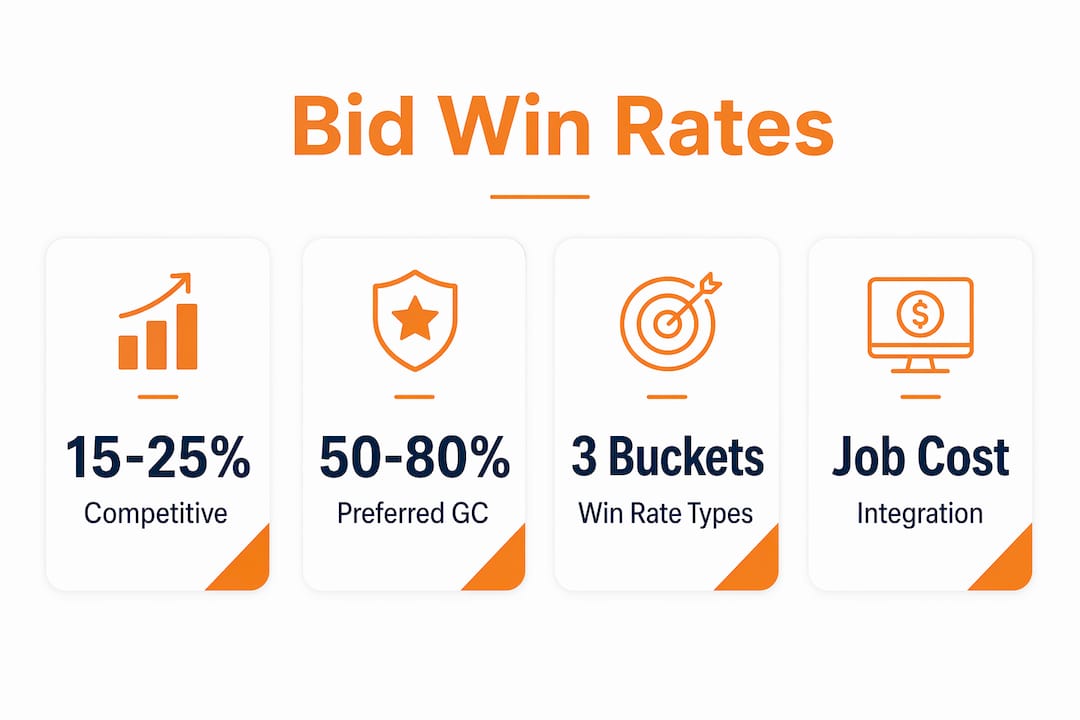
Job costing is the financial discipline that closes the loop between bidding success and actual profitability. It provides visibility into cost performance during construction, not just at project closeout. That timing matters. Catching a labor overrun in week 3 gives you options. Finding it at closeout gives you a lesson.
The connection between bid tracking and job costing works like this:
- Estimate-to-actual variance shows whether your bid assumptions were accurate. Consistent overruns in a specific trade or scope signal a systemic estimating problem.
- Real-time cost visibility during execution lets project managers flag margin erosion before it becomes unrecoverable.
- Post-project feedback loops feed corrected cost data back into future bid templates, improving accuracy over time.
- Overhead allocation accuracy reveals whether your markup covers actual indirect costs or just direct labor and materials.
Refining bids with job cost monitoring prevents margin erosion during project execution. Without this connection, a strong win rate becomes a vanity metric. You are winning work and losing money at the same time.
Pro Tip: After each project closes, compare your original bid breakdown line by line against actual costs. Flag any category where actuals exceeded the estimate by more than 10%. That category is your next estimating calibration target.
Improving commercial bid accuracy requires this kind of feedback loop. Subcontractors who skip it tend to repeat the same estimating errors across multiple projects before the pattern becomes obvious.
How does win rate tracking improve bidding selectivity?
Bid selectivity is the practice of choosing which opportunities to pursue based on your realistic probability of winning at a profitable margin. It directly affects how much estimating capacity you burn and how much revenue you actually close.
Win rates below 15–20% on competitive bids often signal a misalignment between your cost structure and the market. Win rates above 40% on competitive bids can signal underpricing or insufficient overhead recovery. Both extremes are problems worth diagnosing.
A go/no-bid scoring matrix is the most reliable tool for improving selectivity. ConstructConnect’s bid/no-bid calculator is one widely used example. The matrix scores each opportunity before you commit estimating hours to it. A consistent scoring process reduces wasted effort and focuses your team on bids where you have a genuine competitive edge.
A practical bid evaluation sequence looks like this:
- Screen for fit. Does the project type, size, and location match your core capabilities? If not, score it low and move on.
- Assess the client relationship. Have you worked with this GC or owner before? Relationship history improves win probability.
- Evaluate the competition. How many subcontractors are likely bidding? More bidders mean lower win probability and tighter margins.
- Check estimating capacity. Do you have the bandwidth to prepare a quality bid by the due date? A rushed bid is usually a losing bid.
- Score and decide. Use a consistent numeric scoring system so your go/no-bid decisions are comparable over time.
Win rate influences related KPIs like average tender value, proposal turnaround time, and cost-to-bid ratio. Monitoring these together gives you a complete picture of bidding efficiency. Win rate viewed in isolation tells you the outcome. The supporting KPIs tell you the cause.
What does a reliable bid tracking system look like?
The foundation of any bid analytics program is clean, consistent data. Most subcontractors underestimate how much their win rate calculations are distorted by incomplete records.
Consistent data capture across all pipeline stages matters more than the specific software you use. A well-maintained spreadsheet outperforms a poorly maintained platform every time. The key is discipline, not technology.
Every bid log entry should capture these fields:
- Bid due date and the date you actually submitted
- Bid/no-bid decision and the reason for it
- Bid owner (which estimator prepared it)
- Submitted amount and your target margin
- Award result (won, lost, pending, no-award)
- Loss reason when available (price, scope, relationship, timing)
The loss reason field is the most underused and most valuable. Knowing you lost 12 bids on price in a single quarter tells you something specific about your cost structure or markup. Knowing you lost 8 bids because the project was awarded to a preferred sub tells you to stop pursuing that GC’s open bids.
Tracking multiple bids simultaneously requires a system that updates in real time as bid status changes. Stale pipeline data produces win rate calculations that lag reality by weeks. That lag makes the metric useless for near-term decisions.
Won2build’s Bid Track is built specifically for this workflow. It captures bid data, tracks pipeline stages, and produces win rate reports without requiring manual reconciliation between separate tools.
Key Takeaways
Segmented bid win rate analysis, combined with job costing integration, is the most reliable method commercial subcontractors have for protecting margins and bidding smarter.
| Point | Details |
|---|---|
| Segment your win rates | Separate competitive bids from relationship awards to get an accurate read on pricing health. |
| Connect bids to job costs | Track estimate-to-actual variance on every project to catch margin erosion early. |
| Use a go/no-bid matrix | Score every opportunity before committing estimating hours to reduce wasted effort. |
| Log loss reasons consistently | Capturing why you lost reveals patterns that aggregate win rates never show. |
| Monitor supporting KPIs | Track turnaround time and cost-to-bid alongside win rate for a complete picture. |
The metric most subcontractors are reading wrong
I have worked with estimating teams that were proud of a 35% win rate. On the surface, that sounds solid. But when I asked them to pull out the negotiated work and the repeat-client awards, the competitive win rate dropped to 11%. They were not winning in the market. They were winning with their existing relationships and calling it performance.
The uncomfortable truth about bid analytics is that most subcontractors are measuring the wrong number. They track total wins divided by total bids and stop there. That calculation tells you almost nothing useful. Separating event-based outcomes from process metrics is what actually identifies the internal cause of losses. Are you losing because your price is too high? Because your proposals are slow? Because you are chasing the wrong GCs? Each cause has a different fix, and you cannot find it in an aggregate number.
The other mistake I see constantly is treating win rate as a bidding metric rather than a profitability metric. Winning a bid at a margin that evaporates during execution is not a win. It is a slow loss. The subcontractors who grow consistently are the ones who have closed the loop between their bid log and their job cost reports. They know which project types they price accurately and which ones they consistently underestimate. That knowledge is worth more than any single contract award.
My advice: start with segmentation, add job costing integration, and build the habit of reviewing your loss reasons every quarter. The pattern will become obvious within two or three review cycles.
— Jen Reese
Won2build Bid Track: built for subcontractor bid analytics
Commercial subcontractors who want to move from gut-feel bidding to data-driven decisions need a system that captures bid data, tracks pipeline stages, and connects outcomes to cost performance.
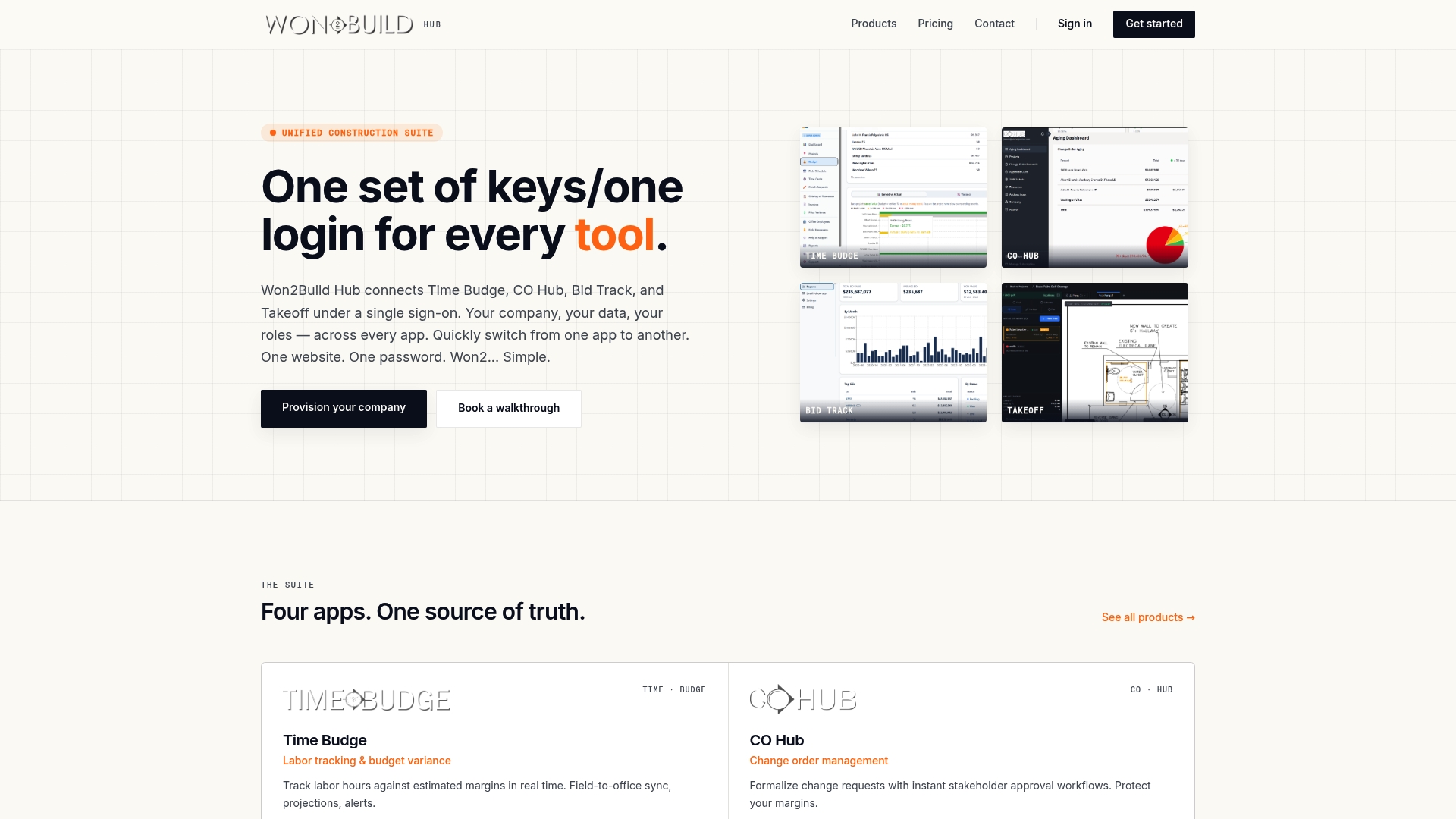
Won2build’s Bid Track software does exactly that. It is designed for subcontractors who need to track bid outcomes, analyze win rates by segment, and feed results back into estimating decisions. Bid Track integrates with Won2build’s other tools, including CO Hub for change order management, so the data you capture during bidding stays connected through project execution. If you are ready to replace a fragmented spreadsheet system with a purpose-built pipeline tool, Won2build is worth a close look.
FAQ
What is a good bid win rate for commercial subcontractors?
A competitive bid win rate of 15–25% is generally considered healthy for open competitive bids in commercial subcontracting. Rates below 15% often signal a pricing or fit problem, while rates above 40% on competitive work may indicate underpricing.
Why does segmenting win rates matter more than tracking the overall number?
Aggregate win rates blend preferred relationship wins with competitive wins, which distorts the picture of your true market competitiveness. Segmenting by bid type reveals where your estimating effort is actually generating returns.
How does job costing connect to bid win rate tracking?
Job costing provides visibility into actual project costs during execution, not just at closeout. Comparing actuals to your original bid assumptions shows whether your pricing was accurate and feeds better data into future estimates.
What data fields should every bid log include?
Every entry should capture the bid due date, submission date, bid owner, submitted amount, award result, and loss reason. Consistent data capture across all pipeline stages is more important than the software platform you choose.
What is a go/no-bid matrix and why does it improve win rates?
A go/no-bid matrix is a scoring tool that evaluates each opportunity against criteria like project fit, client relationship, competition level, and estimating capacity before you commit resources. Using a consistent scoring matrix reduces wasted estimating effort and focuses your team on bids with the highest probability of a profitable win.
Recommended
One login for estimating, bid tracking, change orders, and labor.
The Hub is free. Pay only for the apps you turn on.
Create your free Hub account- 7 Concrete Takeoff Steps Estimators Use to Avoid Ordering ShortfallsFollow seven concrete takeoff steps to calculate cubic yards, size rebar and formwork, convert volumes to supplier units, and verify quantities before bid...
- Are E-Signature Change Orders Legal and Worth the Switch?E-signature change orders streamline your workflow, ensuring faster approvals, fewer disputes, and quicker invoicing—discover the benefits now!
- How to Link Takeoff to Estimate for Accurate BidsLink your takeoff quantities to your estimate for accurate bids. Discover the seamless integration method that reduces errors and saves time.