
Protect Margin With a Six Stage Change Order Workflow for Subcontractors
Six stage change order workflow for subcontractors: itemized pricing, approval routing, electronic signatures, and an audit ready trail.

A compliant change order workflow always produces three things: documented scope, cost, and time changes; a clear approval trail; and an auditable closeout that ties back to invoicing. Skip any of those, and you have paperwork, not a process. The stages below turn that requirement into a repeatable system, with the software practices that make it defensible under audit.
TL;DR:
- A six-stage repeatable change order workflow ensures proper documentation, approval, and closeout, with each stage having clear ownership and specific outputs.
- Enforceable change orders must include scope change, cost adjustment, and time shift, with signature sequences following established standards like AIA G701 or ConsensusDocs 795.
- Proper approval routing uses defined status steps such as Draft, Interim Approval, Approval, Scheduled, and Completed, with automation supporting timely sign-offs.
- Sending approved change orders to field teams requires immediate notification, updated drawings, proper schedule adjustments, and written acknowledgments for high-value scope changes.
- Software like CO Hub automates ID assignment, document attachments, routing, e-signatures, and audit trails to prevent skipping steps and ensure compliance and enforceability.
Table of Contents
- What Is a Change Order Workflow, and Why Does It Need Six Stages?
- What Documents Make a Change Order Legally Enforceable?
- How Should You Structure Change Order Approval Routing?
- How Do You Get an Approved Change Order Into the Field?
- How Do You Close Out and Invoice a Change Order?
- How Does Software Enforce a Repeatable Change Order Workflow?
- What Standard Forms Should You Use for Change Order Documentation?
- How Software Enforces the Change Order Workflow Step by Step
- What Are the Timeline and Notice Requirements for Change Orders?
- Why Subcontractors Should Own Their Change Order Workflow
- How CO Hub Fits Into Your Change Order Workflow
- Sources
- FAQ
What Is a Change Order Workflow, and Why Does It Need Six Stages?
A construction change order process breaks down into six repeatable stages: identification, documentation and pricing, internal review, client presentation and approval, execution and communication, and closeout. Each stage has an owner, defined inputs, and a specific output, which is what turns a one-off scramble into an SOP your whole team can run on every project.
- Identification. A field lead or PM flags the trigger, usually a request for information (RFI), a purchase requisition (PR), a constructive change directive (CCD), or a change order request (COR). Log the trigger date, source document, and a one-line description immediately, before memory fades.
- Documentation and pricing. The estimator or PM builds itemized labor, material, and equipment costs and attaches backup like vendor quotes or timecards. The common failure here is vague scope language; fix it by requiring a line-item breakdown before the CO leaves draft status.
- Internal review. A project executive or controller checks margin and contract compliance. Skipping this step is how underpriced COs slip through, so require a second signature before external submission.
- Client presentation and approval. The PM presents the priced CO to the owner or general contractor for signature. Delays often happen because backup documents are missing, so bundle everything into one packet.
- Execution and communication. Once approved, the change routes to the field with updated drawings and work orders.
- Closeout. Finance reconciles the CO against actual costs and rolls it into invoicing and the project log.
Pro Tip: Assign one person as the “CO gatekeeper” for each project. When every stage funnels through a single accountable reviewer, you catch missing signatures and underpriced line items before they cost you.
What Documents Make a Change Order Legally Enforceable?
An enforceable change order needs three specific elements under AIA A201 guidance: the change in the work, the adjustment to the contract sum, and the adjustment to the contract time. Miss one, and the document may not hold up as a binding modification to the contract.
- Scope description, stating exactly what work changes.
- Contract sum adjustment, the dollar amount added or subtracted.
- Contract time adjustment, stating whether the schedule shifts.
- Signature sequence: the architect typically prepares the AIA G701 form, then the owner, contractor, and architect sign in that order.
Subcontractors working outside AIA-governed projects often use ConsensusDocs 795 subcontract change order templates instead, which follow a similar structure but skip the architect signature step.
A Construction Change Directive (CCD) is different: it directs work to start immediately, without waiting on agreed pricing, and later converts into a formal change order once cost and time are settled. Starting work without either document in hand is the single riskiest move a subcontractor can make. AIA contracts commonly require written notice of a claim within 21 days of the event, and missing that window can forfeit your right to payment entirely.
How Should You Structure Change Order Approval Routing?
Approval routing fails when statuses are vague or approvers are unclear about what unlocks what. A workable status sequence looks like this: Draft → Interim Approval → Approval → Scheduled → Completed, and each status should gate a specific action rather than just describing a mood.
- Draft blocks field work and invoicing until pricing is complete.
- Interim Approval allows provisional field work to start on urgent items while final pricing is negotiated.
- Approval unlocks scheduling and formal notification to subs.
- Scheduled confirms the change is in the active work plan.
- Completed locks the record for invoicing and closeout.
Assign approvers by rule (project value thresholds, cost codes) rather than by manual selection whenever you can. Enterprise platforms increasingly support one-of-group approvals and optional approver logic, which cuts bottlenecks without loosening authorization controls. Before submission, run a checklist: complete scope description, itemized pricing, attached backup, and correct approver assignment.
Pro Tip: Set a 48 hour reminder cadence for pending approvals and escalate automatically after 72 hours. A change order that sits untouched for a week almost always means someone forgot it existed, not that it needs more thought.
How Do You Get an Approved Change Order Into the Field?
Approval on paper means nothing until the field knows about it. Build a notification matrix that specifies who gets told, through what channel, and how fast.
- Notify the affected subs through mobile alerts or an updated work order the same day approval clears.
- Update drawings and tag the change so field crews see the current version, not last week’s set.
- Update the master schedule to reflect any time adjustment from the CO.
- Require written acknowledgment from the sub or foreman for anything above a set dollar threshold, so there is a record someone actually saw it.
- Manage change lines carefully. If a scope item needs to move to a different CO, or gets canceled before the CO reaches Completed status, log the change with a timestamp rather than silently deleting it.
Losing this link between approval and field execution is where most rework claims actually originate.
How Do You Close Out and Invoice a Change Order?
Closeout is where the change order stops being a negotiation and becomes a financial record. Generate the invoice from the approved CO amount, typically folding it into the next progress billing cycle rather than issuing a separate invoice, unless the owner’s contract terms require otherwise.
Keep a change order log with these minimum fields for every entry: cause, cost, time impact, approval dates, supporting attachments, and close date.
| Log field | Why it matters |
|---|---|
| Cause code | Groups COs by root cause for future estimating |
| Cost delta | Tracks margin impact per change |
| Time delta | Feeds schedule risk analysis |
| Approval trail | Supports audit and dispute defense |
| Close date | Confirms the CO is locked for invoicing |
Closed COs are a data asset, not just paperwork. Teams that keep this log consistent feed it back into estimate calibration and profitability analysis, catching the same underpriced scope items before they repeat on the next bid.
How Does Software Enforce a Repeatable Change Order Workflow?
Standards tell you what a change order needs. Software is what actually stops someone from skipping a step. A platform enforcing this workflow typically assigns a unique ID to every CO, requires attachments before allowing a status change, applies routing rules based on cost thresholds, and captures e-signatures with a timestamped audit trail.
- Unique ID and logging prevent duplicate or orphaned change requests.
- Attachment requirements block submission until backup documentation exists.
- Routing rules enforce the approval sequence automatically instead of relying on someone remembering to forward an email.
- E-signature capture creates the same enforceability as a wet signature, provided delegation-of-authority rules are followed, a point state DOT guidance now explicitly recognizes.
- Audit trail timestamps every status change, which is exactly what you need if a dispute reaches litigation.
Won2Build’s CO Hub is built around this same six-stage logic, pairing routing rules with e-signature capture so the workflow enforces itself rather than depending on memory.
Following AIA and state DOT documentation standards, paired with a 75% milestone sign-off checkpoint and a strict 21-day claim notice SOP, closes most of the gaps that turn change orders into disputes.
What Standard Forms Should You Use for Change Order Documentation?
Two form families dominate change order documentation, and picking the wrong one for the relationship creates friction later. AIA G701 is the standard used on projects governed by AIA A201 general conditions, and it requires the architect to prepare the form before routing it for owner and contractor signature. It works well when an architect is actively administering the contract and needs to certify the scope change themselves.
ConsensusDocs takes a different approach. The ConsensusDocs 795 standard subcontract change order is built for the subcontractor to general contractor relationship directly, without requiring an architect signature step. Most subcontractors working design build or negotiated contracts find this format faster to route, simply because there is one fewer required party in the signature chain.
Whichever form you use, the document needs the same three elements: scope, contract sum adjustment, and contract time adjustment. What changes between the two forms is mainly signature routing and who holds authority to certify the change.
Where teams get into trouble is mixing formats mid-project, using a G701 on one CO and an internal template on the next. That inconsistency makes your change order log harder to audit and gives an opposing party an easy argument that your documentation practices were sloppy if a dispute reaches arbitration. Pick one standard form per contract relationship at kickoff, and stick with it through closeout. If you’re managing subcontract relationships across multiple general contractors, keep a reference copy of each required form on hand, since GCs frequently specify their preferred template in the subcontract agreement itself.

How Software Enforces the Change Order Workflow Step by Step
Logging is the first enforcement layer. Every change order needs a unique identifier the moment it is created, tied to a specific project and cost code, so nothing gets lost in an inbox or a shared drive folder. Manual systems fail here constantly, because a CO started in an email thread has no ID until someone remembers to create one in a spreadsheet, usually days later.
Notifications close the second gap. When a change order status shifts, from Draft to Interim Approval, for instance, the system should automatically alert the next person in the chain rather than waiting for someone to forward it. This is where most delays in state DOT change order processing actually originate: not disagreement over price, but a document sitting untouched in someone’s queue.
E-signatures replace the wet-ink signature requirement without weakening enforceability, as long as delegation-of-authority rules are followed correctly. That means the system needs to confirm the signer actually holds authority to approve at that dollar threshold, not just that someone with system access clicked a button.
The audit trail ties it together. Every status change, every attachment upload, every signature gets a timestamp and a user ID attached to it permanently. If a change order ends up disputed months later, that trail is what proves the scope was approved before work started, not after. Software like Won2Build’s CO Hub builds all four of these enforcement layers into the six-stage structure directly, which is a meaningfully different experience than trying to replicate the same discipline across email threads and shared spreadsheets.

What Are the Timeline and Notice Requirements for Change Orders?
Timing matters as much as documentation, and the biggest risk in most change order disputes is not price disagreement but a missed notice deadline. AIA contracts commonly require written notice of a claim within 21 days of the event that caused it. Miss that window, and you can lose the right to recover costs even when the underlying claim is legitimate.
Realistic timeline expectations vary by owner type. On public agency work, state DOT guidance calls for timely processing paired with price justification documentation and funding coordination before a change order can move forward, which often extends the approval window compared to private commercial work. Private owners with fewer bureaucratic layers can often turn around a straightforward CO in a few business days if pricing backup is complete on submission.
Signature sequencing also affects your timeline. Under AIA practice, the architect typically prepares the G701 form first, then routes it for owner and contractor signature in sequence. A ConsensusDocs subcontract change order skips that architect step, which is usually the single reason it moves faster through approval.
Set an internal target of same-day notification to the field once a change order reaches Approved status, and treat the 21-day claim notice window as a hard deadline your team tracks the same way you’d track a bid due date, not a soft guideline. Industry commentary from groups like AGC has repeatedly flagged delayed CO processing as a direct driver of contractor cash flow problems, which is exactly the outcome a disciplined timeline is meant to prevent.
Why Subcontractors Should Own Their Change Order Workflow
Subcontractors who treat change order management as the GC’s problem end up absorbing the cash flow gap themselves. Every day a CO sits unsigned is a day your crew worked for free on paper. Owning the workflow, even just standardizing one project’s CO log before rolling it out company wide, is how you protect margin instead of hoping the general contractor’s paperwork catches up eventually.
— Jen Reese
How CO Hub Fits Into Your Change Order Workflow
You’ve just read what a compliant six-stage change order process actually requires: itemized pricing, routing rules, e-signatures, and an audit trail that survives a dispute. CO Hub was built around that exact structure, letting you log a change order with a unique ID, attach pricing backup, route it through interim and final approval, and capture an e-signature the moment it’s approved. Every status change lands in the same audit trail finance needs at closeout, and approved COs flow straight into invoicing without re-keying numbers into a separate system.
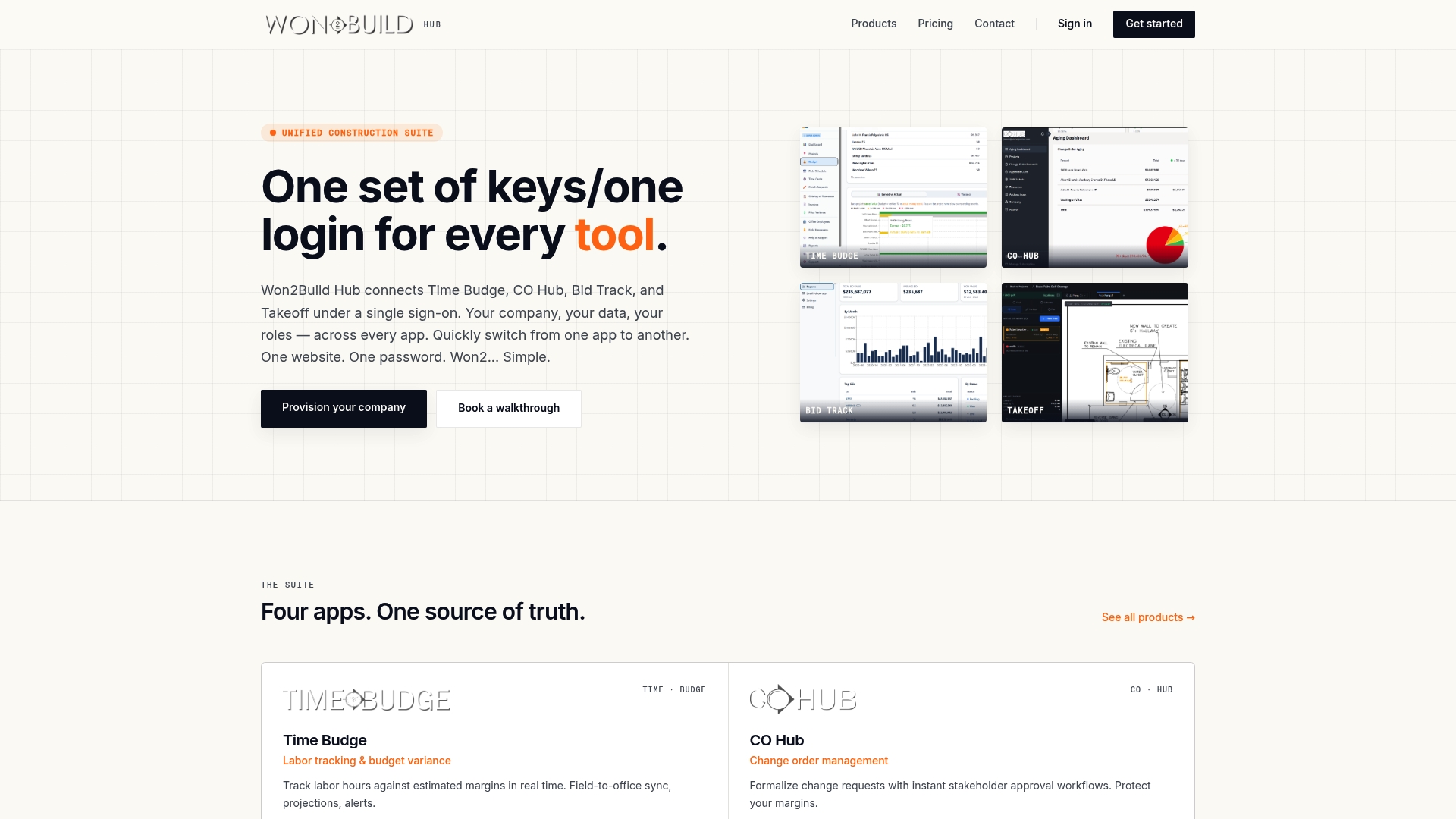
CO Hub runs $59 per month per company, with a small per-active-field-worker fee on top for team members using the mobile app. If you’re running Time Budge or Bid Track already, the same login carries across every Won2Build tool, so change order data, labor tracking, and estimating stay in sync without double entry. Check current pricing and plans or start a trial to see how a real project’s change order log looks inside CO Hub.
Sources
- Construction Change Orders: Fundamentals, Process & Forms | AIA Contract Documents
- Section 1: Change Orders — TXDOT
- The Anatomy of a Repeatable Change Order Workflow — ConstructionOnline Blog
- Change Order Workflow — Oracle documentation
- ConsensusDocs standard subcontract change order
FAQ
What Is the Change Order Process?
The change order process is the sequence of steps that turns a scope change request into a signed, priced, and scheduled contract modification. It runs from identification through documentation, internal review, client approval, field execution, and closeout, following the six-stage structure covered in this article.
What Are the Five Steps of a Change Order Workflow?
Most frameworks actually use six stages rather than five: identification, documentation and pricing, internal review, client approval, execution, and closeout. Some simplified versions merge internal review into documentation, producing a five-step version of the same underlying repeatable workflow.
What Is the Difference Between an RFI and a Change Order?
A request for information (RFI) asks a question about design intent or an unclear spec, and it does not by itself authorize any cost or schedule change. A change order is the signed document that actually adjusts the contract sum and contract time, and it often gets triggered by an RFI response revealing a scope gap.
What Is an SCO in Construction?
SCO typically stands for Subcontract Change Order, a change order issued specifically between a general contractor and a subcontractor rather than between the owner and the prime contractor. These often follow a ConsensusDocs 795 template rather than the AIA G701 form used at the owner level.
Does CO Hub Support E-Signatures and Approval Routing?
Yes, CO Hub includes e-signature capture and configurable approval routing as part of its core change order management features. Pricing for CO Hub is $59 per month per company, plus a per-active-field-worker fee for mobile app access.
Recommended
One login for estimating, bid tracking, change orders, and labor.
The Hub is free. Pay only for the apps you turn on.
Create your free Hub account- Managers: Make Mobile Field Workflows Resilient for 72 Hour OutagesPlaybook for field managers: offline first mobile workflows, resilient sync and conflict handling, compliance first AI guardrails, and practical pilot steps.
- Daily Signed Records: Force Account Tracking for Managers & InspectorsField checklist for project managers and inspectors to keep force account tracking audit-ready: use daily signed records for labor, equipment, and...
- Stop Timecard to Report Drift: Labor Cost Codes for SubcontractorsFix the timecard to report chain with labor cost codes that tie crews to budgets. Includes a 6 code starter and a burdened rate example.