
Daily Signed Records: Force Account Tracking for Managers & Inspectors
Field checklist for project managers and inspectors to keep force account tracking audit-ready: use daily signed records for labor, equipment, and...

Every force-account claim rises or falls on one thing: daily, signed records for labor, equipment, and materials, cross-referenced to the change order and verified by both the inspector and contractor foreman before the day ends. Skip that step and the paperwork problem becomes a payment problem. The final change-order package needs weekly summaries plus payroll and equipment-rate backup behind every hour and every invoice.
TL;DR:
- Force account should only be used when no contract unit price exists, negotiations fail, or the scope cannot be estimated in advance, especially on federally funded projects requiring formal approvals.
- Daily records must be signed by both inspector and foreman, and include detailed information on labor hours, equipment usage, and materials, with supporting documentation and photographs to ensure verifiability.
- Equipment costs should be based on actual contractor records whenever available; if not, validated schedules like EquipmentWatch can be used, but equipment identification must be precise to prevent delays or rejections.
- Reconciliation of daily records, invoices, and rate sheets must be thorough, with consistent identifiers and documented proof of materials installation to avoid common claims rejections.
- Integrated digital systems and disciplined procedures, including early validation and clear folder organization, significantly reduce administrative time and improve audit readiness.
Table of Contents
- When force account makes sense instead of a priced change order
- Daily tracking checklist: labor, equipment, and materials
- How to validate equipment rates and documentation
- Turning daily records into a defensible change-order package
- The forms and digital tools that keep records consistent
- Common mistakes that get force-account costs rejected
- How field-tested habits and integrated software cut admin time
- Legal and contractual considerations specific to force account tracking
- Handling disputed force account claims and resolution processes
- Why the daily record is a risk-management tool, not paperwork
- How Won2Build keeps force-account records audit-ready
- Sources
- FAQ
When force account makes sense instead of a priced change order
Force account is the fallback method, not the default one. It applies when three conditions line up: there’s no contract unit price that fits the work, the owner and contractor can’t agree on a lump-sum or unit price for the extra work, or nobody can reasonably estimate the total scope before the work starts. When any of those apply, tracking actual costs as the work happens becomes the only workable path to fair payment.
There’s an important distinction between a force account estimate (FE) and a force account with actual costs (FA). An FE is used to support progress payments while the work is ongoing and total costs are still unknown, essentially a running projection based on the best available data. The FA figure, built from verified daily records, is what settles final payment. Using an FE early keeps cash flowing to the contractor without waiting for the job to wrap, but the final reconciliation always has to trace back to actual documented costs, not the estimate.
For federally funded work, the rules tighten. Agency force account, where a public agency performs the work itself rather than through a contractor, requires a cost-effectiveness determination and formal approval under FHWA Directive 5060.2, which also draws the line between “agency force account” and “contract force account.” Locally funded projects without federal dollars attached have more flexibility, but the same discipline pays off: an owner who can’t produce daily verification records has a much weaker position in any later dispute.
Before directing force-account work, confirm:
- No applicable unit price exists in the contract for the work in question.
- The contractor and owner have tried and failed to agree on a negotiated price.
- The scope or duration of the work can’t be reasonably estimated in advance.
- For federally funded projects, any required cost-effectiveness or approval steps are documented before work begins.
Daily tracking checklist: labor, equipment, and materials
The daily record is the backbone of every force-account claim. FHWA’s companion resource describes contractor force account tracking sheets that capture labor, equipment, and materials, with agencies expected to check contractor invoices against inspector records before releasing payment. Here’s what that looks like in practice, broken down by category.
- Labor. Record each worker’s name, trade classification, and exact hours worked, rounded to the nearest half hour. Cross-check hours against certified payroll or a payroll tracking platform, and keep evidence of fringe benefits or per-diem amounts claimed. Any overtime needs a stated reason, not just a number on the sheet.
- Equipment. Log a unique equipment ID for every machine on site, along with make, model, year, and capacity. Separate operating hours from standby hours, since they’re often billed differently, and note the rate source, whether that’s a Blue Book category or a rental invoice.
- Materials. Assign a material ID (M-1, M-2, and so on) to each item, and tie it to a delivery ticket number and supplier invoice. Record the quantity actually used, where it was incorporated into the work, and attach any required certification.
- End-of-day agreement. Before the crew leaves, the inspector and contractor foreman should both initial the daily record and note a short description of what was accomplished. Photos of installed work or delivered material add weight if the claim is ever questioned later.
The equipment and materials fields matter more than they look. An inspector who writes “excavator, 4 hours” instead of “Cat 320 excavator, ID E-14, 4 hours operating” has created a record that’s much harder to defend if a reviewer later asks which rate applies. The same goes for materials: a delivery ticket without a location of incorporation doesn’t prove the material got installed, it only proves it arrived on site, as detailed in as-built verification methods for construction teams.
Pro Tip: Keep a single running log per force-account item rather than scattering entries across multiple daily reports. It cuts reconciliation time in half when the CO package finally gets assembled.
Consistent daily habits also make labor tracking easier to defend downstream. A field guide to tracking labor hours on job sites walks through the same half-hour rounding and cross-check principles that apply directly to force-account labor lines.
How to validate equipment rates and documentation
Equipment costs are where force-account claims most often run into trouble, mostly because inspectors default to a rate sheet without confirming it’s the right source. FAR 31.105 directs the use of actual contractor accounting records for equipment ownership and operating costs whenever those records are available. A predetermined schedule like EquipmentWatch (commonly called the Blue Book) is acceptable only when actual cost data isn’t available, and even then, unallowable cost elements have to be excluded before the rate is applied.
In practice, that means:
- Ask the contractor for actual equipment cost records before defaulting to a rate schedule.
- When using EquipmentWatch or Blue Book rates, confirm the rate category matches the equipment’s actual make, model, year, and capacity.
- Record operating and standby hours separately, and document whether the contract allows standby pay for idle equipment.
- For rented equipment, collect the rental invoice directly rather than estimating from a schedule.
Equipment identification precision is the single most common failure point in rate validation. Missing capacity or make/model details make it nearly impossible to match a machine to the correct Blue Book category, according to FAR 31.105 guidance on equipment cost documentation, which pushes reviewers back to owners for clarification and slows payment.
Rentals add another wrinkle. Some agencies accept the rental invoice as-is for reimbursement, while others require converting the rental rate to the equivalent Blue Book rate, particularly when the rental rate looks inflated relative to standard schedules. Confirming which approach the contract or agency spec book requires before the equipment shows up on site avoids a rewrite of the cost record later.

Turning daily records into a defensible change-order package
Reconciliation is where scattered daily paperwork either becomes an audit-ready package or falls apart. The process starts by cross-checking contractor daily records against certified payroll systems (LCPtracker is a common example), material invoices, and equipment rate sheets. Consistent ID conventions, M-1 for the first material item, E-1 for the first equipment item, make this step far faster because every reviewer can trace a cost from the daily sheet straight through to the invoice.
A complete force-account CO package typically includes:
| Attachment | Purpose |
|---|---|
| Signed daily reports | Inspector and contractor agreement on hours and quantities |
| Weekly summaries | Rolled-up totals for labor, equipment, and materials |
| Material invoices (M-IDs) | Proof of cost and traceability to delivered items |
| Equipment rate reports (E-IDs) | Rate source and hours by machine |
| Contractor invoices | Supporting documentation for rented equipment or subcontracted work |
| Force Account Summation | Final rolled-up cost summary for the change order |
The most common reasons a force-account claim gets kicked back are predictable: missing proof that materials were actually incorporated into the work, unallowable cost elements left in an equipment rate, and wage rates on the daily sheet that don’t match certified payroll. Materials are a particular trap. A delivery ticket by itself often isn’t enough; the daily record needs to tie the delivered material to a specific location in the work along with a contractor statement that it was installed, a point PennDOT’s material documentation guidance makes directly. Catching these gaps before submission, rather than after a reviewer flags them, is what separates a fast reconciliation from a stalled one. A structured project budget tracking setup makes this cross-checking step part of the normal weekly routine instead of a scramble at closeout.
The forms and digital tools that keep records consistent
Every state DOT names its force-account forms a little differently, but the categories are the same everywhere: a daily labor account, an equipment and materials account, a weekly recap, and a Force Account Summation for the final tally. Some states use specific form numbers (Form 316 and MURK forms are common examples), and most construction manuals set a dollar threshold below which invoices alone may be acceptable without the full force-account process. Finding the correct form starts with the state’s construction manual or the FHWA companion resource, not a generic template.
Digital e-ticketing has started replacing paper delivery tickets on many projects, and for good reason. Pilot programs summarized in FHWA’s e-construction guidance show that e-ticketing cuts transcription errors and gives real-time visibility into material quantities as they’re delivered. It has limits, though: spotty cell coverage on remote sites and inconsistent vendor compatibility mean some agencies keep paper tickets running in parallel during the transition.
Whichever format is used, a predictable folder structure saves time at closeout:
- Name files by force-account item number, then by date, so a reviewer can trace a week’s activity without hunting.
- Store weekly recaps and the Force Account Summation in the same folder as the daily records they summarize.
- Keep exported e-ticketing data alongside scanned paper backups for a full audit trail.
Pro Tip: Build the folder structure before the force-account work starts, not after. Retrofitting file names onto three weeks of scattered daily reports costs more time than it saves.
Common mistakes that get force-account costs rejected
Most rejected force-account claims trace back to a handful of repeat offenders, all preventable with a little discipline up front.
- Accepting unsigned or unverified daily entries instead of requiring inspector and foreman sign-off every day.
- Relying on contractor hourly lines without checking them against certified payroll or prevailing wage requirements first.
- Using inconsistent or missing ID conventions, which makes it nearly impossible to trace a material or equipment line back to its invoice.
- Applying markups to equipment or material costs before stripping out unallowable cost elements.
- Waiting until the change order is assembled to look for missing documentation, instead of catching gaps daily.
Each of these is a process fix, not a technology fix. A reviewer doesn’t care whether the record was kept on paper or in an app: they care whether it’s signed, traceable, and complete.
How field-tested habits and integrated software cut admin time
Assigning one primary inspector per force-account item and requiring a nightly reconciliation with the foreman is a small time investment that prevents much larger disputes later. The habit matters more than the tool, but the tool changes how fast that habit pays off.
- Field hour entries that flow directly into job-cost reports avoid the double entry that causes labor lines to drift from payroll records.
- Change order and T&M ticketing tools that timestamp and store signatures create the audit trail reviewers ask for without extra paperwork.
- Material and equipment IDs entered once in the field, rather than re-keyed in the office, reduce the transcription errors that trigger rejected claims.
Integrated systems that connect field data collection to office reporting shorten the gap between a day’s work and a submittable weekly summary, which is exactly the gap that causes most force-account delays.
Legal and contractual considerations specific to force account tracking
Force-account work sits inside the contract’s changes clause, and that clause typically spells out notice requirements, markup limits, and what documentation the owner can demand before paying. Missing a notice deadline, even by a day or two, can jeopardize an otherwise valid claim regardless of how well the daily records were kept.
Advance agreements matter here. Federal procurement guidance under FAR part 31 recommends settling unusual or disputed cost treatments in writing before the cost is incurred, rather than arguing about it after the work is done. The same logic applies on non-federal contracts: if there’s any question about whether a cost category is reimbursable, an emailed agreement between owner and contractor before the work starts is worth far more than a debate at closeout.
Wage compliance is a separate legal thread entirely. Certified payroll and prevailing wage rules apply to force-account labor the same way they apply to any other contract work, and a wage rate mismatch between the daily sheet and certified payroll is one of the most common reasons an owner’s reviewer sends a claim back. Confirming wage classifications match the work actually performed, not just the job title on the timesheet, prevents a clean cost record from unraveling under legal review.
Handling disputed force account claims and resolution processes
Disputes usually start the same way: the contractor’s total doesn’t match what the inspector’s daily records support. The first move is always back to the paper trail. Line up the contractor’s invoice against the signed daily reports, weekly summaries, and equipment or material IDs, and isolate exactly where the numbers diverge rather than disputing the total figure in general terms.
Most contracts include a formal claims or dispute resolution process, often starting with a request for additional documentation, moving to a negotiation between project management and the contractor, and escalating to mediation or arbitration only if those steps fail. Because force-account costs are, by definition, work without a pre-agreed price, disputes tend to center on rate validity (was the equipment rate sourced correctly) or scope (was the work actually within the force-account directive) more often than on the hours themselves.
The single best defense against a drawn-out dispute is the daily signature. When both the inspector and the foreman have initialed the same record each day, there’s very little left to argue about beyond rate interpretation. When that daily agreement is missing, even a well-documented total cost can get tied up for weeks while both sides reconstruct what actually happened.
Why the daily record is a risk-management tool, not paperwork
Treating the force-account record as an afterthought is the single most expensive habit in this line of work. Every signed daily sheet is a small, mutual agreement that protects both the owner and the contractor from a bigger argument later. The fix isn’t more paperwork, it’s better timing: initial the record before the crew leaves, not before the invoice is due.
— Jen Reese
How Won2Build keeps force-account records audit-ready
Force-account paperwork gets harder the more systems it’s split across. Won2Build connects the pieces: Time Budge captures field hours down to the day, CO Hub manages T&M tickets and change-order documentation, and Takeoff tracks material quantities and IDs from the plan set forward.
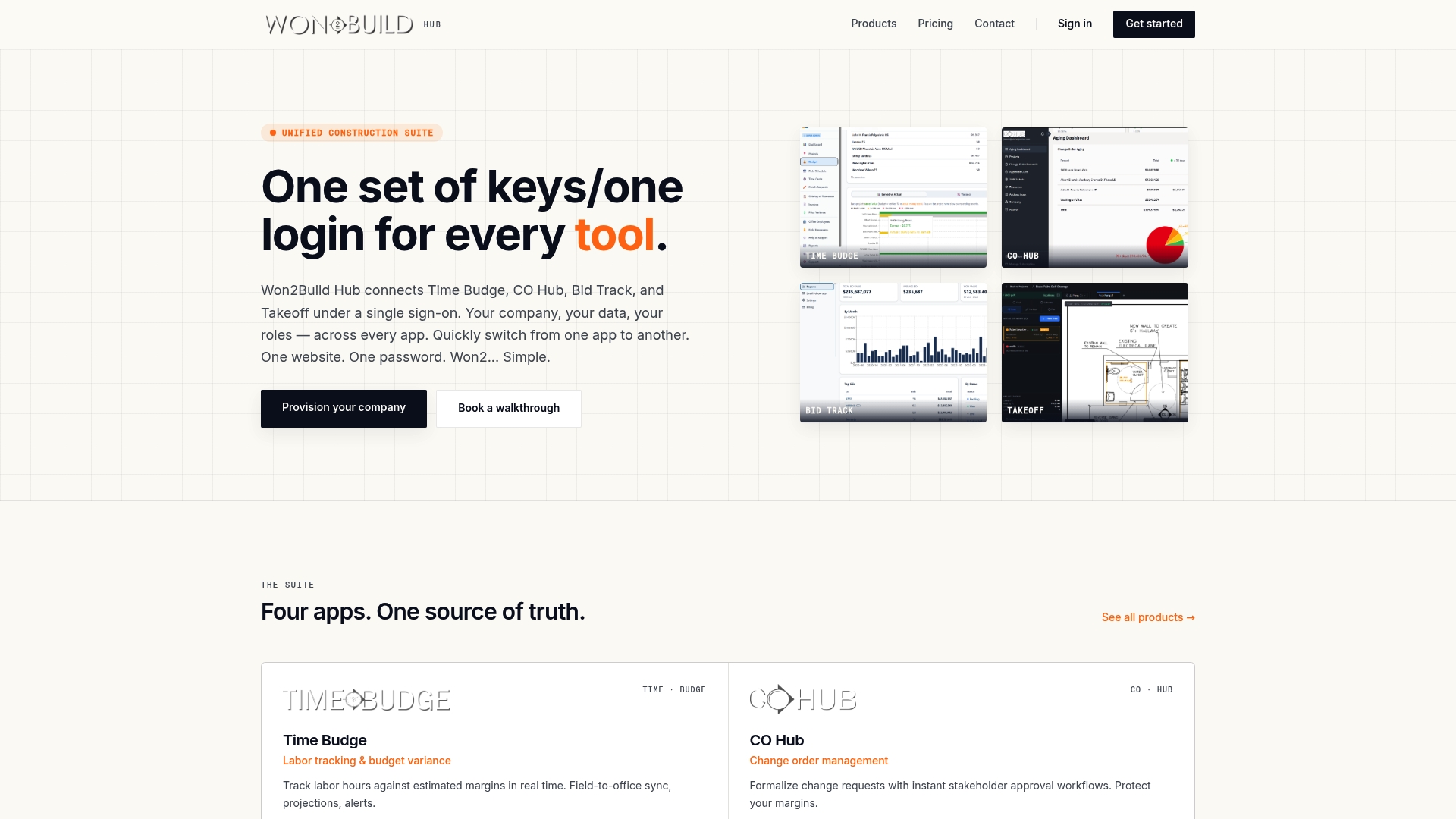
- Field hours logged in Time Budge flow directly into CO Hub without re-entry, keeping labor lines consistent with payroll.
- CO Hub’s ticketing produces the signed daily records and weekly recaps a reviewer expects to see in a force-account package.
- Takeoff’s material quantities carry the same IDs into CO Hub, so a delivery ticket and a change-order line always trace back to the same source.
Subcontractors managing force-account work across multiple crews can see pricing and plan details for Time Budge, CO Hub, and the rest of the suite, or start with a single module and add others as the workload grows.
Sources
FAQ
What records are required for force account tracking?
Force account tracking requires daily, signed records covering labor hours, equipment operating and standby time, and material quantities with supporting invoices. FHWA’s companion resource confirms that agencies must verify contractor invoices against these inspector records before payment.
When should a project use force account instead of a unit price?
Force account applies when there’s no contract unit price that fits the extra work, when the owner and contractor can’t agree on a negotiated price, or when the total scope can’t be reasonably estimated before work begins. Agency-performed force account on federally funded projects additionally requires a cost-effectiveness determination under FHWA Directive 5060.2.
What equipment rate source should be used for force account billing?
Actual contractor accounting records are the preferred source for equipment costs whenever they’re available. When those records aren’t available, FAR 31.105 permits using a predetermined schedule like EquipmentWatch or the Blue Book, after excluding any unallowable cost elements.
Who needs to sign off on daily force account records?
Both the project inspector and the contractor’s foreman should initial the daily record before the workday ends, confirming agreement on hours, equipment use, and materials. This daily sign-off is widely recommended as the strongest safeguard against later disputes over force-account totals.
What causes a force account claim to get rejected during audit?
The most common causes are missing proof that materials were actually incorporated into the work, unallowable cost elements left in an equipment rate, and wage rates that don’t match certified payroll. Checking each daily record against invoices and payroll before submitting the change-order package catches most of these issues early.
Recommended
One login for estimating, bid tracking, change orders, and labor.
The Hub is free. Pay only for the apps you turn on.
Create your free Hub account- Managers: Make Mobile Field Workflows Resilient for 72 Hour OutagesPlaybook for field managers: offline first mobile workflows, resilient sync and conflict handling, compliance first AI guardrails, and practical pilot steps.
- Stop Timecard to Report Drift: Labor Cost Codes for SubcontractorsFix the timecard to report chain with labor cost codes that tie crews to budgets. Includes a 6 code starter and a burdened rate example.
- Cut Clock In Errors: Bilingual Time Tracking for SubcontractorsField-tested advice for subcontractors on deploying bilingual time tracking that translates full workflows, reduces clock-in errors, and keeps audit logs...