
Cut Clock In Errors: Bilingual Time Tracking for Subcontractors
Field-tested advice for subcontractors on deploying bilingual time tracking that translates full workflows, reduces clock-in errors, and keeps audit logs...

The fastest way to cut clock-in errors and dispatcher headaches on a bilingual crew is to run a fully native bilingual time-tracking system, one that translates the entire workflow, not just the login screen. That means push notifications, cost-code menus, error messages, and audit logs all render correctly in a worker’s chosen language. This guide covers what “truly bilingual” means, why partial translations fail on real job sites, and how to test a system before you commit to it.
TL;DR:
- Fully bilingual systems must translate every screen, including error prompts, push notifications, audit logs, and messaging, not just the login page.
- Dialect and regional terminology variations require customizable translations to ensure accuracy and relevance for different crews.
- Partial translations or device-only language settings often lead to misunderstandings, mistakes, and missed communications on noisy, fast-moving job sites.
- A connected, integrated platform with single sign-on reduces translation discrepancies between applications, maintaining consistency across workflows.
- Rigorous testing with representative crew members, including low-literacy workers, is essential before deploying a fully bilingual time-tracking solution.
Table of Contents
- What “truly bilingual” time tracking means in the field
- Why simple translations fail on job sites
- Operational benefits: accuracy, compliance, and retention
- Implementation checklist: what to localize and test before deployment
- How to choose a bilingual time-tracking solution
- Won2Build perspective: why a single suite approach matters for bilingual field teams
- If you want a field-tested bilingual suite: how Won2Build addresses these needs
- Sources
- FAQ
What “truly bilingual” time tracking means in the field
A language toggle on the login page is not bilingual software. It is a translated welcome mat in front of an English-only house. Real bilingual time tracking extends the same language logic through every screen a worker touches during a shift, and every screen a manager or dispatcher touches when reviewing that worker’s data.
That coverage needs to include:
- Clock-in and clock-out flows, including confirmation messages and error prompts when a punch fails.
- Cost-code and task pickers, so a worker selecting a task sees labels in their own language, not abbreviated English codes.
- Push notifications, covering shift reminders, missed clock-out alerts, and schedule changes.
- Dispatcher-to-worker messaging, where a message sent in English should render in the worker’s preferred language and vice versa.
- Audit logs and exports, which need to stay readable to whoever is reviewing them, whether that is a Spanish-speaking foreman or an English-speaking office manager doing payroll.
- Onboarding and first-login screens, since a new hire’s first experience with the app sets expectations for everything after it.
Worker-level language preference matters here. Two crew members using the same app on the same job site might set different languages, and the system needs to store each interaction in a way that renders correctly no matter who is viewing it later. A dispatcher reading a log in English should see the same event a worker logged in Portuguese, translated cleanly, not as raw untranslated text or a broken string.
Dialect and terminology matter too. Construction Spanish varies by region: a “cost code” or “change order” might carry a different common phrase depending on whether your crew is largely Mexican, Central American, or Caribbean in origin. Brazilian Portuguese has its own construction vocabulary that differs meaningfully from European Portuguese, so a system translated for one will read stiffly or incorrectly for the other. A tool built for field use should let you adjust or confirm terminology rather than assume one translation fits every crew.
Why simple translations fail on job sites
Job sites are loud, fast, and unforgiving of ambiguity. A worker glancing at a phone between tasks, wearing gloves, standing near running equipment, does not have the patience or the visual bandwidth to parse a half-translated screen. When only the surface UI gets translated, the parts that matter most in the moment, error messages, confirmation prompts, cost-code labels, often stay in English. That gap is where mistakes happen.
Common failure points look like this:
- An app’s main menu is in Spanish, but the error message that appears after a failed clock-in stays in English, so the worker has no idea what went wrong.
- Cost codes are listed as English abbreviations even though the rest of the interface is localized, forcing workers to guess or ask a foreman.
- Push notifications about schedule changes arrive in English and go unread, leading to missed shifts or late arrivals that dispatchers then have to chase down by phone.
These are not cosmetic problems. Foreign-born workers made up a significant share of the U.S. civilian labor force in 2025 and were more likely to work in construction and related occupations than native-born workers, which means language gaps in field software affect a meaningful share of any crew, not a handful of outliers.
Safety training reinforces the same lesson. OSHA’s Spanish-language training materials, including full slide decks, workbooks, and sign-in sheets for fall-prevention programs, exist because OSHA recognizes that safety comprehension depends on language access, not just translated posters. OSHA’s construction outreach page goes further, encouraging employers to deliver training in workers’ primary languages wherever possible. A time-tracking app that ignores this standard while a company’s safety program embraces it creates an inconsistent message: safety matters enough to translate, but daily operations do not.

Operational benefits: accuracy, compliance, and retention
When a bilingual system actually works end to end, the payoff shows up in places managers feel every week: fewer phone calls, fewer disputed hours, and less time spent re-explaining the same screen to the same worker.
Dispatcher load drops first. A worker who understands a clock-in error message can usually fix it without calling the office. A worker who gets a schedule change notification in their own language shows up on time without a follow-up text. Multiply that across a crew of fifteen or twenty, and the hours saved on phone calls and manual corrections add up fast.
Payroll accuracy follows the same logic. When cost codes and task labels are clear, workers log time against the right job and the right task the first time, which cuts down on the after-the-fact corrections that eat into a payroll admin’s week. Fewer corrections also means fewer disputes over hours, which matters for both trust and compliance.

Retention is the less obvious benefit but often the bigger one. A crew member who can navigate the entire app independently, without leaning on a bilingual coworker or a patient foreman, feels more in control of their own job. That autonomy tends to show up in word-of-mouth hiring, since workers are more likely to recommend a job to a friend or relative when the tools around them are not a daily source of friction.
Safety and compliance gains round it out. When training content and safety alerts are fully accessible in a worker’s language, not just the parts someone remembered to translate, comprehension improves and the paper trail for compliance holds up better under review.
Pro Tip: Ask new hires which language they prefer during onboarding, not after their first payroll dispute.
Implementation checklist: what to localize and test before deployment
Before rolling out any bilingual time-tracking system across a full crew, run it through a structured check. This protects against the gap between what a vendor demo shows and what actually happens on a job site.
- Audit every screen and message a worker sees, including first login, clock-in and clock-out, cost-code selection, push notifications, dispatcher messaging, selfie or photo verification steps, and any help-ticket submission flow.
- Confirm audit log rendering shows the same event correctly in both languages depending on who is viewing it, and that an English export is available for office review and compliance audits.
- Recruit a representative pilot group, including at least one crew member who is not comfortable reading long English text, and have them complete a full shift’s worth of tasks using only the app.
- Simulate common errors on purpose, such as a missed clock-out or a wrong cost-code entry, and confirm the correction flow and resulting message are fully readable in the worker’s chosen language.
- Test offline mode behavior, since job sites with weak signal need punches and messages to sync correctly once connectivity returns, without losing language settings in the process.
- Check geofencing and language persistence when a worker’s device is set to a different system language than their app preference, since some tools quietly default back to the device language and break the experience.
- Review help-ticket and support flows to confirm a worker can ask for help in their own language and get a response in that language, not just a translated auto-reply.
Pro Tip: Run the pilot on your noisiest, busiest job site, not your quietest one. That is where translation gaps show up fastest.
How to choose a bilingual time-tracking solution
Marketing copy and real bilingual capability often look identical until you start asking specific questions. A few criteria separate the two.
Look for end-to-end language coverage across every screen, not just the login and dashboard. Confirm worker-level rendering, meaning each person’s language preference is stored and displayed correctly regardless of who else views that data. Check whether audit logs export cleanly in both languages, and whether the system supports offline persistence without losing translation settings. Ask whether construction terminology can be customized for your crew’s dialect, and confirm what bilingual support availability looks like when something breaks mid-shift.
A few direct questions to ask a vendor or pilot team:
- How does the audit log render for a manager viewing a Spanish-language entry?
- Who translated the terminology, and can we adjust it for our crew’s regional vocabulary?
- Is bilingual support included in the base plan, or does it require a higher tier?
- Can you share sample pilot metrics from a crew similar to ours?
Watch for red flags that signal a surface-level translation rather than a real one.
Partial translation, a language setting tied only to the device rather than the worker account, bilingual features locked behind a premium tier, untranslated audit logs, and no evidence of testing with low-literacy users are the clearest signs a “bilingual” tool has not been built for the field.
Won2Build perspective: why a single suite approach matters for bilingual field teams
Bilingual failures rarely happen in one app alone. They happen in the gaps between apps, when a schedule change made in one tool does not sync to the time-tracking app a worker actually uses, or when a cost code translated correctly in one screen shows up as a raw code in another.
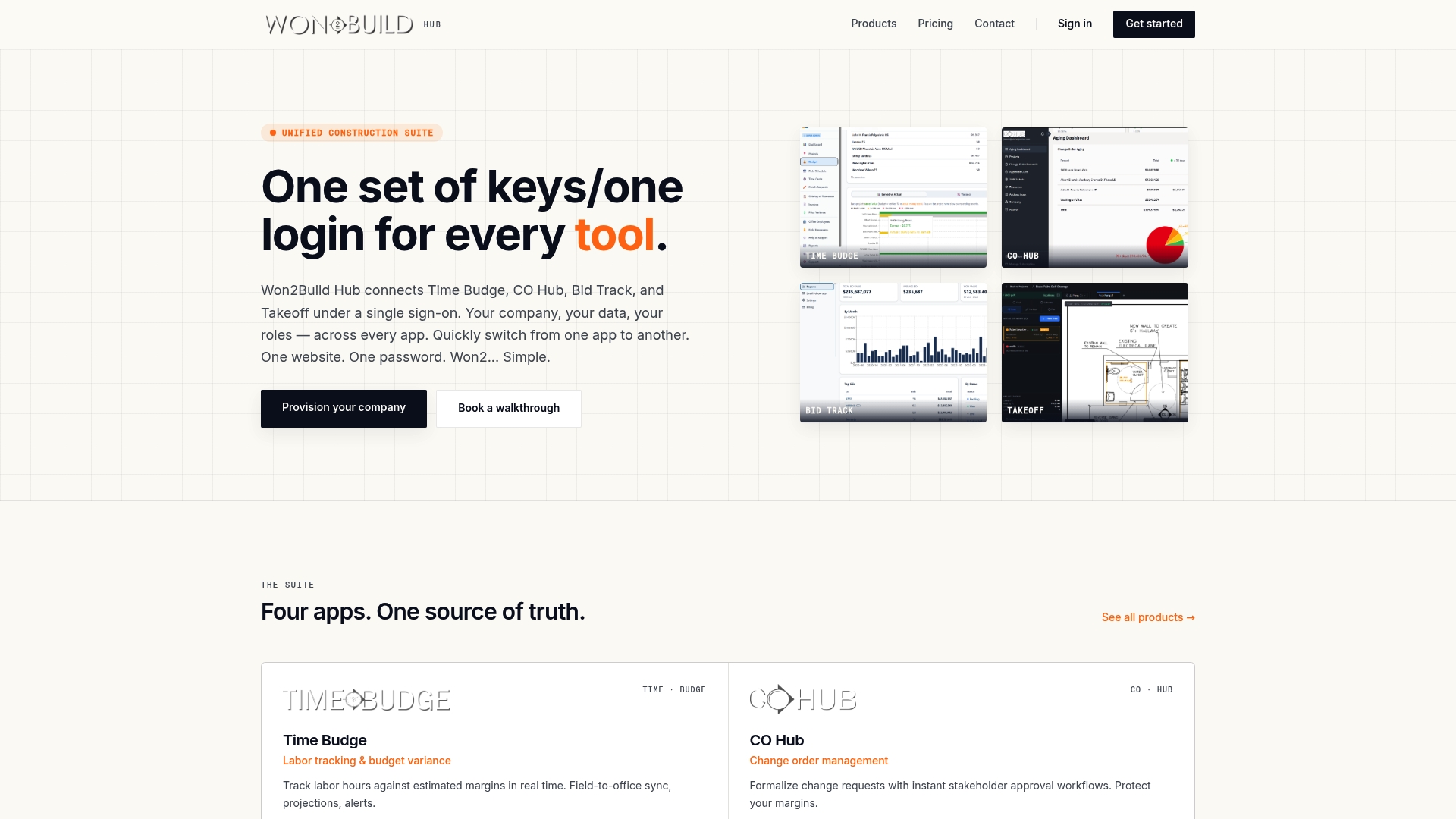
Won2Build Hub integrates four apps, Time Budge, CO Hub, Bid Track, and Takeoff, under a single sign-on, which matters more for bilingual crews than it might first appear. When labor tracking, change orders, and bid data live in one connected system instead of four disconnected ones, terminology stays consistent across every workflow a worker or office manager touches. A cost code translated one way in Time Budge does not show up mistranslated in CO Hub. A schedule edit made in the office syncs to the field in real time, in whichever language a worker has set.
Single sign-on also reduces the double entry that tends to introduce translation drift in the first place. Every re-entry of the same data into a separate system is another chance for a label, a code, or a message to lose consistency between languages. Fewer systems means fewer places for that consistency to break.
— Jen Reese
If you want a field-tested bilingual suite: how Won2Build addresses these needs
If the checklist above sounds like more than you want to test on your own, that gap is exactly what a purpose-built suite is meant to close. Time Budge, part of the Won2Build Hub, gives field crews a bilingual interface for clock-in, clock-out, and daily task tracking, synced in real time with the office side so a schedule change or cost-code update shows up correctly no matter which language a worker has set.
A practical pilot looks like this:
- Request a demo focused on your crew’s primary languages and terminology.
- Run a short pilot with a mixed-language crew, including at least one low-literacy or limited-English worker.
- Track dispatcher hours, clock-in error rates, and correction requests before and during the pilot.
- Confirm onboarding and support are available in the languages your crew actually speaks.
Time Budge is available at $199 per month per company, plus a $2 per month active field worker fee, with the full suite priced the same way through Won2Build’s pricing page. If your crew has outgrown guesswork on language gaps, that pricing page is the place to start.
Sources
- Labor Force Characteristics of Foreign-born Workers news release (2025 results)
- OSHA grant materials for Spanish-language fall prevention training
- 3D visualization and scenario-based training for low-literacy and LEP construction workers (ASCE study)
- OSHA construction outreach training in Spanish
FAQ
What makes time-tracking software “truly bilingual”?
True bilingual software translates every screen a worker or manager touches, including clock-in flows, error messages, push notifications, and audit logs, not just the login page or main menu. If any part of the workflow reverts to English, especially error handling, it is only partially translated.
Does bilingual time tracking actually reduce errors?
Systems that translate the full workflow, including cost-code selection and error messages, tend to reduce clock-in mistakes because workers understand what went wrong and can correct it without calling a dispatcher. Foreign-born workers, who make up a meaningful share of the construction workforce, are the group most affected by language gaps in these tools.
How does bilingual software affect crew retention?
Workers who can navigate an app independently, without relying on a bilingual coworker, tend to feel more confident in their job and are more likely to recommend the employer to others. This effect is harder to quantify than error rates, but it shows up in reduced turnover and stronger word-of-mouth recruiting.
Is bilingual safety training different from bilingual time tracking?
They serve different purposes but reinforce each other. OSHA provides Spanish-language safety training materials, and research on low-literacy training methods shows that visual and scenario-based formats improve comprehension beyond plain text translation, a lesson that applies directly to how bilingual time-tracking interfaces should be designed.
What should I test before rolling out a bilingual app to my crew?
Test the full workflow with a representative pilot group, including at least one worker who struggles with long English text, and simulate common errors like a missed clock-out or wrong cost code. Confirm audit logs render correctly in both languages and that offline mode does not reset language settings.
Recommended
One login for estimating, bid tracking, change orders, and labor.
The Hub is free. Pay only for the apps you turn on.
Create your free Hub account- Managers: Make Mobile Field Workflows Resilient for 72 Hour OutagesPlaybook for field managers: offline first mobile workflows, resilient sync and conflict handling, compliance first AI guardrails, and practical pilot steps.
- Daily Signed Records: Force Account Tracking for Managers & InspectorsField checklist for project managers and inspectors to keep force account tracking audit-ready: use daily signed records for labor, equipment, and...
- Stop Timecard to Report Drift: Labor Cost Codes for SubcontractorsFix the timecard to report chain with labor cost codes that tie crews to budgets. Includes a 6 code starter and a burdened rate example.