
Managers: Make Mobile Field Workflows Resilient for 72 Hour Outages
Playbook for field managers: offline first mobile workflows, resilient sync and conflict handling, compliance first AI guardrails, and practical pilot steps.

The most reliable approach to mobile field workflows combines an offline-first app architecture, centralized enterprise mobility management (EMM), and limited on-device AI deferring to manager approval on compliance-sensitive edits. This structure protects data when signal drops, keeps devices secure, and prevents automation from making safety calls it shouldn’t make. Teams that adopt it see higher field productivity, cleaner compliance records, and fewer costly data errors.
TL;DR:
- Use append only logs to preserve conflicting entries, then create correction records; last write wins syncing can erase compliance details needed for later review.
- Test offline recovery with a representative workload for at least 72 hours, confirming local storage capacity and automatic synchronization after connectivity returns.
- Reserve AI for low risk tasks such as photo tagging and transcription; managers must approve compliance records, while conflicting incident accounts remain visible.
- Pilot two or three representative jobs, testing outages, conflicting entries, and an incident report; track completion time, errors, reporting delays, and compliance incidents.
- For bring your own device deployments, use per app VPNs, separate work profiles, and selective wipes that remove company data without erasing personal files.
Table of Contents
- Core components of an effective mobile field workflow
- How AI and automation fit into mobile field workflows
- Offline-first architecture and sync strategies for field teams
- Security, compliance, and device management
- How to choose and deploy a mobile workflow solution
- Scaling mobile workflows: governance, training, and operational metrics
- Won2Build’s approach to mobile field workflows
- Author perspective: practical trade-offs managers must accept
- How Won2Build helps implement the recommended mobile field workflow
- FAQ
- Sources
- Primary sources and guidance for implementation
Core components of an effective mobile field workflow
A workflow built for field conditions starts with forms and tasks that are structured, not freeform. Structured fields, conditional logic, and required digital signatures cut down on incomplete submissions and give supervisors a consistent record to review. A task tied to a work order should require the same fields every time, regardless of which crew member fills it out.
On-device capabilities matter just as much as the forms themselves. A local database lets workers keep entering data when there’s no signal. Camera metadata (timestamp, GPS coordinates, device ID) attaches context to every photo automatically. Background queues hold completed work until the device reconnects, and geotags paired with timestamps create a verifiable trail of where and when work happened.
Integrations determine whether that field data actually becomes useful. Before choosing or building a system, map out where data needs to flow:
- Work order systems, so field updates close the loop with dispatch.
- Payroll platforms, so logged hours flow directly into pay runs without re-entry.
- Change order and T&M tracking, so extra work gets billed instead of absorbed.
- GIS or mapping layers, so location-based tasks and assets stay synced across teams.
Permission levels and audit logging round out the system. Field workers should only see and edit what’s relevant to their role, while managers retain visibility into every change, including who made it, when, and from where. This combination of structured capture, device-level reliability, and permission-aware logging is what separates a workflow that holds up under audit from one that falls apart under scrutiny.
How AI and automation fit into mobile field workflows
AI can meaningfully speed up field data entry, but where it runs matters. On-device AI processes data locally, which keeps the app functional without signal and avoids sending sensitive job-site data to an external server for every small task. Cloud AI offers more processing power but depends on connectivity and introduces a privacy tradeoff that managers should weigh before adopting it for anything involving personal or safety-related data.
Several AI assists are genuinely useful in the field without creating risk:
- Auto-filling repetitive fields based on job type or crew history.
- Tagging photos automatically by job site, task, or equipment type.
- Transcribing voice notes into structured incident or progress reports.
- Flagging anomalies, like a time entry that doesn’t match a worker’s usual pattern.
The guardrails matter more than the features. Compliance-sensitive entries, safety incidents, OSHA-reportable events and change orders affecting cost should never be finalized by automation alone. A manager needs to review and approve those records before they’re treated as final. Automation should never silently merge conflicting safety reports either; if two workers log different accounts of the same incident, both versions need to stay visible for a human to reconcile.
There’s also a practical cost to running AI features on a mobile device. Continuous background processing drains battery faster and can slow down the interface on older hardware, which matters when crews are relying on a phone for a full shift outdoors.
Pro Tip: Turn off always-on AI features for workers whose devices are more than two generations old; the battery and performance cost usually outweighs the convenience.
Offline-first architecture and sync strategies for field teams
An offline-first system assumes connectivity will fail and designs around that assumption instead of treating it as an edge case. Three components make this work in practice:
- A local database that stores every form, photo, and task completion on the device the moment it’s captured.
- An append-only log that records each entry as a new, timestamped record rather than overwriting previous versions, which preserves a full audit trail.
- A sync queue that holds completed work and transmits it automatically once the device reconnects, without requiring the worker to remember to do anything.
Conflict resolution is where many systems fail silently. Last-write-wins approaches simply overwrite older data with whatever synced most recently, which is fine for a casual note but dangerous for a compliance record where the original entry needs to remain intact. Append-only logs handle this better: when two conflicting entries exist, both are preserved and a correction record is created instead of erasing either one. This approach, often emphasized in offline-first architecture guidance, keeps the audit trail intact even when two crew members log the same event differently.
Sync patterns should be flexible rather than forced. Delayed or manual sync options let workers choose when to transmit large uploads, which avoids draining battery or freezing the app mid-task. Background sync can trigger automatically once a stable connection is detected, and chunked uploads break large files, like high-resolution photos or video, into smaller pieces so a dropped connection doesn’t mean starting over.
Before rolling out any offline-first system, test it against a realistic worst case: simulate 72 or more hours without connectivity using a representative workload, and confirm the local database has enough storage and the sync recovery process behaves predictably once the connection returns.

Security, compliance, and device management
Centralized device management is not optional for field teams handling job-site data. Enterprise mobility management (EMM) and unified endpoint management (UEM) platforms let administrators enforce security policies, push updates, and remotely wipe a lost or stolen device without touching the worker’s personal data on a bring-your-own-device setup. NIST’s guidance on mobile device security outlines EMM, mobile application management (MAM), mobile threat defense (MTD), and policy enforcement as core capabilities of a secure enterprise mobile deployment, and recommends treating these as part of a structured device life cycle rather than a one-time setup.
Compliance requirements shape what field apps need to capture and how fast. OSHA’s incident reporting guidance requires rapid reporting of fatalities and serious injuries, which means field apps need offline incident capture that works the moment something happens, not after a worker finds signal.
Field teams often need close to full uptime and offline resilience for extended periods to stay compliant with reporting windows when connectivity is unreliable, according to OSHA reporting requirements. That single figure should drive how much offline storage and retry logic a system needs.
For bring-your-own-device environments specifically, NIST’s BYOD practice guide documents concrete protections: per-app VPNs, app vetting before deployment, selective wiping that removes only enterprise data, and separation between personal and work profiles on the same device.
Before a full rollout, verification matters:
- Run a pilot that confirms policy enforcement and selective wipe actually work as configured.
- Set a patching cadence so security updates reach devices on a predictable schedule.
- Monitor device compliance and flag anything that falls out of policy automatically.
How to choose and deploy a mobile workflow solution
Choosing a system, whether built in-house or bought, comes down to a short list of criteria: reliable offline support, audit-quality logging, EMM integration, mapping or GIS capability for location-based tasks, and open APIs or connectors to existing back-office systems like payroll and accounting.
A pilot program is the fastest way to find out if a candidate system holds up:
- Select two or three representative jobs that reflect the range of conditions your crews actually work in.
- Test offline scenarios deliberately, including extended outages, to see how the app behaves when it reconnects.
- Verify conflict resolution by having two workers log conflicting information on the same task and checking that both versions survive.
- Run a compliance case test that mirrors an OSHA-style incident report, from capture through final sign-off.
- Build a short training plan: micro-training sessions of 15 to 20 minutes per feature tend to stick better than a single long onboarding session, paired with a clear manager approval process and an escalation path for anything flagged as noncompliant.
Track a few pilot metrics closely: task completion time, data error rate, reporting latency, and compliance incident rate. If those numbers don’t improve during the pilot, the system isn’t ready for a wider rollout, regardless of how polished the interface looks. For teams building out time capture specifically, this field-ready mobile timesheet guide walks through practical setup choices worth testing during a pilot.
Scaling mobile workflows: governance, training, and operational metrics
Once a pilot proves out, governance becomes the thing that keeps the system consistent as more crews come on board. One person or team should own the workflow design centrally, while local leads handle day-to-day permissions and exceptions within a clear permissions matrix.
Training needs to go beyond a one-time walkthrough. Critical tasks, like compliance events or change order approvals, deserve a short certification step so managers know a worker has actually demonstrated the process, not just watched a demo.
Ongoing maintenance keeps the system from decaying:
- Plan for device lifecycle replacement before batteries and processors start limiting app performance.
- Push updates on a managed schedule rather than leaving them to individual workers.
- Define support SLAs so field issues get resolved within a known window.
- Keep a rollback plan ready in case an update breaks a critical workflow.
Pro Tip: Review compliance incident rate and reporting latency weekly, and review device health and training completion monthly. Weekly numbers catch problems before they compound.
Won2Build’s approach to mobile field workflows
Our suite maps directly onto these patterns for subcontractors specifically. Time Budge handles offline-capable time capture in the field, while CO Hub keeps change orders and T&M tickets tied to the original job record rather than a separate spreadsheet. Some systems integrate project data from estimate through execution under a single login, helping ensure consistency between bid stage numbers and field-tracked data. We suggest piloting by trade and stressing offline sync along with an OSHA-style incident capture scenario before a full rollout, a pattern covered in more depth in our guide to offline time tracking.
Author perspective: practical trade-offs managers must accept
The honest trade-off in mobile field workflows is this: reliability and compliance guardrails come first, and experimental automation comes second. I’d rather see a manager slow down AI adoption on anything touching safety or compliance than speed up convenience features that save a few seconds per entry. Start with AI on low-risk tasks like photo tagging, require human sign-off everywhere compliance is involved, and only scale once a small pilot has actually proven the system holds up under real field conditions.
— Jen Reese
How Won2Build helps implement the recommended mobile field workflow
Subcontractors looking to put these patterns into practice don’t need to build them from scratch. Our Hub gives field crews and office staff a single login across the tools that matter for this kind of workflow:
- Offline-capable time tracking that syncs once a connection returns.
- Change order and T&M management tied to the original job record.
- Bid and estimate data that stays consistent from pipeline through execution.
- Pricing models that include a flat fee plus per-active-user charges for certain modules allow costs to scale predictably as crews grow.
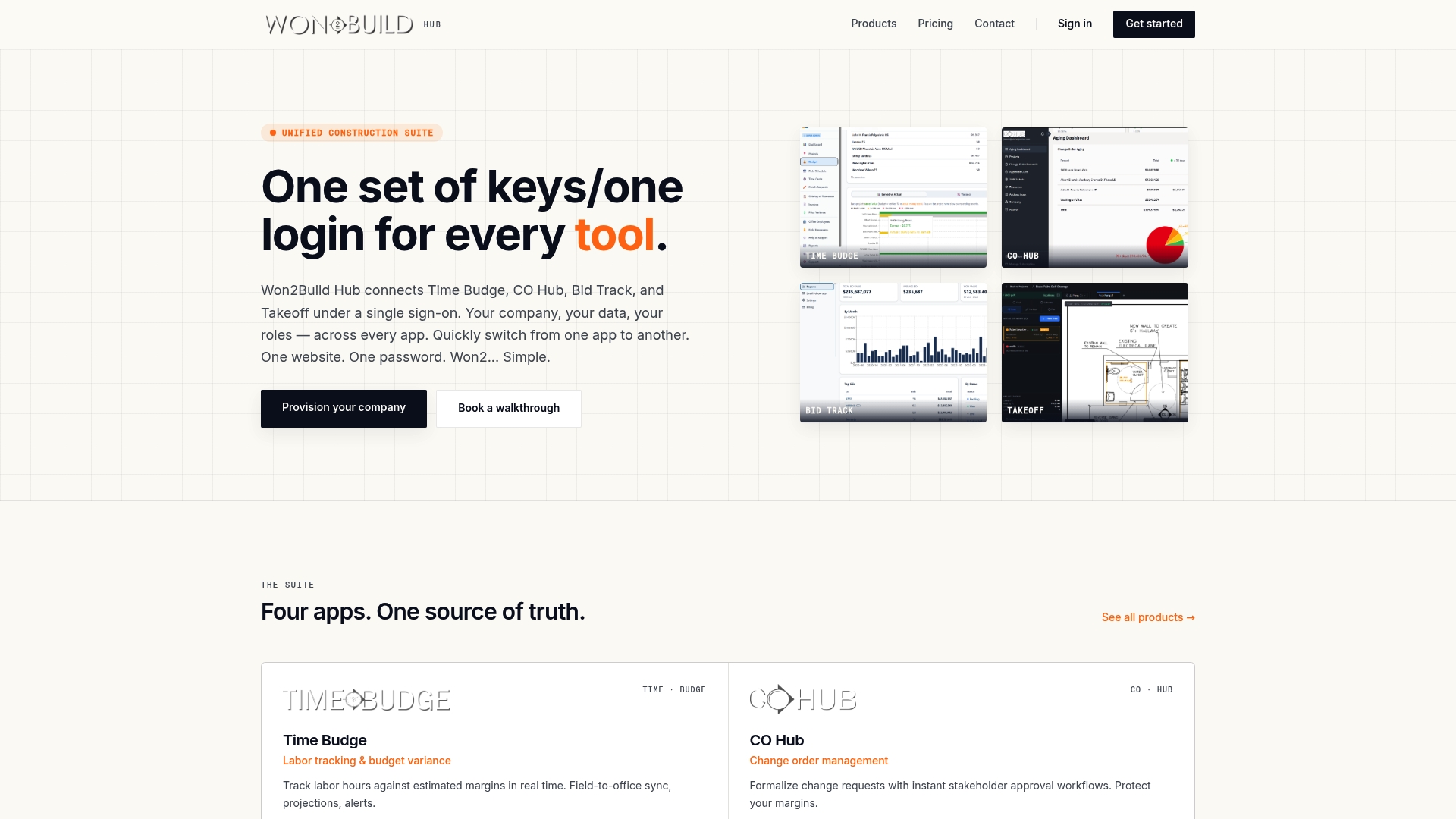
If you’re ready to see how this fits your crews, check pricing and plan details or explore the full construction software suite to find the right starting point for a pilot.
FAQ
What does “offline-first” mean for a field service app?
An offline-first app stores data locally on the device first and syncs it to the cloud once a connection is available, rather than requiring a live connection to function. This keeps field crews working through dead zones or extended outages without losing data.
How does EMM differ from MDM for field teams?
Mobile device management (MDM) controls the entire device, while enterprise mobility management (EMM) and mobile application management (MAM) can isolate control to specific work apps, which matters on bring-your-own-device setups. NIST’s mobile security guidance outlines both approaches as part of a broader enterprise mobility strategy.
Can AI make compliance decisions in field apps automatically?
No. Compliance-sensitive events, including anything that could become an OSHA-reportable incident, should always require a manager’s review and approval before being finalized, with AI limited to assisting tasks like tagging or transcription rather than making the final call.
How long should a mobile workflow pilot run before full rollout?
A pilot should run long enough to test offline scenarios, conflict resolution, and at least one compliance case test, which typically means covering a full job cycle on two or three representative projects. Watch task completion time, data error rate, and compliance incident rate throughout to judge readiness.
What should subcontractors look for in pricing for field workflow software?
Look for pricing that scales predictably as crews grow rather than penalizing you for adding workers mid-project. Our pricing page lists flat per-company fees alongside a small per-active-field-worker fee for specific modules, which keeps costs transparent as teams expand.
Sources
- OSHA reporting guidance
- Guidelines for Managing the Security of Mobile Devices in the Enterprise (NIST SP 800-124r2)
- Mobile Device Security: Bring Your Own Device (NIST SP 1800-22)
- Get started with ArcGIS Field Maps
Primary sources and guidance for implementation
- OSHA reporting guidance: rules and timelines for reporting workplace incidents.
- NIST SP 800-124r2: enterprise mobile device security framework.
- NIST SP 1800-22: BYOD security practice guide.
- ArcGIS Field Maps: offline task and mapping workflow examples.
Recommended
One login for estimating, bid tracking, change orders, and labor.
The Hub is free. Pay only for the apps you turn on.
Create your free Hub account- Daily Signed Records: Force Account Tracking for Managers & InspectorsField checklist for project managers and inspectors to keep force account tracking audit-ready: use daily signed records for labor, equipment, and...
- Stop Timecard to Report Drift: Labor Cost Codes for SubcontractorsFix the timecard to report chain with labor cost codes that tie crews to budgets. Includes a 6 code starter and a burdened rate example.
- Cut Clock In Errors: Bilingual Time Tracking for SubcontractorsField-tested advice for subcontractors on deploying bilingual time tracking that translates full workflows, reduces clock-in errors, and keeps audit logs...