
How to Submit Winning Subcontractor Bids
Learn how to submit winning subcontractor bids with effective strategies. Improve your success rate and stand out to general contractors today!

A winning subcontractor bid is a clear, complete, and compliant proposal that addresses scope, risk, and client requirements so effectively that the general contractor (GC) has no reason to look elsewhere. The industry term for this standard is a “scope-proof bid,” and it is the benchmark every commercial subcontractor should target. Win rates vary by trade from 18% to 45%, which means even top performers lose more than half their bids. The gap between the top and bottom of that range comes down to process, not price. To submit winning subcontractor bids consistently, you need a disciplined system for selecting projects, reading bid packages, preparing proposals, and following up.
How to submit winning subcontractor bids: start with the right projects
The single biggest mistake subcontractors make is bidding on everything. Bidding on low-probability projects wastes estimating hours, dilutes focus, and shrinks margins. Winning is about bidding the right projects, not the most projects.
A structured bid/no-bid decision process solves this. Score every invitation against five factors before committing estimating resources:
- Location: Is the project within your crew’s practical travel range? Remote sites add cost and risk.
- Contract terms: Does the contract include “pay-if-paid” clauses? Payment terms critically impact your cash flow and risk exposure on every job.
- Client history: Have you worked with this GC before? A track record of fair dealing matters more than project size.
- Trade fit: Does the scope match your crew’s core skills and current capacity?
- Competitive landscape: How many subs are likely bidding? A six-way competition on a thin-margin job is rarely worth your time.
Score each factor on a simple 1–5 scale. Any invitation scoring below a threshold you set, say 15 out of 25, gets a polite decline within 24 hours. Track your decline reasons in a spreadsheet. Over time, patterns emerge: you may find you consistently lose bids from a specific GC, or that out-of-area projects never convert. That data sharpens future decisions.
Pro Tip: A consistent bid/no-bid scoring process reduces wasted estimating hours by roughly 30%, freeing your team to build stronger proposals on the bids that actually fit.
What does a bid package actually require?
Bid packages for commercial projects can exceed 1,500 pages. Missing late addenda or supplementary conditions is one of the most common and costly errors a subcontractor can make. Scope gaps discovered after contract award destroy margins fast.
Treat every bid package as a document audit. Work through this checklist in order:
- Division 00 (Procurement Requirements): Read the Instructions to Bidders, bid form, and contract forms in full. These set the rules for submission.
- Division 01 (General Requirements): Covers temporary facilities, safety requirements, and project schedule constraints that affect your cost.
- Technical specifications: Read every section that touches your trade, including sections that reference your work from adjacent trades.
- Drawings: Cross-reference plan sheets with specifications. Conflicts between drawings and specs are your risk to price.
- Addenda: Log every addendum by number and date. Confirm your bid reflects the latest revision of every document.
- Exhibits and attachments: Insurance requirements, bonding thresholds, and minority participation goals often live here.
After the audit, build an inclusion/exclusion list. This document states exactly what your price covers and what it does not. It protects you during bid leveling and prevents scope creep after award. A well-organized trade bid scope is one of the clearest signals to a GC that your team is professional and prepared.
Pro Tip: Use digital takeoff and document review tools to cross-reference drawings and specs automatically. Missed items in manual reviews cost subcontractors real margin post-award.
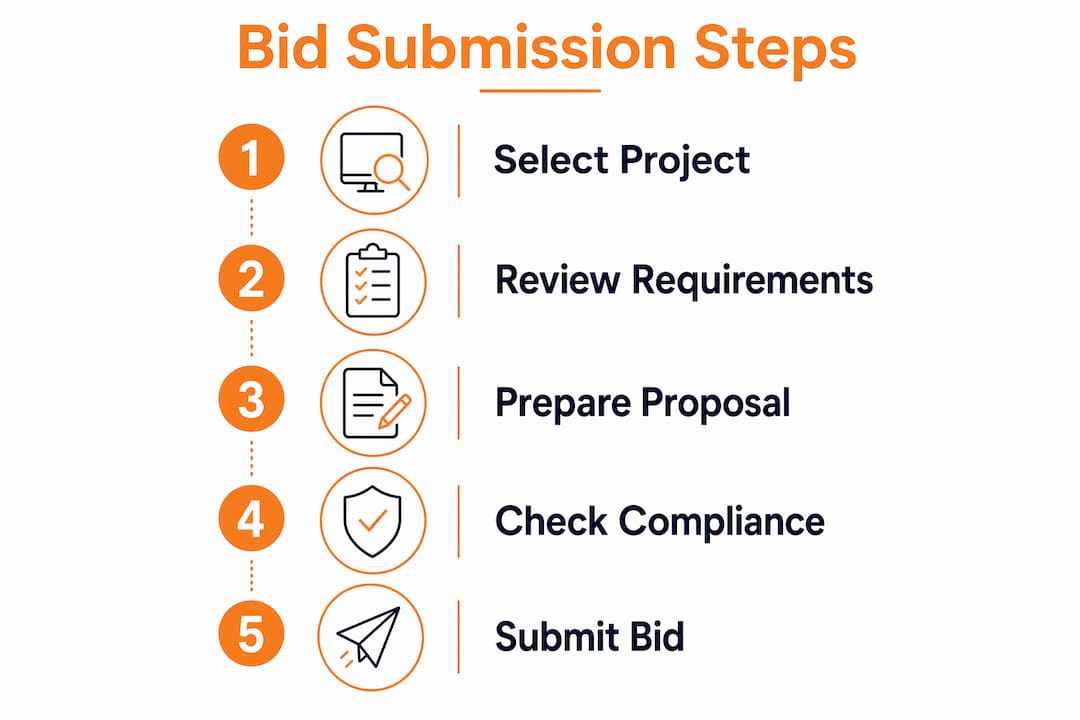
How do you prepare a clear, competitive, and compliant bid?
GC estimators perform bid leveling to compare every subcontractor’s price on an apples-to-apples basis. A bid that is easy to level wins more often than a bid that is merely the lowest number. Clarity is a competitive advantage.
Structure every proposal in this order:
- Cover letter: State your company name, license number, project name, and base bid price in the first paragraph. Include two or three relevant project references with contact names.
- Base bid: Present your lump sum or unit price clearly. Label every line item.
- Alternates: List each alternate exactly as the GC requested it, with a clear add or deduct amount.
- Inclusions and exclusions: Attach the scope list you built during the bid package audit.
- Assumptions: State any conditions your price depends on, such as access hours, phasing sequence, or owner-furnished materials.
- Schedule: Provide your anticipated crew mobilization date and duration. GCs use this to build their master schedule.
- Warranty and approvals: Note your standard warranty terms and any submitted product substitutions.
Follow the GC’s bid instructions exactly. If they require a specific bid form, use it. If they require PDF submission by 2:00 PM, submit by 1:45 PM. Failing to follow strict bid instructions disqualifies 20–30% of subcontractors before pricing is even considered. That is a self-inflicted loss.
Pro Tip: Run a 10-point pre-send checklist before every submission: bid form complete, all addenda acknowledged by number, insurance certificate attached, cover letter price matches bid form price, alternates labeled correctly, exclusions listed, schedule included, contact info current, file named per GC instructions, and submission method confirmed.

For a detailed checklist you can use on every bid, the bid submission checklist from Won2build covers the most common disqualification triggers.
What should you do after submitting a bid?
Most subcontractors either go silent after submission or flood the GC with check-in calls. Both approaches hurt you. Follow-up calls that simply check in add no value and signal that you have nothing new to offer.
Effective post-submission follow-up looks like this:
- Confirmation email: Send a brief email within one hour of submission confirming the GC received your bid and listing your contact for clarifications.
- Clarification window: If you discover a pricing error or scope omission within 24 hours of submission, send a written correction immediately. Most GCs will accept it if award has not been made.
- Value-add contact: If you have a legitimate update, such as a material lead time change or a value engineering option, that is a valid reason to reach out. A generic “just checking in” is not.
- Loss feedback request: When you do not win, send a short email asking one question: “Can you share what drove the award decision?” Most GCs will respond briefly, and that answer is worth more than any estimating software.
Save every piece of bid correspondence in a project folder. Over time, your loss feedback emails become a data set. You will see patterns: your electrical bids consistently come in 8% high, or a specific GC always awards to the same sub regardless of price. That intelligence shapes your next bid.
Pro Tip: Log every bid outcome, your price, the award price, and the feedback reason, in a simple tracker. Six months of data will show you exactly where your pricing or scope presentation needs work.
Key Takeaways
Winning construction contracts consistently requires process discipline at every stage, from bid selection through post-submission follow-up, not just competitive pricing.
| Point | Details |
|---|---|
| Selective bidding wins more | Score every invitation on five factors and decline low-probability bids within 24 hours. |
| Audit the full bid package | Log every addendum and build an inclusion/exclusion list to prevent costly scope gaps after award. |
| Clarity beats lowest price | GC estimators favor bids that are easy to level; a complete, organized bid outperforms a vague low number. |
| Follow instructions exactly | Noncompliance disqualifies 20–30% of bids before pricing is reviewed; use a pre-send checklist every time. |
| Request loss feedback | A single email asking why you lost delivers more bidding insight than months of guesswork. |
Why process beats price every time
I have reviewed hundreds of bid outcomes over the years, and the pattern is consistent: the subcontractor who wins is rarely the cheapest. The winner is the one whose bid the GC estimator can read in under five minutes without picking up the phone.
Most subcontractors treat bidding as a pricing exercise. It is actually a communication exercise. When a GC receives 12 bids and yours is the only one with a clean scope list, acknowledged addenda, and a cover letter that matches the bid form number, you stand out before anyone looks at your price. That is not luck. That is process.
The subcontractors I see burning out are the ones chasing every invitation. They submit 40 bids a month, win three, and wonder why their margins are thin. The ones growing steadily submit 15 bids a month, win six, and protect their labor by only taking work that fits. Selective bidding is not a sign of limited capacity. It is a sign of business discipline.
Digital tools matter here, but not for the reason most people think. The value is not speed. The value is consistency. When your takeoff process, your scope list format, and your submission checklist are built into a system, every bid looks professional regardless of who on your team built it. That consistency builds GC confidence over time, and GC confidence turns into preferred sub status.
— Jen Reese
Won2build tools built for subcontractor bid success
Subcontractors who want to compete at a higher level need more than good intentions. They need systems that make every bid faster, cleaner, and harder to disqualify.
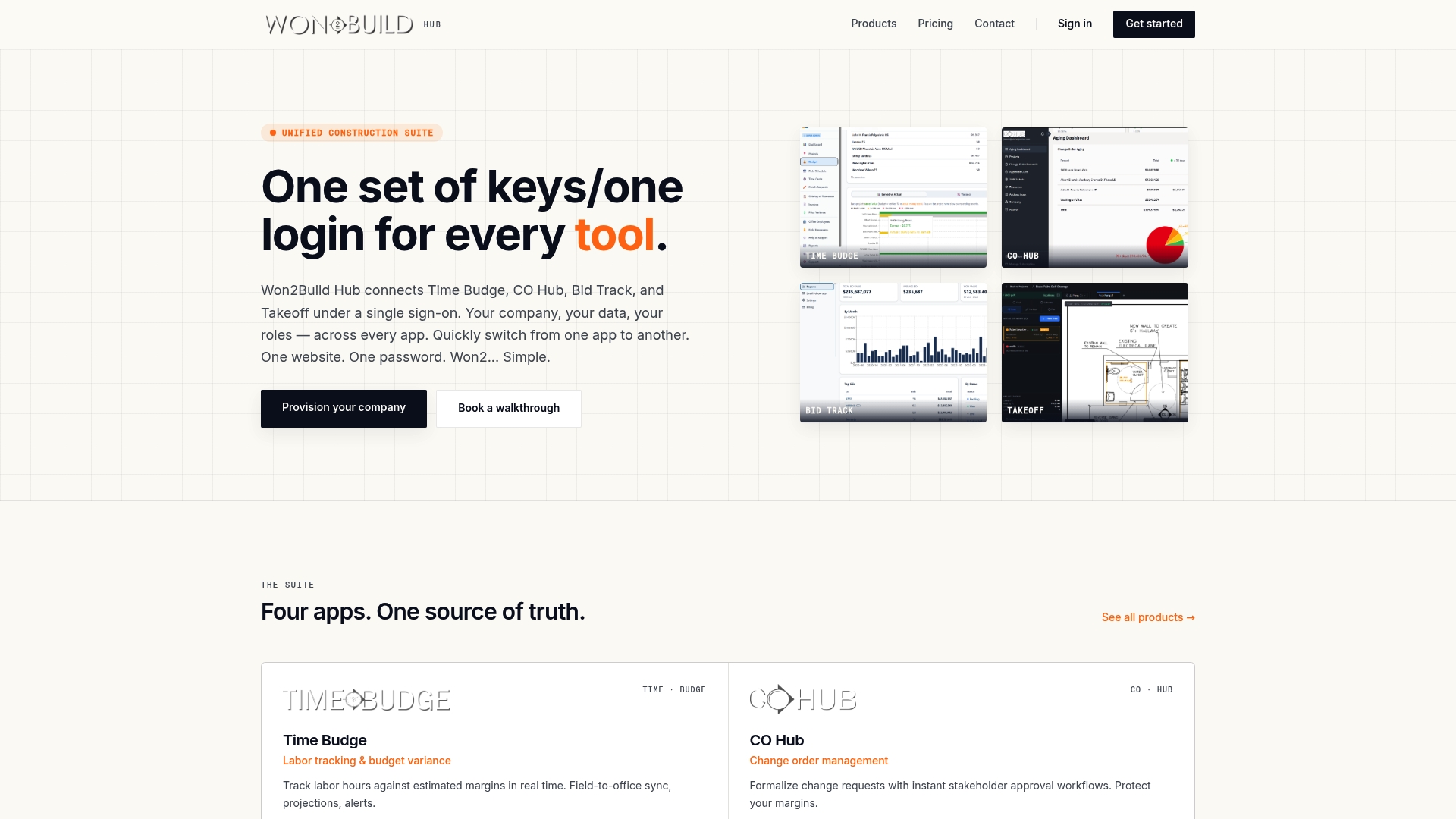
Won2build’s Bid Track software gives subcontractors a full bid pipeline view, from invitation through award, so nothing falls through the cracks. The platform tracks bid status, stores correspondence, and flags submission deadlines before they become problems. Paired with Won2build’s Takeoff tool, subcontractors can quantify plans digitally and feed accurate material counts directly into their estimates. Both tools share a single sign-on, so your estimating team works from one system without re-entering data between applications. For subcontractors serious about subcontract trade bidding in 2026, Won2build provides the infrastructure to bid smarter and win more.
FAQ
What is a healthy win rate for subcontractor bids?
Win rates vary by trade and range from 18% to 45%. Subcontractors at the top of that range typically use a structured bid/no-bid process and submit fewer, better-prepared proposals.
Why do subcontractors get disqualified before pricing is reviewed?
Noncompliance with bid instructions eliminates 20–30% of submissions outright. Common causes include missing bid forms, unacknowledged addenda, and incorrect file formats.
How does bid leveling affect subcontractor selection?
GC estimators use bid leveling to compare proposals on equal scope. A clear, complete bid with an inclusion/exclusion list is easier to level and often wins over a lower but ambiguous price.
When should a subcontractor follow up after submitting a bid?
Send a confirmation email within one hour of submission. After that, only follow up if you have a specific correction or value-add update. Avoid generic check-in calls.
How can loss feedback improve future bids?
Requesting a brief explanation after a loss reveals whether you lost on price, scope clarity, or relationship. That feedback is the fastest way to identify and fix recurring weaknesses in your bidding process.
Recommended
One login for estimating, bid tracking, change orders, and labor.
The Hub is free. Pay only for the apps you turn on.
Create your free Hub account- How to Compare Plan Revisions and Control Estimate ChangesA practical guide for commercial subcontractors on comparing plan revisions, catching scope changes, and keeping estimates and change orders in step.
- Drywall Takeoff Basics: A Step-by-Step Guide for SubsLearn drywall takeoff basics: how to measure walls and ceilings, deduct openings, convert to sheets, set waste and finish levels, and avoid costly misses.
- How to Reduce Profit Fade on Subcontractor JobsProfit fade usually starts in the field and hides until closeout. Here is how subcontractors can catch it weekly and protect the margin they bid.