
How to Build Commercial Project Budget Forecasts That Hold
Learn how to build commercial project budget forecasts that adapt to changing conditions, helping you avoid overruns and ensure project success.

Construction budget forecasting is the ongoing process of predicting what a commercial project will actually cost as it unfolds, not just what you estimated before breaking ground. Unlike a static bid, a forecast updates continuously as conditions change, giving project managers a live view of financial trajectory. Poor financial planning is one of the leading reasons construction projects fail, and continuous forecasting is the discipline that closes that gap.
The industry term for this practice is “cost forecasting” or “project cost forecasting,” and it sits at the heart of commercial project financial control. Done well, it catches overruns before they become irreversible, supports smarter procurement decisions, and keeps stakeholders aligned on where the money is going.
How to build commercial project budget forecasts that actually work
Construction budget forecasting differs from a cost estimate in one fundamental way: it never stops. An estimate is a snapshot taken before work begins. A forecast is a rolling prediction that absorbs new data at every milestone, scope change, and market shift. The RICS Commercial Management of Construction standard describes the process as iterative and cyclic, with forecast updates feeding back into value engineering and procurement strategy throughout the project life.

Why does this matter for commercial projects specifically? Because the financial stakes are higher, the stakeholder count is larger, and the cost variables are more volatile. A forecast gives you the mechanism to act before problems compound.
Key reasons forecasting drives better outcomes:
- Financial control: A live forecast shows whether you are tracking to budget or drifting, so corrective action happens while options still exist.
- Risk management: Forecasting forces you to quantify uncertainty, which means contingency reserves are sized to actual risk rather than guesswork.
- Profitability protection: Catching a labor overrun at 30% completion is recoverable. Catching it at 90% is not.
- Stakeholder confidence: Lenders, owners, and investors make better decisions when they see a forecast grounded in current data rather than a stale estimate.
- Procurement alignment: Updated forecasts feed directly into buying strategy, letting teams lock in pricing when conditions favor it.
What goes into a complete construction budget forecast
A forecast is only as reliable as the inputs behind it. Miss a cost category early and you spend the rest of the project chasing a number that was never realistic.
The core components every commercial project forecast needs:
- Historical cost data: Past project actuals by trade, project type, and geography give you a defensible baseline. Without them, you are estimating from theory.
- Material cost projections: Current supplier quotes, not last year’s prices. Regional cost variations can reach 20–40% within the US, so national averages without local validation produce inaccurate early figures.
- Labor cost projections: Loaded rates by role, including benefits and burden. Field labor is where most commercial projects bleed margin, so granular tracking here pays off.
- Equipment costs: Owned, rented, and operator costs, time-phased against the project schedule.
- Soft costs: Permits, architectural and engineering fees, legal expenses, and environmental studies. These can add roughly 20% to the total budget if overlooked, yet they routinely get underestimated in early commercial forecasts.
- Contingency reserves: Sized to project risk, not applied as a flat percentage. New builds on clean sites typically carry 5–7% contingency, while complex renovations with higher uncertainty warrant 15–20%.
- Indirect costs and overhead: Site insurance, temporary facilities, mobilization, and office overhead all belong in the forecast.
- Schedule and resource integration: Cost and time are inseparable. A forecast that ignores schedule compression or crew availability gaps will miss the mark.
Step-by-step process for forecasting a commercial project budget
The sequence below reflects how experienced project managers actually build forecasts, not just how textbooks describe it.
-
Define scope and document assumptions explicitly. Every forecast starts with a clear scope statement. What is included, what is excluded, and what assumptions underpin the numbers. If you skip this step, you are building on sand. Scope gaps discovered mid-project are the single most common driver of budget overruns.
-
Break the project into work packages. Use a Work Breakdown Structure (WBS) to divide the project into discrete, estimable components. The goal is granularity fine enough that each package can be costed with reasonable confidence. For commercial builds, this typically means separating sitework, structural, MEP, envelope, and interior finish as distinct packages.
-
Estimate costs for each package using the right method. Three methods cover most commercial situations. Bottom-up estimation builds cost from individual task estimates and produces the highest accuracy when a complete WBS exists. Parametric estimation multiplies a unit cost by a measurable quantity, such as cost per square foot or cost per linear foot of piping, and works well when reliable historical unit costs are available. Three-point estimation weights optimistic, most likely, and pessimistic scenarios using the PERT formula, reducing single-point bias on uncertain work packages.
-
Size contingency reserves based on identified risks. Contingency is a calculated risk management tool, not a buffer for poor planning. Pull from your risk register, estimate the cost impact and probability of each significant risk, and use that expected value as your contingency floor. Higher-risk scopes, renovations, or projects with unknown site conditions need more headroom.
-
Set a cost baseline and lock it. Once the estimate is approved, it becomes the baseline. This is the fixed reference point against which all future performance is measured. Without a locked baseline, you have no way to determine whether you are over or under at any given point.
-
Track actuals against the baseline using earned value management (EVM). EVM compares the value of work completed against actual cost incurred and planned budget to produce forward-looking cost projections. If your Cost Performance Index (CPI) drops below 0.9 early in the project, re-estimate to completion rather than assuming a recovery that rarely materializes.
-
Update and reforecast at milestones and after scope changes. Forecasts must be updated after every major milestone and significant change. Three triggers should prompt an immediate reforecast: actual costs deviating from planned costs by more than 10% at a phase boundary, a confirmed scope change, or a schedule shift that affects resource loading.
-
Communicate forecasts clearly with stakeholders. A forecast buried in a spreadsheet does not drive decisions. Translate the numbers into a budget summary that shows where money is going, what the variance is against baseline, and what actions are planned. Stakeholders who understand the forecast make better decisions faster.
Forecasting vs. cost estimating: why both matter
Project managers sometimes use these terms interchangeably. They describe different things, and confusing them creates real financial risk.
The key distinctions:
- Cost estimating is a one-time snapshot of projected costs, typically produced before construction begins. It answers the question: “How much do we expect this to cost?” It feeds the budget baseline and informs contract pricing.
- Budget forecasting is a dynamic, rolling prediction of final costs that updates as the project progresses. It answers: “How much will this actually cost given what we know right now?”
- Estimates alone cannot detect deviation. Once construction starts, an estimate is historical. Only a forecast, updated with actual cost and progress data, can surface a developing overrun in time to act.
- The budget is the approved spending target; the forecast is the current prediction. Distinguishing these two is critical to preventing budget drift. When teams conflate them, they lose the ability to measure performance against a fixed reference point.
- Decision-making quality depends on forecast currency. A stale estimate from preconstruction tells you nothing about whether a subcontractor is running over in month four. A current forecast does.
Common pitfalls that wreck construction budget forecasts
Most forecast failures are predictable. Here is where commercial projects most often go wrong:
- Underestimating soft costs. Permits, legal fees, architectural revisions, and environmental reviews get treated as afterthoughts. They are not. Budget them explicitly from the start.
- Using national cost databases without local validation. Regional pricing variation of 20–40% means a national average can be wildly off for your specific market. Cross-reference subcontractor quotes to reflect actual local conditions.
- Failing to update after scope or schedule changes. A scope change that is not reflected in the forecast immediately creates a phantom budget. The numbers look fine on paper while the actual cost trajectory has already shifted.
- Applying a flat contingency percentage to every project. A 10% contingency on a straightforward tilt-up warehouse and a 10% contingency on a historic renovation are not equivalent risk positions. Size contingency to the actual risk profile.
- Mixing the forecast with the budget baseline. Once teams start revising the baseline to match the forecast, they lose the ability to measure performance. Keep them separate, always.
- Ignoring indirect costs until they surface as overruns. Site insurance, temporary fencing, mobilization, and general conditions can quietly consume a meaningful share of the budget before structural work even begins.
Pro Tip: Maintain a documented audit trail for every reforecast. Record the date, the trigger event, and the rationale for each revision. This audit trail tells you exactly why costs diverged from baseline, which is the only way to improve accuracy on future projects.
Which tools actually support construction budget forecasting?
Technology does not replace judgment, but it closes the gap between what is happening in the field and what the forecast reflects.
- Integrated project management platforms with budget tracking: The most useful platforms connect cost data directly to the project schedule, so a delay in one trade automatically flags its cost impact. Real-time cost integration enables proactive monitoring and faster reforecasting.
- Digital takeoff software: Accurate quantity takeoffs are the foundation of reliable cost estimates. Digital plan quantification tools reduce manual errors and speed up the process of converting drawings into measurable values.
- Labor tracking applications: Field labor is the most volatile cost line in commercial construction. Tools that capture actual hours by task in real time give project managers the data they need to catch labor overruns before they compound. Won2build’s Time Budge application tracks labor costs at the job level, syncing field data directly to office reporting.
- Change order management software: Every unmanaged change order is a forecast error waiting to happen. Platforms that capture, price, and approve changes in a structured workflow keep cost impacts visible and traceable.
- Cost estimating software with historical data integration: Tools that pull from localized price books and past project actuals produce more defensible estimates than those relying on generic databases.
- Cloud-based collaboration platforms: When owners, designers, estimators, and contractors access the same cost data, the chance of a costly miscommunication drops sharply. Shared visibility is not a luxury on complex commercial projects.
Best practices for accurate commercial project budget forecasts
Accuracy is not luck. It comes from discipline applied consistently across the project lifecycle.
- Document every assumption. “Assumes union labor rates at current CBA” is a traceable assumption. “Labor: $240,000” is not. Undocumented assumptions are the source of most forecast disputes.
- Use scenario-based planning. The golden rule of cost forecasting is to treat it as a dynamic, iterative process with best-case, worst-case, and most-likely scenarios. Scenarios are not pessimism; they are preparation.
- Engage construction experts early in design. Bringing a construction manager or experienced subcontractor into preconstruction planning surfaces cost issues before design is locked. Independent cost validation from professionals with current market data improves budget certainty and reduces late-stage surprises.
- Benchmark against past project data. Your own completed projects are the most reliable cost database you have. Build an internal rate card and update it after every closeout.
- Maintain strict separation between the budget baseline and rolling forecasts. The baseline is fixed. The forecast moves. Conflating them destroys your ability to measure performance.
- Update forecasts on a regular cadence, not just when problems appear. Monthly updates are a reasonable minimum for most commercial projects. Teams with real-time field data can reforecast weekly, catching deviations while they are still small.
- Validate local pricing before finalizing any forecast. National cost databases are a starting point, not a final answer. Confirm with subcontractor quotes and current supplier pricing before committing to a number.
For a practical look at how soft costs like permits and legal fees fit into a complete budget, the planning checklist approach used in residential construction translates directly to commercial preconstruction.
How real-time data and scenario planning sharpen your forecasts
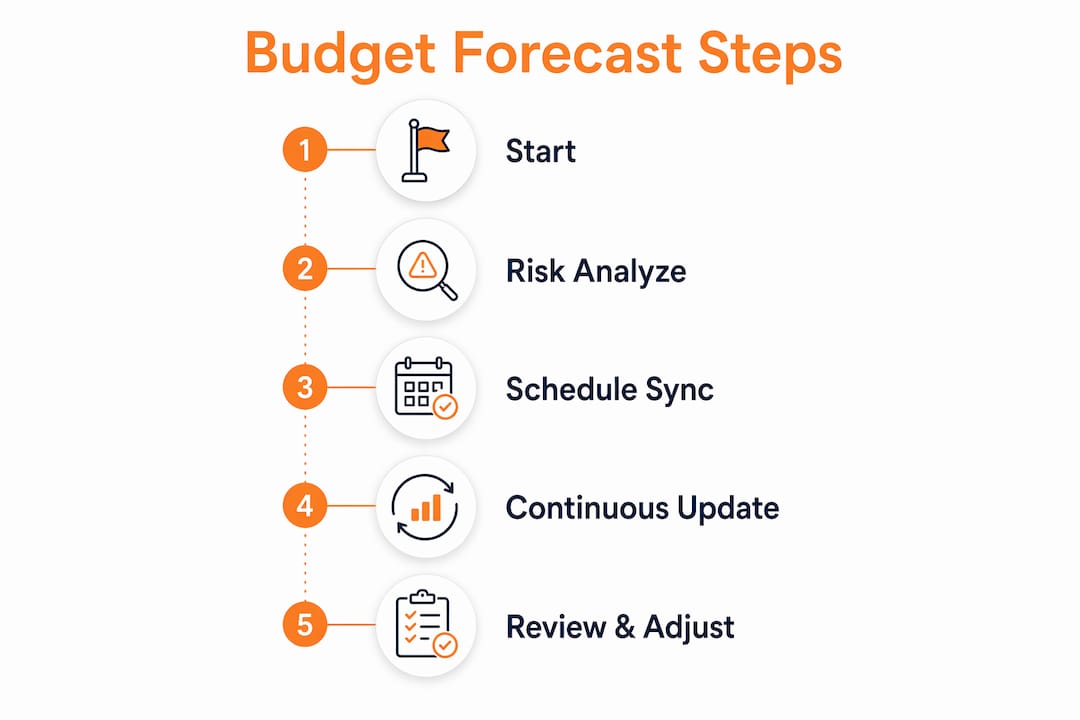
Dynamic reforecasting is what separates project managers who catch problems early from those who explain overruns at closeout. The concept is straightforward: instead of waiting for a monthly cost report, you build a system that flags deviations as they happen and triggers a forecast update automatically.
Scenario planning works alongside real-time data by giving you pre-built responses to trigger events. The best approach is to define those triggers before construction starts, not after a problem surfaces.
- Build trigger points into the project plan. Define specific thresholds, such as actual costs exceeding planned costs by 10% at any phase boundary, that automatically prompt a reforecast and a stakeholder update.
- Maintain three live scenarios: best case (everything tracks to plan), most likely (current trajectory with known variances), and worst case (identified risks materialize). Update all three at each milestone.
- Integrate field data in real time. The gap between what is happening on site and what the forecast reflects is where overruns hide. Platforms that sync field labor and material data directly to cost reports close that gap.
- Use rolling forecasts for financial agility. A rolling forecast replaces the static end-of-project view with a continuously updated picture of final cost. This gives owners and lenders the visibility they need to make financing and procurement decisions confidently.
- Pivot procurement strategy based on forecast signals. When a forecast shows a cost trend moving upward on a specific trade, that is the signal to accelerate procurement, lock in pricing, or explore substitutions before the trend hardens.
Pro Tip: When you build your project schedule, add explicit “forecast review” milestones at each phase gate. Tying budget alignment checks to schedule milestones means the reforecast happens as a natural part of project rhythm, not as a reactive scramble.
How to incorporate risk analysis into your budget forecast
Risk analysis and budget forecasting are not separate disciplines. Every contingency line in a forecast should trace back to a specific identified risk, not a general comfort margin.
Start with a formal risk register before finalizing any forecast. For each risk, assign a probability and a cost impact. Multiply them to get an expected value, then sum those expected values to set your contingency floor. This approach, consistent with PMI PMBOK guidance, produces a contingency reserve that is defensible to owners and lenders because it is grounded in documented risk assessment rather than intuition.
Mitigation strategies belong in the forecast too. If you have a plan to reduce the probability or impact of a risk, that plan has a cost. Budget it explicitly. A mitigation that is not funded is not really a mitigation.
For commercial renovations or projects with unknown site conditions, carry a separate management reserve above the contingency line. Contingency covers identified risks; management reserve covers the genuinely unknown. Keeping them separate preserves clarity when you need to draw on either one.
Review the risk register at every forecast update. Risks that have passed without triggering release their contingency back to the project. New risks that emerge get added with their own expected value. A forecast that reflects the current risk picture is far more useful than one built on assumptions from preconstruction.
How budget forecasts connect to scheduling and resource planning
A budget forecast that lives in isolation from the project schedule is incomplete. Cost and time are the same variable expressed differently. When a trade runs two weeks late, it does not just affect the schedule; it affects crew costs, equipment rental, and potentially the cost of every downstream trade that was sequenced behind it.

The practical integration point is the time-phased budget. Rather than tracking total project cost against a single number, a time-phased forecast allocates cost to specific periods aligned with the schedule. This lets you compare not just total spend but the rate of spend against the plan. If you are 30% through the timeline but have consumed 50% of the budget, that is an early warning that demands a reforecast, not a note in the meeting minutes.
Resource planning feeds the forecast directly. When crew availability changes, when a subcontractor mobilizes late, or when material lead times extend, those events have cost consequences that belong in the forecast immediately. The teams that catch overruns early are the ones who treat schedule updates and forecast updates as the same event.
Won2build’s platform connects field labor tracking, change order management, and bid data in a single environment, so schedule-driven cost changes surface in the forecast without manual reconciliation between disconnected systems. That kind of real-time synchronization between field and office is what makes time-phased forecasting practical rather than theoretical.
What successful budget forecasting looks like in practice
Two scenarios illustrate how the principles above play out on real commercial projects.
Scenario 1: Ground-up office building. A project manager on a 60,000-square-foot office build uses a bottom-up WBS estimate at preconstruction, validated against regional subcontractor quotes. Contingency is set at 7% based on a clean site and well-defined scope. At the 30% completion milestone, actual labor costs on the structural package are running 12% over plan. Because the forecast is updated weekly with field data, the overrun surfaces at week eight, not at closeout. The project manager reallocates contingency, accelerates the MEP procurement to lock in pricing before a forecasted material price increase, and adjusts the schedule to reduce overtime in the finishing trades. The project closes within 2% of the original baseline.
Scenario 2: Historic building renovation. A renovation project carries 18% contingency from the start, reflecting unknown conditions behind existing walls. When demolition reveals unexpected structural remediation, the risk register already has a line item for that scenario with a pre-approved response plan. The forecast absorbs the cost, the contingency draw is documented with a clear audit trail, and the owner is notified with a revised forecast the same week. No emergency budget request, no redesign scramble. The pre-built scenario plan converts a potential crisis into a managed variance.
The common thread in both cases is that forecasting was treated as an active management tool, not a reporting obligation.
Take control of your project finances with Won2build
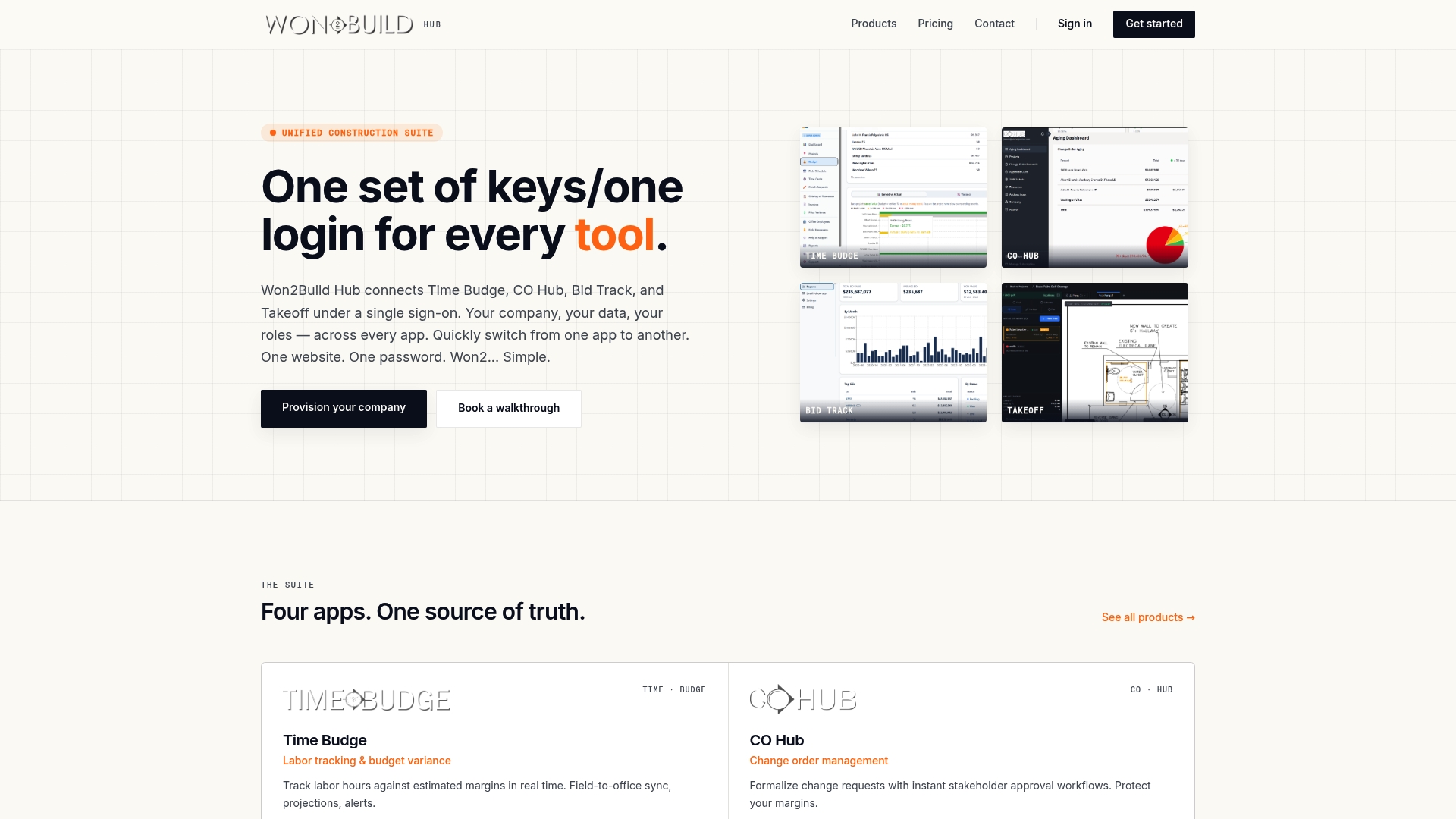
Won2build is built for construction subcontractors who need accurate, real-time financial visibility across every active project. The platform’s integrated suite connects digital takeoff for precise quantity-based estimates, Bid Track for bid pipeline management, CO Hub for change order tracking, and Time Budge for field labor cost capture, all under a single sign-on. When your takeoff data, labor actuals, and change order costs live in the same system, your forecast reflects reality instead of lagging behind it.
If you are ready to move from reactive budget management to proactive forecasting, Won2build gives you the tools to do it.
Key Takeaways
Accurate commercial project budget forecasting requires continuous updates, risk-calibrated contingency, and strict separation of the budget baseline from the rolling forecast throughout the project lifecycle.
| Point | Details |
|---|---|
| Forecasting is continuous | Update forecasts at every milestone and after any scope or schedule change, not just at project start. |
| Soft costs add up fast | Permits, legal fees, and architectural expenses can add a significant portion to the total budget if excluded from early forecasts. |
| Contingency reflects risk | New builds typically carry a smaller contingency reserve; complex renovations warrant a larger contingency based on actual risk exposure. |
| Baseline and forecast stay separate | Mixing the approved budget baseline with the rolling forecast destroys your ability to measure performance and catch drift early. |
| Regional pricing matters | Regional pricing can vary substantially across US markets, so national averages require local validation before any forecast is finalized. |
Recommended
One login for estimating, bid tracking, change orders, and labor.
The Hub is free. Pay only for the apps you turn on.
Create your free Hub account- 7 Concrete Takeoff Steps Estimators Use to Avoid Ordering ShortfallsFollow seven concrete takeoff steps to calculate cubic yards, size rebar and formwork, convert volumes to supplier units, and verify quantities before bid...
- Are E-Signature Change Orders Legal and Worth the Switch?E-signature change orders streamline your workflow, ensuring faster approvals, fewer disputes, and quicker invoicing—discover the benefits now!
- How to Link Takeoff to Estimate for Accurate BidsLink your takeoff quantities to your estimate for accurate bids. Discover the seamless integration method that reduces errors and saves time.