
Subcontractors: Stop Losing Margin on Change Order Backlog
Operations-first playbook for subcontractor PMs to clear change order backlog and protect margin with 24 hour capture, one week sprints, documented...

Clear a change order backlog by triaging for impact, documenting every item within 24 hours, pricing fast with a repeatable template, and routing approvals through daily sprints instead of weekly meetings. A dedicated change order management tool is one option built to run that sequence without losing track of paperwork. The order matters more than the speed of any single step.
TL;DR:
- Larger projects tend to generate more change orders, increasing the need for strict backlog discipline from the outset.
- An open change order older than 30 days without pricing or approval should be treated as urgent to avoid cost erosion.
- Prioritizing safety, schedule-critical, high-dollar, and contract-exposure items reduces risks and accelerates backlog clearance.
- Consistent, daily triage and documentation within 24 hours are essential to maintain a recoverable claim and prevent spiraling costs.
- Integrating field capture, estimating, and tracking tools into a single system speeds approval and keeps project data linked.
Table of Contents
- What a subcontractor change order backlog actually is
- Which numbers to track and when to escalate
- A 5-point checklist to decide what you clear first
- The step-by-step workflow that clears backlog fastest
- Documentation and the audit trail that protects your claim
- The KPIs and daily routine that keep backlog from creeping back
- Which tools actually speed up clearance
- Preventing the next backlog before it starts
- What field-tested backlog discipline actually looks like
- A practical option for clearing backlog and protecting margin
- FAQ
- Sources
What a subcontractor change order backlog actually is
A change order backlog is the full set of pending COs sitting in different stages: submitted but unpriced, priced but awaiting owner or GC approval, approved but not yet executed, and executed but not invoiced. It builds from design errors and omissions, owner-directed scope changes, unanswered RFIs, and schedule conflicts that force out-of-sequence work.
Each stage carries its own risk. The Construction Industry Institute documents hidden productivity losses from crowding and craft inefficiency that compound the longer items sit unresolved, while the Volpe Center’s 2025 report warns that an unmanaged volume of changes erodes trust between parties and drives costs upward.
Which numbers to track and when to escalate
Five metrics tell you whether a backlog is under control: open CO count, total backlog dollar value, average days open, approval rate, and cycle time from submission to signed approval. Track them weekly at minimum, daily once the backlog grows past a dozen open items.

Project size changes the math. An ASCE analysis of 125 design-build building projects found a correlation of 0.59 between project size and the number of change orders generated, meaning larger jobs need tighter backlog discipline from the start, not after the queue backs up.
An item open more than about a month without a priced estimate or signed approval should be treated as urgent, according to the operational thresholds the Volpe report frames around documenting cause and coding entries for trend review. Past that point, recoverable costs start to slip and crew memory of the original directive fades.
A 5-point checklist to decide what you clear first
Not every open CO deserves the same urgency. Rank items against these five filters before assigning anyone to work them.
- Safety or stop-work items come first regardless of dollar value, since they block the schedule entirely.
- Schedule critical-path items rank next because delay here cascades into every downstream trade.
- High dollar value items (anything materially affecting job margin) get priority over small-dollar paperwork.
- Contract exposure items, including anything tied to a notice deadline or liquidated-damages clause, move up regardless of size.
- Age breaks ties: the oldest open item in a tied category gets worked first.
Assign an owner and a response deadline to each band: same-day for safety and critical-path items, 48 hours for high-dollar and contract-exposure items, and one week for routine low-value changes. Print this list or paste it into your daily stand-up so the team triages the same way every morning.
The step-by-step workflow that clears backlog fastest
A repeatable sequence beats ad hoc handling every time. Run every CO through these steps in order.
- Capture within 24 hours. Take dated photos, log the crew and hours affected, and follow up any verbal directive with a written RFI or email confirmation the same day.
- Assign and tag. Give the item an owner, a priority band from the checklist above, a deadline, and a cause code (design error, owner directive, RFI response, or field condition).
- Price using a template. Break out labor, materials, lost productivity, general conditions, and markup separately. Add a 10 to 15 percent contingency for out-of-sequence or disrupted work, a premium SMACNA guidance attributes to lost productivity and lack of competitive pricing on change work.
- Submit a complete packet. Attach photos, reference drawings or specs, time-impact notes, and the standard form (AIA G709 or equivalent). A consistent packet speeds review and cuts the back-and-forth that stalls approvals.
- Decide on directive work. Proceed under a written construction change directive only when the owner or GC has authorized it in writing. Never start disputed scope on a verbal promise.
- Invoice and close out. Once signed, invoice promptly and move the item to a closed log entry with the final documentation attached.
Pro Tip: Set a same-day rule that no field directive goes undocumented past the end of the shift, even a quick phone photo and a one-line note beats trying to reconstruct the story a week later.
Documentation and the audit trail that protects your claim
What you collect now determines what you can recover later. The essentials are dated photos, RFIs, written confirmation of any verbal directive, daily reports, time sheets tied to the specific CO, and a standard form such as AIA G714 for directives or G709 for proposal requests.
Code every entry with a cause (owner directive, design error, RFI, field condition) so the data can be analyzed later for trends, a practice the Volpe report recommends specifically to reduce future change-order frequency.
Keep everything in one place rather than scattered across email threads and phone galleries. Proper document control means versioned PDFs, time stamps on every upload, and role-based access so field staff can add evidence without being able to alter approved records. SMACNA’s own guidance centers on maintaining a formal change order log as the single source of truth for status and approvals.

The KPIs and daily routine that keep backlog from creeping back
Five numbers belong on a daily dashboard: average days open, the percentage of items older than 30 days, backlog dollar value broken out by priority band, approvals pending beyond their response window, and the invoice conversion rate on closed items.
Review these daily while the backlog is active, and set a one-week sprint target to move a fixed number of items to closed status. When the trend line on “days open” rises instead of falls, that is a staffing signal, not just a paperwork problem. When approvals stall past their contractual response window, flag it for escalation rather than letting it sit quietly in the queue.
Which tools actually speed up clearance
Five categories of tools move a backlog faster: field capture and RFI logging, estimating templates with bid pipelines, dedicated CO tracking, time and labor sync, and reporting dashboards that surface aging items automatically.
Integration matters more than any single feature. When field photos, RFIs, labor hours, and pricing templates live in separate systems, attachments get lost and someone retypes the same data twice. A single sign-on across tools removes that failure point entirely. CO Hub tracks change orders and T&M tickets from submission through invoicing, while Bid Track handles the estimating side with templates for labor, materials, and markup, both inside the same Won2Build Hub login so data moves from field to office without re-entry.
Preventing the next backlog before it starts
Contract language is the cheapest fix available. Require written change orders for any scope modification, name the signatories authorized to approve them, and set a firm response window in the subcontract itself.
On the preconstruction side, early contractor involvement and thorough takeoffs catch conflicts before they become field directives. Early involvement in design-build delivery correlates with fewer change orders than traditional design-bid-build. Train field staff on same-day documentation so errors and omissions get caught and recorded immediately, not discovered weeks later during a dispute.
What field-tested backlog discipline actually looks like
The 24-hour capture rule and daily backlog sprints are not bureaucracy, they are the difference between a recoverable claim and a written-off cost. Every backlog I have watched spiral out of control started the same way: a verbal directive nobody wrote down until the invoice fight started.
Pro Tip: Run the stand-up at the same time every morning. Consistency does more for backlog health than any single piece of software.
— Jen Reese
A practical option for clearing backlog and protecting margin
Most backlogs grow because pricing, approvals, and field documentation live in separate tools that do not talk to each other. 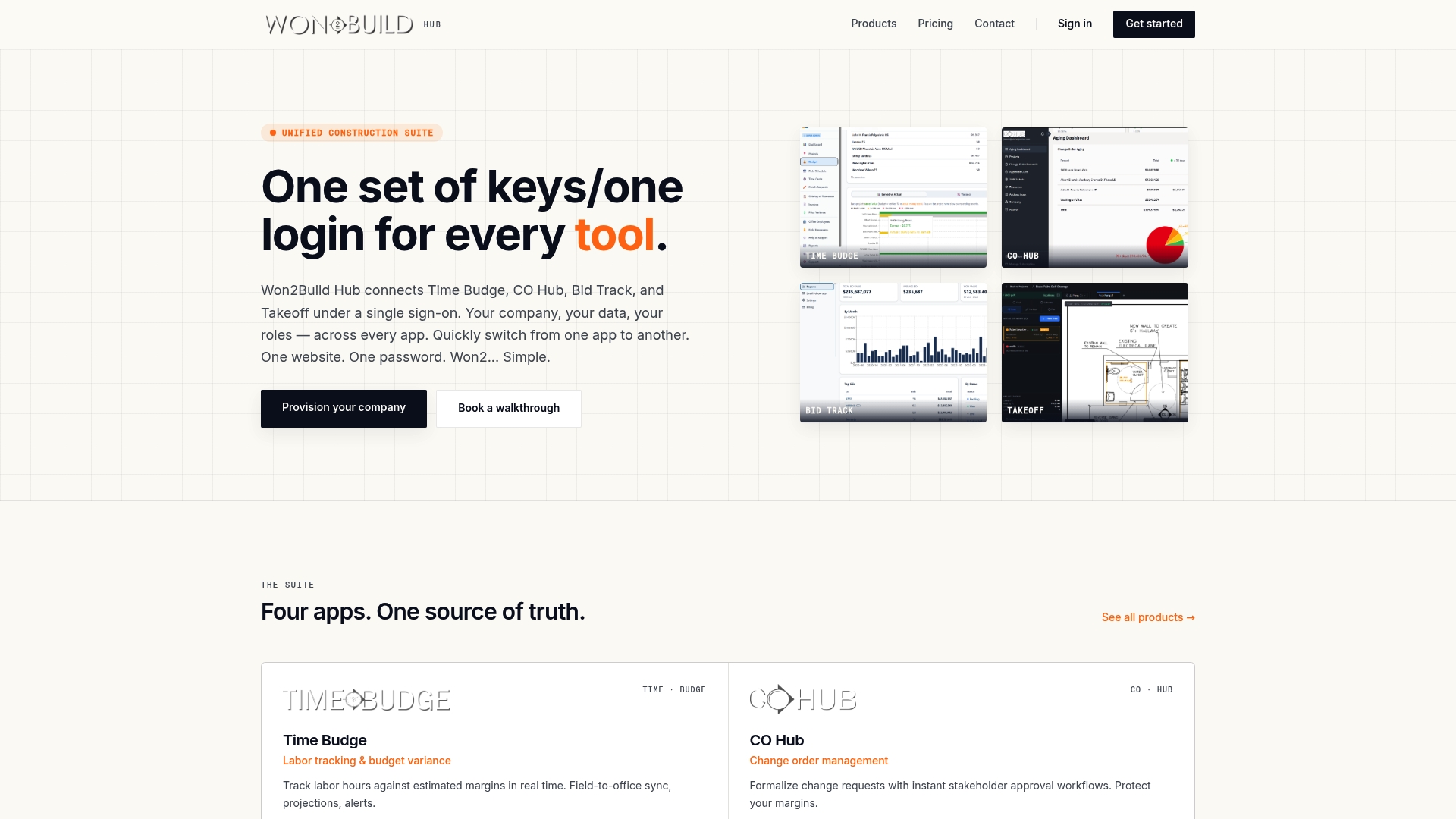
Won2Build Hub connects CO Hub, Bid Track, and Time Budge under one login, so a photo captured in the field, a priced change order, and the labor hours behind it stay linked instead of scattered across apps. CO Hub is priced separately per company, with an additional monthly fee per active field worker for certain modules. Check current pricing or view the product suite to see which combination fits your backlog size.
FAQ
What counts as a change order backlog in construction?
It is the full queue of pending change orders at any stage: submitted but not yet priced, priced but awaiting approval, approved but not executed, or executed but not invoiced. A subcontractor tracks all four stages together to see true exposure.
How long should a change order sit before it is flagged urgent?
An item without a priced estimate or signed approval after 30 days should move to urgent status, based on the documentation and tracking practices the Volpe Center recommends for managing change-order risk. Past that point, recoverable costs and supporting memory both start to erode.
Why do larger projects see more change orders?
Larger projects involve more trades, more design interfaces, and more opportunities for scope conflicts, which is why an ASCE analysis of 125 design-build building projects found a correlation of 0.59 between project size and the number of change orders generated. Delivery methods with earlier contractor input tended to generate fewer changes in that same study.
What should a change order submission packet include?
A complete packet includes dated photos, the relevant RFI or written confirmation, reference drawings or specs, time-impact notes, and a standard form such as AIA G709 or G714 for directives. A consistent packet format speeds GC and owner review and cuts follow-up questions.
Does Won2Build help manage a change order backlog?
CO Hub, part of the Won2Build suite, tracks change orders and T&M tickets from initial submission through pricing, approval, and invoicing, synced with Bid Track for estimating. It is priced at $59 per month per company, separate from the per-worker fee on certain other modules.
Sources
- Understanding Construction Change Orders Report (Volpe Center)
- Impacts of Change Orders on Cost and Schedule Performance and the Correlation with Project Size of DB Building Projects
- Construction changes and change orders: their magnitude and impact (Construction Industry Institute)
- Change Orders and Extra Work: Tools for Change (SMACNA Contracts Bulletin #98)
Recommended
One login for estimating, bid tracking, change orders, and labor.
The Hub is free. Pay only for the apps you turn on.
Create your free Hub account- Managers: Make Mobile Field Workflows Resilient for 72 Hour OutagesPlaybook for field managers: offline first mobile workflows, resilient sync and conflict handling, compliance first AI guardrails, and practical pilot steps.
- Daily Signed Records: Force Account Tracking for Managers & InspectorsField checklist for project managers and inspectors to keep force account tracking audit-ready: use daily signed records for labor, equipment, and...
- Stop Timecard to Report Drift: Labor Cost Codes for SubcontractorsFix the timecard to report chain with labor cost codes that tie crews to budgets. Includes a 6 code starter and a burdened rate example.