
Charge 25–30% on Small Change Orders: Pricing Matrix & Audit Checklist
Use an audit-ready pricing matrix and itemized cost lines to set defensible markup on change orders. See when 25–30% applies and get a checklist plus a...

Small, disruptive changes under $1,000 often justify a markup often around 25–30% or more. Before you write a number anywhere, check your contract for markup caps and notice deadlines, and document every cost line so the markup survives a dispute.
TL;DR:
- For small change orders under $1,000, contractors typically apply a markup of around 25 to 30 percent due to fixed administrative and remobilization costs spread over a small base.
- Larger changes over $5,000 usually warrant a reduced markup between 15 and 20 percent because they approach production efficiency levels similar to original bids.
- Contract specifics, such as federal FAR or owner-negotiated blended rates, can impose fixed markup ceilings that override internal policies, requiring careful review before pricing.
- Itemizing costs in a change order, including direct labor, materials, equipment, and schedule impacts, alongside documented overhead and profit, protects against disputes and justifies the markup.
- Consistent documentation and adherence to a formal workflow are essential to defend markup calculations, especially during disputes or audits.
Table of Contents
- What’s a Reasonable Markup on Change Orders?
- What Should a Change Order Include? Cost Lines That Belong in the Price
- How Do You Calculate Markup on a Change Order?
- Contract Clauses That Set Your Markup Ceiling
- How Should Subcontractor Markup Tiers Work?
- Building a Documentation Process That Protects Your Markup
- Why Most Contractors Undercharge on Small Changes
- Streamline Change Order Pricing and Approvals With CO Hub
- Sources
- FAQ
What’s a Reasonable Markup on Change Orders?
But that range is a starting point, not a rule you apply uniformly. The size, timing, and disruption level of a change all push the number up or down, and a peer-reviewed ASCE analysis of change-order pricing found widespread inconsistency in how contractors decide which costs even belong in that markup calculation before percentages get applied.
Here’s the logic behind the spread. A $500 change to swap out a light fixture carries almost the same administrative burden, remobilization hassle, and schedule disruption as a $5,000 change. Your crew still has to stop, requote, get sign-off, and restart. Spreading that fixed overhead over a smaller dollar base means the percentage has to climb just to break even on the real cost of interrupting the work. Estimator practice reflects this directly: guidance on how to price construction change orders commonly recommends higher percentages, often a markup often around 25–30% or more, on the smallest and most disruptive changes.
Large changes work the opposite direction. Once a change order approaches the scale of a sub-bid or a meaningful portion of the original contract, you’re closer to normal production efficiency.
Here’s a matrix you can adapt to your own jobs:
| Change size | Recommended markup range | Why |
|---|---|---|
| Under $1,000 | a markup often around 25–30% or more+ | Fixed admin, remobilization, and disruption costs are spread over a tiny cost base |
| $1,000–$5,000 | 20–25% | Some efficiency of scale, but still enough disruption to justify a premium over baseline |
| Over $5,000 | typically between 15% and a combined markup around 20% | Approaches original-bid production efficiency; contract caps often apply directly |
A few things worth flagging before you lock in a number:
- Federal contracts under FAR and many public agency contracts specify their own markup ceilings, and those override any internal matrix you build.
- Some owners negotiate a single blended markup rate up front for the entire project, which simplifies your math but removes your flexibility on small changes.
- If your contract is silent on markup, you’re not free to pick any number. You still need a defensible, consistent method tied to your actual costs, not just an industry average.
That last point matters more than most contractors treat it. A consistent internal policy, applied the same way every time, holds up far better in a dispute than a number that shifts project to project with no documented rationale.
What Should a Change Order Include? Cost Lines That Belong in the Price
A change order that only lists a lump price invites pushback. One that itemizes cost categories is much harder to argue with, and it’s the only version that actually protects your markup if a dispute lands on an owner’s desk or in front of an arbitrator.
Start with the direct costs, fully burdened:
- Direct labor, including payroll taxes, workers’ comp, and benefits, not just the base wage rate
- Materials at your actual purchase cost, plus delivery and handling
- Equipment, whether rented or owned, at a documented rate
- Subcontractor quotes, passed through with their own markup intact
- Remobilization and travel time, especially when the change requires a second trip to the site
- Site supervision, clerical time, and any additional project management hours the change actually consumes
- Schedule impact costs, including extended general conditions if the change pushes the timeline
Overhead and profit sit on top of that direct-cost total, and this is where a lot of contractors blur two very different things into one number. Overhead covers your indirect costs, the office rent, insurance, admin salaries, and equipment depreciation that don’t attach to a single job. Profit is your actual margin on top of that.
Pro Tip: Don’t double-count. If bonding or insurance costs are already allocated as job costs elsewhere in your accounting, pulling them into overhead again on the change order inflates your markup without you noticing.
Industry guidance on fair markups on changes to the work commonly points to overhead running around 10–12% and profit landing separately around 5–8%, which is roughly how the roughly between 10% and a combined markup around 20% combined figure breaks down in practice. Whether you present those as one blended line or two separate lines on the change order form usually comes down to what your contract or the owner’s accounting team prefers. Either way, the cost detail underneath needs to hold up on its own, which is also where a reference like a construction estimate components checklist earns its place in your standard process.

How Do You Calculate Markup on a Change Order?
Markup and margin get confused constantly, and using the wrong one in a negotiation costs you real money. Here’s the difference, stated plainly:
Markup % = Markup Dollars ÷ Cost
Margin % = (Price − Cost) ÷ Price
If an owner says “we only pay 15%” without specifying which one they mean, you need to ask, because the dollar difference is real.
Here’s how that plays out across the three tiers:
- Small change, $800 in direct costs. Apply 28% combined O&P. Markup dollars: $224. Final price: $1,024.
- Mid-size change, $3,200 in direct costs. Apply 22% combined O&P. Markup dollars: $704. Final price: $3,904.
- Large change, $18,000 in direct costs. Apply 16% combined O&P, often split as separate lines, say 10% overhead and 6% profit for transparency. Markup dollars: $2,880. Final price: $20,880.
On the change order form itself, you can present the markup as one combined O&P line or break it into overhead and profit separately. Separate lines tend to draw fewer questions from owners’ reps, since they can see exactly what each dollar covers. Sales tax treatment depends on your state and whether the change involves materials, labor, or both, so confirm the rule for your jurisdiction before the tax line goes on the form.
Contract Clauses That Set Your Markup Ceiling
Before you price anything, read the contract’s changes clause. It’s the first move, not a formality, and skipping it is how contractors end up eating costs they were entitled to bill.
Standard form contracts handle this differently:
- AIA documents commonly reference reasonable overhead and profit without a hard percentage, though many project-specific riders add one.
- Federal contracts under FAR frequently specify exact markup schedules or sliding scales tied to dollar thresholds, and these are non-negotiable once the contract is signed.
- ConsensusDocs and similar standard agreements often set a benchmark, commonly around 15% O&P for self-performed work, with lower caps of roughly 5–10% for work performed by subcontractors, according to industry change order management guidance.
Notice requirements matter just as much as the percentage. Most contracts require written notice within a set number of days of discovering a change, and missing that window can waive your right to any markup at all, regardless of how well you documented the cost.
Deductive changes, where scope gets removed rather than added, follow their own logic. Contract language typically determines whether you retain your overhead and profit on the deleted amount or credit it back in full. Many contracts allow the contractor to keep a partial O&P allowance on deletions to cover sunk planning and procurement costs already incurred, but plenty of others require a full dollar-for-dollar credit. Read the specific clause before you calculate a credit, because guessing wrong here creates disputes fast.
Log every notice and communication with a timestamp. If a dispute reaches arbitration months later, the paper trail is often the only thing standing between you and a markup you never get paid.
How Should Subcontractor Markup Tiers Work?
The flow is straightforward on paper: a subcontractor submits a quote that already includes its own overhead and profit, and the prime contractor adds its own markup on top, commonly 5–10% unless the contract specifies a different rate.
The trouble starts when contracts explicitly prohibit stacked markups or cap the total combined percentage across every tier. If your contract has that language and you apply your full standard markup on top of a sub’s already-marked-up quote, you can end up disputing your own invoice.
A few rules keep this clean:
- Request itemized sub quotes, not lump sums, so you can verify their cost basis before adding your own markup.
- Document your prime markup rate in writing on every change order that includes subcontracted work, referencing the specific contract clause that allows it.
- On deductive changes involving subcontracted scope, confirm whether the sub’s credit includes their O&P or just direct cost, then apply the same logic to your own markup on that credit.
- Reconcile the total against the contract’s markup ceiling before submission, not after the owner’s rep flags it.
Cascading markup errors are one of the fastest ways to lose credibility on a change order, even when every individual number was defensible on its own.
Building a Documentation Process That Protects Your Markup
A markup percentage means nothing if you can’t prove the cost underneath it. AACE International’s guidance on change order procedures identifies undefined procedures as one of the leading causes of change-order conflict, and the fix isn’t complexity, it’s consistency. A simple process that field crews actually follow beats a detailed policy nobody reads.
Set up a repeatable workflow with clear ownership at each step:
- Notice. Whoever spots the change, usually the site super, logs it the same day with a timestamp.
- Pricing. The estimator or PM prices it using your standard cost lines and markup matrix, attaching sub quotes and supplier invoices as backup.
- Approval. One designated approver signs off below a set dollar threshold; anything above it needs a second signature, but don’t stack more approval layers than the dollar risk justifies.
- Tracking. The signed change order and every supporting document get filed against the project’s cost code, so accounting can reconcile it without chasing paper.
That single habit closes most of the gap between a markup that survives review and one that gets challenged.*
Systems built around versioned approvals and audit trails make this easier to enforce than a folder of PDFs ever will, especially when leveraging specialized field service software for plumbing, HVAC & electrical designed for MEP trades. Project management platforms with structured change-order capabilities reduce billing leakage precisely because every markup decision is timestamped and tied to its supporting cost data automatically, instead of living in someone’s memory or a scattered email thread.

Why Most Contractors Undercharge on Small Changes
The biggest mistake contractors make on change orders isn’t picking the wrong percentage. It’s applying their original-bid markup to a change that behaves nothing like the original bid.
Conventional advice tells contractors to “just add your standard markup.” That’s fine for large changes that approach production efficiency. It’s a losing strategy for the small, disruptive ones that make up most change order volume on a typical job. The ASCE research on change-order pricing backs this up with a broader point: a lot of the confusion in this space isn’t about percentages at all, it’s about contractors not agreeing internally on which costs belong in the calculation before any percentage gets applied.
If you take one thing from this article, make it this: build your matrix first, then defend it with documentation every single time. The percentage matters less than the consistency behind it. An owner’s rep who sees the same disciplined process on every change order stops fighting you on the fifth one, because they’ve learned you don’t pad numbers, you document them.
— Jen Reese
Streamline Change Order Pricing and Approvals With CO Hub
Won2Build’s CO Hub is built specifically to operationalize the pricing matrix and documentation habits this article walks through, not a generic project management add on retrofitted for construction. It lets you attach sub quotes and supplier invoices directly to each change order, roll up cost lines automatically instead of rebuilding a spreadsheet every time, and route approvals through a versioned trail that shows exactly who priced, reviewed, and signed off on every markup decision.
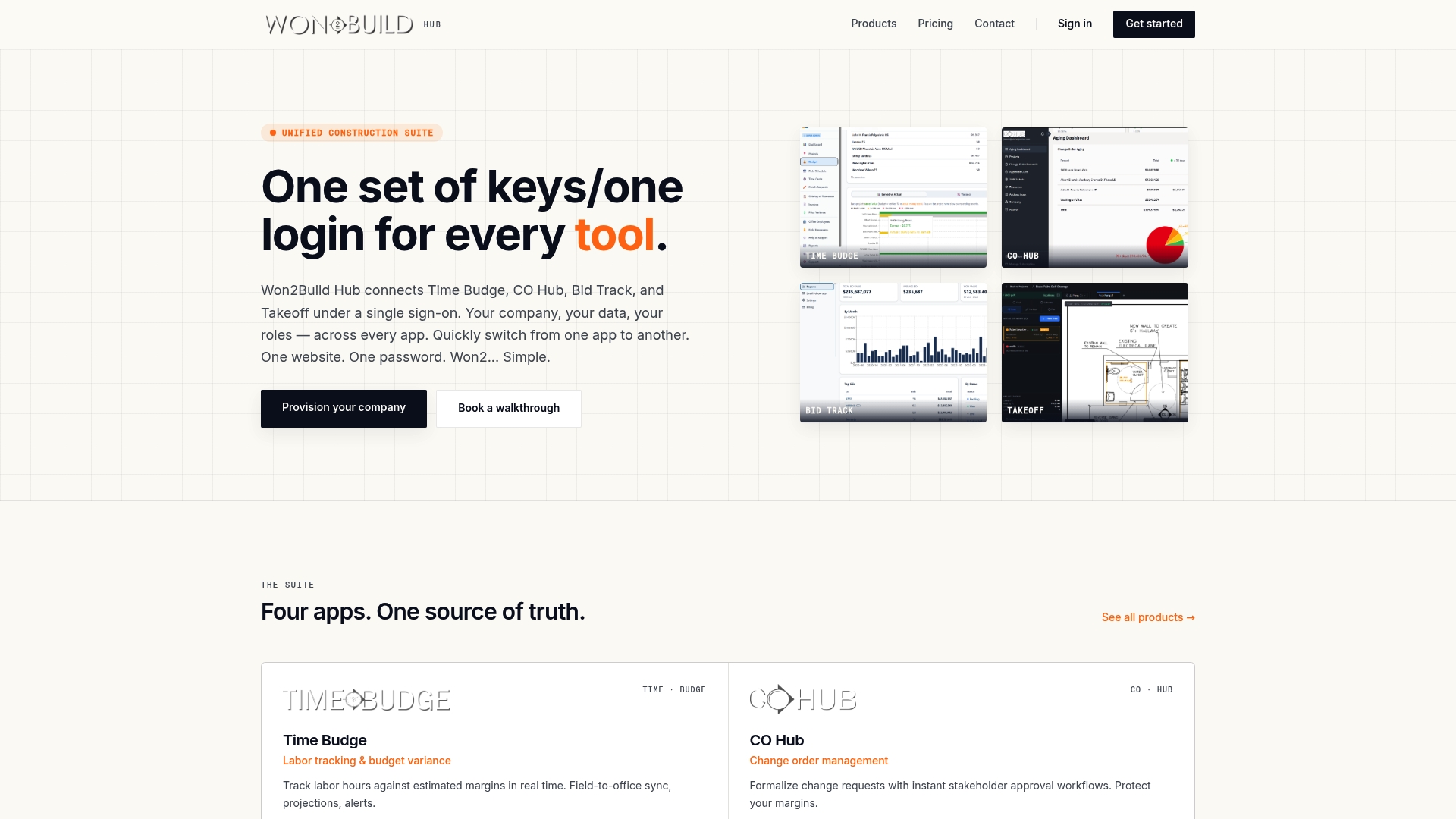
That audit trail matters most when a markup gets challenged months later. Instead of digging through emails, you pull up a timestamped record tied to the original notice, the cost backup, and the approval chain. CO Hub is a subscription-based application that syncs data between the field and the office in real time, so the super logging a change on-site and the estimator pricing it back at the trailer are working off the same data. It’s also part of Won2Build Hub, the full suite that adds labor tracking, bid estimating, and digital takeoff under one login. Check current pricing and plans or start a trial to see how it handles your next batch of change orders.
Sources
The figures and contract framing in this article draw on estimator practice, standard-form contract guidance, and construction management research. For deeper reading:
- AACE International change order procedures guidance
- How to Price Construction Change Orders (EstimatorSuite)
- Change order management guide (ToolGrit)
- ASCE analysis of change-order pricing
- Microsoft Dynamics 365: change order management capabilities (2026 release plan)
FAQ
What Is an Acceptable Change Order Percentage?
Confirm your contract doesn’t specify a different cap, since AIA, federal FAR, and ConsensusDocs agreements each handle this differently.
What Is the Standard Pricing Method for Construction Change Orders?
Standard practice prices the change order as its own mini-contract: direct cost plus a markup for overhead and profit, rather than reusing your original bid’s efficiency. This approach reflects guidance from estimator resources on pricing change orders, which recommend higher percentages on smaller, more disruptive changes.
What Should a Change Order Include?
A defensible change order itemizes direct labor, materials, equipment, subcontractor quotes, remobilization costs, and schedule impact, then applies overhead and profit on top. Attaching sub quotes and supplier invoices as backup, as CO Hub does automatically, makes the pricing much harder to dispute later.
What Is a Reasonable Markup for Subcontractors?
Always confirm whether the sub’s quote already includes its own overhead and profit before layering yours on top.
Recommended
One login for estimating, bid tracking, change orders, and labor.
The Hub is free. Pay only for the apps you turn on.
Create your free Hub account- Managers: Make Mobile Field Workflows Resilient for 72 Hour OutagesPlaybook for field managers: offline first mobile workflows, resilient sync and conflict handling, compliance first AI guardrails, and practical pilot steps.
- Daily Signed Records: Force Account Tracking for Managers & InspectorsField checklist for project managers and inspectors to keep force account tracking audit-ready: use daily signed records for labor, equipment, and...
- Stop Timecard to Report Drift: Labor Cost Codes for SubcontractorsFix the timecard to report chain with labor cost codes that tie crews to budgets. Includes a 6 code starter and a burdened rate example.