
Construction Estimate Components List: 2026 Field Guide
Discover the essential construction estimate components list for 2026. Ensure accuracy and avoid cost overruns with this comprehensive guide.

A construction estimate components list is the structured catalog of every cost element a project requires, from raw materials to profit margin, organized so nothing gets missed and every number can be defended. Nearly 90% of construction projects face cost overruns, and incomplete estimates are the leading cause. The industry standard for organizing these components is CSI MasterFormat, which divides costs into numbered divisions that map directly to trade scopes. AACE International defines estimate classes from Class 5 (conceptual) to Class 1 (definitive), giving estimators a shared language for accuracy expectations. A complete building estimate checklist covers direct costs, indirect costs, overhead, contingency, and profit, all structured so any reviewer can trace every dollar back to a quantity and a unit price.
1. What belongs on a construction estimate components list
A complete construction estimate components list divides costs into two master categories: direct costs and indirect costs. Direct costs are expenses tied directly to physical construction work. Indirect costs cover everything that supports the project without touching the structure itself. Missing either category produces a budget that will fail before the first invoice arrives.
The construction cost breakdown structure that holds up under scrutiny includes these primary line items:
- Direct costs: labor, materials, equipment, and subcontractor scopes
- Indirect costs: general conditions, project management, insurance, permits, and bonding
- Soft costs: architectural and engineering fees, legal, financing, and inspections
- Contingency reserve: a risk-calibrated buffer, not a flat percentage
- Overhead and profit: company overhead allocation plus the target margin
Each category needs its own section in the estimate document. Mixing them into a single lump sum destroys auditability and makes scope disputes nearly impossible to resolve.
2. Labor costs: the highest-risk line item

Labor is the largest source of errors in any construction cost breakdown. The fix is to price labor using fully burdened crew rates rather than bare wages. A fully burdened rate includes base pay, payroll taxes, workers’ compensation, health benefits, union fringes if applicable, and small tool allowances. That total rate, multiplied by hours per unit of work, gives you a defensible number.
Unit hours are the key input. Instead of estimating “electricians for three weeks,” price by unit: hours per linear foot of conduit, hours per fixture, hours per panel. This method forces you to count the actual scope before you price it, which is exactly the discipline that separates accurate estimates from wishful thinking.
Pro Tip: Build a labor rate sheet as a separate tab in your estimate workbook. Reference it with named ranges so every crew rate updates automatically when wages change. One edit propagates everywhere, and you eliminate the manual entry errors that inflate or deflate labor totals.
3. Material costs and systematic takeoffs
Material costs require a quantity takeoff before any pricing can begin. A material takeoff counts every unit of every material the project requires, measured in the units your supplier quotes: linear feet, square feet, cubic yards, each, or tons. Pricing a material before you have a confirmed quantity is guessing, not estimating.
Waste factors belong in every material line item. Concrete gets a 5–10% waste factor for form spillage and over-pour. Framing lumber carries 10–15% for cuts and defects. Tile and flooring typically add 10% for cuts and breakage. Skipping waste factors is one of the most common reasons material budgets run short on residential and commercial jobs alike.
Unit pricing should come from current supplier quotes, not from memory or last year’s bid. Material prices shift with supply chain conditions, and accurate takeoffs tied to current pricing are the only reliable foundation for a competitive bid.
4. Equipment costs: rental, ownership, and scheduling
Equipment costs split into two models: rental and ownership. Rental pricing is straightforward. You take the daily or weekly rate, multiply by the scheduled duration, and add mobilization and fuel. Ownership costs require a different calculation that includes depreciation, maintenance reserves, insurance, and the opportunity cost of capital tied up in the asset.
Operator wages belong in the equipment section, not the labor section, when the operator is dedicated to a single piece of equipment for the duration of its use. Separating operator costs from general labor prevents double-counting and keeps the estimate auditable by trade.
Scheduling is the variable most estimators underestimate. Equipment sitting idle on a job site still costs money. Build your equipment schedule from the construction sequence, not from a rough guess about project duration. A concrete pump needed for two pours should be priced for two days plus mobilization, not for the full project duration.
5. General conditions and indirect cost components
General conditions typically account for 5–8% of hard costs and cover the site infrastructure that makes construction possible without directly producing any finished work. This percentage matters because it is large enough to swing a bid from profitable to break-even if omitted.
General conditions line items include:
- Site mobilization and demobilization
- Temporary fencing, signage, and site security
- Portable toilets and wash stations
- Dumpsters and ongoing waste disposal
- Temporary power, water, and lighting
- Job site trailer or office setup
- Daily and final cleanup
Each of these items needs its own line in the estimate. Bundling them into a single “general conditions” lump sum makes it impossible to verify the number or adjust it when scope changes.
6. Soft costs, permits, and insurance
Soft costs are the non-construction expenses that every project carries. Architectural and engineering fees typically run 5–15% of construction cost on commercial projects, depending on complexity. Permit fees vary by jurisdiction but must be researched and itemized, not estimated as a round number. Legal fees, financing costs, and owner-paid inspections all belong in this section of the construction budgeting list.
Insurance is a direct cost of doing business and must appear as a named line item. General liability, builders risk, and any project-specific coverage need individual entries with confirmed premium amounts. Bonding costs for performance and payment bonds belong here as well, typically calculated as a percentage of the contract value.
Pro Tip: Call your insurance broker at the start of every major bid. Premium rates change, and a stale rate from a prior project can understate your actual cost by thousands of dollars on a large contract.
7. Contingency reserves: calibrated, not generic
Contingency buffers start at 5–10% of hard costs as a minimum, but that range is a starting point, not a formula. The right contingency for a ground-up commercial build in a new market is not the same as the right contingency for a tenant improvement in a building you have worked in before. Contingency allocations should reflect project-specific risks rather than a standard percentage applied uniformly.
Risk factors that justify a higher contingency include incomplete drawings, unknown subsurface conditions, long lead times on specialty equipment, and first-time work with a new owner or design team. Risk factors that justify a lower contingency include complete construction documents, familiar site conditions, and a repeat client relationship with a clear scope.
Document your contingency rationale in the estimate. If a dispute arises later, a written explanation of why you set the contingency at 12% instead of 8% is far more defensible than a number with no context.
8. Markup vs. margin: getting profit right
A 25% markup does not equal a 25% margin. A 25% markup equals a 20% margin, and confusing the two is a reliable way to underprice work. Markup is calculated on cost. Margin is calculated on revenue. If your target is a 20% gross margin, you need to apply a 25% markup to your total costs.
Overhead allocation belongs in the estimate before profit is applied. Company overhead includes office rent, administrative salaries, software subscriptions, vehicles, and any cost not tied to a specific project. Divide your annual overhead by your projected annual revenue to get an overhead rate, then apply that rate to each estimate as a percentage of direct costs.
Profit margin expectations vary by project type and market conditions. Subcontractors on competitive bid work often operate at 10–15% gross margin. Negotiated or design-build work can support higher margins because the competitive pressure is lower.
9. Structural organization using CSI MasterFormat
CSI MasterFormat organizes construction costs into numbered divisions, from Division 01 (General Requirements) through Division 49 (Waterway and Marine Construction). Using these divisions as your estimate structure means any owner, architect, or auditor can navigate your document without a guide. A complete estimate includes a detailed header, scope of work description, itemized takeoffs organized by division, subcontractor slots, overhead, profit, contingency, exclusions, and assumptions.
The three-tab spreadsheet system is the most reliable digital structure for estimate project components. Separating takeoff quantities from pricing into distinct tabs, with a bid summary tab that pulls from both, prevents the formula errors that occur when quantity and price live in the same cell. Named ranges link the tabs so a quantity change in the takeoff tab flows automatically to the cost total.
Clearly labeling estimates as projections with expiration dates of 15–30 days protects you from price volatility. Material prices move, and an estimate without an expiration date is an open-ended commitment you never agreed to make.
10. Common pitfalls and how to avoid them
The most damaging estimating error is the template-first approach. Starting with a saved estimate from a prior job and editing it for the new project skips the drawing review that reveals scope differences. Estimates must start with thorough drawing and specification reviews before any pricing begins. The template is a formatting tool, not a substitute for takeoff.
Separate, auditable line-item breakouts increase defensibility and make cost control possible during construction. A lump sum for “electrical rough-in” cannot be compared against actual costs at project completion. An itemized breakout by system, floor, or phase can be tracked weekly against field progress.
Validation is the final step most estimators skip. Build a validation column into your spreadsheet that flags any line item with a zero quantity, a missing unit price, or a total that falls outside a reasonable range for that scope. Conditional formatting in Excel or Google Sheets can highlight these cells automatically, turning a manual review into a two-minute scan.
Pro Tip: Add an “exclusions and assumptions” section at the bottom of every estimate. List what is not included and what conditions you assumed. This single habit eliminates the majority of scope disputes before they start.
Key takeaways
A complete construction estimate components list requires direct costs, indirect costs, contingency, and profit to be itemized separately. Lump sums and missing categories are the primary drivers of cost overruns and contract disputes.
| Point | Details |
|---|---|
| Labor is the highest-risk line item | Use fully burdened crew rates and unit hours to prevent underestimation. |
| General conditions need explicit budgeting | These indirect costs run 5–8% of hard costs and must be itemized, not bundled. |
| Contingency must reflect actual risk | Calibrate your buffer to project-specific conditions, not a standard percentage. |
| Markup and margin are not the same | A 25% markup equals a 20% margin. Confusing them underprices your work. |
| Expiration dates protect contractors | Label estimates as projections with a 15–30 day validity window to avoid stale pricing disputes. |
Why I think most estimators undervalue structure
I have reviewed hundreds of estimates over the years, and the ones that cause the most damage are not the ones with wrong numbers. They are the ones with no structure. A number buried in a lump sum is impossible to defend, impossible to track, and impossible to learn from after the job closes.
The estimators who consistently win profitable work share one habit: they treat the estimate document as a communication tool, not just a pricing exercise. A well-organized estimate tells the owner what they are buying, tells the field what they are building, and tells the accounting team what to track. That clarity builds trust faster than any sales pitch.
Won2build’s approach resonates with me because it connects the estimate to the rest of the project workflow. When your takeoff quantities feed directly into your bid and your bid connects to your change order process, you are not just estimating. You are building a data trail that protects your margin from the first line item to the final invoice. That is what a professional estimating process looks like in practice.
The industry frameworks, CSI MasterFormat, AACE estimate classes, and the three-tab spreadsheet discipline, exist because experienced estimators learned the hard way what happens without them. Adopt them before you need them, not after a painful overrun teaches you why they matter.
— Jen Reese
Won2build tools built for accurate construction estimates
Estimators who want their components list to drive real project outcomes need software that connects takeoff to bid to change order without manual re-entry.
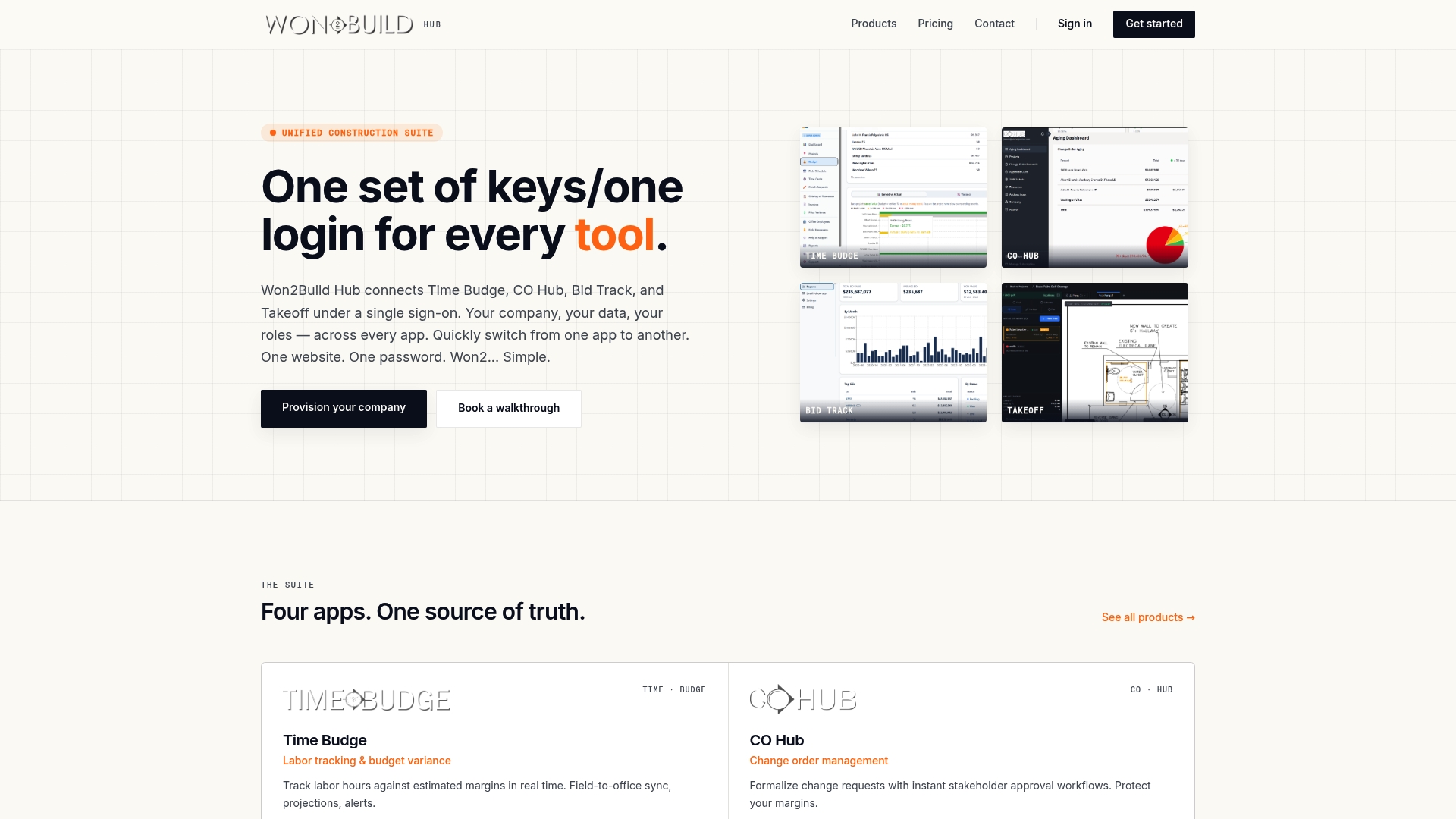
Won2build’s Bid Track manages your entire bid pipeline and estimate workflow in one place, so your components list becomes a living document rather than a static spreadsheet. The Takeoff application lets you measure quantities directly from digital plans, feeding accurate counts into your estimate without transcription errors. When scope changes after award, CO Hub tracks every change order against the original estimate, keeping your budget current through every project phase. Together, these tools put the best practices covered in this guide into daily practice.
FAQ
What are the main components of a construction estimate?
A construction estimate includes direct costs (labor, materials, equipment, subcontractors), indirect costs (general conditions, insurance, permits), soft costs, contingency, overhead, and profit margin. Each category requires its own itemized line items for the estimate to be auditable.
How do I calculate contingency in a construction estimate?
Start with a minimum of 5–10% of hard costs, then adjust upward based on project-specific risks such as incomplete drawings, unknown site conditions, or long lead times on materials. Document your reasoning in the estimate.
What is the difference between markup and margin in construction?
Markup is calculated on cost; margin is calculated on revenue. A 25% markup on costs equals a 20% gross margin. Applying the wrong formula consistently underprices your work.
Why should construction estimates have expiration dates?
Estimates labeled as projections with a 15–30 day expiration window protect contractors from material price changes and scope creep. Without an expiration date, a contractor can be held to pricing that no longer reflects current market conditions.
What is CSI MasterFormat and why does it matter for estimating?
CSI MasterFormat is the industry-standard numbering system that organizes construction costs into divisions by trade and scope. Using it as your estimate structure makes your document readable by any owner, architect, or auditor without additional explanation.
Recommended
One login for estimating, bid tracking, change orders, and labor.
The Hub is free. Pay only for the apps you turn on.
Create your free Hub account- How to Compare Plan Revisions and Control Estimate ChangesA practical guide for commercial subcontractors on comparing plan revisions, catching scope changes, and keeping estimates and change orders in step.
- Drywall Takeoff Basics: A Step-by-Step Guide for SubsLearn drywall takeoff basics: how to measure walls and ceilings, deduct openings, convert to sheets, set waste and finish levels, and avoid costly misses.
- How to Reduce Profit Fade on Subcontractor JobsProfit fade usually starts in the field and hides until closeout. Here is how subcontractors can catch it weekly and protect the margin they bid.