
Commercial Project Budget Baseline: A Complete Guide
Learn what a commercial project budget baseline is and why it’s crucial for financial control. Master your project’s cost management today!

What is a commercial project budget baseline?
A commercial project budget baseline, known formally as the cost baseline, is the approved, time-phased budget that excludes management reserves and serves as the primary benchmark for measuring and controlling financial performance throughout a project’s lifecycle. Think of it as the financial contract you make with yourself before a single shovel hits the ground. Once approved, it becomes a locked reference point. Every dollar spent gets measured against it.
The cost baseline is also referred to as the Budget at Completion (BAC) in PMI’s PMBOK framework. That matters because it clarifies exactly what the baseline represents: the total authorized cost for completing the defined scope, spread across time.
Here’s what the cost baseline includes and excludes:
- Approved work package cost estimates for all defined project activities
- Contingency reserves allocated for known, identified risks
- Time-phased distribution aligned to the approved project schedule
- Exclusion of management reserves, which address unknown risks and sit outside the baseline
- Integration with scope and schedule baselines to form the Performance Measurement Baseline (PMB)
Why a budget baseline matters for commercial project success
Without a fixed financial reference point, cost control becomes guesswork. The baseline gives project managers a concrete target to track against, turning raw spending data into meaningful variance signals.

A well-established cost baseline does several things at once. It enables early detection of cost overruns before they compound. It creates financial accountability across the project team. And it supports proactive decisions, like redeploying resources from low-priority tasks or cutting non-essential procurement, before spending spirals past recovery.
Key benefits project managers rely on:
- Variance detection: compare actual costs to planned costs at any reporting period
- Early warning system: flag deviations before they become budget crises
- Financial accountability: every expenditure traces back to an approved work package
- Forecasting accuracy: a stable baseline makes Estimate at Completion (EAC) calculations reliable
- Stakeholder communication: sponsors and owners get a clear picture of financial health
Statistic callout: Management reserves typically constitute 5–10% of the total project budget per PMI PMBOK standards. Keeping those reserves separate from the cost baseline is what preserves the baseline’s integrity as a performance measurement tool.
What goes into a cost baseline?
The cost baseline is not simply a lump-sum budget number. It’s a structured breakdown of every authorized cost, organized by work package and spread across the project timeline.
Included in the cost baseline:
- Work package estimates: direct costs such as labor, materials, equipment, and subcontractor fees, calculated at the work-package level using a Work Breakdown Structure (WBS)
- Contingency reserves: funds set aside for identified risks with a known probability of occurring; these are part of the baseline because they cover foreseeable uncertainty
- Indirect costs: overhead, facilities, software licenses, and training tied to specific project activities
- Time-phased distribution: the budget spread across schedule periods, creating the S-curve that Earned Value Management uses as its Planned Value (PV) reference
Excluded from the cost baseline:
- Management reserves: held by program leadership for unknown-unknown risks; accessing them requires a formal change request, not a routine budget draw
The formula is straightforward:
A time-phased baseline aligned to the project schedule is what makes variance tracking meaningful. Without that time dimension, you cannot tell whether a cost deviation happened because of a schedule slip or an actual cost overrun.
Cost baseline vs. overall project budget: what’s the difference?
Project managers and construction professionals use these terms interchangeably all the time. They are not the same thing, and confusing them creates real problems during financial reporting.
| Aspect | Cost baseline | Project budget |
|---|---|---|
| Definition | Approved, time-phased budget for performance measurement | Total approved funding including all reserves |
| Includes | Work package costs + contingency reserves | Cost baseline + management reserves |
| Nature | Time-phased across the project schedule | Reflects total cost; not necessarily time-phased |
| Purpose | Cost performance measurement and variance tracking | Funding, planning, and financial approvals |
| Flexibility | Fixed; changes require formal approval | Can be adjusted using management reserves via change request |
The practical difference shows up during execution. If actual costs exceed the baseline, the project manager triggers corrective action. If costs exceed the total project budget (baseline plus management reserves), the project has a funding problem that requires sponsor intervention.
Management reserves address unknown-unknown risks and require separate handling from baseline funds. Blending them into the baseline reduces performance measurement accuracy and makes it harder to tell whether the project is genuinely on track.
How to create and establish a cost baseline
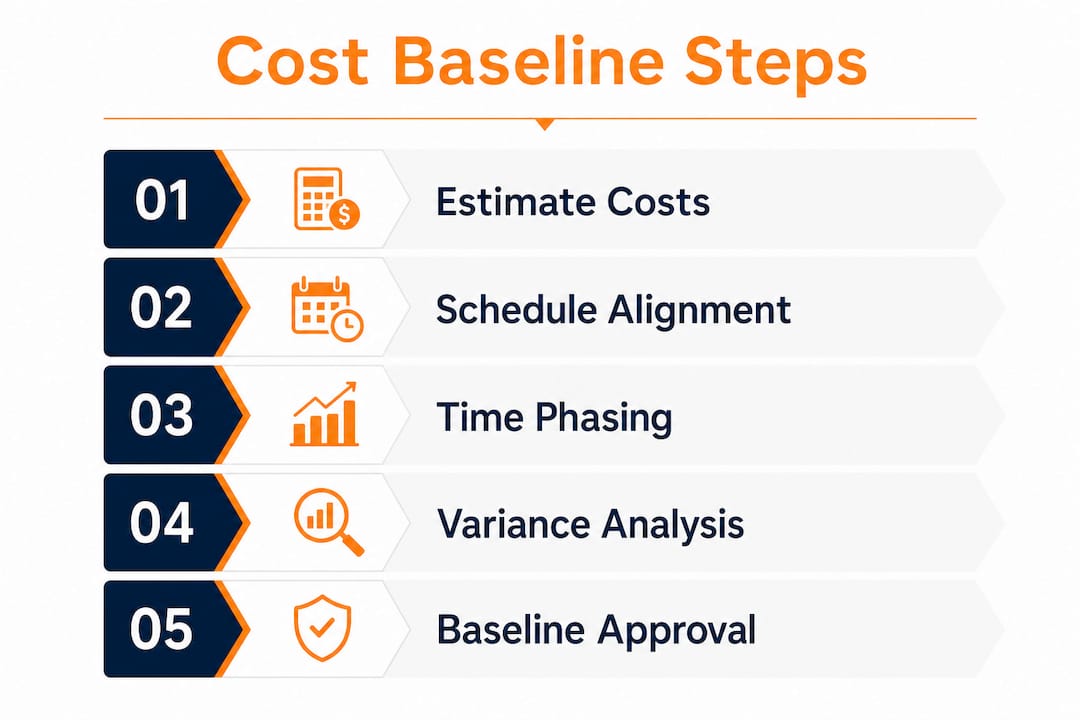
Creating a cost baseline is a structured process. Rushing it or skipping steps produces a baseline that erodes within weeks of project kickoff.
Step-by-step process:
- Define the scope completely. The baseline cannot be built on a vague scope. Start with a fully approved Work Breakdown Structure that captures every deliverable.
- Estimate costs at the work-package level. Calculate direct and indirect costs for each WBS element: labor hours, material quantities, equipment rates, and subcontractor fees.
- Identify risks and assign contingency reserves. For each known risk, estimate the likely cost impact and probability. Add contingency reserves to the relevant work packages.
- Align the budget to the project schedule. Spread costs across schedule periods to create the time-phased Planned Value curve. This is the S-curve that EVM depends on.
- Present for formal approval. The cost baseline must be formally approved by the project sponsor or change control board before execution begins.
- Lock the baseline and enforce change control. Once approved, the baseline is fixed. Any modification requires a documented change request, review, and approval through the governance workflow.
For commercial construction projects, this process often ties directly to the commercial bid estimating process, where the detailed estimate becomes the foundation of the site budget.
Pro Tip: Protect your baseline from the start by tying every scope addition to a formal change order before any work begins. Informal scope creep, where field teams absorb small additions without documentation, is the fastest route to baseline erosion.
Common mistakes that undermine baseline integrity
Most baseline failures are not caused by bad estimates. They’re caused by poor discipline after the baseline is set.
- Confusing contingency reserves with management reserves. Contingency is inside the baseline and covers known risks. Management reserves are outside it and cover unknowns. Treating them as interchangeable destroys the baseline’s accuracy as a measurement tool.
- Updating the baseline without formal approval. This is the most common error. Project managers adjust numbers to match actual spending, which makes the baseline meaningless. Updating without proper approval leads to baseline erosion and loss of financial control.
- Failing to time-phase the budget. A lump-sum baseline with no schedule alignment cannot support Earned Value Management. You need Planned Value by period to calculate Cost Performance Index (CPI) and Schedule Performance Index (SPI).
- Absorbing scope changes without a change order. When field teams complete work outside the original scope without documentation, the baseline no longer reflects reality. Scope changes without baseline updates make original benchmarks meaningless.
- Overwriting baseline data with management reserves. Pulling from management reserves without a formal change request and then recording it as a baseline adjustment corrupts the performance record.
- Failing to communicate baseline changes to stakeholders. When the baseline shifts, everyone tracking project performance needs to know. Silent updates create conflicting reports and erode trust.
For a broader look at job costing mistakes that affect baseline accuracy, trade subcontractors face many of the same pitfalls across disciplines.
How to monitor and control the cost baseline
Establishing the baseline is only half the job. Monitoring it consistently throughout execution is where most projects either hold the line or lose control.
Core monitoring techniques:
- Earned Value Management (EVM): the most reliable method for tracking financial performance. EVM compares Planned Value (PV), Earned Value (EV), and Actual Cost (AC) to produce variance metrics like Cost Variance (CV) and CPI. Without a time-phased baseline, EVM produces meaningless numbers.
- Variance analysis: at each reporting period, calculate the difference between planned and actual costs. A negative Cost Variance signals overspending; a positive one signals underspending.
- Corrective action triggers: when actual spending exceeds the baseline, corrective resource allocations or scope adjustments are necessary to bring costs back in line.
- Reforecasting: update the Estimate at Completion (EAC) regularly based on current CPI to give stakeholders an accurate picture of where the project will finish financially.
- Change control process: any budget modification goes through the formal change control board. This preserves the baseline’s integrity as an auditable record.
- Real-time cost tracking: digital tools that sync field labor and material costs to the office in real time reduce the lag between spending and reporting, giving managers a chance to act before variances compound.
Statistic callout: The cost baseline serves as the reference point for all cost control and reporting. When actual spending exceeds it, corrective resource allocation or scope adjustment is required to prevent further overrun.
Setting up project budget tracking from day one gives field and office teams a shared view of where costs stand against the approved baseline at any moment.
A practical example: cost baseline in a commercial construction project
Consider a commercial tenant improvement project with a total cost baseline of $550,000, phased across six months.

| Month | Planned value (cumulative) | Actual cost (cumulative) | Cost variance |
|---|---|---|---|
| Month 1 | — | — | +$3,000 |
| Month 2 | — | — | +$2,000 |
| Month 3 | — | — | -$25,000 |
| Month 4 | — | — | -$40,000 |
| Month 5 | — | — | -$40,000 |
| Month 6 | $550,000 | — | -$40,000 |
The project started on track. By month 3, a material price spike and unplanned rework pushed actual costs $25,000 above the baseline. By month 4, the variance had grown to $40,000, where it held through completion.
The lesson here is not that the overrun was inevitable. It’s that the baseline made the problem visible at month 3, not at project closeout. A project manager monitoring EVM metrics at each reporting period had a window to act: renegotiate a material contract, reduce scope on a lower-priority finish item, or request management reserve access through a formal change request. Without the baseline, that window doesn’t exist.
Expert perspective: maintaining baseline integrity with the right tools
Disciplined change control is the single most important factor in keeping a cost baseline useful. A baseline that gets quietly adjusted to match actual spending is no longer a performance measurement tool. It’s just a running total.
Construction professionals who maintain baseline integrity share a few consistent practices:
- Treat the baseline as a contract, not a suggestion. Any deviation triggers a formal review, not an informal adjustment.
- Keep management reserves completely separate from contingency reserves in your cost tracking system. Mixing them obscures whether overruns are coming from known risks or genuine unknowns.
- Document every change request, even small ones. In regulated or publicly funded environments, formal change control and sponsor approval create the audit trail that protects the project team.
- Use digital tools that enforce the separation. Manual spreadsheets make it too easy to overwrite baseline figures. Integrated software that locks the baseline and routes changes through an approval workflow removes that temptation.
Won2build’s Time Budge application tracks labor costs in real time, feeding actual field data directly into budget comparisons against the approved baseline. The CO Hub module manages change orders through a documented workflow, so every baseline adjustment carries a paper trail. For subcontractors managing multi-phase commercial bids, that kind of integration between cost tracking and change management is what keeps the baseline meaningful from phase to phase.
Pro Tip: Integrate your cost baseline into your project management software before execution begins, not after the first variance appears. Real-time data sync between field and office means you catch cost deviations in days, not months.
Commercial projects require digital tools that connect baseline budgeting, labor tracking, and change order management in one place. Fragmented systems, where estimates live in one spreadsheet and change orders in another, are where baseline erosion quietly takes hold.
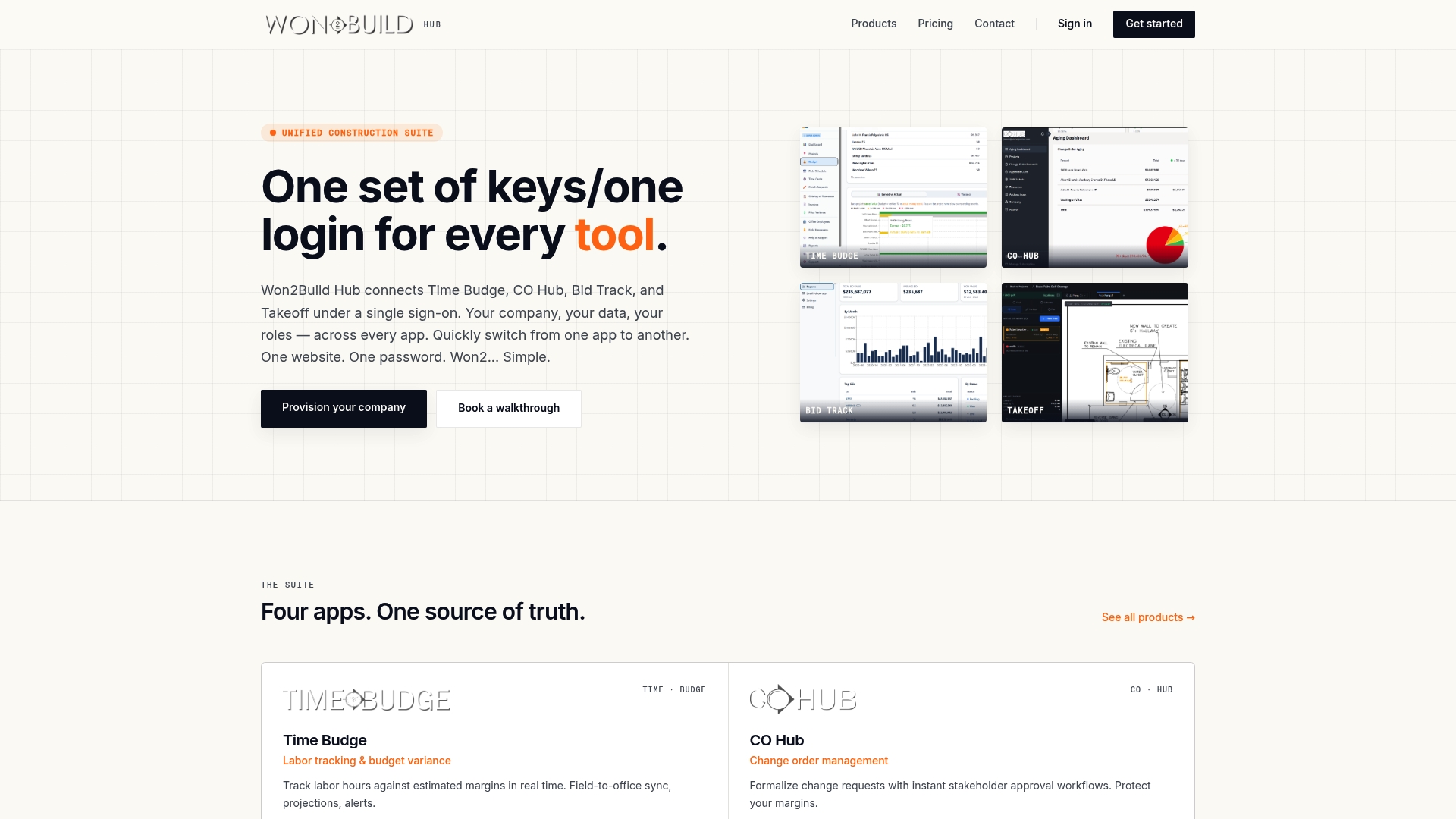
Won2build’s suite gives construction subcontractors a single platform to set, track, and protect their cost baseline from bid through closeout. Explore the Takeoff tool to see how precise quantity takeoffs feed directly into accurate cost baselines for commercial projects.
Key Takeaways
A commercial project budget baseline is the approved, time-phased cost plan that excludes management reserves and serves as the fixed benchmark for measuring every dollar spent against what was planned.
| Point | Details |
|---|---|
| Cost baseline definition | The approved, time-phased budget excluding management reserves; also called the Budget at Completion (BAC). |
| Management reserves | Constitute 5–10% of total project budget and sit outside the cost baseline; access requires a formal change request. |
| Baseline vs. project budget | The project budget equals the cost baseline plus management reserves; they serve different purposes and must stay separate. |
| Baseline erosion risk | Updating the baseline without formal approval or absorbing scope changes without change orders makes the original benchmarks meaningless. |
| EVM dependency | Earned Value Management requires a time-phased baseline to calculate Planned Value and produce reliable Cost Performance Index metrics. |
Recommended
One login for estimating, bid tracking, change orders, and labor.
The Hub is free. Pay only for the apps you turn on.
Create your free Hub account- How to Compare Plan Revisions and Control Estimate ChangesA practical guide for commercial subcontractors on comparing plan revisions, catching scope changes, and keeping estimates and change orders in step.
- Drywall Takeoff Basics: A Step-by-Step Guide for SubsLearn drywall takeoff basics: how to measure walls and ceilings, deduct openings, convert to sheets, set waste and finish levels, and avoid costly misses.
- How to Reduce Profit Fade on Subcontractor JobsProfit fade usually starts in the field and hides until closeout. Here is how subcontractors can catch it weekly and protect the margin they bid.