
Benefits of Cloud Based Takeoff Software for Contractors
Discover the benefits of cloud based takeoff software for contractors. Improve accuracy, speed up estimates, and boost profits across projects.

Cloud based takeoff software is defined as a web-accessible platform that digitizes construction quantity measurements, stores project plans centrally, and syncs all calculations in real time. The benefits of cloud based takeoff software go far beyond basic convenience. Construction professionals gain faster estimates, fewer costly errors, and the ability to collaborate across job sites and offices without version conflicts. Platforms like Won2build bring these advantages together in one connected suite, giving subcontractors a direct path to more accurate bids and stronger profit margins.
What are the main efficiency benefits of cloud based takeoff software?
Cloud based takeoff software cuts the time estimators spend on manual measurement by automating calculations and centralizing all project data. Instead of redrawing lines on paper or hunting through email chains for the latest plan set, your team works from one live source.
The efficiency gains show up in several concrete ways:
- Automated quantity calculations handle the math in the background, so estimators focus on scope review rather than arithmetic.
- Reusable templates let teams apply standard assemblies from past projects to new bids, cutting setup time significantly.
- Centralized storage means no one wastes time searching shared drives or email folders for the right drawing version.
- Real-time updates push changes to every user instantly, preventing rework caused by outdated information.
- Web browser access removes the need for local software installation, so estimators can start working from any device without IT delays.
Cloud-based estimating software accelerates bid turnaround by automating takeoff quantities and reusing templates. That speed directly translates to more bids submitted per month and more revenue opportunities captured.
Pro Tip: Build a library of standard takeoff templates organized by trade or project type. Reusing them on similar bids can cut your setup time in half and keep your measurements consistent across the team.

How does cloud based takeoff software improve accuracy and reduce costly errors?
Manual takeoffs fail in predictable ways: transposed numbers, outdated drawing versions, and unit inconsistencies that compound across a bid. Cloud takeoff software removes most of those failure points by design.
Key accuracy improvements include:
- Automatic unit consistency so linear feet never get confused with square feet mid-calculation.
- Always-current drawings because the platform stores the latest uploaded set and flags superseded versions.
- Single data source that eliminates the version control problem entirely. Every estimator works from the same file.
- Documented assumptions attached directly to measurements, so reviewers can audit quantities without guessing.
- Direct integration with estimating that pushes quantities into cost databases without re-entry.
Cloud takeoff software centralizes digital plans and measurements in one connected space, enabling real-time updates and reducing costly manual errors. That single-source approach is what separates cloud platforms from desktop tools or spreadsheets, where each user maintains a separate file.
Underbidding caused by missed quantities is one of the most damaging errors a subcontractor can make. Accurate takeoff measurements protect your margin before the project even starts.
Pro Tip: After completing a takeoff, push quantities directly into your estimating workflow before finalizing the bid. The cross-check between takeoff totals and cost line items catches unit errors that visual review alone misses.
In what ways does cloud takeoff software enhance collaboration across teams?
Real-time collaboration is the feature that separates cloud platforms from every desktop or spreadsheet-based alternative. When multiple estimators, project managers, and field supervisors access the same live project, information silos disappear.
Here is how that plays out in practice:
- Simultaneous access lets two estimators divide a large project by trade and work in parallel without overwriting each other’s measurements.
- Instant syncing means a project manager reviewing scope in the office sees the same updated quantities the estimator just entered from a job site walk-through.
- Browser-based access removes the barrier of VPN connections or remote desktop sessions. A superintendent can pull up the takeoff on a tablet during a site visit.
- Transparent documentation gives every team member visibility into scope assumptions, reducing disputes during bid review.
- Faster decision-making results from fewer email chains. When a drawing revision arrives, one upload updates everyone simultaneously.
Teams collaborating on cloud platforms experience fewer miscommunications and faster decision-making thanks to instant data syncing. For distributed construction teams managing multiple active bids, that speed advantage compounds across every project.
Cloud access enables construction estimators to work from anywhere, including the office, site, or home, improving flexibility and response time. That flexibility matters most when a bid deadline falls on a Friday afternoon and your lead estimator is on a job site two hours away.
What are the economic and competitive advantages for construction firms?
The business case for cloud takeoff software is straightforward. Faster, more accurate estimates produce better bids, and better bids win more contracts.
Using cloud takeoff software reduces estimating time by automating measurement processes and allowing simultaneous user access. Fewer hours per bid means your team can pursue more opportunities without adding headcount.
Accurate, transparent estimates supported by cloud takeoff lead to better client trust and more competitive bids. Clear quantity documentation and scope breakdowns are easier to share with clients, which reduces disputes and change order friction after award.
Cloud takeoff software empowers smaller teams to produce results competitive with larger firms by leveling the access and tools available. A four-person estimating team using cloud tools can match the output quality of a much larger department relying on manual methods.
The economic benefits also extend to construction risk mitigation. Reducing errors in the estimating phase cuts the likelihood of costly rework, scope disputes, and margin erosion during construction.
| Benefit category | What it delivers |
|---|---|
| Efficiency | Faster takeoffs, more bids submitted per cycle |
| Accuracy | Fewer unit errors, current drawings always in use |
| Collaboration | Real-time access for all team members, no version conflicts |
| Economics | Lower estimating overhead, stronger bid confidence |
| Scalability | Small teams compete with larger estimating departments |
What best practices support successful adoption of cloud takeoff software?
Adopting cloud takeoff software delivers full value only when the team uses it consistently and correctly. The technology solves the data problem. The workflow solves the human problem.
Practical steps that support a successful rollout:
- Verify internet reliability at your primary office and any remote sites where estimators work regularly. Cloud tools require a stable connection to sync correctly.
- Train every team member on the same workflow so measurements follow a consistent naming convention and folder structure.
- Build and maintain a cost library tied directly to your takeoff templates. Linked costs reduce re-entry and keep estimates aligned with current material pricing.
- Upload drawings immediately when revisions arrive. A stale drawing in a cloud platform causes the same errors as a stale spreadsheet.
- Communicate changes in real time using the platform’s commenting or notification features rather than separate email threads.
Integrating cloud takeoff and estimating software reduces data re-entry, errors, and manual reconciliation. That integration is the highest-leverage move available to most estimating teams. Won2build’s Takeoff application connects directly with Bid Track, so quantities flow into bid estimates without a separate export step.
Pro Tip: Assign one team member as the drawing manager for each active project. That person controls uploads and version labels, which prevents two estimators from working off different revision sets at the same time.
Key Takeaways
Cloud based takeoff software delivers its greatest value when accuracy, speed, and collaboration work together rather than as isolated features.
| Point | Details |
|---|---|
| Accuracy is the foundation | Centralized drawings and automatic calculations eliminate the version errors that cause underbidding. |
| Speed compounds over time | Reusable templates and automated math let teams submit more bids without adding staff. |
| Collaboration removes silos | Real-time syncing means every team member works from the same live data, regardless of location. |
| Economics favor adoption | Fewer errors and faster turnaround reduce overhead and improve bid win rates. |
| Integration multiplies gains | Connecting takeoff directly to estimating workflows removes re-entry and catches unit errors before bids go out. |
Why cloud takeoff changed how I evaluate construction technology
I have watched construction teams spend entire afternoons reconciling two versions of the same takeoff because one estimator worked from a PDF saved to their desktop and another pulled from the shared drive. The argument was never about skill. It was about data. Cloud takeoff software eliminates that argument entirely, and that is why I consider it a foundational investment rather than a nice-to-have upgrade.
What surprises most project managers is how quickly the collaboration benefit shows up. Within the first month of adoption, teams report fewer “which version is current?” conversations and faster bid reviews because everyone is already looking at the same numbers. The accuracy improvement takes a little longer to quantify, but it shows up in fewer post-award scope disputes and tighter final costs versus estimates.
My honest advice: do not evaluate cloud takeoff tools by their feature lists alone. Evaluate them by how well they connect to your estimating and bid tracking workflows. A takeoff that lives in isolation still requires manual re-entry, which reintroduces the errors you were trying to eliminate. Platforms that integrate bid tracking with takeoff give you the full efficiency gain. Smaller firms especially benefit from this integration because they cannot afford a dedicated data entry role between estimating and bidding.
The firms I have seen get the most out of cloud takeoff are the ones that treat adoption as a workflow redesign, not just a software swap. They rebuild their templates, retrain their teams, and commit to uploading drawings the moment revisions arrive. That discipline is what turns a good tool into a competitive advantage.
— Jen Reese
Won2build’s cloud takeoff solution for construction teams
Won2build’s Takeoff application gives construction subcontractors a purpose-built cloud platform for digital plan quantification, built to work alongside the rest of the Won2build suite.
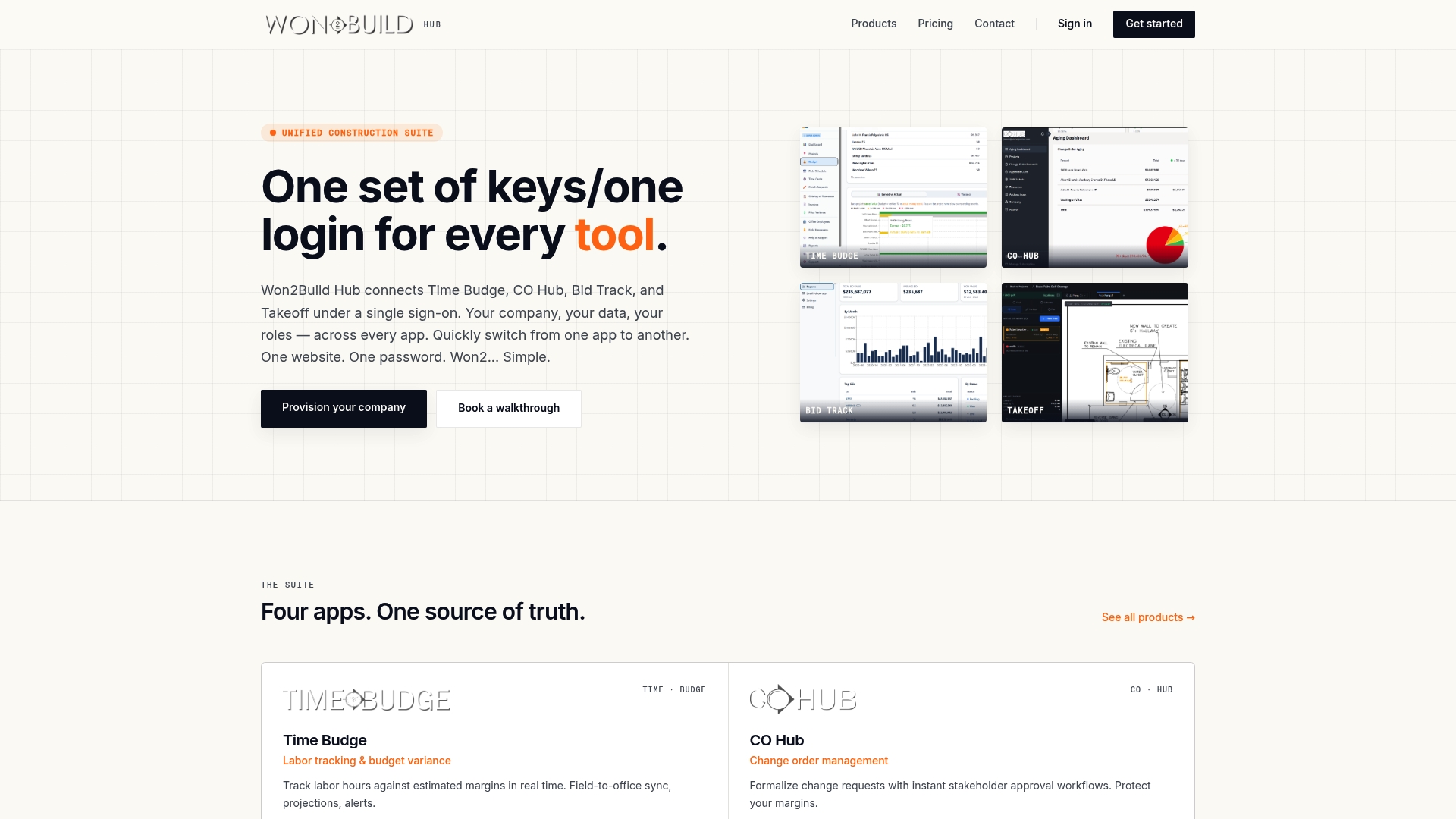
Won2build’s cloud takeoff software connects directly with Bid Track, so quantities move from measurement to bid estimate without re-entry or export files. Every project stays in one place, every team member sees the same live data, and every bid goes out with quantities you can document and defend. For subcontractors protecting tight margins on commercial work, that level of accuracy and integration is not optional. It is the standard. Visit the Won2build Takeoff page to see how the platform fits your estimating workflow, and explore Bid Track to see how the two tools work together.
FAQ
What is cloud based takeoff software?
Cloud based takeoff software is a web-accessible platform that lets construction estimators measure quantities from digital plans, store all project data centrally, and sync updates in real time across every team member.
How does cloud takeoff software reduce estimating errors?
It eliminates version control problems by storing one live drawing set that all users access simultaneously, and it automates calculations so unit errors from manual math do not reach the final bid.
Can small construction firms benefit from cloud takeoff tools?
Cloud takeoff software gives smaller teams professional-level accuracy and collaboration without requiring a large estimating department, leveling the playing field against larger competitors.
How does cloud takeoff software support faster bidding?
Automated measurements, reusable templates, and simultaneous team access cut the hours required per takeoff, allowing estimating teams to pursue more bids within the same time window.
What should I look for when choosing cloud takeoff software?
Prioritize platforms that integrate directly with your estimating and bid management workflow, offer reliable real-time syncing, and support organized cost libraries tied to your standard assemblies.
Recommended
One login for estimating, bid tracking, change orders, and labor.
The Hub is free. Pay only for the apps you turn on.
Create your free Hub account- Change Order Documentation: Subcontractors’ Same Day Field ChecklistLearn how subcontractors can document field changes the same day, support costs and schedule impacts, and carry approved changes into SOV updates.
- Managers: Make Mobile Field Workflows Resilient for 72 Hour OutagesPlaybook for field managers: offline first mobile workflows, resilient sync and conflict handling, compliance first AI guardrails, and practical pilot steps.
- Daily Signed Records: Force Account Tracking for Managers & InspectorsField checklist for project managers and inspectors to keep force account tracking audit-ready: use daily signed records for labor, equipment, and...