
Pilot and Peer Review to Cut Digital Takeoff Errors for Contractors
Run a one project pilot and require a documented scope to quantity peer review before bids. See Won2Build's takeoff workflow as a tested example.

A correct digital takeoff workflow combines 2D measurement, 3D model quantification, locked document version control, and a documented scope-to-quantity peer review before any number goes into a bid. If your team is still doing this manually or with disconnected tools, the single best first step is not a full software rollout but consulting with a commercial, residential & infrastructure construction expert to vet vendors and implementation strategies. It’s a pilot on one live project that defines your data needs, your integration points, and how you’ll measure success before you scale.
TL;DR:
- Confirm project revisions, verify scales, and cross-reference drawings before exporting quantities to prevent common errors like double-counting or unit mismatches.
- Use a documented peer review process run by someone independent of the initial estimate to catch processing gaps and ensure data accuracy.
- Pilot a digital takeoff on a single project with clear metrics for time savings, accuracy improvements, and rework reduction before full team adoption.
- Build standardized templates, define responsibilities, and schedule ongoing training to ensure repeatable, scalable workflow implementation.
- Prioritize process discipline and a thorough pilot over software features alone, as proper procedures significantly impact accuracy and efficiency.
Table of Contents
- What Is the Digital Takeoff Process, Step by Step?
- What Causes Digital Takeoff Errors, and How Do You Catch Them?
- How Do You Choose and Pilot a Takeoff Tool?
- How Do You Roll Out a Digital Takeoff Workflow Across a Team?
- How Won2Build Approaches the Digital Takeoff Workflow
- Why the Pilot Matters More Than the Software
- Try an Integrated Takeoff Workflow With Won2Build
- Sources
- FAQ
What Is the Digital Takeoff Process, Step by Step?
A digital takeoff process turns drawings and models into priced quantities through a repeatable sequence, not a one-off measuring exercise. Skipping steps is exactly how a wrong revision or a missed unit conversion ends up baked into a submitted bid.
Here’s the order that works, drawn from how platforms like Autodesk Forma Takeoff structure the process and how Autodesk’s own workflow documentation sequences project setup:
- Lock the project and control versions. Publish current drawings, lock revisions, and use consistent file naming before anyone touches a measurement tool. Cloud-based document management keeps every estimator working from the same file, which Autodesk’s construction takeoff documentation credits with cutting setup time and eliminating sync errors.
- Run the 2D takeoff. Measure linear runs, areas, and counts directly from published sheets. Classify each item consistently, whether that’s a wall assembly or a duct run, and hold the line on units. Mixing linear feet with square feet in the same takeoff sheet is a classic error that snowballs downstream.
- Bring in the 3D model. Import or condition the model, then map each model element to your takeoff type so the software can generate quantities automatically rather than requiring a second manual pass.
- Combine 2D and 3D outputs. Keep both tied to their source drawing or model view so anyone auditing the number later can trace it back to where it came from.
- Snapshot and export. Every export needs metadata: revision number, date, and author. A quantity without that trail is nearly impossible to defend if a dispute comes up mid-project.
This is the same sequence DPR Construction followed on a pilot project, and running 2D and 3D quantification side by side, rather than in separate silos, is what shortened their setup time.
What Causes Digital Takeoff Errors, and How Do You Catch Them?
Digital tools don’t remove estimating risk. They just move where the risk hides. The Associated General Contractors (AGC) points to a consistent set of failure points that show up regardless of which software a team uses: measuring off the wrong revision, unverified scale on a scanned PDF, double-counting quantities that appear on overlapping plan views, missed specs buried in a general notes sheet, mixed units in a single formula, and exporting numbers without any link back to the source drawing.
None of these are software bugs. They’re process gaps, and every one of them is preventable with a checklist run before quantities leave the estimating desk.
- Confirm the revision. Cross-check the drawing date and revision number against the addenda log.
- Verify scale. Spot-check at least one known dimension against the printed scale bar, especially on scanned sets.
- Cross-reference source drawings. Trace every major quantity back to the sheet it came from.
- Audit formulas. Re-run at least one calculation manually for each major cost category.
- Check units. Confirm every line item uses the correct unit of measure before it hits the estimate.
Pro Tip: Assign one person, not the original estimator, to run the scope-to-quantity checklist. A second set of eyes catches the errors the first estimator is too close to see.
The peer review itself should be documented, not informal. Name a reviewer who is not the original takeoff author, define exactly what they’re signing off on (revision, scale, units, formula logic), and log every correction with a timestamp. That log becomes your evidence trail if a bid gets challenged.
How Do You Choose and Pilot a Takeoff Tool?
Before evaluating any construction takeoff software, map your current process and write down exactly what data needs to move where. What file formats does your model come in? Does your estimating software need an API connection or will a manual export work for now? Get specific here, because vague requirements produce vague pilots.
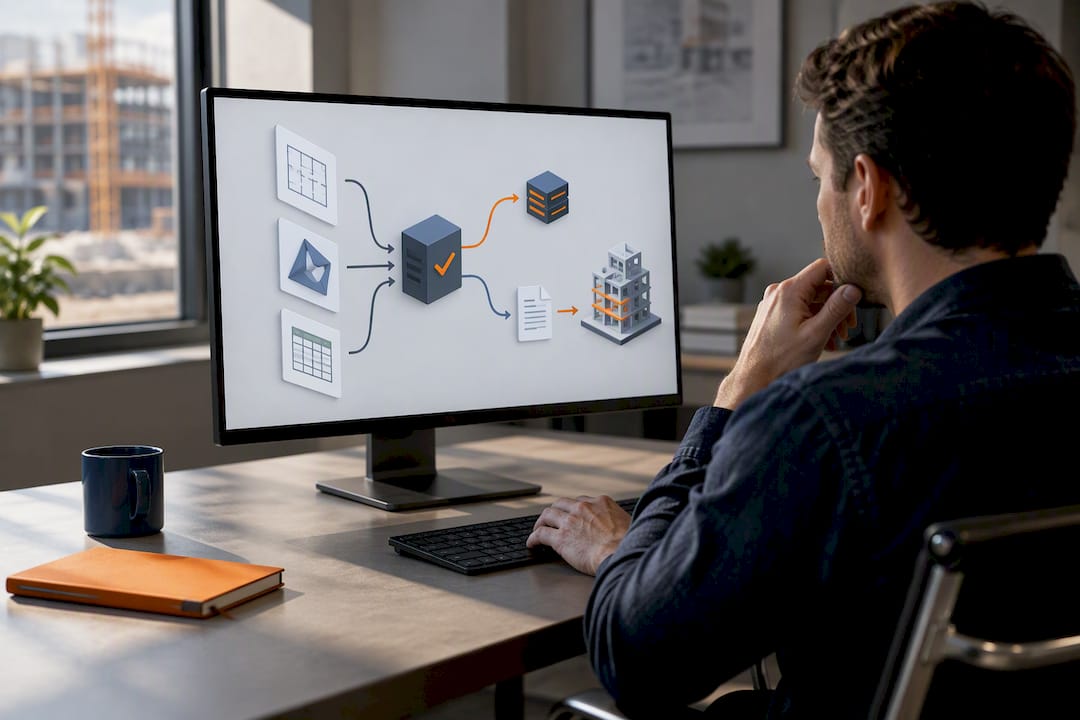
AGC’s technology selection guidance recommends a phased approach rather than jumping straight to a live project, and a sandbox test with historical drawings is often the lower-risk starting point. If you do run it live, keep it to one project and one estimating team, with a defined timeline and stakeholders from estimating, project management, and the field.
Measure the pilot against concrete numbers:
- Time saved per takeoff compared to the manual baseline
- Accuracy delta between pilot quantities and as-built or verified quantities
- Reduction in rework hours tied to takeoff corrections
When you talk to vendors, ask direct questions: who owns the exported data, what support looks like after go-live, what the realistic production timeline is, and which features are actually shipping versus still on a roadmap. AGC’s “AI for Estimating & Preconstruction” workshop framework treats AI appropriately here: useful for document review, scope validation, and building reusable prompt templates, but never a replacement for an estimator’s final sign-off on quantities.
How Do You Roll Out a Digital Takeoff Workflow Across a Team?
Pilot results only matter if you turn them into a repeatable operation. Start by naming a rollout champion, someone with authority to enforce the new process, and map clear responsibilities across the estimator, the peer reviewer, and whoever controls document versions.
Build standard templates before you scale past the pilot team:
- A takeoff classification table that every estimator uses the same way
- File naming and version conventions that apply project-wide
- Snapshot and export metadata requirements, non-negotiable on every submission
- A shared formula library so two estimators never calculate the same assembly two different ways
Training needs a calendar, not a single kickoff meeting. Schedule follow-up check-ins at 30 and 90 days, and collect structured feedback rather than hallway comments. Construction Executive’s analysis argues that construction remains under-digitized precisely because rollouts skip this step, treating adoption as a one-time event instead of an ongoing process.
Track operational metrics from day one: estimate variance against final costs, time per takeoff, number of revision cycles per bid, and simple adoption numbers like how many estimators are actually using the new workflow versus falling back on old habits. Teams that combine 2D and 3D takeoffs in a single environment report shorter setup time and easier audits, a pattern confirmed by DPR’s pilot with Autodesk Takeoff, where formula reuse across similar assemblies cut redundant work significantly.
How Won2Build Approaches the Digital Takeoff Workflow
Won2build built its Takeoff module around the same problem this article has been walking through: quantities that lose their context the moment they leave the drawing. Because Takeoff runs inside the same construction management platform as other modules, a quantity generated during takeoff can feed directly into a bid estimate without retyping numbers into a second system, reducing double entry and data loss.
Take the export step covered earlier in this workflow: a snapshot with revision, date, and author metadata. In an integrated system, that same snapshot can carry forward into the bid pipeline automatically instead of getting re-keyed by hand. Field-oriented guides on why commercial bids require detailed takeoffs walk through this handoff in more depth for teams building out their own templates.
Why the Pilot Matters More Than the Software
The industry’s real failure point isn’t a bad piece of software. It’s skipping the pilot and trying to change an entire estimating team’s habits overnight. Every documented rollout that worked, including DPR’s, started narrow: one project, one team, a defined set of metrics.
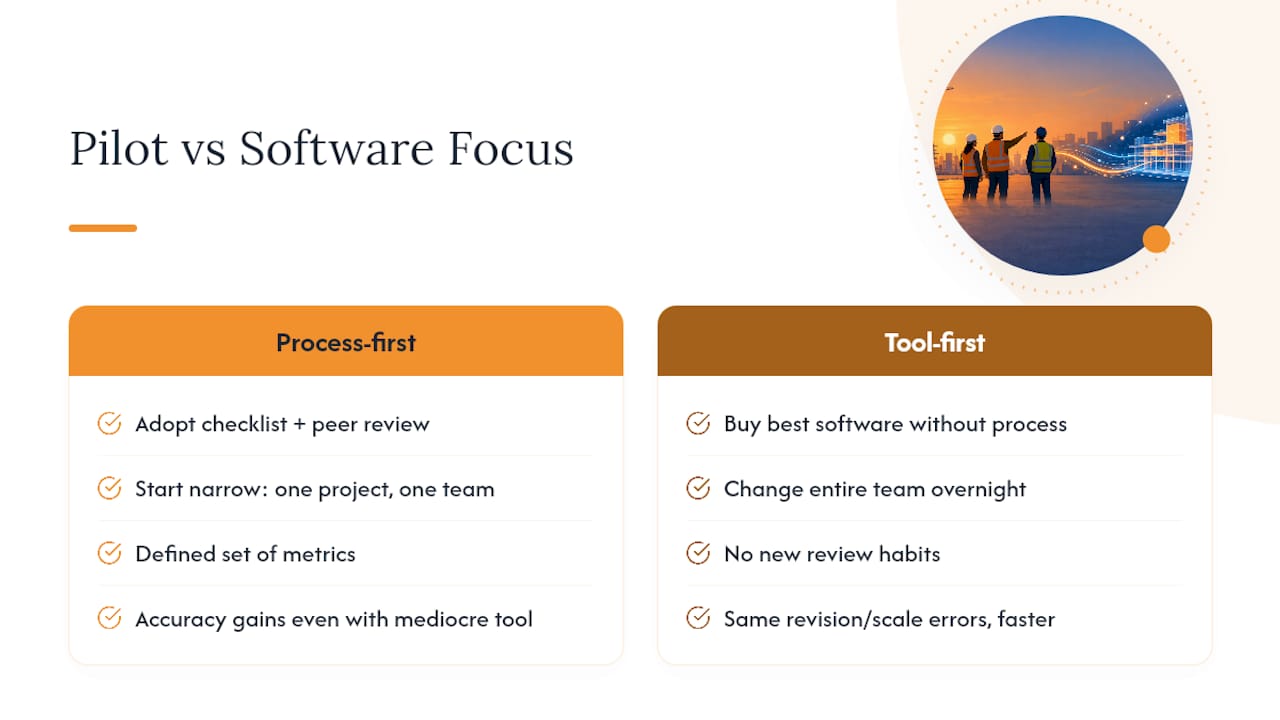
Conventional advice tends to frame digital takeoff adoption as a technology decision. It’s actually a process decision, and the technology just executes it. A team that adopts a scope-to-quantity checklist and a real peer review will see accuracy gains even on a mediocre tool. A team that buys the best software on the market without changing its review habits will keep making the same revision and scale errors, just faster.
If you take one thing from this, prioritize the checklist and the pilot design before you shop for features. Won2Build Hub’s integrated structure, where takeoff quantities flow into bidding without manual re-entry, is a useful example of what the payoff looks like once the process discipline is already in place. Start there, not with a feature comparison spreadsheet.
— Jen Reese
Try an Integrated Takeoff Workflow With Won2Build
The platform provides users with single sign-on across its modules, so quantities generated during takeoff can sync directly with the bid pipeline instead of being re-typed.
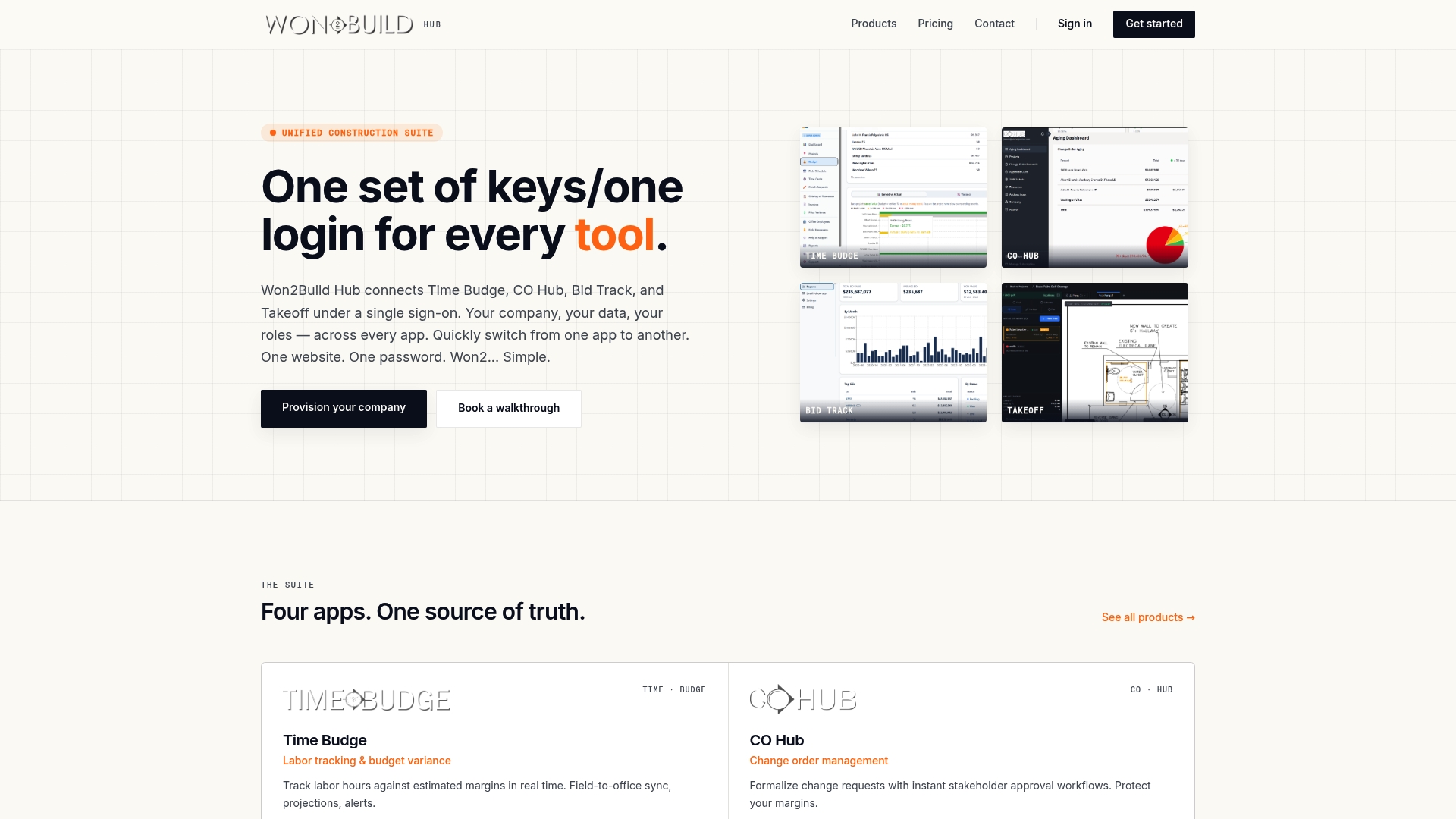
Having single sign-on across modules helps avoid double entry, lost revisions between systems, and supports real-time updates between the field and the office. If your team is ready to pilot a digital takeoff workflow the way this article recommends, one project, clear metrics, a documented review, check current plans and pricing for Takeoff and the rest of the Won2Build Hub suite, or explore the full product lineup to see how the modules connect. Reach out for implementation help if you want a hand designing the pilot itself.
Sources
- Associated General Contractors (AGC) — Project innovation & delivery guidance
- Construction Executive — The ROI of estimating accuracy in preconstruction (2026)
FAQ
What Is a Digital Takeoff?
A digital takeoff is the process of measuring quantities, linear feet, areas, and counts, directly from digital drawings or 3D models instead of paper plans. It replaces manual scaling and hand tallying with software-driven measurement, classification, and export.
What’s the Difference Between 2D and 3D Takeoff?
2D takeoff measures quantities from flat drawings using digital scaling tools, while 3D takeoff pulls quantities directly from a BIM model’s elements. Most accurate workflows combine both, using Autodesk Forma Takeoff’s approach of running 2D and 3D quantification in the same environment for cross-checking.
How Do You Prevent Takeoff Errors Before a Bid Goes Out?
Run a scope-to-quantity checklist covering revision date, scale verification, drawing cross-references, formula audits, and unit checks, then route it through a documented peer reviewer who is not the original estimator. This structured review catches the failure points AGC identifies most often: wrong revisions and double-counted quantities.
Does Won2Build Offer a Takeoff Tool?
Yes. Won2build’s Takeoff module handles digital plan quantification and connects directly to Bid Track and the rest of the Won2Build Hub suite under one login. Pricing for Takeoff isn’t published; current details are available on the Won2build pricing page.
Should AI Replace Estimator Judgment in Takeoff?
No. AI works best for document review, scope validation, and building reusable estimator templates, not for generating unchecked automated quantities. AGC’s AI for Estimating & Preconstruction framework treats it strictly as an assistant, with the estimator retaining final sign-off.
Recommended
One login for estimating, bid tracking, change orders, and labor.
The Hub is free. Pay only for the apps you turn on.
Create your free Hub account- Managers: Make Mobile Field Workflows Resilient for 72 Hour OutagesPlaybook for field managers: offline first mobile workflows, resilient sync and conflict handling, compliance first AI guardrails, and practical pilot steps.
- Daily Signed Records: Force Account Tracking for Managers & InspectorsField checklist for project managers and inspectors to keep force account tracking audit-ready: use daily signed records for labor, equipment, and...
- Stop Timecard to Report Drift: Labor Cost Codes for SubcontractorsFix the timecard to report chain with labor cost codes that tie crews to budgets. Includes a 6 code starter and a burdened rate example.