
Real-Time Reporting in Commercial Projects: 2026 Guide
Discover the role of real-time reporting in commercial projects. Boost decision-making, reduce costs, and drive profitability in 2026.
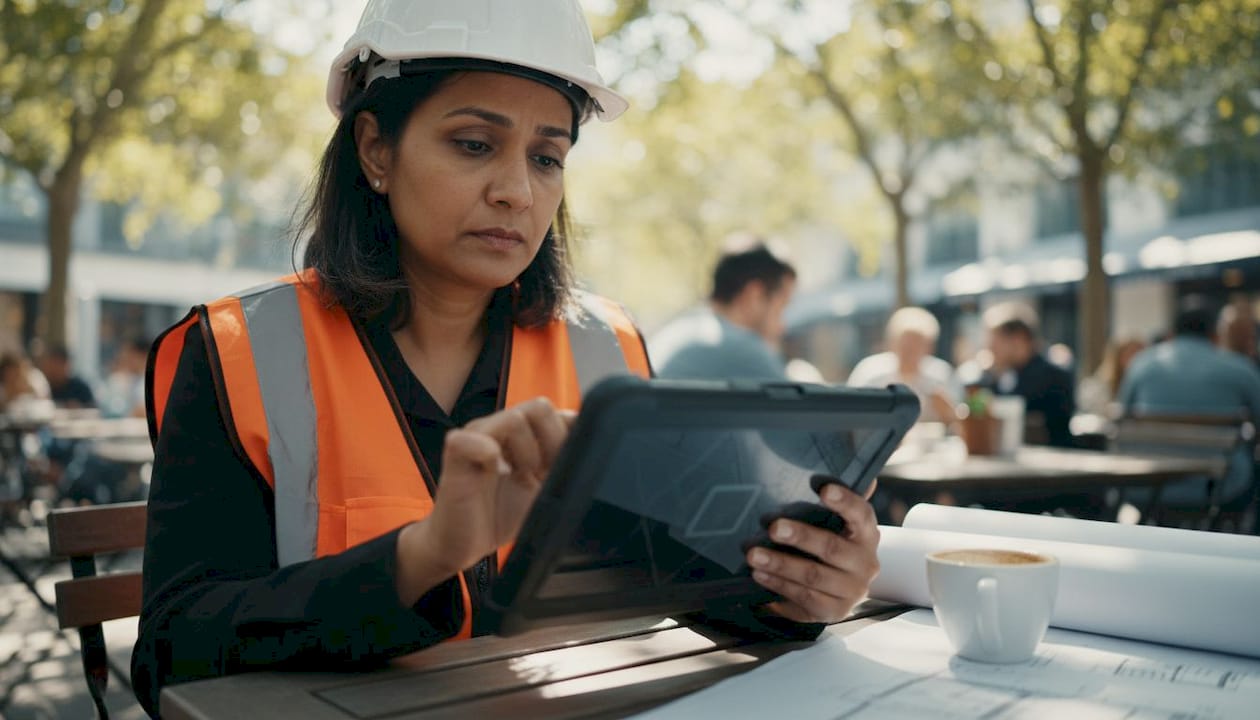
Real-time reporting in commercial construction is defined as the continuous, automated capture and delivery of live project data covering costs, labor hours, schedule progress, and site conditions. The role of real-time reporting in commercial projects goes far beyond convenience. It determines whether project managers act on facts or assumptions. Companies classified as real-time businesses achieve 62% higher revenue growth and 97% higher profit margins than their peers. That gap exists because speed of information directly controls speed of decision. For commercial construction teams managing tight budgets and complex subcontractor networks, that advantage is the difference between a profitable close and a costly overrun.
What are the key benefits of real-time reporting in commercial construction?
Real-time reporting delivers five measurable benefits that traditional reporting methods cannot match.
1. Faster decision-making
Real-time construction reporting eliminates the 24–72 hour data lag that plagues manual aggregation. Project managers receive live cost and schedule data instead of yesterday’s spreadsheet. That speed lets them act before a small deviation becomes a budget crisis.

2. Reduced rework and cost overruns
Early identification of deviations is the single most effective way to cut rework costs. When a concrete pour deviates from spec, a live dashboard flags it within minutes. A delayed report flags it after the next pour has already started.
3. Accurate budget forecasting
Live cost data replaces end-of-week estimates. Project managers can compare actual spend against the budget at any point in the day, not just at monthly reviews. That accuracy makes forecasting reliable rather than speculative.
4. Greater accountability across the supply chain
Real-time visibility creates a shared record that every subcontractor and stakeholder can access. Disputes over what happened and when become easier to resolve. Accountability improves because the data is timestamped and objective.
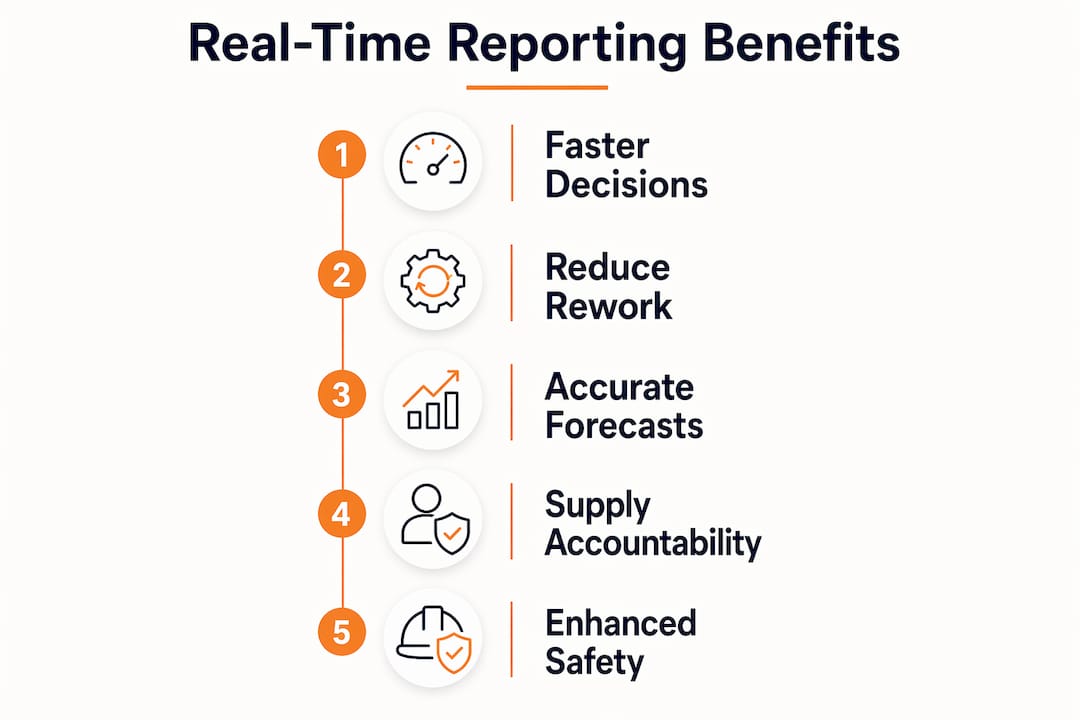
5. Better safety monitoring
Site condition data captured in real time lets safety managers respond to incidents before they escalate. A near-miss logged at 9:00 AM triggers a corrective protocol by 9:15 AM, not at the end-of-day safety debrief.
| Benefit | Traditional reporting | Real-time reporting |
|---|---|---|
| Decision lag | 24–72 hours | Minutes |
| Budget accuracy | Weekly estimates | Live actuals |
| Rework detection | After the fact | During execution |
| Accountability | Disputed records | Timestamped data |
| Safety response | End-of-day review | Immediate alert |
Pro Tip: Connect your real-time budget tracking system to your change order workflow. Every approved change order should update the live budget automatically, not manually.
How does real-time reporting improve efficiency compared to traditional methods?
Traditional construction reporting relies on manual spreadsheets and paper logs. That process causes delays and poor decision-making because data must be collected, aggregated, and distributed before anyone can act on it. By the time a project manager reads the report, the site has moved on.
The practical cost of that lag is significant. Consider a subcontractor who falls two days behind on steel framing. With traditional reporting, the general contractor learns about it at the weekly progress meeting. By then, the mechanical and electrical crews scheduled to follow the framing have already mobilized. Rescheduling them costs money and compresses the overall schedule.
With real-time reporting, project managers identify subcontractor delays immediately and can quantify the downstream schedule impact the same day. That lets them redirect resources, notify follow-on trades, and adjust the critical path before costs compound. The difference is not just speed. It is the shift from reactive management to proactive control.
Acting on outdated data creates a false sense of security. A project that looks on track in Monday’s report may already be two days behind by the time that report is read on Wednesday. Real-time feeds close that gap by anchoring decisions to actual site conditions.
Pro Tip: Make real-time data a standing agenda item in every project meeting. Embedding live data in reviews shifts the conversation from “what happened last week” to “what do we do right now.”
When does real-time reporting add the most value?
Not every metric on a commercial project requires minute-level updates. Real-time data infrastructure carries ongoing costs, and adoption should align with the decision windows and financial impact of delays. Spending on live streaming for data that only informs weekly decisions wastes budget that could go to field resources.
The right question is: how long can a decision wait before the cost of waiting exceeds the cost of the reporting system? That is the decision window. For safety incidents, the window is seconds. For labor hour tracking, the window is hours. For budget forecasting, the window is days.
Use this framework to match reporting frequency to decision type:
- Minute-level updates: Safety incidents, equipment failures, structural deviations
- Hourly updates: Labor productivity, material deliveries, daily progress against schedule
- Daily automated reports: Budget variance, subcontractor performance, punch list status
- Weekly summaries: Stakeholder reporting, contract compliance, forecast revisions
Reducing financial close time from 15 days to 5 days often delivers more tangible benefit than complex real-time streaming for many financial decisions. That insight matters for commercial project teams deciding where to invest in reporting infrastructure. Start with the decisions that carry the highest cost of delay, and build from there.
Pro Tip: Audit your last three project overruns and identify where the first warning sign appeared in the data. That exercise tells you exactly which metrics need real-time frequency and which can stay on a daily cycle.
How can commercial project teams implement real-time reporting effectively?
Effective implementation starts before the first shovel hits the ground. Clear rules for data ownership, formats, and timing at project kickoff give every stakeholder a unified, trustworthy data source. Without that agreement, teams end up with five versions of the same report and no consensus on which one is correct.
Technology requirements
The core technology stack for real-time reporting in commercial construction includes three components:
- Mobile data capture: Field crews log labor hours, material receipts, and site conditions from a phone or tablet. This eliminates paper logs and the manual aggregation step that creates the 24–72 hour lag.
- Cloud dashboards with role-based access: Project managers see cost and schedule data. Subcontractors see their own performance metrics. Owners see high-level progress and budget status. Each role gets the data it needs without information overload.
- Automated integration between field and office: Change orders, timecards, and takeoff measurements should flow into the same system without double entry. Won2build’s suite connects CO Hub, Bid Track, Time Budge, and Takeoff through a single sign-on, so data captured in the field updates office records automatically.
Cultural and governance requirements
Technology alone does not create a real-time reporting culture. Governance and culture are critical success factors beyond the platform itself. Project leaders must model the behavior they want. If the superintendent still runs the morning meeting from a printed report, the team will not trust the live dashboard.
Training matters too. Field crews need to understand why timely data entry affects the whole project, not just their own task. When a laborer logs hours at the end of the shift instead of in real time, the labor cost data is already hours old. That gap compounds across a crew of 20.
Live data dashboards empower employees to act within guardrails, improving agility at every level of the project. That autonomy only works when the data is current and trusted. Governance protocols, such as defined submission windows and data validation rules, protect that trust.
Pro Tip: Assign a data steward on every project, someone responsible for monitoring data quality and flagging gaps in real time. This role does not require a dedicated hire. A senior foreman or project engineer can own it with the right tools.
Proper construction timecard practices are one of the most overlooked inputs to real-time reporting accuracy. When timecard data is late or inconsistent, every downstream metric from labor cost to schedule progress becomes unreliable.
Commercial cleaning contractors face a parallel challenge. Coordinating site readiness with active construction requires live data on which areas are cleared and when. A construction cleaning bid preparation process that accounts for real-time data flows helps align site operations with project expectations from day one.
Key Takeaways
Real-time reporting in commercial construction projects reduces decision lag, cuts rework costs, and shifts project management from reactive to proactive control.
| Point | Details |
|---|---|
| Define data ownership early | Set clear rules for who provides what data and when at project kickoff. |
| Match frequency to decision windows | Use minute-level updates for safety and daily reports for budget variance. |
| Integrate field and office data | Eliminate double entry by connecting timecards, change orders, and takeoffs in one system. |
| Embed live data in meetings | Make real-time dashboards the basis for every project review, not printed reports. |
| Invest where delay costs most | Prioritize real-time infrastructure for metrics where a 24-hour lag causes financial damage. |
What I’ve learned about real-time reporting after years in commercial construction
The most common mistake I see project teams make is treating real-time reporting as a technology purchase. They buy a dashboard, connect a few data feeds, and expect the culture to follow. It does not.
The teams that get the most out of live data are the ones that changed how they run meetings before they changed their software. They stopped reviewing last week’s numbers and started asking what the current data requires them to do today. That shift in question changes everything. It moves the conversation from accountability for the past to ownership of the future.
I have also seen the opposite failure: teams that invested in expensive real-time streaming for metrics that only inform monthly decisions. The infrastructure cost was real. The benefit was not. Matching reporting frequency to actual decision cycles is not a compromise. It is good engineering.
The field-to-office gap is where most real-time reporting programs break down. A foreman who does not trust the system will find workarounds. A project engineer who gets contradictory data from two sources will default to the one they built themselves. Winning that trust requires consistency, simplicity, and visible proof that the data actually changes decisions. Show the field crew one example where their real-time input prevented a costly mistake, and adoption accelerates faster than any training program.
— Jen Reese
Won2build tools built for real-time project control
Commercial subcontractors who want live project visibility without building a custom tech stack have a direct path forward with Won2build.
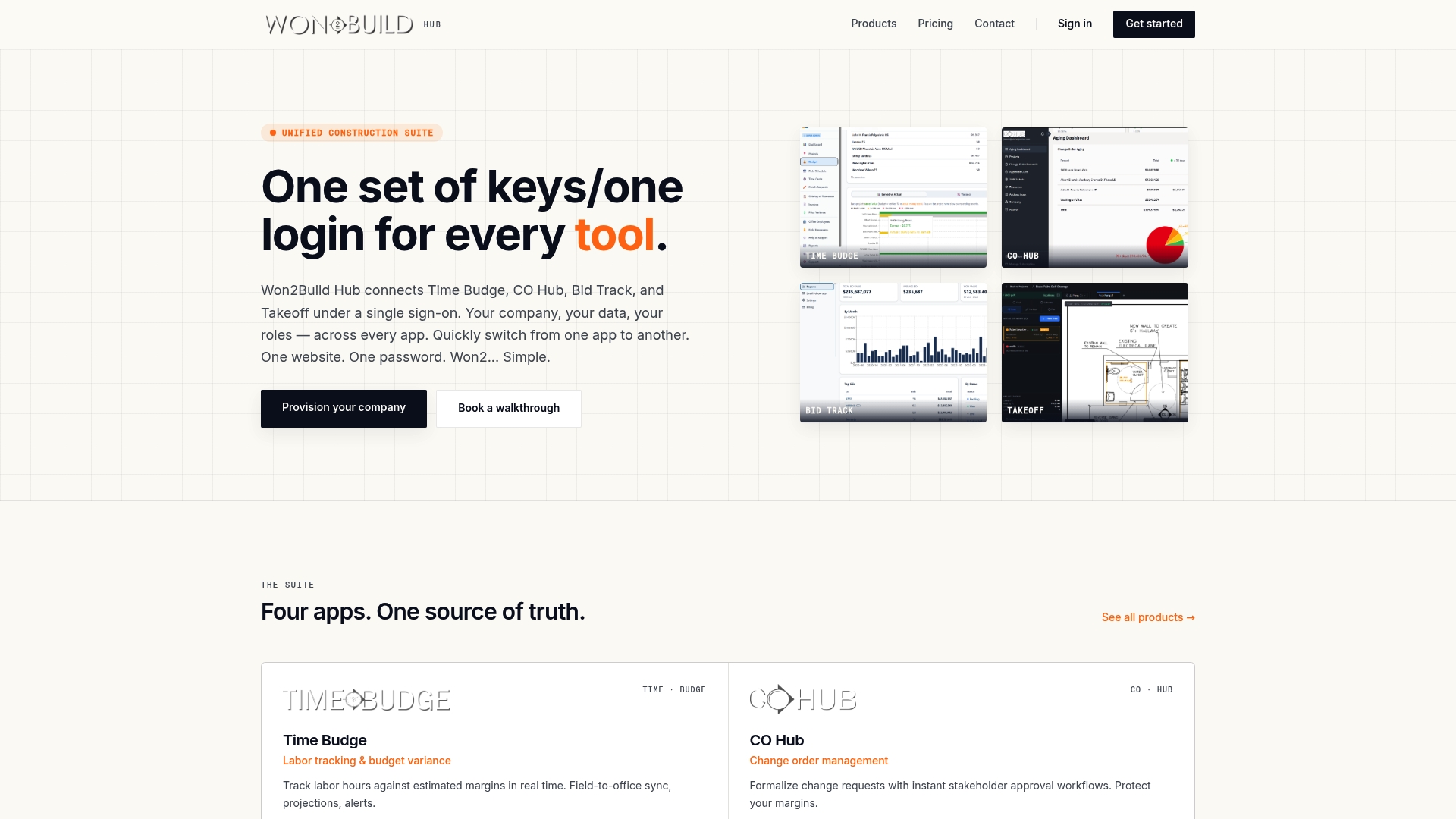
Won2build’s CO Hub tracks change orders in real time, so cost impacts are visible the moment a change is submitted, not after it is approved and invoiced. Bid Track gives estimating and project teams a live view of the bid pipeline, connecting pre-construction data directly to active project oversight. The Takeoff tool digitizes plan measurement and feeds live quantity data into project records. All four applications in the Won2build suite share a single sign-on, so field data and office data stay synchronized without manual reconciliation. For subcontractors protecting margins on commercial projects, that integration is where real-time reporting pays off directly.
FAQ
What is real-time reporting in construction?
Real-time reporting in construction is the automated, continuous capture of project data including costs, labor hours, and site conditions, delivered to project managers without the 24–72 hour lag of manual aggregation. It enables proactive decisions based on current site conditions rather than outdated records.
How does real-time reporting reduce cost overruns?
Real-time reporting flags deviations from budget and schedule as they occur, allowing project managers to intervene before small issues compound into overruns. Without live data, corrective action typically comes days after the damage is already done.
Does every project metric need real-time updates?
No. Data frequency must match decision cycles to justify the infrastructure investment. Safety incidents require immediate data, while budget forecasting and stakeholder reporting often work well on daily or weekly automated cycles.
What is the biggest barrier to real-time reporting adoption?
The biggest barrier is cultural, not technical. Teams accustomed to weekly printed reports resist live dashboards until they see direct proof that current data changes outcomes. Leadership buy-in and governance protocols matter more than the platform itself.
How does Won2build support real-time reporting for subcontractors?
Won2build connects change order management, bid tracking, labor hours, and digital takeoffs through a single platform with real-time data synchronization between field and office. That integration eliminates double entry and keeps project records current without manual updates.
Recommended
One login for estimating, bid tracking, change orders, and labor.
The Hub is free. Pay only for the apps you turn on.
Create your free Hub account- How to Compare Plan Revisions and Control Estimate ChangesA practical guide for commercial subcontractors on comparing plan revisions, catching scope changes, and keeping estimates and change orders in step.
- Drywall Takeoff Basics: A Step-by-Step Guide for SubsLearn drywall takeoff basics: how to measure walls and ceilings, deduct openings, convert to sheets, set waste and finish levels, and avoid costly misses.
- How to Reduce Profit Fade on Subcontractor JobsProfit fade usually starts in the field and hides until closeout. Here is how subcontractors can catch it weekly and protect the margin they bid.