
Construction Resource Allocation: 6 Steps for PMs to Cut Idle Time
Construction project managers can tie takeoff quantities to crews, equipment, and materials, using weekly reviews and a 30 day checklist to curb idle time.

Treat resource availability as the primary constraint: allocate labor, equipment, materials and budget to maintain crew continuity and reduce idle time, then let your schedule follow that reality instead of the other way around. Resource allocation in construction means matching those four resource classes to the work that needs them, week by week. Done well, it keeps crews moving steadily and cuts the idle hours that quietly eat margin.
TL;DR:
- At weekly reviews, compare planned and actual hours, confirm crew availability and lead times, and resolve double bookings by shifting lower priority starts.
- Consolidate crews when utilization falls below about 65%; if one resource remains overallocated for two weeks, level the plan or move a start date.
- Give scarce equipment to activities with the least schedule float, and order materials by working backward from lead times with a delivery buffer.
- Tie contingency to specific risks, such as supplier delays, incomplete drawings, or limited productivity history, and escalate when a cost bucket exceeds its allowance.
Table of Contents
- A Stepwise Framework: Plan, Quantify, Assign, Level, Monitor, Adjust
- Labor Allocation Tactics: Sizing Crews and Keeping Them Moving
- Equipment and Materials: Sequencing, Pooling, and Lead Times
- Budget Allocation and Contingencies Tied to the Resource Plan
- Tools and Workflows: Resource Views, BIM, and Clean Data
- Monitoring and KPIs: When to Reallocate Before It’s Too Late
- A working toolset can map onto the six-step framework cleanly instead of relying on a spreadsheet full of version-control problems. Takeoff can handle the quantify step, turning digital plans into the quantities crew sizing depends on. Bid Track can support the plan step by carrying those quantities into estimates and committed scope. Time tracking software can handle assign and monitor, logging field hours in real time so the weekly review runs on current numbers instead of last week’s guesses. Change order management software manages the budget impact of change orders as they happen, keeping the cost baseline connected to what actually changed in the field.
- A 30-Day Checklist for Closing Allocation Gaps
- Try Won2Build Hub for Connected Allocation Data
- FAQ
- Sources
A Stepwise Framework: Plan, Quantify, Assign, Level, Monitor, Adjust
Resource allocation works best as a cycle, not a one-time exercise. You plan before mobilization, quantify what each activity actually requires, assign people and equipment against real availability, level the plan when conflicts show up, monitor performance in the field, then adjust before small gaps become big ones.
Planning starts in preconstruction, when you set the resource baseline against the schedule of values and the contract scope. Quantifying means converting drawings and takeoffs into labor hours, equipment days and material quantities, not guessing at crew size from past jobs that may not match this one. Assignment is where you commit named crews and specific equipment to specific activities, with real start dates tied to actual availability rather than a wish list.
Leveling is the step most PMs skip under deadline pressure, and it is the one that prevents overallocation. When two activities compete for the same crew or the same excavator, leveling shifts start dates or redistributes work so nobody is double-booked on paper. Monitoring and adjusting close the loop: you compare planned versus actual hours weekly and correct course before the variance compounds. Research on integrated scheduling models backs this sequence directly: embedding labor allocation into the scheduling process, rather than fitting labor to a fixed schedule, measurably reduces construction time, cost, and resource fluctuation source.
Use this checklist at the start of every project and again at each weekly replanning session:
- Confirm current takeoff quantities against the latest drawing set.
- List committed crews, their skills and their earliest available date.
- Check equipment and material lead times against the activity start dates.
- Identify any resource assigned to two activities in the same window.
- Set or revise the cost baseline against the resource plan.
- Flag activities with less than one week of schedule float left.
Weekly allocation reviews need the right people and the right inputs to be worth the time:
- Project manager and superintendent, who own the schedule and field sequencing.
- Lead foreman or crew leads, who know real productivity on the ground.
- Procurement or purchasing contact, who confirms lead times and order status.
- Current takeoff quantities, committed crew availability, and material and equipment lead times as shared inputs.
A solid preconstruction meeting agenda gives you a repeatable template for capturing these inputs before the first crew mobilizes, which saves rework later.
Labor Allocation Tactics: Sizing Crews and Keeping Them Moving
Crew sizing starts with converting takeoff quantities into labor hours using a productivity rate specific to the activity and conditions, then dividing by the hours available in the work window. A framing crew pouring 2,000 square feet at a known productivity rate needs a specific number of carpenter hours; back into crew size from the deadline, not the other way around. BIM quantities paired with Line of Balance scheduling improve this math directly: a workforce planning study found that BIM-LOB integration reduces errors in quantity and productivity estimation, which makes crew counts more defensible before you commit people to the job.
Multi-skilling softens the bottlenecks that show up when one trade finishes early and another is not ready to start. A crew member who can frame and also hang drywall keeps working instead of sitting idle between activities, and that flexibility shortens the gaps that cause the stop-start pattern crews hate most.
Overallocation hides in plain sight until you look at the right view. In Microsoft Project, adding Percent Allocation to the Resource Usage view source shows exactly which resource is booked above 100% in a given week, which is the fastest way to catch a double-booked crew before it becomes a missed date.
Practical fixes once you spot overallocation:
- Shift the lower-priority activity’s start date rather than splitting the crew thin across both.
- Redeploy a crew to the nearest feasible site instead of pulling from an unrelated one, since distance-aware reassignment helps preserve continuity and reduce travel time on scattered-site work source.
- Add a second qualified crew member temporarily rather than extending one crew’s hours into overtime territory for weeks at a stretch.
- Confirm the fix in the next day’s huddle so field leads aren’t working from an outdated plan.
Pro Tip: Lock crew continuity for any activity longer than five days; a crew that starts and stops loses more to re-learning the task than it ever gains from “efficient” reassignment elsewhere.
Accurate hours logged daily, not reconstructed at week’s end, make every one of these decisions faster. A field guide to tracking labor hours covers the habits that keep that data clean.
Equipment and Materials: Sequencing, Pooling, and Lead Times
When equipment is scarce, the critical path gets it first. A single excavator shared across three trenching activities should go wherever the float is smallest, and every other activity waits or finds a workaround rather than competing for the same machine on the same day.

Material ordering follows the activity window backward: take the lead time, add a buffer for delivery variance, and place the order against that date rather than against when the budget happens to get approved. Staging matters just as much as ordering. Materials delivered too early sit exposed to weather or theft and clutter the site; delivered too late, they stall a crew that has nothing else to do.
Equipment pooling across active projects reduces idle rental days, but only with clear rules:
- Transfer equipment between sites only after confirming the receiving site’s activity is truly ready to start, not just scheduled to start.
- Factor transport time into the schedule explicitly; a two-hour haul between sites is lost productive time on both ends.
- Track which project is responsible for transport cost before the move, not after a dispute over the invoice.
- Give procurement visibility into the weekly allocation review so lead-time conflicts surface before they become emergencies.
A coordination checklist tying procurement to the weekly review keeps this from falling apart between meetings: confirm outstanding orders, flag any lead time that has slipped, and match equipment availability against the next two weeks of activities rather than just the current one.
Budget Allocation and Contingencies Tied to the Resource Plan
Your resource plan should drive the cost baseline, not run parallel to it. Labor hours convert to labor burden costs at the loaded rate for each trade. Equipment days convert to operating costs, including fuel and maintenance, not just the rental rate. Material quantities convert directly from the takeoff, and indirect costs like supervision and site overhead get allocated against the duration the resource plan actually projects.
Contingency sizing should track the specific uncertainty driving it rather than a flat percentage applied uniformly across every job:
- Add contingency for activities with long material lead times, since a single supplier delay can push the whole sequence.
- Add contingency where scope has not been fully detailed, since quantities derived from incomplete drawings carry more risk than those from a finished set.
- Add contingency for activities with limited historical productivity data, where your hours-per-unit estimate is closer to a guess than a measurement.
Watch these items daily or weekly to catch budget drift early: hours logged against budgeted hours for each active crew, change orders pending approval against their cost impact, and committed costs against the remaining contingency balance. A step-by-step budget tracking guide walks through setting up these comparisons so drift shows up in days, not months. Escalate to leadership the moment a single cost bucket exceeds its contingency allowance, not after the whole project’s contingency is gone.
Tools and Workflows: Resource Views, BIM, and Clean Data
A handful of software views do most of the heavy lifting in allocation decisions. The Resource Usage view shows hours assigned per resource per time period; the Resource Graph shows the same data visually, making overallocation obvious at a glance; capacity planning views compare committed hours against available hours across the whole project roster. Learning to read percent allocation in these views turns a vague sense that “the schedule feels tight” into a specific, fixable conflict.
BIM quantities feeding into Line of Balance visuals let you size crews by location as well as by activity, which matters on multi-unit or multi-floor work where the same trade repeats across several zones. This combination produced high usability scores in workforce planning case studies focused on reducing quantity estimation errors.
Each replanning cycle, refresh these fields before trusting the plan: current crew availability, confirmed lead times, earned hours to date, and any new commitments since the last review. Stale data in any one of these fields quietly undermines every decision built on top of it.
- Resource Usage and Resource Graph views for spotting overallocation early.
- BIM-LOB combinations for location-based crew sizing on repetitive work.
- Capacity planning views for comparing committed versus available hours project-wide.
- A single data source for takeoff, estimates, time tracking and change orders to avoid conflicting numbers between tools.
Pro Tip: Re-enter the same crew hours in three different systems and you will eventually trust the wrong one; a single data flow from takeoff through time tracking removes that risk entirely.
Monitoring and KPIs: When to Reallocate Before It’s Too Late
A handful of metrics tell you when allocation is working and when it is about to fail. Crew utilization rate compares hours worked to hours available; equipment utilization does the same for machines. Planned versus actual productive hours catches productivity drift early, lead-time variance flags supply risk before it hits the schedule, and change-order exposure tracks how much unapproved scope is sitting in the pipeline.
- Crew utilization below roughly 65% signals an opportunity to consolidate crews rather than keep two half-staffed teams running.
- Persistent overallocation on the same resource across two or more weeks means leveling the plan or shifting a start date, not hoping it resolves itself.
- Lead-time variance beyond your planned buffer should trigger a procurement follow-up the same day it’s spotted, not at the next scheduled meeting.
Poor resource forecasting and synchronization remain among the most commonly cited contributors to project overruns source, according to industry-wide research on project performance. That makes a disciplined weekly review one of the higher-leverage habits a PM can build: inputs are updated availability, lead times and earned hours; attendees are the PM, superintendent and crew leads; decisions cover leveling, redeployment and contingency use; follow-ups get a name and a date before the meeting ends.
A working toolset can map onto the six-step framework cleanly instead of relying on a spreadsheet full of version-control problems. Takeoff can handle the quantify step, turning digital plans into the quantities crew sizing depends on. Bid Track can support the plan step by carrying those quantities into estimates and committed scope. Time tracking software can handle assign and monitor, logging field hours in real time so the weekly review runs on current numbers instead of last week’s guesses. Change order management software manages the budget impact of change orders as they happen, keeping the cost baseline connected to what actually changed in the field.
On a demo, it’s worth asking specifically about field-to-office data sync speed, how mobile time entries get captured on job sites with limited connectivity, and what per-project reporting looks like once labor, estimates and change orders are flowing through connected systems instead of disconnected ones.
A 30-Day Checklist for Closing Allocation Gaps
If I were running a project right now, here’s the sequence I’d follow over the next month.
- Week one: validate current takeoff quantities and crew commitments against the latest drawings.
- Week two: run a pilot crew continuity test on one activity, tracking stop-start time directly.
- Weeks three and four: hold weekly allocation reviews with the full input list, then clean up any stale availability or lead-time data surfaced along the way.
First deliverables worth putting in front of leadership: a one-page KPI summary, a resource usage snapshot flagging any overallocation, and a short list of corrective actions with owners attached. For more on building these habits into daily practice, the Won2Build blog covers the field-level details that make the framework stick.
— Jen Reese
Try Won2Build Hub for Connected Allocation Data
Every step in this framework depends on current numbers: quantities from takeoff, committed hours from the field, and cost impacts the moment a change order lands. We built Won2Build Hub so those numbers live in one place instead of four, with a single login connecting Takeoff, Bid Track, Time Budge and CO Hub and real-time sync between field and office. That means your weekly allocation review runs on data entered once, not re-typed three times and quietly drifting out of sync.
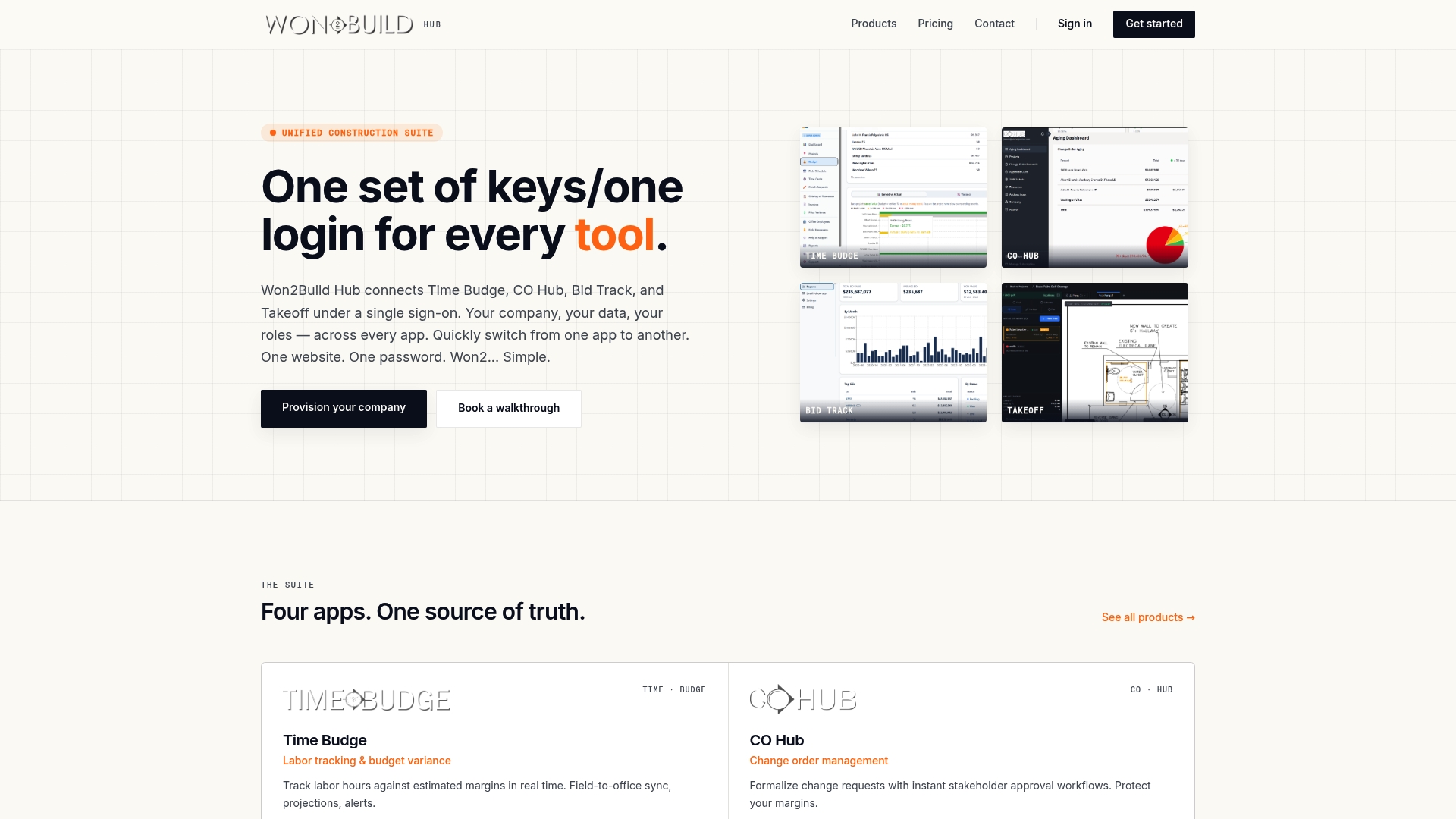
Time Budge and Bid Track are each available at $199 per month per company, CO Hub at $59 per month per company, and Takeoff is included at no cost; an active field worker fee of $2 per month applies to certain modules. Check current plans and pricing or explore the full product suite to see which modules fit your next project.
FAQ
What are examples of resource allocation?
Examples include assigning a framing crew to a specific building phase based on available hours, reserving an excavator for the activity with the least schedule float, ordering structural steel against its lead time rather than the budget approval date, and setting contingency against a specific uncertainty like an unconfirmed delivery date. Each example ties a limited resource to the activity that needs it most urgently.
What is an ERP in construction?
An ERP, or enterprise resource planning system, in construction is software that centralizes financials, procurement, scheduling and labor data across a company rather than tracking them in separate spreadsheets or standalone tools. Many subcontractors use purpose-built modules instead of a full ERP, linking time tracking, estimating and change order management through a shared login.
What is RLS in project management?
RLS most commonly refers to resource leveling schedule, the process of adjusting start dates or durations so that no resource is assigned beyond its available capacity in a given period. It is the practical mechanism behind the “leveling” step in a resource allocation framework, resolving conflicts that show up when two activities compete for the same crew or equipment.
What is resource allocation?
Resource allocation is the process of assigning available labor, equipment, materials and budget to specific project activities based on what each activity needs and when it needs it. In construction, the goal is to keep crews working continuously and equipment in use, rather than building a schedule first and hoping resources happen to be available when it calls for them.
Sources
- Human resource planning for building construction processes through the integration of BIM and Line of Balance
- Multiobjective construction schedule optimization with labor resource allocation: coupling parameter-adaptive genetic algorithm and network flow
- Agent-based simulation for multi-resource-constrained scheduling of scattered atypical repetitive projects
- View resource workloads and availability in Project Desktop
Recommended
One login for estimating, bid tracking, change orders, and labor.
The Hub is free. Pay only for the apps you turn on.
Create your free Hub account- Bid Pipeline Management: 7 Stages That Protect Subcontractor MarginsSee how subcontractors can track bids with CRM fields, a scorecard, weekly and monthly cadences, and a process with seven stages built to protect margins.
- Subcontractor Project Reports: 3 Templates for Same Day ProofCopy three daily report templates to log crew hours, work, materials, safety, and GC directives, creating records with timestamps that support pay.
- Construction Estimate Accuracy: AACE Ranges, QRA, and EVM ChecksSee how AACE estimate classes set cost accuracy ranges, then apply QRA, EVM thresholds, and field checks to tighten construction estimates in practice.