
Bid Pipeline Management: 7 Stages That Protect Subcontractor Margins
See how subcontractors can track bids with CRM fields, a scorecard, weekly and monthly cadences, and a process with seven stages built to protect margins.

Bid pipeline management is the discipline of routing every incoming RFP through one intake queue, a stage-based pipeline and a scored bid/no-bid filter, so your estimators spend hours on jobs you can win and profit from. Start today by creating an intake record for each opportunity with the key fields: project name, GC or owner, bid type, trade scope, estimated value, bid due date, and decision owner.
TL;DR:
- Score bids from one to five on five criteria; pursue totals of 18 or higher, review 13 to 17, and refine thresholds with outcome reviews.
- Set separate timelines and probability weights by bid type; negotiated work may linger in review, while hard bids are driven by due dates.
- Keep accounts, bids, and projects separate, require an expected decision date before submission, and forecast with stage and bid type weights based on historical wins.
- Set takeoff, pricing, review, and sign off deadlines ahead of the bid due date; send RFQs early and level quotes against a scope matrix.
- Track probability weighted pipeline against target annual revenue, plus win rates by bid type, sector, and GC; review estimating hours per win monthly.
Table of Contents
- What does a seven-stage bid pipeline look like?
- How should you set up your CRM to track bids?
- How do you build an intake queue and a bid/no-bid scorecard?
- How do you run estimating and subcontractor coordination without bottlenecks?
- What should your proposal templates and submission checklist include?
- Which KPIs and reports show whether your pipeline is healthy?
- What should you look for in bid pipeline software?
- How do you keep bid and pricing data secure?
- How do you tailor the pipeline to your trade?
- What does a successful pipeline rollout look like?
- Why does selective bidding beat estimating more?
- How does Won2Build support this pipeline?
- FAQ
- Sources
What does a seven-stage bid pipeline look like?
A pipeline only works when everyone means the same thing by each stage. The seven bid stages recommended in current preconstruction sales guidance give you a shared vocabulary, a clear owner at every step and a trigger for moving a bid forward. Here is how we define them for a subcontractor.
- Identified: The opportunity has landed in the intake queue and passed a first look. The owner is business development or whoever monitors plan rooms and inboxes. Capture the seven intake fields. Keep this stage brief, because the only decision is “score it or discard it.”
- Estimating: You committed to bid. The estimator owns it, and the record should show takeoff status, subcontractor and supplier quotes requested, and estimated hours. Dwell time depends on the bid due date. The trigger to move on is a signed-off number.
- Bid submitted: The proposal went out and the submission is logged with date, contact and method. The pursuit lead owns it. Record the expected decision date so follow-up is scheduled, not remembered.
- Under review or shortlisted: The GC or owner is leveling bids, asking for clarifications or inviting you to a scope review. This stage can sit for weeks. The trigger is a written clarification request, a shortlist notice or a verbal “you’re low.”
- Awarded (verbal): You have a verbal commitment but no paper. Ownership shifts toward the preconstruction manager. Capture scope assumptions and exclusions the GC agreed to, because this is where scope drift starts.
- Contract executed: The subcontract is signed. The opportunity converts to a project record and the estimate hands off to operations with its assumptions intact.
- Mobilized or in execution: The job is live. Keep the bid record linked so you can compare estimated labor and material against actuals later.
How stage handling differs by bid type
Hard competitive bids move fastest and punish gaps in coverage. Everything hinges on the due date, so Estimating is the longest stage and Under review is often a single day of bid opening. Negotiated work flips that. You may sit in Under review for a long time while scope and budget are refined, so you need clarification tracking and a more frequent touch cadence. Design-build and preconstruction-service pursuits add early budgeting passes before a real bid exists. For these, we suggest tagging the bid type on the record, then using different expected dwell times and different probability weights for each type. A single default timeline hides the stalled negotiated bids that quietly eat your backlog forecast.
Decision triggers that keep stages honest
Every stage needs one rule that moves a bid forward and one that kills it. “Estimate priced and peer-reviewed” moves a bid out of Estimating. “No response after the last scheduled check-in” moves a bid to Closed-Lost with a reason code. Without exit rules, bids pile up in the middle of the pipeline and your total looks healthier than it is.
How should you set up your CRM to track bids?
Your CRM should model bids, not just contacts. The cleanest structure keeps accounts, bids and projects as separate objects, which is the approach revenue-operations guidance for construction describes. Accounts hold the GC or owner relationship over years. Bids (your opportunities) hold the pursuit of one scope on one job. Projects hold the executed work. If you jam all three into one record, you lose repeat-customer history and you cannot report win rate by GC.
The eight must-have opportunity fields
- Bid type: hard bid, negotiated or design-build. It drives probability weighting and dwell-time expectations.
- Trade scope: the division or package you are pricing. It lets you segment results by what you actually sell.
- Estimated contract value: the working number, updated as the estimate firms up, so the pipeline reflects reality.
- Bid due date: the hard deadline that triggers estimating priorities and calendar alerts.
- Expected decision date: when you expect to hear back. This powers follow-up reminders and forecasting.
- Estimating hours: estimated and actual, so you can see what each pursuit costs and compare it to what it returns.
- GC or owner (account link): ties the bid to the relationship so you can analyze win rate by customer.
- Loss or no-bid reason: a required picklist when a bid closes without a win. This is the raw material for your win/loss reviews.
Probability weighting by bid type
Do not sum raw bid values and call it a forecast. The better approach is to build the forecast from backlog burn plus a probability-weighted pipeline, using your own historical win rates by segment, as the RevOps construction guidance outlines. Assign each stage and bid type its own probability, then review those weights quarterly against actual outcomes. If you have no history yet, start with conservative placeholders and tighten them as data accumulates.
What to sync from estimating
Push the number, the scope summary, the key assumptions and the estimating hours into the CRM. Leave line-item detail in the estimating tool. If your team is still tightening that workflow, our walkthrough of the commercial bid estimating process shows where the handoff points sit.
Pro Tip: Make “expected decision date” a required field before a bid can move to Bid submitted. It is the single field that turns follow-up from guesswork into a calendar.
How do you build an intake queue and a bid/no-bid scorecard?
Opportunities arrive from plan rooms, GC invitations, repeat-customer emails, bid-notification services and word of mouth. The failure mode is the same everywhere: invitations live in five inboxes and three phones, and nobody knows what is actually on the table. The fix is a single intake queue, either a shared inbox that feeds your CRM or a CRM intake form that every invitation must pass through. Documented intake through award is one of the habits that bid management guidance ties to better win rates and margins.
Minimum intake fields and why each matters
- Project name and location: lets you check travel, crew availability and duplicate invitations.
- GC or owner: triggers a quick look at your history with that customer.
- Bid type: sets the expected effort and win probability.
- Trade scope: confirms the work is something you actually perform.
- Estimated value: screens out jobs below your minimum or beyond your bonding or capacity.
- Bid due date: exposes conflicts with other deadlines.
- Decision owner: one named person accountable for go or no-go.
A compact scorecard
Score each opportunity from 1 to 5 on five criteria: fit with your trade and size range, relationship with the GC or owner, schedule and crew availability, margin potential, and estimating effort versus expected return. Add the scores for a total out of 25. A workable starting rule is to pursue anything at 18 or higher, send 13 to 17 to the decision owner for a judgment call, and decline anything lower. Treat these thresholds as a starting point and adjust them as win/loss reviews show which scores actually predict wins.

Triage in practice
Set a service level so every new record is scored promptly, and the decision owner signs off on anything in the gray zone. Write discard criteria in plain language so they are easy to apply, for example “outside our service radius,” “GC has paid late twice,” “bid due in two days with no plans yet” or “scope is mostly work we subcontract out at thin margin.” Experienced operators often decline a large share of what comes in, which protects estimating capacity for the bids that matter. Log every decline with a reason, because a no-bid that is recorded teaches you something and one that is forgotten teaches you nothing.
How do you run estimating and subcontractor coordination without bottlenecks?
Most estimating delays are not math problems. They are handoff problems: nobody knows who owns takeoff, the sub quotes arrive at 4:55 p.m. on due day, and the review happens in a panic. Fix it with explicit milestones and owners.
Define internal deadlines that sit well ahead of the real one: takeoff complete, pricing complete, review complete, final sign-off. Assign one owner to each. Then work the subcontractor and supplier side deliberately. Strong bid management practice includes monitoring plan rooms, prequalifying subcontractors, sending RFQs in advance and leveling bids before you commit to a number. Our bid management guide for subcontractors goes deeper on that sequence.
- Prequalify your sub and supplier list. Keep a short bench per trade with current insurance, capacity and responsiveness notes.
- Invite early and in one batch. Send RFQs the same day the bid is approved, with plans, scope sheet and a clear response deadline set before your own.
- Track responses on the bid record. Note who confirmed, who declined and who has gone quiet.
- Follow up on a schedule. One reminder at the midpoint and one the day before the response deadline.
- Level the quotes with a scope matrix. List every scope item down the side and every bidder across the top. Mark included, excluded or qualified. A low number with three exclusions is not a low number.
- Run a two-person review. A second estimator, not the author, checks quantities, scope coverage, exclusions, labor assumptions and math, then signs off using a short checklist.
Pro Tip: Put exclusions and qualifications in your proposal in plain words and in the same order as the scope matrix. Disputes later usually trace back to a scope item both sides assumed the other had priced.
What should your proposal templates and submission checklist include?
Standardizing proposals cuts rework and keeps rushed bids from skipping the parts that win work. Proposal tools exist largely for this reason: they centralize content with templates and analytics and integrate with CRMs, which speeds delivery and reduces manual work. You do not need a tool to start, though. A shared template library does the job.
Standard proposal sections
- Cover and summary: project, scope covered and total price, stated up front.
- Scope of work: what is included, tied to plan sheets and spec sections.
- Exclusions and clarifications: the items you did not price and the assumptions behind the number.
- Schedule and mobilization: lead times, crew availability and any sequencing constraints.
- Alternates and unit prices: if requested, listed separately and clearly labeled.
- Qualifications and references: short, relevant and specific to the project type.
Submission checklist
Before anything leaves the building, confirm the format the GC requires, every requested form and attachment, addenda acknowledged, bond or insurance documents where needed, final sign-off recorded, and the submission itself logged with time and method. Our bid submission checklist for subcontractors covers the full list, and our note on estimate templates explains how to keep pricing consistent.
Three short follow-up emails
- Confirmation (same day): “Confirming we submitted our proposal for [project] today. Please let us know if you need anything else from us.”
- First follow-up (a few days after submission, or just before the expected decision date): “Checking in on [project]. Happy to walk through scope or clarify any exclusions.”
- Last check-in (shortly after the expected decision date passes): “Wanted to close the loop on [project]. If the schedule has changed, tell us and we will update our availability.”
Log each send in the CRM and set the next task before you close the record.
Which KPIs and reports show whether your pipeline is healthy?
Pick a few metrics you will actually review. A few do most of the work.
Backlog coverage ratio. Divide your current bid pipeline by your target annual revenue. Use probability-weighted pipeline, not raw bid totals, and add remaining backlog burn to get a realistic picture, as the RevOps guidance recommends. A ratio well below what your historical win rate requires warns you of a revenue gap months before it hits. The caveat: it is only as good as your stage discipline and your probability weights.
Segmented win rate. One blended win rate hides everything useful. Break it out by bid type, sector and GC. You may win most negotiated work with repeat customers and few hard bids against open competition, which tells you where to point estimating hours. Our post on three bid pipeline metrics walks through the basics.
Active bid register. A regular one-page list of every open bid with stage, value, due date, decision date, owner and next action. It is the tactical report your weekly meeting runs on.
| Metric | How to calculate it | What to do with it |
|---|---|---|
| Backlog coverage ratio | Probability-weighted pipeline divided by target annual revenue | Increase pursuit volume or shift mix if coverage is thin |
| Segmented win rate | Wins divided by decided bids, per bid type, sector or GC | Reallocate estimating hours to the strongest segments |
| Estimating hours per win | Total estimating hours divided by number of wins | Tighten the scorecard if hours per win keep climbing |
Close the loop with a monthly win/loss review. Every loss reason feeds back into the scorecard, and every win confirms which criteria are worth weighting heavily. Teams that build lost-bid intelligence and compliance checks into their workflow tend to see structured processes shorten bid cycles and cut errors.
What should you look for in bid pipeline software?
Judge tools by capability and integration, not by brand name. Proposal software and proposal management platforms share a common core, and bid pipeline software for subcontractors needs the same core plus estimating awareness.
Feature categories to prioritize
- Centralized intake: one place every invitation lands, with required fields.
- Stage-mapped pipeline: your seven stages, with owners, dwell-time alerts and exit rules.
- Estimating integration: estimate totals, scope notes and hours flow in without retyping.
- Template management: a content library and editable proposal templates that prevent versioning problems.
- Follow-up automation: reminders tied to expected decision dates and logged activity.
- Analytics: backlog coverage, segmented win rate and estimating hours per win without a spreadsheet rebuild.
Integration priorities
Plan room feeds should land in the intake queue. Estimating and takeoff tools should sync into the bid record. Accounting and job-costing systems should receive the project on award so estimated and actual numbers can be compared. Add mobile access for estimators and field leaders, and single sign-on so your team is not juggling logins.
Evaluating return
Estimate the hours you would save on data entry and status chasing, the win-rate lift you might see from better follow-up, and the rework avoided through consistent scope matrices. RFP research suggests teams using proposal software tend to submit more responses and collaborate better, and often see measurable ROI within a year, but your own before-and-after numbers matter more than anyone’s averages.
Vendor checklist as questions
Can every invitation be captured in one queue? Can we define our own stages and fields? Does it pull estimate data without double entry? Can we reuse proposal templates and log submissions automatically? Does it report backlog coverage and win rate by segment? Who can see what, and can we restrict it?
How do you keep bid and pricing data secure?
Your bid pipeline holds some of the most sensitive information in the business: your pricing, your margins, your subcontractor quotes and your customers’ project details. Treat it that way when you evaluate software or set up a shared inbox.
Start with access control. Estimators, business development and field staff rarely need the same visibility, so look for role-based permissions that limit who can see pricing, margins and sub quotes. Confirm that data is encrypted in transit and at rest, and ask how the vendor handles backups and recovery. Ask where data is stored, who at the vendor can see it and what happens to your records if you cancel.
Add the basics on your side: strong, unique passwords or single sign-on, multi-factor authentication where offered, and a quick offboarding step that removes access the day someone leaves. Be careful with email attachments and shared drives, since plans and pricing often travel through both. Finally, check any confidentiality terms in GC bid invitations and prequalification packets, because some restrict how plans and pricing may be shared. Build a short written policy for how bid documents are stored and who may forward them. Security that lives in a policy people actually follow beats advanced features nobody turns on.
How do you tailor the pipeline to your trade?
The seven stages and eight fields are a starting frame, not a straitjacket. A good system bends to how your trade really buys and sells work.
An electrical or mechanical sub may add fields for equipment lead times, specialty submittals and engineering coordination, since long-lead items can change both price and schedule. A drywall, painting or flooring sub may want fields for square footage, unit pricing and finish levels, because bids are often built on production rates. Earthwork and site-work subs may track haul distance and quantities. Roofing and envelope contractors often add warranty terms and manufacturer requirements.
Customization usually shows up in several areas. First, custom fields on the bid record for the data your trade prices from. Second, custom stages or sub-stages, such as a Budget pricing step for design-build pursuits. Third, scorecard criteria weighted to what makes your trade profitable, such as crew availability in a tight labor market or material price risk. Fourth, report segments by scope package, so your win rate by trade division is visible.
Keep the changes disciplined. Add a field only if someone will use it in triage, estimating or reporting. Every extra required field slows down intake, and a pipeline people avoid is worse than a simple one they update every day.

What does a successful pipeline rollout look like?
Here is a composite example, built to show the mechanics rather than report a real customer’s results. Say a mid-sized mechanical subcontractor receives invitations from email, two plan rooms and a few long-time GCs. Estimators chase everything, due dates collide, and the owner senses the team is working hard on bids that rarely pay.
The firm makes several changes. It creates one intake queue and requires the seven minimum fields. It adopts the scorecard and starts declining low-scoring invitations, logging every reason. It maps its bids to the recommended stages and holds a regular review of the active bid register. And it begins tracking win rate by GC and bid type.
Within a few months of data, patterns tend to emerge. Negotiated work with a handful of repeat GCs wins at a much higher rate than open hard bids. Hard bids with thin scope documents consume many estimating hours and rarely convert. The firm shifts hours toward its strongest segments, declines the weakest, and uses its backlog coverage ratio to decide when to push for more work and when to hold capacity.
The point is not that any one tactic is magic. Documented processes tied to intake, sub prequalification, bid leveling and post-bid analysis are consistently linked to better win rates and fewer estimating errors. The example shows how those habits combine into something you can measure and repeat.
Why does selective bidding beat estimating more?
Most subcontractors I talk to believe the answer to a thin backlog is more bids. I think that is usually backwards. Every pursuit carries a real cost in estimator hours, sub coordination and management attention, and the cost of poor bid management goes beyond wasted time to weaker relationships and a weaker competitive position. Losses more often trace to scope gaps, weak proposals or a missing relationship than to price alone. Fewer, better-chosen bids, priced with clean scope and followed up with discipline, protect margins in a way volume never will. Run a short pilot: one intake queue, one scorecard, one weekly review. Within 90 days, measure your backlog coverage ratio and one win-rate segment.
— Jen Reese
How does Won2Build support this pipeline?
Everything above can run on spreadsheets, but it runs better when the tools share data. Our Bid Track application gives you a central place to manage bids and estimating. Because it sits inside our Hub, one login also opens Takeoff, Time Budge and CO Hub.
[CTA_IMAGE_PLACEHOLDER]
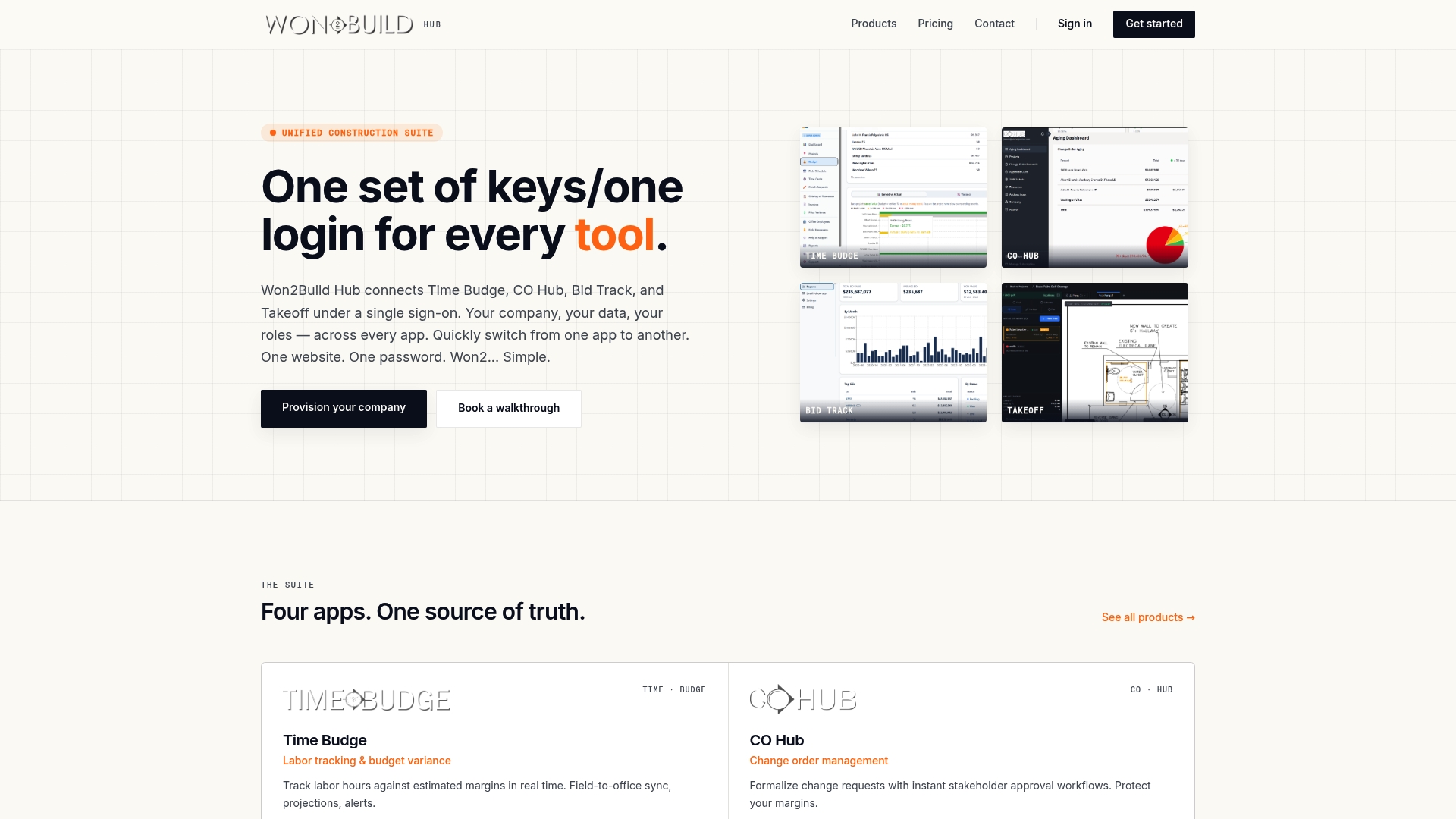
- Bid management: manage bids in Bid Track.
- Estimating: manage estimates with Bid Track.
- Single sign-on: one login across the Won2Build Hub.
Try this: use Bid Track to manage bids and check your backlog coverage as data accumulates. Bid Track is $199 per month per company, and current prices for every plan are on our pricing page.
FAQ
Is bid manager a stressful job?
It can be, mostly because of fixed deadlines and fragmented information. A defined intake queue, clear stage owners and a weekly review remove much of the scramble. Stress drops when decisions about what to bid are made early rather than the night before a due date.
What is the best bid management software?
The best choice depends on your trade, team size and existing tools, so evaluate by capability: centralized intake, stage tracking, estimating integration, templates, follow-up and analytics. Proposal software roundups show most tools center on templates, collaboration and CRM integration. Choose the one that fits how your estimators already work.
Is bid management a good career?
For people who like structured problem-solving, yes. The role sits between business development, estimating and operations, and it grows more valuable as firms treat bidding as a managed process rather than a scramble. Skills in scoring, forecasting and CRM setup transfer well.
What is the best pipeline management software for sales teams?
Look for custom stages and fields, forecasting with probability weighting, activity tracking and integrations with your other systems. For construction subcontractors, add estimating awareness and the ability to separate accounts, bids and projects. General sales tools work if you configure them carefully.
Sources
- Preconstruction Sales Operations: Proven 7-Stage Bid System
- State of Bid Excellence Construction Snapshot
- Construction Bid Management Guide (2026)
- 17 Proposal Software Tools for Proposal Creation and Management
Recommended
One login for estimating, bid tracking, change orders, and labor.
The Hub is free. Pay only for the apps you turn on.
Create your free Hub account- Subcontractor Project Reports: 3 Templates for Same Day ProofCopy three daily report templates to log crew hours, work, materials, safety, and GC directives, creating records with timestamps that support pay.
- Construction Estimate Accuracy: AACE Ranges, QRA, and EVM ChecksSee how AACE estimate classes set cost accuracy ranges, then apply QRA, EVM thresholds, and field checks to tighten construction estimates in practice.
- Change Order Pricing: Daily T&M Tickets Protect Subcontractor MarginLearn to price change orders with defined scope, cost codes, signed daily T&M tickets, and contract exhibits that support subcontractor payment.