
Change Order Pricing: Daily T&M Tickets Protect Subcontractor Margin
Learn to price change orders with defined scope, cost codes, signed daily T&M tickets, and contract exhibits that support subcontractor payment.

Price the delta, not a fresh estimate. Use lump sum or unit price when the added scope is clearly defined, reserve cost-plus or time and materials for undefined work and attach a not-to-exceed cap, and treat every verbal change as a liability until you have it in writing. The single move that protects your margin fastest is logging the change the moment it happens: open a separate cost code and start collecting owner-signed daily tickets before the first worker swings a hammer.
TL;DR:
- Use lump sum for defined scope, unit prices for known rates with variable quantities, and cost plus or capped time and materials for uncertain work.
- Acknowledge changes within 48 to 72 hours and submit final pricing within the contract notice period, often 7 to 14 days.
- Add remobilization, lost productivity, rework, extended site overhead, and bond or insurance increases when a change disrupts work or extends the schedule.
- For an owner directive before agreement, give written notice that you are proceeding under protest, reserve pricing and time extension rights, and document work immediately.
Table of Contents
- Why change orders go wrong and the hidden costs you must price
- Core pricing methods: how they work and when to choose each
- Step-by-step process to price a change order
- How to calculate overhead and profit markups
- Accounting for schedule impacts and indirect costs
- Contract clauses and owner directives that control your pricing method
- Presenting the price and handling objections
- Tools and tracking that make change-order pricing accurate and defensible
- Handling fast-track or emergency changes
- Common objections and quick rebuttals
- A subcontractor operator’s tested discipline
- Won2Build Hub: putting these pricing methods into daily practice
- FAQ
- Sources
- Authoritative templates, industry guidance, and contract exhibits
Why change orders go wrong and the hidden costs you must price
Most change order disputes trace back to three causes: scope that was never pinned down in writing, notice that arrived too late to matter contractually, and verbal direction from a superintendent that nobody documented. Each one gives the owner room to argue later that the work was always in scope or that you never properly asked for payment.
The bigger problem is what gets left off the invoice entirely. Subcontractors routinely price the visible labor and material but skip the costs that only show up weeks later:
- Extended general conditions from schedule slippage caused by the change
- Remobilization costs when crews leave and return to the site
- Lost productivity on the original scope because of disruption or stacking of trades
- Rework tied to the change, including demolition of completed work
- Bond and insurance adjustments tied to a higher contract value
Industry guidance from CMAA’s change order estimating guide recommends treating a change order estimate during construction as a Class 1 estimate, with accuracy in the range of -10% to +15%, and building in extra contingency because disruption compounds costs. That means pricing the change against your original contract baseline, not as a standalone job. The delta concept matters because an owner will almost always benchmark your price against what the work “should” cost in a vacuum, and you need the baseline comparison to show why it costs more now.
Core pricing methods: how they work and when to choose each
Four methods cover nearly every change order you will price, and picking the right one depends entirely on how well the added scope is defined at the time you have to submit a number.
Lump sum works when the scope, quantities, and conditions are fully known. You build it the same way you built your original bid: quantify the added work, apply current material costs, apply fully burdened labor rates, add equipment, then layer in overhead and profit. It gives the owner cost certainty and gives you a fixed number to defend, which is why owners prefer it whenever possible.
Unit price fits repetitive, quantifiable work where the rate is known but the final quantity is not, such as additional linear feet of trenching or extra square footage of drywall. You price per unit using your established rates and let the final quantity true up the total.
Cost-plus recovers your actual, documented costs plus a markup for overhead and profit. It suits scope that is real but not fully defined, like unknown subsurface conditions discovered mid-excavation. The catch is that cost-plus only works if your cost tracking is airtight: every invoice, every labor hour, and every piece of equipment time needs a paper trail tied to that specific change.
Time and materials (T&M) bills labor hours, material costs, and equipment time at agreed rates, typically with a not-to-exceed (NTE) ceiling. Common practice treats T&M as a method for exploratory or genuinely undefined work, never as a default, because open-ended billing invites disputes over hours and efficiency.
Use this sequence when a change lands on your desk:
- Ask whether the scope and quantities are known. If yes, price it as lump sum or unit price.
- If the scope is partially known, quote cost-plus with a markup schedule stated up front.
- If the scope is genuinely undefined, propose T&M with a firm NTE cap and daily owner sign-off.
- Never let verbal direction turn into open-ended T&M without a signed ticket for everyday worked.
T&M should be your last resort, not your default, and it only works with controls: a cap, daily tickets signed by the owner’s representative, and documented burden rates agreed before work starts. Our guide on choosing between T&M and lump sum walks through the tradeoffs in more detail.
Step-by-step process to price a change order
A repeatable intake process keeps you from missing a notice deadline or losing the paper trail that proves your costs.
- Log the change the moment it’s raised. Note who authorized it, whether it arrived as an RFI, a construction change directive, or a formal change order request, and the date.
- Build the estimate. Run a quantity takeoff for the added scope, pull current vendor quotes for materials, apply fully burdened labor rates (wages plus payroll taxes, insurance, and benefits), and add equipment rental lines.
- Acknowledge receipt fast. Send written acknowledgment within 48 to 72 hours so the clock on your notice obligations is clearly running in your favor.
- Issue a preliminary price. A rough number within a few days keeps the project moving and signals you are tracking costs, even before the final proposal is ready.
- Submit the final priced proposal inside whatever notice window your contract specifies, often 7 to 14 days depending on the subcontract language.
Pull your line items from the same structure you use for original bids. Our field guide to estimate components breaks down the categories worth itemizing, and a labor cost calculator helps you get fully burdened rates right the first time instead of guessing.
Documentation has to exist before you need it, not after a dispute starts. Keep a separate cost code for every change, collect daily T&M tickets signed by the owner’s representative, photograph conditions before and after, and attach every material quote to the proposal file.

Pro Tip: Open the cost code and start the daily ticket log on day one, even if you expect to settle the change as a lump sum later; you can always convert the records into a lump-sum backup, but you can’t recreate them after the fact.
How to calculate overhead and profit markups
The math behind overhead and profit (O&P) markup is simple once you separate net direct cost from the markup itself: take your direct costs (labor, material, equipment, subcontracted work), then apply a percentage for overhead and a percentage for profit on top.
A basic sample calculation: say the direct cost of a change is $10,000.
- Field overhead (supervision, temporary facilities tied to the job) is usually included in direct cost
- Home office overhead (admin, insurance, bonding) is typically covered by the O&P percentage
- Contract pricing exhibits sometimes cap markup outright
One contract pricing exhibit example caps contractor markup at 10% on self-performed work and requires itemized labor, material, and equipment backup for every proposal. Other forms, including common AIA-style defaults, allow ranges closer to 15% to 20% on self-performed work with lower tiers for subcontracted work, and federal or ConsensusDocs approaches sometimes split the markup between overhead and profit separately. When the contract is silent, anchor your number to whatever range is typical for the contract form in play and state your basis in writing. Watch for tiering limits when a change flows through multiple subcontract tiers, since many exhibits cap the total markup stack regardless of how many parties touch the work. Our markup pricing matrix walks through tiered examples in detail.
Accounting for schedule impacts and indirect costs
A priced change order that only covers labor and material misses the costs that show up when the schedule slips. Extended general conditions, additional supervision time, temporary facilities kept on site longer, and bond or insurance premium adjustments all belong in the price when the change pushes your duration.
- Extended general conditions: daily or weekly rate for field office, supervision, and temporary utilities
- Remobilization: cost of pulling crews off and bringing them back
- Productivity loss: measurable inefficiency caused by stacking trades or working out of sequence
- Bond and insurance: premium adjustments tied to a higher contract value
For delay-driven overhead specifically, the Eichleay formula offers a way to allocate unabsorbed home office overhead to a delayed project. It’s most established in government contract disputes, and whether it applies to private work depends entirely on the contract language and the jurisdiction, so check your subcontract before assuming it’s available to you.
When a change affects the critical path, a time impact analysis (TIA) is the evidence owners and courts expect. A credible TIA ties the delay to a specific activity on the schedule, shows the fragnet inserted to model the impact, and quantifies the resulting shift in completion date. Submit it alongside your priced change order, not after the fact, so the cost and the time extension move together.
Contract clauses and owner directives that control your pricing method
Before you price anything, read the changes clause in your subcontract and any pricing exhibit attached to it. Many exhibits spell out exactly which methods the owner may require and in what order of preference, and one example lets the owner elect lump sum, unit price, or cost-plus, with itemized backup required regardless of method chosen.
Watch for flow-down language that pushes the general contract’s pricing terms onto your subcontract without modification, since that can import markup caps or notice windows you never negotiated directly.
- Check whether the changes clause specifies a required pricing method or leaves it to the owner’s election
- Note the notice window for submitting pricing and the consequence of missing it
- Confirm whether a construction change directive (CCD) or work directive requires you to proceed before price agreement
- Look for a markup cap and whether it applies per tier or to the total stack
If you receive a CCD or work directive, proceed under protest in writing, reserving your right to price and to a time extension, and begin documentation immediately rather than waiting for a negotiated price. When you have leverage to negotiate subcontract terms, ask for a markup floor, a defined notice window measured in business days, and a requirement that any owner-selected method still allows itemized backup.
Presenting the price and handling objections
A one-page cover sheet speeds approval: state the scope delta in one sentence, itemize direct costs by category, show the schedule impact in days, and state your markup basis with a citation to the contract provision that supports it.
- Scope delta: what changed relative to the original contract
- Itemized costs: labor, material, equipment, each with backup attached
- Schedule impact: days added and the activities affected
- Markup basis: the percentage and the contract clause or industry norm it relies on
Common objections and quick answers: “already in scope” gets a side-by-side comparison to the original drawings; “markup is too high” gets the contract clause or pricing exhibit that supports your rate.
Pro Tip: Offer a phased acceptance or a lower NTE as a compromise, but never trade away your right to a time extension or a written signoff just to get a faster yes.
Tools and tracking that make change-order pricing accurate and defensible
Integrated field-to-office tracking closes the gap between what happened on site and what ends up on the invoice. When labor hours, change order documentation, and bid estimates live in connected systems instead of scattered spreadsheets, fewer hours get missed and fewer disputes drag on because the backup is already assembled.
Field-tested operational targets worth adopting regardless of what software you use: acknowledge a change within 48 to 72 hours of notice, and aim for a 21-day turnaround from notice to a submitted, priced proposal. Hitting those windows keeps you inside most contractual notice requirements and signals to owners that your pricing is organized, not improvised.
What belongs in the record for every change:
- A separate cost code opened the day the change is identified
- Searchable photo evidence tied to that cost code
- Vendor quote attachments for material and equipment lines
- Owner-signed daily tickets whenever T&M or cost-plus applies
Our guide to cutting change order turnaround to 21 days and our daily T&M ticket checklist cover the field habits behind these targets in more detail.
Handling fast-track or emergency changes
When an owner directs work to start before pricing is agreed, treat it as T&M with an NTE from the first hour. Collect signed daily tickets, photograph site conditions before work begins, and send written notice reserving your right to full pricing and a time extension.
- Start collecting signed daily tickets and photos immediately, before the first worker mobilizes.
- Send written notice the same day, stating you’re proceeding under protest with rights reserved.
- Build the itemized change proposal as soon as conditions stabilize, including remobilization and extended overhead lines.
- Submit the formal change order inside your contract’s notice window, even if negotiations continue afterward.
Common objections and quick rebuttals
“That’s already paid” gets answered with your cost code report showing the specific hours and materials tied to this change, separate from the base contract. “That should have been in scope” gets a side-by-side against the original drawings or specifications. “Your markup is too high” gets the contract clause or pricing exhibit backing your rate.
- Attach cost code reports, daily tickets, photo logs, and material quotes to every rebuttal
- Accept a pragmatic settlement only if it preserves your time extension and keeps the cost accounted for separately
A subcontractor operator’s tested discipline
The habit that changed outcomes for us wasn’t a smarter estimate. It was documenting and pricing the delta the moment a change happened, before the work started, instead of reconstructing costs weeks later from memory and scattered paperwork. Treating that discipline as routine, not exceptional, is what this software suite is built to support.
— Jen Reese
Won2Build Hub: putting these pricing methods into daily practice
Pricing a change order correctly is only half the job. Getting paid for it depends on evidence you can produce fast, which is why we built CO Hub, Time Budge, and Bid Track to share data instead of living in separate spreadsheets.
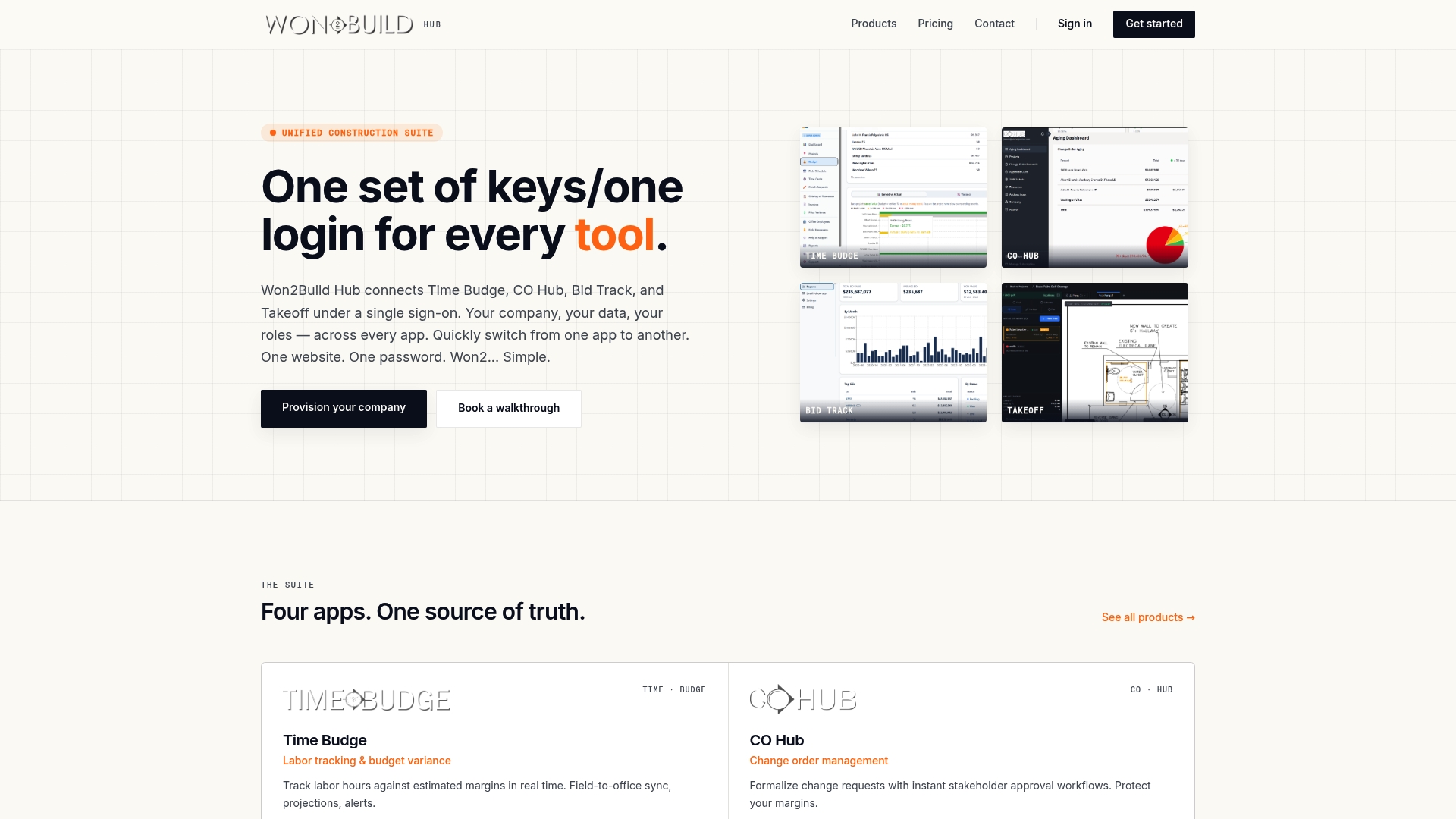
CO Hub captures daily T&M tickets and owner signatures in the field, Time Budge tracks fully burdened labor hours against the right cost code in real time, and Bid Track keeps your original estimate and vendor quotes connected to the change when you need to show the delta. Because these applications run on a single login with real-time sync between field and office, the backup for a change order proposal is already assembled by the time you sit down to write it.
- Faster approvals because your proposal arrives with itemized backup attached, not promised later
- Single-source documentation instead of reconciling tickets, photos, and quotes from different tools
- Fewer disputes because cost codes stay separate and auditable from day one
Our CO Hub product page covers the change order workflow in detail, and our pricing page lists current plans if you’re ready to see how it fits your crew size.
FAQ
What should be included in a construction change order?
A complete change order includes the scope delta, itemized direct costs (labor, material, equipment), the schedule impact, the markup basis, and signed authorization. Backup documentation, including daily tickets, photos, and vendor quotes, should accompany the proposal rather than follow later.
What are the different types of contract pricing methods?
The four primary methods are lump sum, unit price, cost-plus, and time and materials with a not-to-exceed cap. The right choice depends on how clearly the scope and quantities are defined at the time of pricing.
What’s the difference between an RFI and a change order?
An RFI (request for information) asks a question about the drawings or specifications and doesn’t authorize extra work or cost. A change order is the priced, authorized document that actually changes the contract scope, price, or schedule, and it’s often triggered by the answer to an RFI.
Do contractors charge for change orders?
Yes, change orders are priced to recover the added direct costs plus overhead and profit markup, following whatever method the contract specifies or the owner elects. Markup ranges and caps vary by contract form, so the applicable rate should be confirmed against the pricing exhibit or changes clause in the specific subcontract.
Sources
- Pricing of Construction Contract Change Orders (contract exhibit example)
- Estimating Construction Change Orders — CMAA guidance
- Change order management guide — ToolGrit
- Change Order Pricing Guidelines (owner template)
Authoritative templates, industry guidance, and contract exhibits
- Pricing of Construction Contract Change Orders (contract exhibit example)
- Change Order Pricing Guidelines (owner template)
- Estimating Construction Change Orders — CMAA guidance
- Change order management guide — ToolGrit
- Projectmanager
Recommended
One login for estimating, bid tracking, change orders, and labor.
The Hub is free. Pay only for the apps you turn on.
Create your free Hub account- Bid Pipeline Management: 7 Stages That Protect Subcontractor MarginsSee how subcontractors can track bids with CRM fields, a scorecard, weekly and monthly cadences, and a process with seven stages built to protect margins.
- Subcontractor Project Reports: 3 Templates for Same Day ProofCopy three daily report templates to log crew hours, work, materials, safety, and GC directives, creating records with timestamps that support pay.
- Construction Estimate Accuracy: AACE Ranges, QRA, and EVM ChecksSee how AACE estimate classes set cost accuracy ranges, then apply QRA, EVM thresholds, and field checks to tighten construction estimates in practice.