
Stop Paying a 15–30% Buffer: T&M vs Lump Sum for Contractors
Match contract type to risk and governance. Use a capped T&M discovery then fixed-price execution, plus daily time capture, weekly burn reports, and CO...

Lump sum works when the scope is fully drawn and stable; T&M works when conditions or scope can’t be pinned down before work starts. Most experienced contractors default to a hybrid: a capped T&M discovery phase to nail down the unknowns, then a fixed-price contract for the execution work once scope is locked.
TL;DR:
- Lump sum contracts are ideal only when scope and conditions are fully known and stable before bidding, minimizing owner risk.
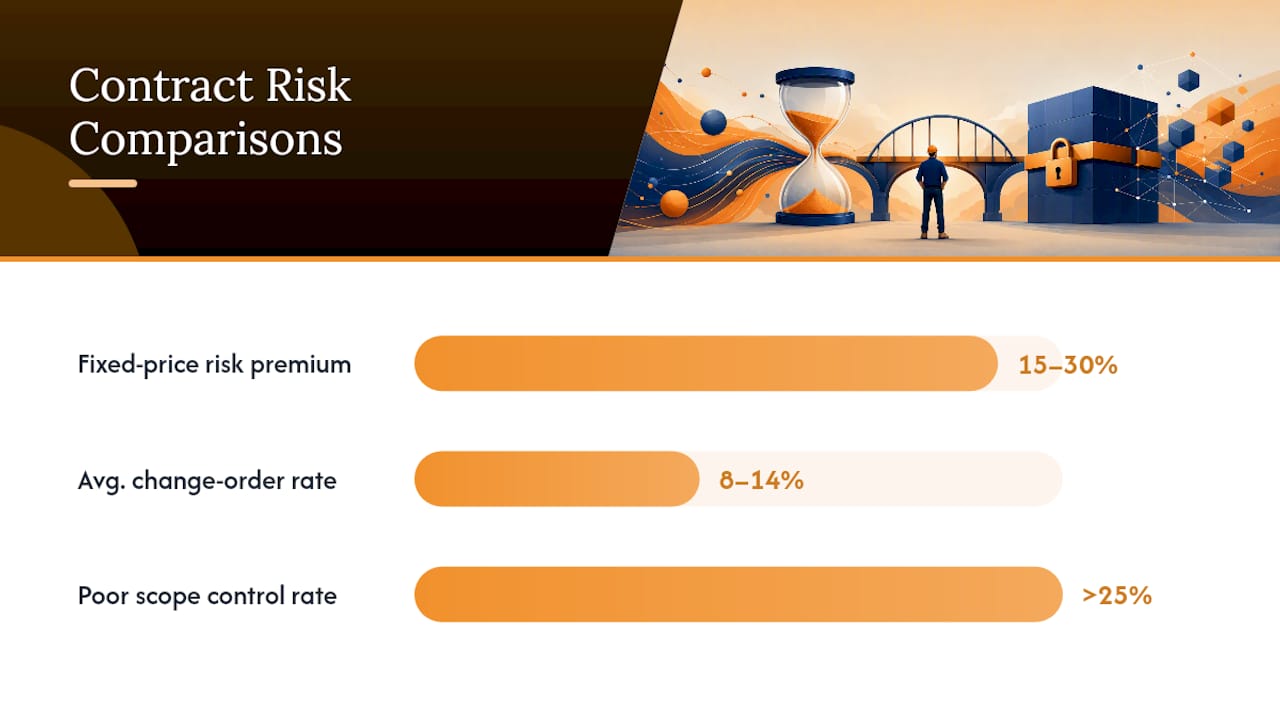
- Fixed-price bids include a 15% to 30% risk premium, often masking unknown costs that could erode contractor margins if scope gaps occur.
- T&M contracts are suitable for unpredictable work but require strict governance tools like caps, daily time tracking, and detailed backup to prevent cost escalation.
- Hybrid models with capped T&M discovery phases followed by fixed prices are the most common, especially for projects with uncertain scope or site conditions.
- Proper contract clauses, daily data collection, and digital tools like Won2Build are essential for controlling costs and reducing disputes in either pricing model.
Table of Contents
- T&M vs Lump Sum: A Quick Comparison
- How Lump-Sum Contracts Work and Where They Break
- Time and Materials Contracts: Mechanics and Cost Controls
- Hybrid Contracts: The Model Most Experienced Teams Actually Use
- How to Choose Between T&M and Lump Sum
- Contract Clauses That Actually Enforce This
- What Makes T&M Actually Predictable on the Ground
- The Practical Rule of Thumb
- Where Won2Build Fits Into Your Contract Governance
- Sources
T&M vs Lump Sum: A Quick Comparison
The fastest way to see the trade-off is to line up what each model actually protects and who ends up holding the risk.
| Factor | Lump Sum (fixed price) | T&M |
|---|---|---|
| Cost certainty | High for the owner | Low unless capped |
| Who carries overrun risk | Contractor | Owner (unless not-to-exceed applies) |
| Scope stability required | High, design must be complete | Low, built for change |
| Best-fit examples | New construction, tenant fit-outs with finished drawings | Emergency repairs, remediation, phased renovations |
| Governance needs | Tight takeoff, written exclusions, allowances | Daily time capture, burn reports, spend caps |
A few things get lost if you only skim the table. Fixed-price bids typically carry a 15% to 30% buffer baked in for unknowns, so “cost certainty” for the owner often means paying for risk that may never materialize. On the T&M side, that certainty gap closes only when someone is actually watching the meter.
- Lump sum rewards contractors who know their site cold and punishes anyone who missed a scope item.
- T&M rewards owners who staff the project with someone empowered to approve or reject hours weekly.
- Neither model fixes a bad design. It just decides who pays when the design fails.
If your drawings are stamped and your specs are tight, take the fixed price. If you’re staring at a hole in a wall with no idea what’s behind it, don’t pretend you can price that with a lump sum.
How Lump-Sum Contracts Work and Where They Break
A lump-sum contract is one number for one defined scope. The owner gets budget certainty, the contractor gets a fixed number to hit, and everyone signs before a shovel touches dirt. It’s the model most owners prefer because it’s simple to compare across bidders and simple to finance against.
That simplicity has a cost. Contractors know they’re on the hook for anything they missed, so bids get padded. A 15% to 30% risk premium is common on fixed-price work, layered in specifically to absorb the things nobody can predict, like a hidden utility line, a permit delay, or a substitution the architect didn’t catch. Owners rarely see that premium itemized. They just see one number, and they assume it’s tight.
The real danger for contractors isn’t the premium, it’s the gap. Lump sum shifts maximum overrun risk onto the contractor, and scope gaps are the single biggest cause of margin loss on fixed-price jobs. Miss a line item in your takeoff, and that cost comes straight out of your profit. Change-order rates on commercial work run 8% to 14% on average, climbing past 25% where scope control is weak. Every one of those change orders is a moment where the original bid didn’t match reality.
Lump sum fits work you can fully draw before bidding: new construction on a finished set of plans, a tenant fit-out with a locked design, a repeat job you’ve built ten times before. It struggles on anything with unknown site conditions, incomplete design, or an owner who hasn’t made key decisions yet.
To protect margin on a fixed-price job:
- Run a complete, line-by-line takeoff before you price anything.
- Write explicit exclusions into the contract. If it’s not listed, it’s not included.
- Use allowances for anything genuinely undefined (finishes, fixtures, unknown conditions) instead of guessing a number.
- Get signed sign-offs at each design milestone so scope disputes have a paper trail.
Pro Tip: Never let “substantially complete” drawings stand in for finished ones. Price the gaps as allowances, not as guesses buried in your markup.
Time and Materials Contracts: Mechanics and Cost Controls
T&M bills for what actually happens: labor at an agreed hourly rate, materials at cost plus a markup, and sometimes a flat fee for equipment or overhead. Rates and markups get set up front, but the total invoice depends entirely on actual hours worked and materials consumed. There’s no risk premium baked in, which is why T&M often looks cheaper on paper than a lump-sum quote for the same job. The catch is that “looks cheaper” and “is cheaper” aren’t the same thing without controls.
T&M is the right call when nobody can honestly price the scope yet. That covers emergency repairs, remediation, and renovation work where site conditions are unknown until walls come open, plus phased projects where the owner wants to start before design is finished. Under pure T&M, the owner carries the cost risk. That’s fine when the owner understands the deal, and dangerous when they don’t.
The fix is governance, not avoidance. Here’s what actually keeps a T&M job from running away:
- Set a not-to-exceed cap. This puts a ceiling on total spend and forces a conversation before costs blow past it, rather than after.
- Require weekly burn reports. A simple hours-and-dollars-spent-to-date report keeps the owner informed in real time instead of at invoice shock.
- Capture time daily, not weekly. Timecards filled out from memory on Friday are guesses. Daily entries tied to specific tasks are documentation.
- Attach invoice backup to every bill. Material receipts, signed field tickets, and task-level labor detail turn an invoice into something an owner can actually verify.
- Name an approver. Someone on the owner’s side has to be authorized to sign off on hours and change orders weekly, or the whole system stalls.
None of this is optional if you want T&M to work for both sides. Governance tools like caps, burn charts, and weekly demos are what separate a managed T&M job from an open tab nobody’s watching.
Pro Tip: If an owner balks at weekly burn reports, that’s your signal they don’t understand what they signed up for. Get it in writing before day one, not after the invoice arrives.
Hybrid Contracts: The Model Most Experienced Teams Actually Use
Pure lump sum and pure T&M are the extremes. Most real projects, especially anything with a discovery phase, land somewhere in between. A capped discovery phase followed by fixed-price execution is the pattern most practitioners lean on, because it prices the unknowns cheaply under T&M and then locks in a fixed number once the scope is actually known.
The workflow typically runs like this: T&M covers investigation, demo, or design development, capped at a dollar figure the owner approves up front. Once that phase closes out, the contractor issues a fixed-price proposal for the execution work, now based on real conditions instead of guesses. The owner gets a smaller, more honest T&M exposure during discovery and a tighter fixed-price number afterward, since the contractor no longer needs to price in as much of a buffer.
A few hybrid variations show up often on commercial jobs:
- T&M with a not-to-exceed cap and a stop-loss trigger that pauses work and forces a review once spend hits a set threshold.
- Fixed-price milestones quoted inside a broader T&M engagement, useful when parts of the scope are known and parts aren’t.
- Phased conversion, where each phase’s fixed price gets locked only after the prior phase’s discovery work closes.
The trigger for converting from T&M to fixed price is simple: once the design is complete enough to take off accurately and the owner has made the decisions that were previously open, price it. Converting too early just reintroduces the scope-gap risk lump sum is supposed to eliminate.
How to Choose Between T&M and Lump Sum
Run through this before you commit to either model:
- Score scope clarity. Is the design 100% complete, are all owner decisions made, and are site conditions known? If yes across the board, lump sum fits.
- Check owner governance capacity. Does the owner have someone who will actually watch weekly burn, approve change orders, and sign acceptance documents? If not, T&M without controls is a bad idea regardless of scope.
- Review the bid itself. Does it name the actual team doing the work, show unit-cost backup, list a clear markup table, and state invoicing cadence? A bid missing any of these is a bid you can’t verify later.
- Watch for red flags. Vague specs, a compressed schedule that skips proper design review, and a history of high change-order rates on similar jobs all point toward hybrid or T&M with tight controls, not straight lump sum.
Questions worth asking any bidder before signing:
- Who specifically is on the crew, and what’s their track record on similar scope?
- Can you show unit-cost backup for major line items, not just a lump total?
- What’s your markup structure on materials and subcontracted work?
- How often will you invoice, and what documentation comes with each invoice?
If a bidder can’t answer these cleanly, that’s a red flag regardless of which pricing model you’re discussing.
Contract Clauses That Actually Enforce This
Good intentions don’t hold up in a dispute. The contract language does. A handful of clauses do the heavy lifting on either model:
- Change-order process. Spell out how a CO gets priced, who approves it, and how fast it has to be turned around, before work starts, not after the first surprise.
- Acceptance criteria. Define what “done” looks like at each milestone, with a signature required before the next phase starts.
- Timekeeping requirements. Require daily time entries with task-level detail, not weekly summaries reconstructed from memory.
- Material markup reconciliation. State the exact markup percentage and require receipts attached to every material line on an invoice.
- Audit rights. Give the owner the right to review backup documentation on demand, which keeps both sides honest without needing a lawyer involved.
- Dispute resolution and stop-loss triggers. Set a clear process for disagreements and a spend threshold that pauses work automatically pending review.
Signed measurement sheets and detailed invoice backup measurably cut disputes at closeout, and a solid change-order management process keeps that particular clause from becoming the weak link in the whole contract.
What Makes T&M Actually Predictable on the Ground
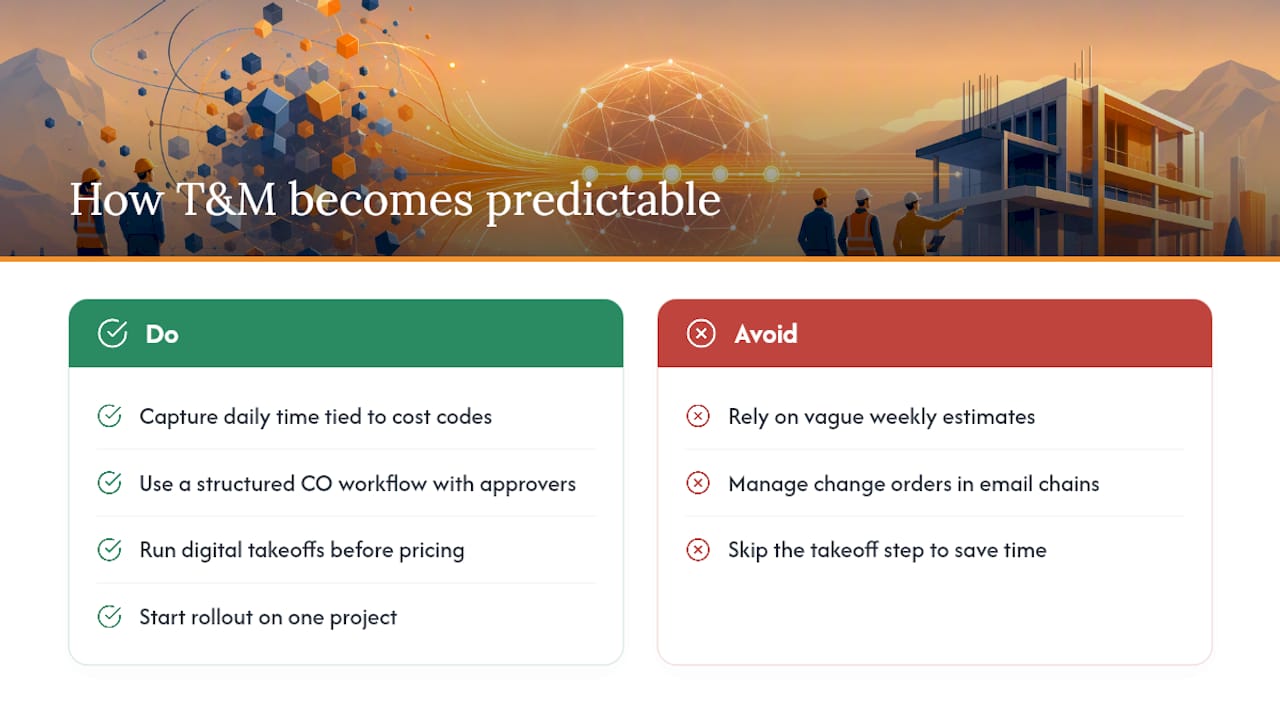
Governance clauses only work if someone captures the data behind them. Daily time entries tied to specific cost codes, not vague weekly guesses, are what let a burn report mean anything. Tools built for commercial time tracking close that gap by capturing hours in the field the moment work happens, so the office isn’t reconstructing a week from memory at invoice time.
Change orders die in email chains and paper tickets when there’s no standard intake process. A structured CO workflow with named approvers and consistent pricing turns a scattered back-and-forth into something both sides can point to later.
Scope gaps on lump-sum bids almost always trace back to a rushed or incomplete takeoff. Digital takeoff tools that quantify plans accurately before pricing catch the line items a manual measurement misses, which is exactly where lump-sum margin erosion starts.
If you’re rolling any of this out, start with one project. Enforce daily time capture without exception, require every change order to run through the same template, and don’t skip the takeoff step to save an afternoon.
The Practical Rule of Thumb
My default, given how often scope shifts mid-project, leans hybrid first: cap the unknowns under T&M, then lock a fixed price once the picture is clear. Three rules that hold up across almost every job. Document everything, because memory loses to paperwork in a dispute every time. Name an approver on both sides before work starts, not after the first disputed invoice. Require daily time capture, not weekly reconstruction. The contractors who lose margin usually skipped one of these three, not because the contract type was wrong.
— Jen Reese
Where Won2Build Fits Into Your Contract Governance
Every control this article recommends, capped discovery, weekly burn reports, named approvers, accurate takeoff, is only as good as the system tracking it. Won2Build is built specifically for subcontractors who need those controls to actually run day to day instead of living in a spreadsheet nobody updates.
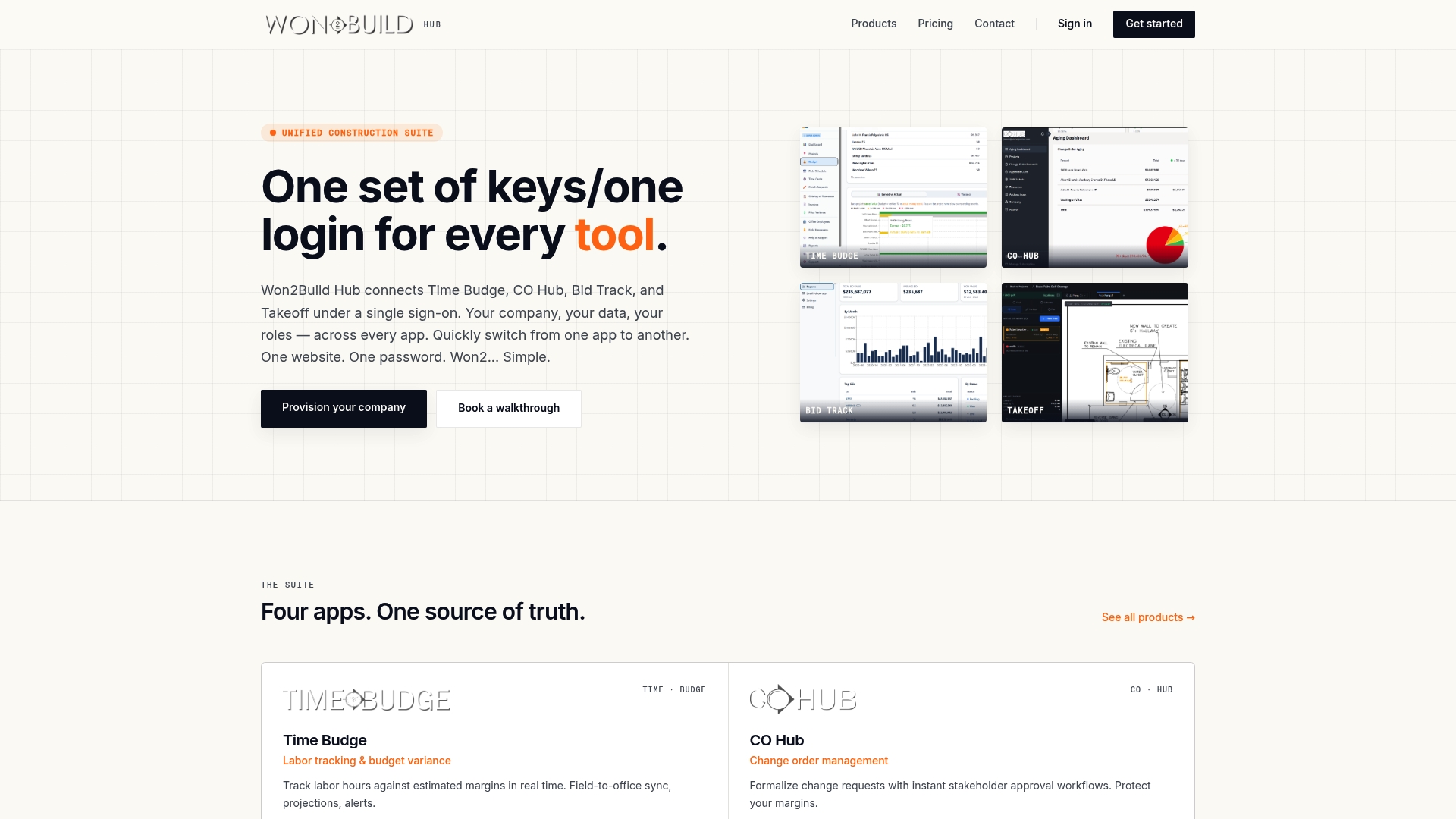
Time Budge captures field hours daily, so your weekly burn reports reflect real work instead of a foreman’s Friday-afternoon guess. CO Hub standardizes change-order intake and approval so every CO follows the same pricing and sign-off process you write into your contract, closing the exact gap that drives disputes at closeout. Takeoff quantifies digital plans accurately before you bid, narrowing the scope gaps that erode margin on fixed-price work. All three run through a single login, so field data syncs to the office in real time instead of getting re-entered by hand.
If you’re tired of chasing paper timecards or reconciling change orders after the fact, start a trial with Won2Build and see how the governance checklist above runs itself.
Sources
- Fixed Price vs Time and Materials: A Practical Guide | Refact
- Fixed Price vs Time and Materials: Which Contract Protects You? | GMWARE
- Fixed-price vs time and materials (NetSuite resource)
Recommended
One login for estimating, bid tracking, change orders, and labor.
The Hub is free. Pay only for the apps you turn on.
Create your free Hub account- Managers: Make Mobile Field Workflows Resilient for 72 Hour OutagesPlaybook for field managers: offline first mobile workflows, resilient sync and conflict handling, compliance first AI guardrails, and practical pilot steps.
- Daily Signed Records: Force Account Tracking for Managers & InspectorsField checklist for project managers and inspectors to keep force account tracking audit-ready: use daily signed records for labor, equipment, and...
- Stop Timecard to Report Drift: Labor Cost Codes for SubcontractorsFix the timecard to report chain with labor cost codes that tie crews to budgets. Includes a 6 code starter and a burdened rate example.