
What Is a Construction Allowance? A 2026 Contract Guide
Discover what is a construction allowance and how it can impact your budget. Learn essential insights for effective contract management.

A construction allowance is a specific dollar amount written into a contract sum as a placeholder for materials or equipment whose final cost cannot be confirmed at signing. The item itself is known — say, the kitchen cabinetry or the bathroom tile — but the owner hasn’t made a final selection yet, so an estimated figure holds its place in the budget. Once the selection is made and the actual cost is known, the contract sum adjusts through a formal change order.
Construction allowances commonly appear for items like:
- Flooring materials (hardwood, tile, carpet)
- Cabinetry and countertops
- Lighting and plumbing fixtures
- Appliances
- Landscaping
One thing contractors and owners both get wrong: allowances cover the cost of materials delivered to the site, including applicable taxes, less any trade discounts. Labor, installation, unloading, overhead, and profit are not part of the allowance. Those costs belong in the contract sum separately.
Table of Contents
- How construction allowances work in contracts and budgets
- Common types of construction allowances and real-world examples
- How do construction allowances differ from contingencies?
- How to calculate, manage, and track allowances effectively
- Expert insights on avoiding common allowance mistakes
- Key Takeaways
- Won2build helps you manage every allowance change order
How construction allowances work in contracts and budgets
Allowances act as line items in the contract documents, holding a position in the budget until the owner finalizes a selection. The contractor prices everything else — labor, installation, overhead — based on the assumption that the allowance covers the material cost. This lets a project move forward and get under contract before every finish decision is locked in.

When the owner picks the actual product, the contractor compares the real cost against the allowance amount. If the flooring the owner selects costs more than the allowance, the contract sum goes up via a change order. If it comes in under, the owner receives a credit. Under AIA A201-2017 Section 3.8, this reconciliation process is formalized through change orders that reflect both the material cost difference and any related changes in contractor costs.
The practical benefit is real: projects can start, bids can be compared on equal footing, and owners retain flexibility on finish selections without blowing up the contract structure. Allowances also show up as named line items on the G703 Continuation Sheet, so tracking them against actual costs is straightforward.
Key points on what allowances include and exclude:
- Included: Material and equipment costs delivered to the site, plus required taxes, minus trade discounts
- Excluded: Labor, installation, unloading, handling, overhead, and contractor profit
Pro Tip: Include firm selection deadlines directly in the allowance clause. Without a specific date, an owner who takes months to choose flooring can stall the entire project, creating scheduling gaps and potential subcontractor availability problems.
Common types of construction allowances and real-world examples
Construction allowances fall into two main categories: material allowances and installation allowances. Most contracts use material allowances far more often, but both serve a purpose depending on how well the scope is defined at bid time.

Material allowances cover the physical product itself. Common examples include flooring, cabinetry, lighting fixtures, plumbing fixtures, appliances, and countertops. A contract might read: “Flooring allowance: $8.00 per square foot, material only.” If the owner selects a tile that runs $11.00 per square foot, the contractor submits a change order for the difference.
Installation allowances apply when the labor scope can’t be precisely defined upfront. This happens when site conditions are uncertain or when final design decisions could change how much work is involved. These are less common than material allowances but show up on projects where, for example, the extent of subfloor prep depends on what’s found once demolition begins.
A few real-world allowance clause examples:
- “Cabinet allowance: $12,000, materials only, owner-selected vendor.”
- “Appliance allowance: $6,500 per unit, delivered to site.”
- “Landscaping allowance: $15,000, materials and plant material only.”
Commercial projects add another layer. Tenant Improvement Allowances (TIAs) work differently from residential allowances. A landlord funds the TIA, typically calculated per square foot of leased space, and recoups it through rent over the lease term. Tenant Improvement Allowances are commonly calculated on a per-square-foot basis, producing a total budget tied to the leased area and rate. The tenant uses that money to build out the space, and the landlord ties the amount to lease length and the tenant’s credit profile.
How do construction allowances differ from contingencies?
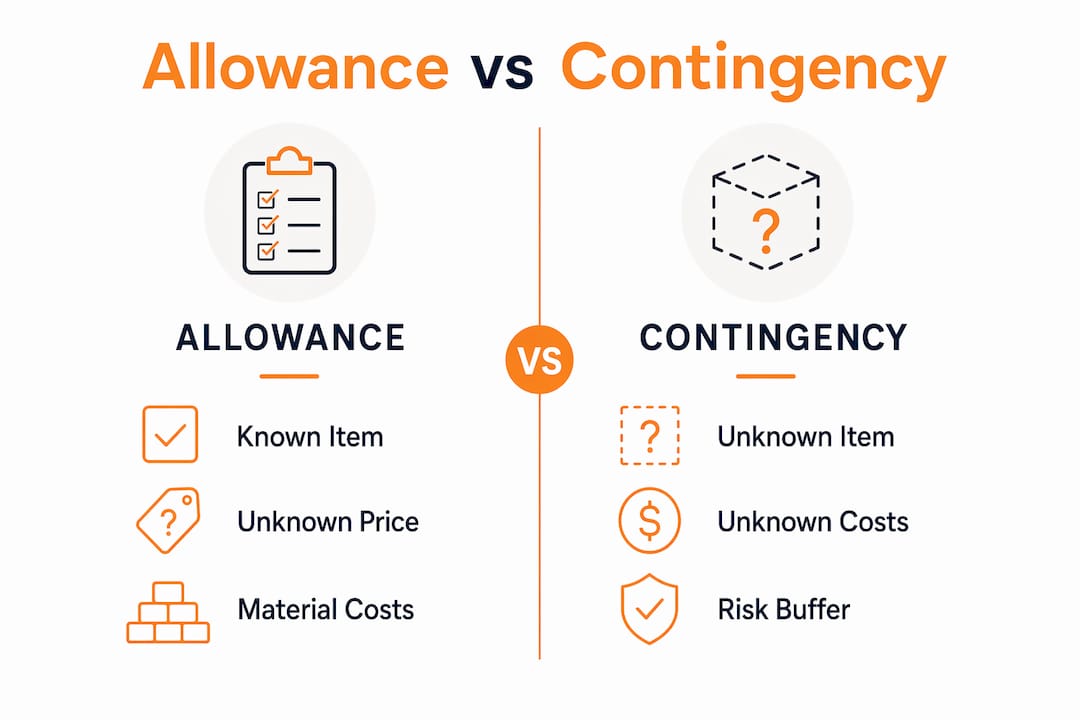
This is where most budget confusion starts. Allowances and contingencies both represent money set aside for costs not fully known at contract signing, but they cover fundamentally different situations.
An allowance is for a known item with an unknown price. You know carpet will be installed. You just don’t know which carpet the owner will choose. A contingency, by contrast, is a reserve for risks that may or may not happen at all — unexpected soil conditions, hidden structural damage, weather delays. The item itself is uncertain, not just the price.
| Feature | Construction Allowance | Construction Contingency |
|---|---|---|
| Covers | Known item, unknown final price | Unknown risk or unexpected event |
| Type of uncertainty | Expected but variable | Unpredictable |
| Controlled by | Owner (selection-driven) | Contractor or owner (risk reserve) |
| Adjusted when | Owner selects the item | Risk event occurs |
| Appears in contract as | Named line item | Reserve fund |
Misclassifying one as the other causes real problems. Treating an allowance as a contingency leads to under-budgeting for custom finishes, because contingency reserves are sized for risk probability, not for the full cost of a known item. Going the other direction, using an allowance to absorb unexpected site conditions, leaves the contractor exposed when the allowance runs out and there’s no formal mechanism to recover the overage.
How to calculate, manage, and track allowances effectively
Base every allowance on a verified vendor quote, not a round number pulled from memory. Experienced project managers consistently point to this as the single most important practice. A quote from an actual supplier at the specified quality level gives you a defensible number. A guess gives you a dispute.
Steps for calculating and managing allowances:
- Get current quotes. Contact vendors for pricing on the specified product category before finalizing the allowance figure.
- Include only material costs. Labor, installation, and overhead go in the contract sum separately. Mixing them into the allowance obscures true costs.
- Document each allowance as a named line item. Vague allowances create arguments. “Flooring allowance: $8.00/sq ft, material only, 1,200 sq ft” is clear. “Flooring: $9,600” is not.
- Track against actuals in real time. As selections are made, log the actual cost against the allowance immediately. Waiting until the end of the project to reconcile creates surprises nobody wants.
- Process change orders promptly. When actual costs differ from the allowance, issue the change order before the work proceeds. Doing it after the fact invites disputes over scope and pricing.
Good project budget tracking catches allowance variances early, before they compound into a budget crisis. The goal is to close out every allowance line item with a corresponding change order, so the final contract sum reflects actual costs accurately.
Pro Tip: When negotiating allowance amounts with an owner, show your vendor quotes. Owners who see the basis for an allowance figure are far less likely to push back on change orders when actual costs land above the estimate.
Expert insights on avoiding common allowance mistakes
The most persistent mistake in construction budgeting is setting allowances low to win a bid. Low-ball allowance numbers make a proposal look competitive on paper, but they transfer the cost problem to the change order process, where owners feel blindsided and contractors fight for money they should have had from the start. Basing allowances on current vendor quotes at the specified quality level eliminates this problem before it starts.
A second common error is confusing allowances with contingencies, which analysts note leads to systematic under-budgeting and cost overruns. Allowances are for known unknowns. Contingencies are for unknown unknowns. Using one bucket for both means neither is sized correctly.
Without firm deadlines for owner selections, allowance clauses become open-ended liabilities. A contract that says “owner shall select flooring with reasonable promptness” is not enforceable in any practical sense. Contracts should specify selection timeframes with actual dates tied to the project schedule, so delays trigger a documented schedule impact rather than a vague disagreement.
Key expert recommendations:
- Base allowances on verified quotes, not historical averages or guesses
- Keep labor and installation costs out of the allowance and in the contract sum
- Use formal change orders, such as AIA G701, to adjust the contract sum when actual costs are known
- Set specific owner selection deadlines in every allowance clause
- Track allowance line items separately from contingency reserves throughout construction
- Never treat an allowance as a general budget buffer for unspecified risks
For commercial projects involving permits and financing, allowance amounts can also affect renovation loan approvals, since lenders often review the contract sum and its components when underwriting construction loans. A well-documented allowance structure supports that process rather than complicating it.
Key Takeaways
A construction allowance is a named, material-only placeholder in the contract sum that adjusts through a formal change order once the owner makes a final selection.
| Point | Details |
|---|---|
| Allowances cover materials only | Labor, installation, overhead, and profit belong in the contract sum, not the allowance. |
| Change orders close out allowances | When actual costs differ from the allowance, the contract sum adjusts via a formal change order such as AIA G701. |
| Allowances differ from contingencies | Allowances cover known items with uncertain prices; contingencies cover unexpected risks that may not occur at all. |
| Base allowances on real quotes | Verified vendor quotes at the specified quality level prevent low-ball estimates and change order disputes. |
| Selection deadlines protect schedules | Contracts should include specific dates for owner selections to prevent allowance delays from stalling the project. |
Won2build helps you manage every allowance change order
Every allowance reconciliation ends in a change order. Won2build’s CO Hub gives subcontractors a purpose-built tool to create, track, and close out change orders the moment actual costs are known, so nothing slips through and the contract sum stays accurate. Pair it with Bid Track to set realistic allowance figures during estimating, and you have a connected workflow from bid to final reconciliation.
Recommended
One login for estimating, bid tracking, change orders, and labor.
The Hub is free. Pay only for the apps you turn on.
Create your free Hub account- 7 Concrete Takeoff Steps Estimators Use to Avoid Ordering ShortfallsFollow seven concrete takeoff steps to calculate cubic yards, size rebar and formwork, convert volumes to supplier units, and verify quantities before bid...
- Are E-Signature Change Orders Legal and Worth the Switch?E-signature change orders streamline your workflow, ensuring faster approvals, fewer disputes, and quicker invoicing—discover the benefits now!
- How to Link Takeoff to Estimate for Accurate BidsLink your takeoff quantities to your estimate for accurate bids. Discover the seamless integration method that reduces errors and saves time.