
2–4 Week Pilot to Fix Construction Time Tracking for Subcontractors
Field-first time tracking for subcontractors: require cost code at clock in and offline sync. Run a 2–4 week pilot to stop payroll cleanup.

The most practical approach is field-capable digital capture that requires cost-code entry at the point of time capture and feeds payroll and job-cost systems automatically. Paper and spreadsheets fail here because they separate the moment work happens from the moment it gets coded, creating gaps that payroll staff spend hours closing. The right method for your crew depends on device ownership, site connectivity, and how mobile your workers are.
TL;DR:
- Using digital capture with mandatory cost-code entry at clock-in ensures accurate job costing and reduces payroll cleanup compared to paper or spreadsheets.
- Offline-capable apps, photo verification, and control over device security are key features for reliable, scalable time-tracking systems in construction sites.
- Pilots should focus on clear exception workflows, weekly audits, and matching payroll sync fields to prevent data errors and streamline payroll processing.
- The most effective method varies by workforce and site conditions, with small crews benefiting from mobile apps and large crews requiring shared kiosks or offline solutions.
- Maintaining consistent, structured data entry and conducting regular payroll reconciliation are crucial to avoiding time theft, errors, and audit issues.
Table of Contents
- Catalog of time tracking methods for construction crews
- Method deep dive: accuracy, admin burden, and payroll readiness
- Match method to workforce and device context
- Implementation framework: evaluate, pilot, deploy, govern, payroll sync
- Won2Build field-tested best practices and checklist (Jen Reese)
- How time tracking supports job costing, T&M billing, and relevant IRS guidance
- Common pitfalls, red flags during pilots, and quick fixes
- Author perspective: three priority actions for a subcontractor manager
- Keeping field capture and payroll in sync with Won2Build
- FAQ
- Sources
Catalog of time tracking methods for construction crews
Every method on a job site falls into one of a few buckets, and each one balances accuracy with cost or admin effort differently.
- Paper timesheets: cheap and familiar, but prone to illegible entries, lost sheets, and hours of manual data entry before payroll can run.
- Shared kiosk or tablet: one device per site cuts hardware cost and works for crews without personal smartphones, though it needs a power source, a weatherproof mount, and some protocol to stop buddy-punching.
- Personal-device mobile apps: fast to deploy since workers already carry the phone, and many support photo verification and cost-code fields natively, but they depend on workers keeping the app charged and open and raise bring-your-own-device policy questions.
- Employer-issued devices: give you full control over settings and security, which matters for larger crews, but add a hardware budget and a device-management burden.
- GPS and geofencing: automatically flags when a worker enters or leaves a job site radius, useful for multi-site crews, though it needs clear disclosure and policy to avoid privacy pushback.
- Biometric punch terminals: nearly eliminate time theft through fingerprint or face verification, but they are fixed to one location and carry a higher upfront cost.
- RFID or NFC badges: fast tap-in, tap-out capture that works well at gated sites, though a lost or shared badge defeats the accuracy benefit.
- Stopwatch or foreman logs: flexible for small crews and short tasks, but entirely dependent on one person’s memory and diligence.
- Offline-capable digital forms: built for sites with no signal, storing entries locally and syncing once connectivity returns, which solves the biggest complaint about app-based systems.
Mobile apps, offline-capable forms, and employer-issued devices are the methods that most readily support cost-code capture at the point of entry. Paper, stopwatch logs, and basic kiosks usually need a workflow change, like a required cost-code field or a foreman sign-off step, before the data is usable for job costing. GPS, biometric, and RFID methods verify presence well but still need a cost-code layer added on top to be more than a payroll clock.
Method deep dive: accuracy, admin burden, and payroll readiness
Picking a method is only half the job. How you configure it determines whether it actually saves payroll time or just moves the cleanup from paper to a spreadsheet.
- Make cost-code entry mandatory at the moment of capture. A time entry without a cost code is incomplete data, not a convenience to fix later; build the field so the clock-in cannot be submitted without it.
- Require a photo or foreman verification for exceptions. Late punches, manual overrides, and missed clock-outs should trigger a verification step rather than auto-approve, which is where most time fraud and payroll disputes originate.
- Capture offline and sync later, but sync on a fixed schedule. Entries made with no signal need to queue locally and push the moment connectivity returns; our offline time tracking guidance covers the settings that prevent entries from silently failing to sync.
- Set an exception workflow, not a blanket override. A foreman should approve or reject flagged entries daily, not weekly, so corrections happen while the work is still fresh in everyone’s memory.
- Expect payroll cleanup when a method lacks structured fields. Paper timesheets and basic stopwatch logs will always require someone to manually translate handwriting or memory into payroll codes, no matter how disciplined your foremen are.
The methods that skip structured cost-code fields, verification steps, or offline queuing will keep generating payroll exceptions regardless of how good your crew is at filling out a form. The fix isn’t more training on the same tool, it’s a tool built to make the correct entry the only entry.
Match method to workforce and device context
The right method changes with the crew in front of you, not with what looks most modern on a sales page.
- Personal-device apps work best when most of your crew already owns a smartphone and is comfortable with basic apps; they struggle on crews with high device turnover or limited data plans.
- Employer-issued devices or shared kiosks fit crews without personal smartphones, seasonal labor, or sites where personal phone use is restricted for safety reasons.
- Shared kiosks need a hygiene and trust control, typically a PIN or badge tap paired with a photo, to prevent one worker from clocking in for another.
- Union agreements or prevailing-wage contracts often dictate how break time, overtime, and job classification must be recorded, which can rule out a method that cannot track those fields separately.
Three quick profiles: a five-person remodeling crew with high phone ownership fits a personal-device app with cost-code fields built in. A 40-person framing crew with mixed device access fits a shared kiosk at the trailer paired with foreman-verified entries. A multi-site electrical subcontractor with prevailing-wage requirements fits an offline-capable app that separates job classification and break time automatically.
Implementation framework: evaluate, pilot, deploy, govern, payroll sync
Rolling out a new method without a structured process is how contractors end up with three overlapping systems and no clean data in any of them.
- Score candidates on operational fit, not feature count. Weight offline behavior, cost-code support, and payroll integration above interface polish. A simple scorecard works: offline capability (30%), cost-code enforcement (30%), payroll sync (25%), ease of training (15%).
- Run a pilot on one crew or one site for two to four weeks. Track missed-punch rate, exceptions per payroll run, and percent of hours cost-coded at entry as your minimum success metrics.
- Set punch rules before launch. Define grace periods for late clock-ins, a clear dispute window, and who approves exceptions.
- Train foremen first, crews second. A foreman who understands the exception workflow will catch problems before they reach payroll.
- Build a governance routine. Schedule weekly audits of flagged entries and a fixed payroll reconciliation cadence so exceptions never pile up for a full pay period.
- Confirm the payroll sync fields match your payroll system’s requirements. Job code, pay rate class, and overtime rules should map automatically rather than requiring a manual translation step each cycle.
Pro Tip: Run your pilot during a normal production week, not a slow one. A quiet week hides the exceptions you’re trying to surface.
Won2Build field-tested best practices and checklist (Jen Reese)
Before rolling out any method company-wide, run three setup checks: confirm cost-code fields are mandatory and cannot be skipped, test the offline queue by capturing entries with the device in airplane mode, and confirm a sample payroll feed matches your payroll system’s expected format.
Train foremen on three points: how to approve or reject a flagged entry same-day, how to verify a worker’s location or photo on an exception, and how to read the job-cost report that results from their crew’s entries. Our construction timecard best practices walk through these checks in more detail.
Integrated tools that share one login across time tracking, change orders, and job costing cut down on double entry, since a labor hour coded once in the field shows up in job-cost reports without someone retyping it into a second system.
How time tracking supports job costing, T&M billing, and relevant IRS guidance
Cost-coded, timestamped labor entries are what make daily productivity tracking possible: comparing budgeted hours against actual hours by task lets a manager catch a losing cost code mid-project instead of discovering it at closeout. Our electronic time tracking overview covers how this data flows into change order and estimating workflows.

The IRS Construction Industry Audit Technique Guide explains that contractors generally use the percentage-of-completion method under IRC Section 460 for long-term contracts, and it describes time-and-materials contracts as paying based on direct labor hours at a fixed rate plus materials, which the Construction Industry ATG lays out in detail. That framing matters for time-tracking policy: a T&M invoice is only as defensible as the labor records behind it, so retaining timestamped, cost-coded entries tied to specific contract lines protects both billing accuracy and audit readiness.
Common pitfalls, red flags during pilots, and quick fixes
- Treating time tracking as payroll-only leaves job costing blind until the project is already over budget.
- Skipping the pilot means problems surface across your whole workforce instead of one test crew.
- Missing cost codes on a meaningful share of entries signals the tool or the training needs fixing before wider rollout.
Pro Tip: If exceptions climb instead of dropping after week two of a pilot, stop and revisit the training before expanding to more crews.
Author perspective: three priority actions for a subcontractor manager
Cost-code accuracy matters more than any app’s interface. A tool that looks modern but lets workers skip the cost-code field will cost you more in payroll cleanup than a clunky one that enforces it. Three moves to make this week: pick one site for a pilot, require cost-code entry on every clock-in starting now, and set a fixed weekly cadence for payroll reconciliation instead of handling it whenever time allows.
— Jen Reese
Keeping field capture and payroll in sync with Won2Build
Running separate systems for time tracking, job costing, and change orders means someone is retyping the same labor hour two or three times before it reaches payroll. A well-designed suite can allow a cost code entered in the field during clock-in to flow straight into job-cost reports without a second data-entry step.
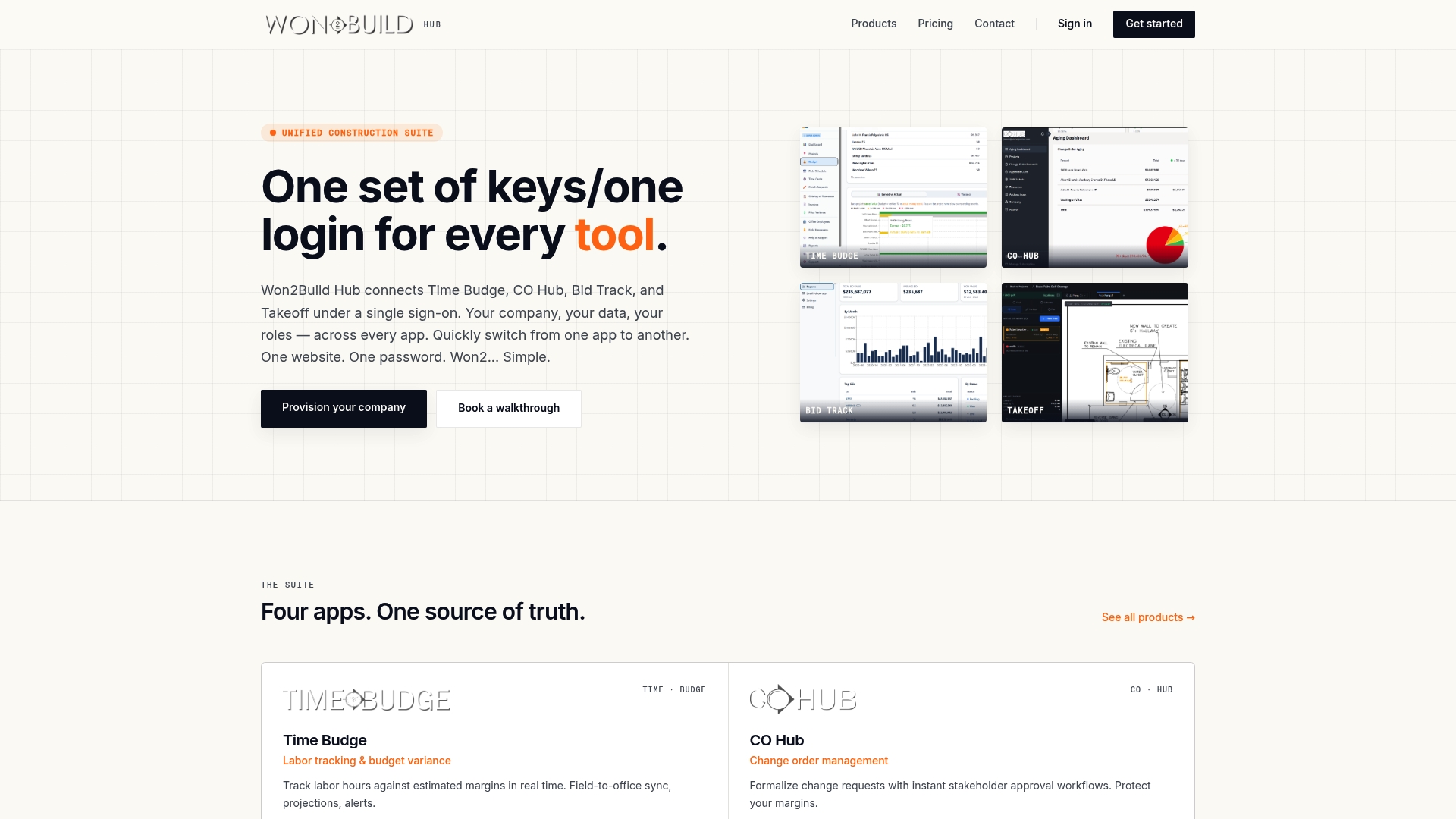
A typical pilot-to-payroll flow looks like this: a foreman’s crew clocks in through Time Budge with a mandatory cost code, exceptions get flagged for same-day approval, and the approved hours sync to payroll on a fixed weekly schedule with no manual translation step in between.
- A unified login can cover labor tracking, change orders, estimating, and takeoff instead of four separate systems.
- Cost codes entered at clock-in can appear in job-cost reports the same day, not at month-end.
- Pricing models may include per-company fees and additional charges based on active users.
| Module | What it handles | Price |
|---|---|---|
| Time Budge | Labor tracking and job costing | $199 per month per company |
| CO Hub | Change order and T&M ticket management | $59 per month per company |
| Bid Track | Bid estimating and pipeline management | $199 per month per company |
| Active field worker fee | Per active field worker on certain modules | $2 per month per worker |
Check current packaging and the full product family on our pricing page to see which modules fit your current workflow.
FAQ
What is the best way to track time spent on projects?
The most reliable approach pairs field-capable digital capture with mandatory cost-code entry at the point of clock-in, so labor hours are already tagged to the right job and task before they reach payroll. This avoids the manual translation step that paper timesheets and basic spreadsheets always require.
What is the best construction time tracking app?
There is no single best app for every crew; the right choice depends on device ownership, site connectivity, and whether you need cost-code enforcement built into the clock-in step. Look for offline capture, mandatory cost-code fields, and a direct payroll sync rather than judging on interface alone.
What is the best time tracker for contractors?
Subcontractors generally get the most value from a tool built specifically for job costing and labor tracking rather than a generic time clock, since labor hours need to tie directly to cost codes and contract lines. Won2Build’s Time Budge is built for this purpose, pairing field capture with job-cost reporting in one login.
Can QuickBooks track time for contractors?
QuickBooks offers basic time tracking features that can log hours for invoicing and payroll purposes, but it was not built specifically for construction cost-code tagging or field-level job costing. Contractors who need labor hours tied directly to job-cost codes and T&M billing often pair or replace it with a construction-specific tool.
Recommended
One login for estimating, bid tracking, change orders, and labor.
The Hub is free. Pay only for the apps you turn on.
Create your free Hub account- Managers: Make Mobile Field Workflows Resilient for 72 Hour OutagesPlaybook for field managers: offline first mobile workflows, resilient sync and conflict handling, compliance first AI guardrails, and practical pilot steps.
- Daily Signed Records: Force Account Tracking for Managers & InspectorsField checklist for project managers and inspectors to keep force account tracking audit-ready: use daily signed records for labor, equipment, and...
- Stop Timecard to Report Drift: Labor Cost Codes for SubcontractorsFix the timecard to report chain with labor cost codes that tie crews to budgets. Includes a 6 code starter and a burdened rate example.