
What Is a Section 01 Specification for Building Projects?
Discover what a Section 01 specification entails for building projects, including essential administrative rules, procedures, and quality control.

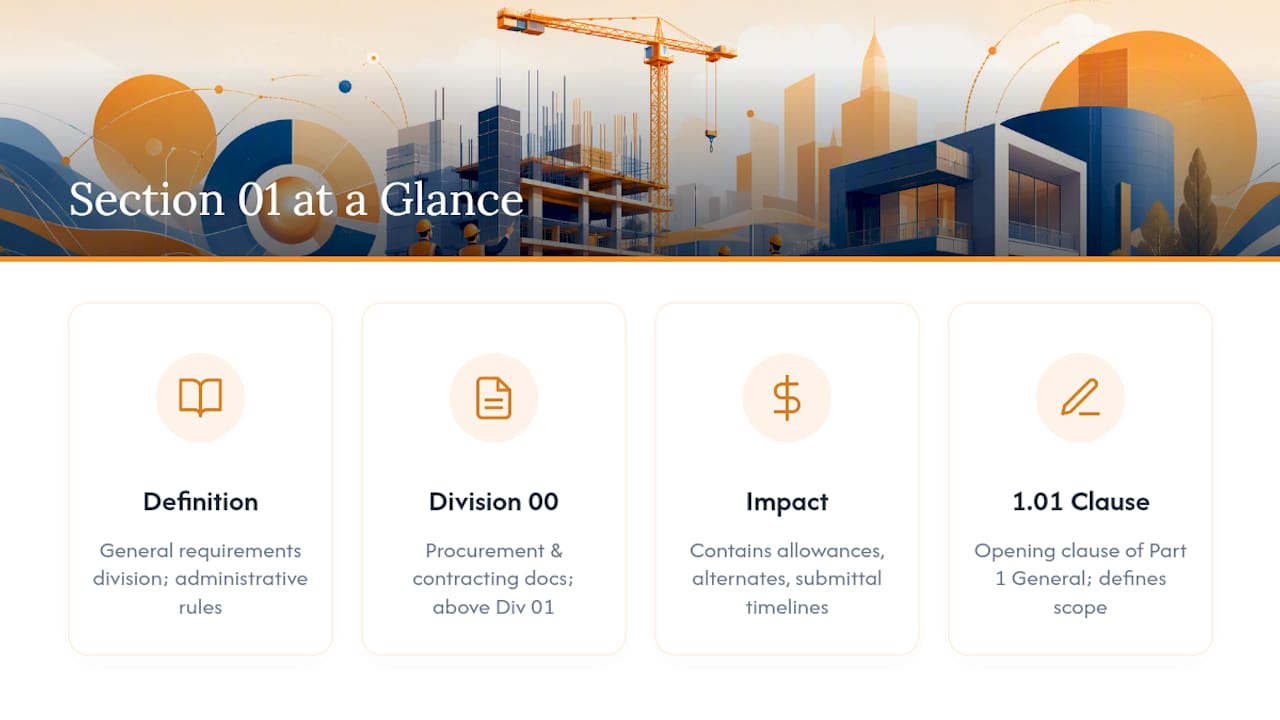
A Section 01 specification is the general requirements division in the CSI MasterFormat system, the part of a project manual that sets the administrative and procedural rules governing everything else in the job. It doesn’t tell you what material goes into a wall assembly. It tells you how the project runs: who submits what, when, and under what conditions. Division 01 sits alongside the standards defined by SectionFormat and often references code bodies like the ICC’s I-Codes to keep every technical section consistent with the same ground rules.
Division 01 typically covers:
- Administrative procedures — submittal schedules, RFI protocols, payment applications, and change order processes.
- Temporary facilities and controls — job site utilities, security, dust control, and construction fencing.
- Quality and closeout requirements — mock-ups, testing, warranties, O&M manuals, and final inspections.
If you price a bid without reading Division 01 closely, you’re pricing half the job.
Key Takeaways
Division 01 sets the administrative rules that govern every technical division on a project, and reading Part 1 General closely before bidding is the single most reliable way to avoid hidden costs.
| Point | Details |
|---|---|
| Division 01 defines process, not product | It governs submittals, payment, temporary facilities, and closeout across every trade. |
| Watch Part 1 General closely | Cost surprises like allowances and submittal counts usually hide there, not in Part 2 or 3. |
| Contract precedence matters | General Conditions and Division 00 govern conflicts; know your order-of-precedence clause. |
| Red flags cost real money | Vague substitution language and unclear owner-furnished responsibility are common disputes. |
| Extract items before you bid | Pull allowances, submittal deadlines, and closeout deliverables into your estimate early. |
Table of Contents
- What Is a Section 01 Specification Used For?
- What Sections Make Up Division 01 General Requirements?
- How Does Division 01 Relate to the Contract and General Conditions?
- How Should You Read Section 01 Before Bidding?
- What Are the Common Red Flags in Division 01?
- How Do You Read a Typical 1.01 Section Includes Clause?
- What Should Subcontractors Extract From Division 01 for a Bid?
- Why Division 01 Deserves a Closer Read Than Most Bidders Give It
- Get Division 01 Into Your Bid Workflow, Not Just Your Reading Pile
- Where to Learn More About Division 01 and General Requirements
- Frequently Asked Questions
- Sources
What Is a Section 01 Specification Used For?
Division 01 works like the operating manual layered on top of every technical section in the project. It doesn’t specify the roofing membrane or the HVAC controls sequence, but it dictates the submittal deadlines, the payment schedule, and the closeout paperwork that apply across every trade touching the job.
Practitioners generally check Division 01 for:
- Submittal requirements and review turnaround times
- Payment procedures, including schedule of values and retainage terms
- Alternates and allowances that shift scope or price
- Temporary facilities: power, water, sanitation, protection of existing work
- Quality control measures: mock-ups, testing agencies, inspection sequences
- Closeout and commissioning deliverables
Division 01 exists to remove ambiguity between what the drawings show and what the contract actually requires. When a spec section is silent on a procedural question, Division 01 usually answers it. Before you price a bid, scan the index for line items tied to allowances, alternates, or owner-furnished equipment. Those three categories cause more scope disputes than almost anything else in a project manual, and they’re often buried a few pages deep in a section nobody reads until it’s too late.
What Sections Make Up Division 01 General Requirements?
Division 01 is broken into numbered subsections, each covering a distinct administrative function. A sample Division 01 standard specification from a real project manual shows the typical numbering and scope you’ll encounter on most commercial jobs.
| Section Number | Title | Practical Implication |
|---|---|---|
| 01 10 00 | Summary | Defines project scope, work by others, and phasing. Read this first to confirm what’s actually included. |
| — | Alternates | Lists priced options the owner may or may not accept. Track these separately in your bid. |
| — | Substitution Procedures | Sets deadlines and documentation for proposing equal products. Miss the window and you’re locked in. |
| — | Administrative Requirements | Covers meetings, coordination drawings, and progress reporting obligations. |
| — | Submittal Procedures | Dictates format, quantity, and review timelines for shop drawings and product data. |
| — | Quality Requirements | Specifies testing agencies, mock-ups, and inspection thresholds. |
| — | Temporary Facilities and Controls | Assigns responsibility for job site utilities, fencing, and dust control. |
| — | Product Requirements | Sets storage, handling, and substitution limits for materials. |
| — | Closeout Procedures | Lists final inspection steps, punch list procedures, and record document requirements. |
| — | Operation and Maintenance Data | Defines format and delivery timing for O&M manuals. |
| — | Project Record Documents | Covers as-built drawing requirements and turnover format. |
| 01 91 13 | General Commissioning Requirements | Assigns testing, verification, and acceptance duties, often coordinated per WBDG commissioning guidance. |
Every 01 section follows the same three-part SectionFormat structure:
- Part 1, General — administrative conditions, references, and submittal requirements. This is where most cost surprises hide.
- Part 2, Products — material or equipment standards, when applicable to that particular 01 section.
- Part 3, Execution — installation, testing, and quality verification steps.
Part 1 is where estimators lose the most money by skimming. That’s where allowance amounts, submittal counts, and testing frequencies live.
How Does Division 01 Relate to the Contract and General Conditions?
Division 01 doesn’t operate in isolation. It sits below Division 00, the procurement and contracting requirements division that includes bid forms, instructions to bidders, and the agreement itself. Above both, the General Conditions of the Contract, often based on a form like AIA A201, establish the legal order of precedence when documents conflict.
In practice, that means: the contract and General Conditions govern the relationship, Division 01 governs the process, and technical divisions govern the product. When Division 01 says something different than what a technical section implies, the order of precedence clause in your contract tells you which one wins.
Before pricing, verify:
- Scope flags in Division 00 bid documents that cross-reference Division 01
- Allowance and alternate line items and who carries the risk if actual costs exceed the allowance
- Substitution procedures and whether “or equal” language applies
- Owner-furnished, contractor-installed items and who’s responsible for damage during installation
- Schedule requirements tied to liquidated damages or milestone payments
Pro Tip: If Division 01 language contradicts a drawing note, don’t guess. Issue an RFI before bid day. Assumptions made during estimating have a way of becoming change order disputes six months into construction.
How Should You Read Section 01 Before Bidding?
Reading Division 01 well is a skill, and it follows a repeatable sequence rather than a random skim.
- Scan the spec index first. Flag any 01 section referencing allowances, alternates, or owner-furnished equipment. These change your number.
- Read Part 1 General in every technical section relevant to your scope, then cross-reference back to Division 01 for submittal counts and review periods.
- Extract submittal and schedule requirements into your bid plan. Note how many days the architect has to review, and build float into your schedule accordingly.
- Flag change-order triggers and closeout deliverables before you sign, not after mobilization.
Pull specific data points as you go: required mock-ups, test reports, temporary facility obligations, and schedule milestones tied to payment. Division 01 frequently shifts responsibilities that drawings alone don’t show, like which trade provides temporary heat or who pays for a failed test and retest.
What Are the Common Red Flags in Division 01?
Certain patterns in Division 01 language should slow you down before you submit a number.
- Vague substitution language that doesn’t specify a deadline or approval authority, leaving you exposed if the architect rejects your proposed equal late in the schedule.
- Ambiguous allowance amounts that don’t state whether labor is included, which can turn a modest budget line into a five-figure gap.
- Owner-furnished equipment with unclear installation responsibility, a classic source of finger-pointing when the unit arrives damaged or late.
- Unrealistic submittal timelines that assume same-week turnaround on multi-page shop drawing packages.
- Conflicting order-of-precedence language between Division 01 and the General Conditions, which creates a legal gray zone nobody wants to litigate.
Each of these translates directly into hidden cost or schedule risk if it slips past bid review. A construction industry guide on Division 01 makes the same point: reading these sections before pricing meaningfully reduces post-award change orders.
Never assume scope when Division 01 contradicts the drawings. Document your assumption in writing, submit an RFI, and get a written answer before you carry that risk into a signed contract.
How Do You Read a Typical 1.01 Section Includes Clause?
Every 01 section opens with a predictable set of headings, and knowing what each one signals saves real time during bid review.
- 1.01 Section Includes — defines exactly what’s covered in that section. This is your scope boundary.
- 1.02 Related Requirements — cross-references other sections you need to check for overlapping scope.
- 1.03 References — lists industry standards (ASTM, ANSI, and similar) the work must comply with.
- 1.04 Submittals — states what documentation is required and often the review timeline.
A typical 1.01 clause might read: “This section includes administrative and procedural requirements for submittals, including shop drawings, product data, samples, and quality assurance submittals.” That single sentence tells you submittals aren’t optional paperwork, they’re a contractual deliverable with cost and schedule weight attached.
Pro Tip: Search the document for the words “allowance,” “alternate,” “owner-furnished,” “provide,” and “install.” Those five terms show up almost everywhere real cost impact hides in a spec.
What Should Subcontractors Extract From Division 01 for a Bid?
Before you finalize a number, pull these items directly from Division 01 and log them in your estimate:
- Required mock-ups, test reports, and the agency responsible for testing.
- Submittal schedule, including review turnaround windows for each package.
- Temporary facilities and utilities you’re responsible for providing or sharing.
- Unit price and allowance items tied to your scope of work.
- Substitution deadlines and the documentation required to propose an equal.
- Closeout deliverables, including O&M data format and record document requirements.
- Commissioning responsibilities, if 01 91 13 applies to your trade.
Pro Tip: Pace your submittal and procurement milestones into your cash-flow model, not just your schedule. Submittal reviews baked into Division 01 can quietly delay a material order if you don’t plan for it upfront.
For a structured way to walk through these items before you submit, Won2build’s construction bid submission checklist and estimate components guide both map closely to what Division 01 typically demands.
Why Division 01 Deserves a Closer Read Than Most Bidders Give It
I’ve watched a subcontractor lose five figures on a single job because an allowance line in Division 01 assumed labor was included when their number didn’t. Nobody caught it until the change order fight started. Division 01 rewards the estimator who reads Part 1 twice, not the one who skims for the material spec and moves on. If you want more on how digital tools help catch these gaps before they cost you, Won2build’s construction estimate guide is worth a look.

Get Division 01 Into Your Bid Workflow, Not Just Your Reading Pile
Division 01 requires deliberate cost extraction. Reading it once during bid review isn’t enough. The allowances, submittal timelines, and closeout deliverables buried in those sections need to live somewhere you’ll actually see them again before you sign a contract or mobilize a crew.
Won2build’s BidTrack software lets you build Division 01 checklist items directly into your estimating workflow, so allowance amounts and substitution deadlines don’t disappear into a PDF nobody reopens. Pair it with Takeoff to pull quantities against those same allowances and alternates, and you’ve closed the gap between what the spec says and what your bid actually reflects. The full Won2build suite ties that data back to field labor tracking and change order management, so a Division 01 requirement flagged at bid time doesn’t get lost by the time the crew shows up.
Where to Learn More About Division 01 and General Requirements
- CSI Resources standards overview explains how MasterFormat and SectionFormat structure every division, including Division 01.
- WBDG’s commissioning guidance covers how testing and acceptance procedures get assigned through Division 01.
- ICC’s I-Codes set the code baseline that Division 01 language must not conflict with.
- ARCAT’s General Requirements overview offers a practical industry view of how Division 01 connects to product sections.
- Private sector bid solicitation guidance walks through procurement procedures that tie back to Division 00 and Division 01 references.
- Won2build’s bid submission checklist turns these standards into a working document you can use on your next bid.
Frequently Asked Questions
What is a Section 01 specification in simple terms? A Section 01 specification is the general requirements division of a project manual. It sets administrative rules like submittal procedures, payment terms, temporary facilities, and closeout requirements that apply across the entire project, not just one trade.
Is Division 01 the same as Division 00? No. Division 00 covers procurement and contracting documents, like bid forms and the agreement itself. Division 01 covers the procedural rules for executing the work once the contract is signed. Division 00 sits above Division 01 in most contract structures.
Why does Division 01 matter for subcontractor bids? It contains allowances, alternates, and submittal timelines that directly affect price and schedule. A subcontractor who skips Division 01 risks missing a cost item buried in Part 1 General of a section they assumed was purely technical.
What does 1.01 Section Includes mean in a spec? It’s the opening clause of a spec section’s Part 1 General, and it defines exactly what scope that section covers. It’s the fastest place to confirm boundaries before you price a line item.
Does Division 01 cover commissioning? Often, yes. Many projects place general commissioning requirements under section 01 91 13, assigning testing, verification, and acceptance responsibilities that affect multiple trades near project closeout.
Sources
- Standards overview — CSI Resources
- SPECIFICATIONS 2.01 DIVISION 01 – GENERAL REQUIREMENTS — Southcentral Foundation (sample project spec)
- Building commissioning — WBDG
- International Building Code (IBC) — ICC
Recommended
One login for estimating, bid tracking, change orders, and labor.
The Hub is free. Pay only for the apps you turn on.
Create your free Hub account- 7 Concrete Takeoff Steps Estimators Use to Avoid Ordering ShortfallsFollow seven concrete takeoff steps to calculate cubic yards, size rebar and formwork, convert volumes to supplier units, and verify quantities before bid...
- Are E-Signature Change Orders Legal and Worth the Switch?E-signature change orders streamline your workflow, ensuring faster approvals, fewer disputes, and quicker invoicing—discover the benefits now!
- How to Link Takeoff to Estimate for Accurate BidsLink your takeoff quantities to your estimate for accurate bids. Discover the seamless integration method that reduces errors and saves time.