
What Is a Commercial Construction ITB? Your Complete Guide
Discover what is commercial construction ITB and how to use it effectively. Ensure accurate bids and streamline your construction projects.

An Invitation to Bid (ITB) is a formal procurement document issued by a project owner to solicit competitive, price-based bids on a fully defined scope of work. Use an ITB when design and specifications are complete and price is the primary selection factor. If the project requires contractor innovation, design input, or qualifications-based evaluation, an RFP is the right tool instead.
Before you open the package or hit send:
- Owners: Confirm construction documents are 100% complete, a standardized bid form is attached, and bonding requirements are spelled out before issuing.
- Contractors: Verify you have the latest addenda, confirm your license and bonding capacity meet requirements, and read the scope narrative before investing estimating hours.
The ITB is the cornerstone of sealed bidding in public works and is equally common in private commercial development once designs are finalized. Get the document right and bid day becomes straightforward math. Get it wrong and you are managing change orders from the first week of construction.
Table of Contents
- What does a commercial construction ITB actually contain?
- How does the ITB procurement process work from start to contract?
- How do contractors prepare a competitive, compliant bid?
- What strategies help project owners get clean, comparable bids?
- ITB vs. RFP vs. RFQ: which procurement route fits your project?
- Why scope gaps in ITBs transfer risk to bid day
- Ready-to-use ITB checklists and a compact template outline
- What timelines and costs should you expect for ITB procurement?
- Key Takeaways
- The part of ITB management most teams get wrong
- Won2build helps you manage the full ITB lifecycle in one place
- Authoritative sources and further reading
What does a commercial construction ITB actually contain?
Every ITB package has the same core architecture. The components below are standard across the industry; a missing item does not just create inconvenience, it creates uneven bids that are nearly impossible to compare fairly.
According to industry guidance, a complete ITB package includes:
- Project identification: Project name, number, owner entity, location, and a brief description of the building type and use.
- Scope narrative: A written description of the work, including explicit inclusions and exclusions. This is the single highest-risk field in any ITB. Vague scope language is the most frequent source of uneven bids and post-award disputes.
- Plans and specifications: Referenced drawing set with revision dates, specification divisions, and any geotechnical or civil reports that affect pricing.
- Bid form: A standardized form requiring line-item pricing, alternates, unit prices, and allowances. When the bid form is standardized across all bidders, leveling multiple bids becomes arithmetic rather than an archaeological reconciliation of incompatible formats.
- Submission instructions: Deadline, format (sealed envelope or electronic portal), delivery address, and the consequences of a late or non-conforming submission.
- Project schedule: Anticipated start date, substantial completion milestone, and any phasing requirements.
- Bonding and insurance requirements: Bid bond percentage, performance and payment bond thresholds, required insurance coverages and limits, and any owner-specific endorsements.
- Contract terms: The form of agreement (AIA A101, A102, or owner-drafted), general conditions, and any special conditions that modify standard terms.
- Pre-bid meeting details: Date, time, location (or virtual link), and whether attendance is mandatory.
- RFI and addenda process: Deadline for questions, how addenda will be issued, and the acknowledgment requirement on the bid form.
Pro Tip: Flag every field that says “as directed by owner” or “per architect’s approval” in the scope narrative. These phrases are scope gaps in disguise. Before bidding, send an RFI asking for a defined answer, or include a written exclusion in your bid.
The highest-risk items are scope gaps, a missing or non-standardized bid form, and unclear alternates. An alternate described only as “add/deduct for premium flooring” without a specified product and quantity will produce bids that cannot be compared. Owners who catch these before issuing save themselves weeks of post-bid clarification.

How does the ITB procurement process work from start to contract?
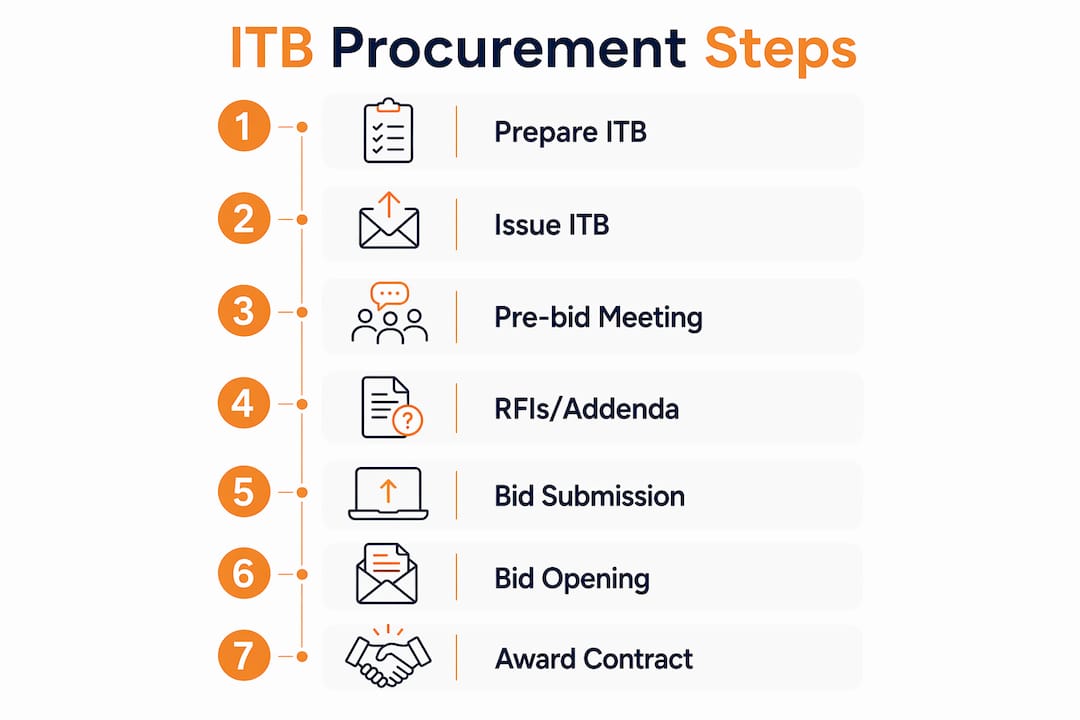
The commercial construction process follows a defined sequence, and the ITB procurement phase sits between completed design documents and construction mobilization. Here is how each step works in practice.

Prepare and issue the ITB
The owner or GC assembles the complete package, uploads it to a plan room or distribution platform, and formally advertises or invites selected bidders. Public projects often require mandatory advertisement periods under state procurement rules; private developers have more flexibility but should still allow adequate time.
Pre-bid meeting and site visits
A pre-bid meeting gives all bidders the same information at the same time, which reduces RFI volume and protects the owner from claims of unequal treatment. Site visits are particularly important for renovation or tenant-improvement projects where existing conditions affect pricing. For complex projects, technical due diligence conducted before the ITB is issued can surface hidden conditions that would otherwise generate change orders after award.
RFIs and addenda
Bidders submit written questions by the RFI deadline. The owner issues written addenda to all bidders simultaneously. Every addendum must be acknowledged on the bid form. If an addendum significantly changes scope or extends the deadline, all bidders receive the same revised timeline. Missing an addendum is one of the most common reasons a bid is declared non-responsive.
Bid submission and opening
Sealed bids are submitted by the stated deadline. In public procurement, bids are opened publicly and read aloud; in private projects, the owner typically opens bids internally. All bids are logged with the submitted amount, alternates, and any exceptions noted.
Responsiveness and responsibility check
A responsive bid complies with all submission requirements: correct forms, required signatures, bid bond attached, all addenda acknowledged. A responsible bidder has the capacity, licensing, bonding, and financial standing to perform the work. Both tests must pass before a bid is considered for award.
Award and contract signing
The lowest responsive and responsible bidder receives the award notice. The owner issues a Notice of Award, the contractor executes the contract and delivers final bonds and insurance certificates, and a Notice to Proceed triggers mobilization. Public procurement adds a protest window between award notice and contract execution.
Public vs. private: Public-sector ITBs are governed by state and federal procurement codes, often requiring mandatory advertising, sealed bidding, and low-bid award with no discretion. Private developers follow their own procedures but adopt similar structures when lender requirements or board governance demand transparency.
How do contractors prepare a competitive, compliant bid?
Winning an ITB is not about submitting the lowest number. It is about submitting the right number with zero compliance gaps. Here is the workflow.
Pre-bid checks
- Download every document in the package and confirm you have the latest drawing revision and all issued addenda.
- Verify your contractor’s license covers the scope and jurisdiction.
- Confirm your bonding capacity covers the required bid bond and the anticipated performance/payment bond.
- Read the scope narrative carefully and flag every ambiguity before you start estimating.
- Attend the pre-bid meeting, even when it is not mandatory. Questions answered there often clarify items that would otherwise become change orders.
Estimating and documenting assumptions
Accurate bid estimating starts with a complete takeoff from the issued drawing set. Use the revision dates on the drawings to confirm you are pricing the current scope, not a superseded set.
- Perform quantity takeoffs by CSI division or trade section.
- Price labor using current wage rates for the project’s jurisdiction, including any prevailing wage requirements on public work.
- Document every allowance and unit price on the bid form exactly as the ITB requests them.
- List exclusions explicitly. If the scope narrative is silent on a specific item, either include it with a note or exclude it in writing. Never assume.
Packaging the bid
- Complete the owner’s standardized bid form. Do not substitute your own format.
- Attach the bid bond (typically 5–10% of the bid amount, though the ITB will specify the exact requirement).
- Include all required certifications: contractor’s license number, safety record attestation, MBE/WBE certifications if required.
- Acknowledge every addendum by number and date on the bid form.
- Submit by the stated deadline through the stated method. A bid delivered one minute late to a public project is typically rejected without exception.
Pro Tip: Attach a one-page scope inclusion/exclusion summary to your bid even when the ITB does not require it. It protects you from post-award scope disputes and signals to the owner that you read the documents carefully.
For a detailed bid submission checklist, review the standard items before you seal the package.
What strategies help project owners get clean, comparable bids?
The quality of bids you receive is a direct reflection of the quality of the ITB you issue. Owners who invest time in the package before it goes out spend far less time managing confusion after bids come in.
Pre-issue preparation:
- Run a prequalification process (RFQ) before issuing the ITB. Gathering bonding capacity, safety history, and relevant project experience in advance reduces the risk of a non-responsible low bid and speeds evaluation on bid day.
- Write a scope narrative with explicit inclusions and exclusions. A clear scope narrative with explicit inclusions and exclusions is the single most effective way to reduce bid padding and scope disputes after award.
- Use a standardized bid form that requires line-item pricing, alternates, and unit prices in a uniform format. This converts bid leveling from a multi-day exercise into a quick comparison.
- Organize the plan room so bidders can find current drawings, specifications, and addenda without hunting. Mislabeled or out-of-sequence documents generate unnecessary RFIs.
Scheduling and communication:
- Allow a realistic bid window. For standard trade packages, two to three weeks is the minimum; complex mechanical or specialty scopes typically need three to four weeks.
- Hold a pre-bid meeting early enough in the bid window that addenda can be issued and absorbed before the deadline.
- Set an RFI cutoff at least five business days before bid day so addenda can be distributed with enough time for bidders to reprice.
Contract and risk clauses:
- Specify the bond requirements clearly: bid bond percentage, performance and payment bond thresholds, and the timeline for delivering executed bonds after award.
- Include liquidated damages language with a defined daily rate so bidders can price schedule risk accurately.
- Define change-order authority limits and the markup structure allowed on owner-directed changes.
- State your evaluation criteria and how you will communicate results. Bidders who know the process upfront are less likely to protest.
Coverage check: Three to five responsive bids on a standard trade package is generally enough to validate market pricing. Fewer than three responsive bids usually signals a scope problem, an unrealistic schedule, or a bid window that was too short. When that happens, rebidding with a revised package is almost always faster than negotiating from a single bid.
ITB vs. RFP vs. RFQ: which procurement route fits your project?
The choice of procurement document shapes everything that follows, from how bidders respond to how you evaluate and award. Here is a side-by-side comparison.
| Document | Purpose | When to use | Selection criteria | Bidder expectation |
|---|---|---|---|---|
| ITB | Solicit price-based bids on a defined scope | Design complete; price is primary factor | Lowest responsive and responsible bidder | Submit price, bond, and required forms |
| RFP | Solicit proposals including approach, qualifications, and price | Design-assist, specialty work, or innovation needed | Best-value scoring (technical + price) | Submit methodology, team, schedule, and price |
| RFQ | Prequalify firms before issuing an ITB or RFP | Need to screen capacity, experience, and financials | Pass/fail qualification criteria | Submit experience, bonding capacity, references |
Decision flow:
- Design complete and price is the only variable → ITB.
- Selection depends on contractor approach, design input, or qualifications → RFP.
- You need to screen the bidder pool before pricing → RFQ, then ITB or RFP.
Design-bid-build delivery aligns naturally with ITB procurement because design is fully complete before contractors are invited to price. Design-build shifts the selection criteria away from price alone, making an RFP the more appropriate vehicle. The ITB vs. RFP distinction is fundamental: ITBs work when the scope is locked; RFPs work when the contractor’s approach to the scope is part of what you are buying.
Why scope gaps in ITBs transfer risk to bid day
Experts in bid management treat an ITB as a scope-delivery mechanism, not a formality. When the scope is clear, risk stays with the party best positioned to manage it. When the scope is ambiguous, that risk migrates to bid day, and whoever wins the job inherits it.
Consider a common scenario: a mechanical scope narrative that references “all HVAC work per plans” without specifying equipment models, controls sequences, or commissioning responsibilities. Three bidders price it three different ways. The low bidder wins, then discovers the controls scope alone adds six figures to their cost. The result is a change order the owner did not budget for and a contractor whose margin is gone before the project starts.
The mitigation is straightforward:
- Require a scope inclusion/exclusion checklist as part of every bid submission.
- Use a standardized bid form with line items that force bidders to price the same scope.
- Issue addenda to answer every RFI in writing, not verbally at the pre-bid meeting.
- Conduct integrated engineering coordination before issuing the ITB to catch system conflicts that would otherwise surface as scope gaps.
- Review bid leveling results before award. If one bid is significantly lower than the others, find out why before signing the contract.
Pro Tip: When bid leveling reveals a significant outlier on the low end, ask that bidder to confirm their scope in writing before award. A scope confirmation letter costs nothing and prevents a “that wasn’t in my bid” conversation six months into the project.
Bid leveling is where scope gaps become visible. A well-structured ITB makes leveling fast; a poorly structured one makes it a forensic exercise.
Ready-to-use ITB checklists and a compact template outline
Owner ITB preparation checklist
- [ ] Construction documents complete and issued for bid (confirm revision date)
- [ ] Scope narrative written with explicit inclusions and exclusions
- [ ] Standardized bid form attached (line items, alternates, unit prices, allowances)
- [ ] Bonding and insurance requirements specified
- [ ] Pre-bid meeting scheduled and details included
- [ ] RFI deadline and addenda process defined
- [ ] Bid submission deadline, format, and delivery method stated
- [ ] Evaluation criteria and award notification process described
- [ ] Contract form attached or referenced
Contractor bid submission checklist
- [ ] All drawings and specifications downloaded; revision dates confirmed
- [ ] All addenda downloaded and acknowledged on bid form
- [ ] License and bonding capacity verified against ITB requirements
- [ ] Quantity takeoffs completed from current drawing set
- [ ] Scope inclusions and exclusions documented
- [ ] Bid form completed in owner’s format (no substitutions)
- [ ] Bid bond attached (confirm required percentage)
- [ ] All required certifications and attachments included
- [ ] Submission method and deadline confirmed
Compact ITB template outline
| Section | Required content |
|---|---|
| 1. Project identification | Name, number, owner, location, building type |
| 2. Scope of work | Written narrative with explicit inclusions and exclusions |
| 3. Plans and specifications | Drawing list with revision dates; specification index |
| 4. Bid form | Line items, alternates, unit prices, allowances, total bid amount |
| 5. Submission instructions | Deadline, format, delivery address, late-bid policy |
| — | Start date, substantial completion, phasing |
| — | Bid bond %, performance/payment bond %, insurance requirements |
| — | Date, time, location, mandatory/voluntary status |
| — | Question deadline, distribution method, acknowledgment requirement |
| 10. Contract terms | Form of agreement, general conditions, special conditions |
Converting this outline into a digital package is straightforward: upload the bid form as a fillable PDF or spreadsheet, host drawings in a plan room with version control, and distribute addenda through a tracked system so you have a record of who received what. Bid-management software handles all of this in one place, which matters when you are managing multiple trade packages simultaneously.
What timelines and costs should you expect for ITB procurement?
Typical procurement milestones
| Milestone | Standard trade packages | Complex / specialty scopes |
|---|---|---|
| ITB preparation | 1–2 weeks | 2–4 weeks |
| Bid window (issue to deadline) | 2–3 weeks | 3–4 weeks |
| RFI cutoff before bid day | 5 business days | two to three weeks |
| Bid evaluation and leveling | 3–5 business days | 1–2 weeks |
| Award to contract execution | 1–2 weeks | 2–3 weeks |
| Contract execution to mobilization | 1–2 weeks | 2–4 weeks |
Bid windows of two to three weeks are the minimum for standard trade packages; complex mechanical or specialty scopes need three to four weeks. Compressing the bid window below these thresholds reduces contractor interest and increases the likelihood of incomplete bids.
Common cost items
For owners:
- Plan room setup and document distribution: varies by platform; many digital plan rooms charge per project or per month.
- Pre-bid meeting facilitation: typically absorbed as project management overhead.
- Bid leveling and evaluation: estimating staff time, typically several hours to several days depending on the number of bids and trade complexity.
For contractors:
- Estimating labor: a competitive bid on a mid-size commercial package can require anywhere from 20 to 80 hours of estimating time depending on scope complexity.
- Bid bond: typically 5–10% of the bid amount, though the ITB will specify the exact requirement. The bond premium itself is a fraction of the bond amount and varies by surety and contractor financial profile.
- Takeoff and plan review: digital takeoff tools reduce this time significantly compared to manual methods.
One practical note on addenda: every addendum that changes scope resets the clock for affected bidders. If an addendum is issued fewer than five business days before the bid deadline, extending the deadline is standard practice and protects the owner from claims of inadequate notice.
Key Takeaways
A well-structured ITB with a standardized bid form, explicit scope inclusions and exclusions, and a realistic bid window is the single most effective way to get clean, comparable bids and avoid scope-driven change orders on commercial construction projects.
| Point | Details |
|---|---|
| ITB definition and trigger | Use an ITB when design is complete and price is the primary selection factor; use an RFP when approach or qualifications matter. |
| Highest-risk ITB component | A vague scope narrative is the most frequent source of uneven bids and post-award disputes; explicit inclusions and exclusions are non-negotiable. |
| Bid window minimums | Allow sufficient time for bid windows, with longer periods often needed for complex or specialty scopes. |
| Contractor compliance | Missing an addendum acknowledgment or submitting late are the two most common reasons a bid is declared non-responsive. |
| Won2build for ITB workflows | Won2build’s Bid Track helps contractors and GCs manage bid packages, track addenda, and standardize bid forms across multiple trade packages. |
The part of ITB management most teams get wrong
Most conversations about ITBs focus on the document itself: what goes in it, how to format the bid form, how long the bid window should be. That is all necessary. But the part that actually determines project outcomes happens before the ITB is written.
The scope narrative is where projects are won or lost, and most owners treat it as an afterthought. They hand the architect’s specification index to a project manager and call it a scope of work. What they get back on bid day is a spread of numbers that cannot be compared because every contractor made different assumptions about what was included.
The fix is not complicated. Write the scope narrative as if you are explaining the project to someone who has never seen the drawings. State what is in. State what is out. If there is a gray area, resolve it before the ITB goes out, not after bids come in. That single discipline, applied consistently, eliminates most of the change-order risk that owners attribute to “contractor behavior” or “market conditions.”
For contractors, the equivalent discipline is the scope confirmation letter. Before you sign a contract on a job where your number was significantly lower than the competition, confirm your scope in writing. Not as a negotiating tactic, but as a record. If your takeoff was right and the others missed something, you want that documented before mobilization.
The ITB process works when both sides treat it as a communication tool, not a legal formality. Owners who write clear documents get better prices. Contractors who read them carefully win better jobs.
Won2build helps you manage the full ITB lifecycle in one place
Assembling a bid package, tracking which subcontractors have responded, managing addenda across a dozen trade packages, and keeping bid forms standardized across every submission: that is a lot of moving parts to manage in spreadsheets and email threads.
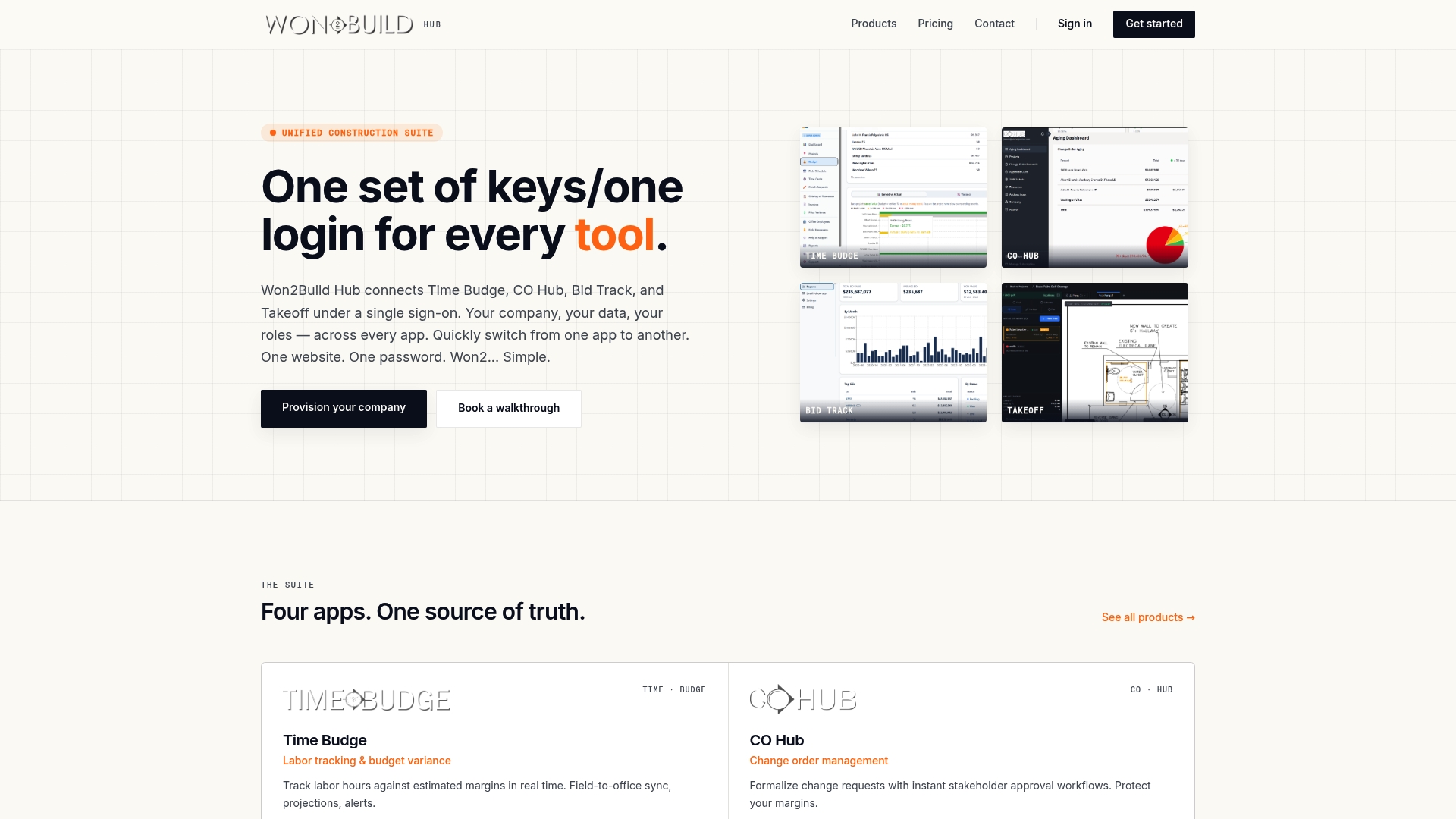
Won2build’s Bid Track is built specifically for construction subcontractors and GCs who need to organize the ITB process without the overhead of enterprise software. You can build bid packages, track bidder responses, log addenda with timestamps, and keep every submission in a single pipeline. The platform connects directly to Won2build’s Takeoff tool, so quantity data flows into your pricing without re-entry. And when a project moves to construction, CO Hub tracks change orders against the original bid scope, so you can see exactly where scope gaps are costing you margin.
Software does not replace a well-written ITB. A clear scope narrative and a standardized bid form still have to come from the people who understand the project. But once those are in place, Won2build handles the tracking, the version control, and the bid-day logistics so your team can focus on pricing accurately and winning the right work. Start with a free look at Bid Track to see how it fits your current workflow.
Authoritative sources and further reading
The following U.S. resources are worth bookmarking if you work regularly with ITBs, public procurement, or construction contracts:
- Federal Acquisition Regulation (FAR): The governing framework for federal procurement, including sealed bidding rules and contract terms. Relevant for any contractor pursuing federal or federally funded construction work.
- Procore Foundation: Industry education resources on construction project management, procurement, and contract administration.
- Zebel: Understanding ITBs in Construction: A clear practitioner overview of ITB structure and procurement roles.
- State procurement offices: Every state maintains its own procurement code for public construction. Search “[your state] public procurement construction” to find the applicable statutes and standard bid documents for your jurisdiction.
- AIA Contract Documents: The American Institute of Architects publishes standard forms of agreement (A101, A102, A201) that are widely referenced in ITB contract terms. Available at aia.org.
For contract-language drafting, particularly liquidated damages clauses, change-order authority, and bonding requirements, consult a construction attorney licensed in your state. For public projects, local procurement counsel familiar with your jurisdiction’s competitive bidding statutes is worth the cost before you issue or respond to a formal ITB.
Recommended
One login for estimating, bid tracking, change orders, and labor.
The Hub is free. Pay only for the apps you turn on.
Create your free Hub account- 7 Concrete Takeoff Steps Estimators Use to Avoid Ordering ShortfallsFollow seven concrete takeoff steps to calculate cubic yards, size rebar and formwork, convert volumes to supplier units, and verify quantities before bid...
- Are E-Signature Change Orders Legal and Worth the Switch?E-signature change orders streamline your workflow, ensuring faster approvals, fewer disputes, and quicker invoicing—discover the benefits now!
- How to Link Takeoff to Estimate for Accurate BidsLink your takeoff quantities to your estimate for accurate bids. Discover the seamless integration method that reduces errors and saves time.