
How to Build Accurate Job Cost Estimates That Protect Margins
Learn how to build accurate job cost estimates that protect margins using essential techniques, ensuring no cost is overlooked.

Accurate job cost estimates come from four things working together: a fully scoped quantity takeoff, current unit pricing (materials, burdened labor, equipment), committed-cost tracking from day one, and a consistent contingency plus markup policy. Get all four right and you have an estimate you can defend. Miss one and you’re guessing.
Here’s where to start right now:
- Run a quantity takeoff directly from the contract documents before you price a single line item.
- Apply burdened labor rates and current supplier quotes, not last year’s numbers.
- Set up committed-cost tracking (purchase orders and subcontracts) before the job kicks off.
Three standards anchor this work: AACE International defines estimate classifications and accuracy bands; CSI MasterFormat provides the cost-code structure that ties estimates to job-cost reports; and RSMeans supplies regional unit-cost benchmarks. Won2Build Hub is the recommended integrated platform for putting all of this into daily practice.
Table of Contents
- Why estimate accuracy directly affects your profit margin
- What every construction estimate must include
- A repeatable estimating workflow for every bid
- Which tools actually improve estimate accuracy?
- How to manage estimates during the job and catch overruns early
- Common estimating mistakes and how to fix them
- A one-page estimating checklist and sample estimate
- How to measure estimate accuracy and set bid thresholds
- How Won2Build Hub reduces estimating errors in practice
- Key Takeaways
- What estimators get wrong about “good enough”
- Won2Build Hub gives you one place to run it all
- Selected sources and further reading
Why estimate accuracy directly affects your profit margin
Every dollar of margin erosion on a project traces back to an estimate that missed something. Underpriced labor, a forgotten subcontractor scope, stale material costs — each one chips away at profit before the first crew shows up. The problem compounds because most contractors don’t discover the gap until closeout, when there’s nothing left to do about it.

The link between estimate accuracy and cash flow is direct. A job priced too thin forces you to either absorb the loss or fight for change orders you should have priced in from the start. Weekly variance review at the cost-code level catches overruns while you can still reassign crews or adjust scope. Monthly reviews are history lessons. Weekly reviews are a steering wheel.
Accurate estimates also sharpen your bid/no-bid decisions. When you know your true cost structure, you can set a minimum margin threshold by job type and walk away from work that doesn’t meet it. That discipline, applied consistently, does more for long-term profitability than winning every bid.
- Profit fade starts at estimate time, not during construction.
- Bid/no-bid rules require a reliable cost baseline to be meaningful.
- Cost-to-complete (CTC) forecasts are only as good as the original estimate they’re measured against.
- Bookkeeping discipline matters too: job cost reports become fiction when invoices and payroll sit uncoded for weeks.
What every construction estimate must include

A complete estimate covers more than materials and labor. Miss any category and you’re building a number that will fall short in the field.
Required cost categories:
- Direct materials (with a waste factor, typically 5–15% depending on trade)
- Direct labor (burdened, not base wage)
- Subcontractors (with scope clearly defined)
- Equipment (rental rates or ownership cost allocation)
- Permits and fees
- Logistics and delivery
- Site protection and temporary facilities
- Testing, inspection, and commissioning
- Indirect costs allocated to the job (supervision, project management, small tools)
- Contingency
- Markup and profit
The standard job-cost formula is: Direct materials + Direct labor + Indirect costs = Job cost. Markup and profit sit on top of that total.
Labor burden is the most commonly underestimated line. A framer earning $30 an hour doesn’t cost $30 an hour. Add FICA, FUTA, SUTA, workers’ comp, general liability (labor portion), health insurance, paid time off, and any retirement contribution, and the fully burdened labor rate typically runs 30–50% above base wage. That $30 framer actually costs $42–$45 an hour. Bid at $30 and you’re losing money on every hour.
Calculate your burden multiplier once a year: total annual labor-related costs divided by total productive wages. Apply that multiplier to every labor hour on every estimate.
| Cost Category | Burdened? | Notes |
|---|---|---|
| Direct labor | Yes | Apply annual burden multiplier |
| Subcontractors | No | Their burden is their problem; verify scope |
| Equipment rental | No | Use current market rates |
| Equipment ownership | No | Apply ownership cost formula |
| Supervision | Yes | Allocate by hours on job |
| Contingency | N/A | % of direct costs; varies by job risk |
| Markup/profit | N/A | Applied to total job cost |
Pro Tip: Build a centralized cost library keyed to a simplified MasterFormat subset — 15 to 30 codes covering the work you actually self-perform or subcontract. Use the same code set in estimating and job-cost tracking. The moment those two sets diverge, the estimate-versus-actual comparison breaks down entirely.
A repeatable estimating workflow for every bid
A simple, repeatable process produces estimates you can stand behind. Estimate accuracy ranges from ±30–50% for ballpark figures down to ±5–10% for detailed line-item estimates. The workflow below targets that detailed end.
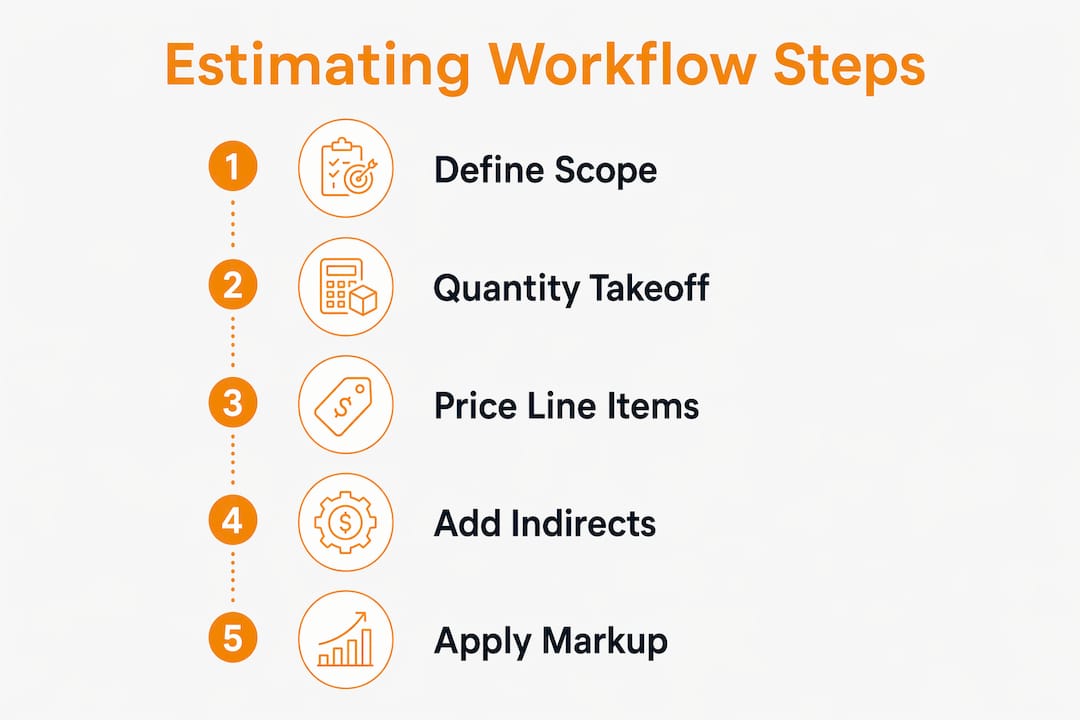
Step 1: Define scope, exclusions, and schedule assumptions
Write down what’s in and what’s out before you touch a drawing. Note phasing, access constraints, and schedule milestones. Schedule affects cost directly: a compressed timeline may require overtime premiums, additional crews, or accelerated material deliveries. Document every assumption in an estimate log — it protects you when scope disputes arise.
Step 2: Quantity takeoff
Digital takeoff tools reduce human measurement error significantly compared to manual scaling. BIM-enabled QTOs go further, pulling quantities directly from model data when the project supports it. Regardless of method, verify your takeoff with a second pass: check for invisible items (underground utilities, embedded anchors, fire-stopping), confirm units match your pricing database, and flag any drawing conflicts before pricing.
Step 3: Price each line item
- Get current supplier quotes in writing, with validity windows noted.
- Apply burdened labor rates by trade and region — regional cost factors from RSMeans or similar databases adjust for local wage and material conditions.
- Use equipment rental rates from current vendor quotes, not last year’s invoices.
- Require written subcontractor bids with defined scope and exclusions.
Step 4: Add indirects, contingency, and markup
Overhead gets applied using a predetermined rate: estimated annual overhead divided by your allocation base (direct labor hours or total direct job cost). Contingency sits on top of direct and indirect costs. Common ranges: 3–5% for well-defined commercial work, 8–15% for projects with significant unknowns or design gaps. Markup and profit come last.
Step 5: Peer review and sign-off
No estimate should leave the office without a second set of eyes. The peer review checklist:
- Scope matches contract documents and exclusions are documented
- Takeoff quantities verified against drawings
- Labor rates are burdened and current
- All subcontractor bids are in writing and within validity
- Contingency is justified in writing
- Assumptions log is complete
- Version is numbered and dated
Pro Tip: Assign version numbers to every estimate revision. “Final_v3” is not a version number. Use a date-stamped naming convention and keep prior versions archived. When a change order dispute surfaces six months later, you’ll need the original.
Which tools actually improve estimate accuracy?
Three tool categories do the heavy lifting, and the integration between them is what separates a tight estimate from a leaky one.
Digital takeoff handles plan quantification. Manual scaling on paper introduces measurement error on every dimension. Digital tools let you count, measure, and export quantities directly to your estimating system. Accurate takeoffs are the foundation — every pricing error downstream is smaller than a quantity error upstream.
Estimating and bid management handles line-item pricing, versioning, and bid assembly. The critical features: a centralized cost library with regional pricing, a burden calculator built into labor lines, and the ability to attach subcontractor quotes to specific line items.
Accounting and job-cost integration closes the loop. An estimate that doesn’t connect to your job-cost system is just a spreadsheet. When cost codes flow from estimate to field, every timecard and invoice lands on the right line automatically.
Feature checklist — what actually reduces errors:
- Auto-assign cost codes from estimate to field (eliminates the dual-code problem)
- Attach POs and subcontracts to cost codes at award (creates committed-cost visibility from day one)
- Real-time field timecards coded to jobs (no batch entry, no uncoded hours)
- Versioned estimate history with assumption logs
- Regional cost factors built into the pricing database
- Centralized cost library with validated market data
Pro Tip: Prefer systems that track committed costs — signed POs and subcontracts — alongside actuals. Committed costs reveal overruns weeks before invoices arrive. A system that shows only money already spent is a rear-view mirror.
Won2Build Hub maps directly to these categories: Takeoff handles digital plan quantification and QTO exports; Bid Track manages estimate creation, versioning, and bid pipeline; CO Hub captures committed costs and change-order workflows; Time Budge syncs field labor to jobs in real time. Single sign-on means no double entry between modules.
How to manage estimates during the job and catch overruns early
The estimate doesn’t stop mattering when the job starts. It becomes the baseline every cost gets measured against.
The three-layer tracking system is the most reliable way to stay ahead of overruns:
- Estimated — what you bid for each cost code
- Committed — signed POs and subcontracts not yet invoiced
- Actual — costs already incurred and posted
Committed costs are the early-warning layer. If you’ve spent $30,000 against a $50,000 budget but have issued POs for another $25,000, you’re already $5,000 over budget — and you can see it today, before a single invoice arrives. Spent-only reporting hides that until closeout.
Recommended cadence: run cost-code-level variance reports weekly on every active job. For reforecasting, hold structured CTC meetings of 30–45 minutes with the PM and finance team monthly. Use current field productivity data, not percent-complete guesses.
Five-column job-cost report format:
| Column | What it tells you |
|---|---|
| Original estimate | What you bid for this cost code |
| Costs to date | Burdened actuals posted so far |
| Committed costs | POs and subcontracts not yet invoiced |
| Cost to complete | Your current estimate of remaining work |
| Projected variance | Estimate minus projected total |
Scan the projected variance column. A cost code trending over budget at 40% job completion is a problem you can still fix. The same number at 95% completion is just a loss.
When variance appears, act immediately:
- Reassign crews to higher-productivity tasks
- Negotiate or formalize pending change orders
- Update cost-to-complete with current field data
- Adjust remaining scope if the contract allows
Pro Tip: Include estimated costs of unapproved change orders in your CTC projections, but defer revenue recognition until the change order is signed. This shows you the real margin compression before it becomes a surprise at closeout.
Good timecard discipline is what makes all of this work. Every payroll run must split hours by job. Every supplier invoice must carry a job and cost code before it’s posted.
Common estimating mistakes and how to fix them
Most margin problems on construction jobs start with one of these errors.
- Eyeballing quantities instead of running a formal takeoff. Fix: require a documented takeoff for every bid, no exceptions. Common measurement errors compound across line items and can swing a bid by thousands.
- Ignoring labor burden. Fix: calculate your burden multiplier annually and hard-code it into every labor line.
- Missing hidden materials or logistics. Fix: use a scope checklist that includes delivery, staging, temporary protection, and waste removal.
- Stale supplier pricing. Fix: require fresh quotes with validity dates on every bid. Prices from six months ago can be off by 10–20% in volatile material markets.
- Mismatched cost-code sets between estimating and field tracking. Fix: one code set, used everywhere, enforced from day one.
- Skipping peer review. Fix: no estimate leaves without a second reviewer signing off on scope, quantities, and rates.
Pre-bid mitigation checklist:
- Scope confirmed against contract documents
- Formal takeoff completed and verified
- Supplier quotes current and in writing
- Subcontractor bids received with defined scope
- Labor rates burdened and current
- Cost codes match field tracking system
- Contingency documented and justified
- Peer review completed and signed
A one-page estimating checklist and sample estimate
Use this checklist before issuing any bid.
Estimate completeness checklist:
- [ ] Scope confirmed, exclusions documented
- [ ] Takeoff complete, quantities verified
- [ ] Supplier quotes current (within 30 days)
- [ ] Subcontractor bids in writing, scope defined
- [ ] Labor burden applied to all labor lines
- [ ] Equipment rates from current quotes
- [ ] Indirects and overhead allocated
- [ ] Contingency percentage justified in writing
- [ ] Assumptions log complete
- [ ] Peer review signed off
- [ ] Version numbered and dated
Sample estimate structure (compact format):
| Line Item | Qty | Unit | Unit Cost | Total |
|---|---|---|---|---|
| Concrete (with 8% waste) | — | CY | — | — |
| Formwork labor (burdened @ —/hr) | — | hrs | — | — |
| Rebar materials | — | lbs | — | — |
| Rebar labor (burdened @ —/hr) | — | hrs | — | — |
| Concrete sub (placed and finished) | 1 | LS | — | — |
| Equipment rental (pump, 3 days) | 3 | days | — | — |
Save this table as a template in your estimating system. The estimate components stay consistent across job types; only the quantities and unit costs change.
Pro Tip: Validated cost data from RSMeans or similar databases is a useful starting point, but always sanity-check figures against your own recent job history. Published databases reflect regional averages — your actual costs may differ based on crew productivity, local wage agreements, and supplier relationships.
How to measure estimate accuracy and set bid thresholds
Measuring your own estimate performance is how you get better at it over time.
Accuracy formula:
Estimate accuracy = (Projected final cost − Final actual cost) ÷ Final actual cost
A result of +5% means you overestimated by 5% (conservative). A result of −8% means you underestimated by 8% (a margin problem). Track this by job type and trade over time to find your systematic biases.
Variance thresholds (example decision rules):
- Green: variance within ±5% of estimate — estimate quality is acceptable
- Amber: variance of ±5–10% — review pricing assumptions and takeoff method
- Red: variance exceeds ±10% — full post-mortem required before next similar bid
Bid/no-bid decision rules:
- Set a minimum gross margin target by job type (e.g., 12% for commercial concrete, 18% for specialty work).
- If your historical accuracy on a job type shows a consistent −8% underestimate, adjust your contingency or markup before bidding.
- For high-risk bids (complex phasing, incomplete drawings, tight schedule), run a sensitivity analysis: recalculate the estimate with material costs 10% higher and labor productivity 15% lower. If the result still meets your minimum margin, proceed.
Monte Carlo simulation is the formal version of this for large or high-stakes bids. It runs thousands of scenarios across your cost variables and returns a probability distribution of outcomes. Most commercial estimating platforms support it; use it when a single job represents more than 20% of your annual revenue.
How Won2Build Hub reduces estimating errors in practice
The workflow problem most subcontractors face isn’t a lack of process knowledge. It’s data loss between steps: quantities calculated in one tool, re-entered into a spreadsheet, then re-entered again into accounting. Each handoff is a chance for error.
Won2Build Hub workflow:
- Takeoff quantifies the plans digitally and exports quantities directly to Bid Track.
- Bid Track builds the line-item estimate with versioning, applies cost codes, and tracks the bid pipeline.
- At award, POs and subcontracts are created in CO Hub, which immediately establishes committed-cost visibility against each cost code.
- Time Budge captures field labor in real time, coded to the job and cost code, and syncs to the job-cost report automatically.
- Weekly job-cost reports pull from all four modules through a single login, with no double entry.
Feature-to-error mapping:
- Single cost-code set across all modules → eliminates estimate/field mismatch
- Committed-cost tracking in CO Hub → reveals overruns before invoices arrive
- Real-time Time Budge entries → no uncoded hours, no batch payroll surprises
- Versioned estimates in Bid Track → full audit trail for change order disputes
- Mobile field access → field crews enter time and T&M data on-site, not from memory
Illustration: A subcontractor issues a PO for $22,000 in specialty hardware. Without committed-cost tracking, that obligation is invisible until the invoice arrives. With CO Hub logging the PO against the cost code at issuance, the job-cost report shows the commitment immediately. The PM sees the projected variance before the invoice arrives, not after, and has time to act. That’s the difference between a managed overrun and a $5,000 surprise at closeout.
Commercial estimating software earns its keep precisely in these handoffs. The fewer re-entries, the fewer errors.
Key Takeaways
Accurate job cost estimates require burdened labor rates, committed-cost tracking, a consistent cost-code set, and weekly variance reviews — all connected through a single integrated workflow.
| Point | Details |
|---|---|
| Burdened labor rates | Fully burdened rates run well above base wage; calculate your multiplier annually and apply it to every estimate. |
| Committed-cost tracking | Log POs and subcontracts against cost codes at award to reveal overruns before invoices arrive. |
| Weekly variance reviews | Cost-code-level reports run weekly act as a steering wheel; monthly reports are a history lesson. |
| Consistent cost codes | Use one code set across estimating and field tracking — divergence breaks the estimate-versus-actual comparison. |
| Won2Build Hub | Takeoff, Bid Track, CO Hub, and Time Budge connect the full workflow through a single login, eliminating re-entry errors. |
What estimators get wrong about “good enough”
There’s a version of estimating that feels rigorous but isn’t. You run a takeoff, you price the materials, you add a labor number that feels right, and you throw 10% on top for contingency. The bid goes out. Sometimes you win. Sometimes the job makes money.
The problem is you don’t know why it made money, or why the last one didn’t. Without burdened labor rates, you’re systematically underpricing every hour. Without committed-cost tracking, you’re flying blind on subcontractor and material obligations for the first 60% of every job. Without a consistent cost-code set, your estimate-versus-actual comparison is meaningless — you’re comparing apples to something that isn’t even fruit.
The contractors who protect margins consistently aren’t necessarily better at math. They’re better at habits: they calculate burden once a year and apply it everywhere, they require written sub bids on every job, they run the variance report every Friday. The process is the protection.
One thing most guides skip: walk the site before you finalize any estimate above a certain dollar threshold. Drawings don’t show you the 18-inch clearance behind the mechanical room, the parking situation that will add two hours of crew travel per day, or the existing slab condition that makes your concrete prep number wrong. Site visits aren’t a luxury. On complex jobs, they’re the difference between a defensible estimate and an expensive assumption.
The other underrated move: build a post-mortem habit. After every job closes, compare the final cost report to the original estimate at the cost-code level. Find the two or three codes that were consistently off. That’s your calibration data for the next bid.
Won2Build Hub gives you one place to run it all
Subcontractors who price work accurately and track it in real time don’t need to be larger to be more profitable. They need fewer handoffs and less re-entry between their estimating, field, and accounting workflows.
Won2Build Hub connects digital takeoff, bid management and estimating, committed-cost and change-order tracking, and real-time labor entry in a single platform built specifically for commercial subcontractors. One login. No double entry. Field data syncs to the office as it’s entered.
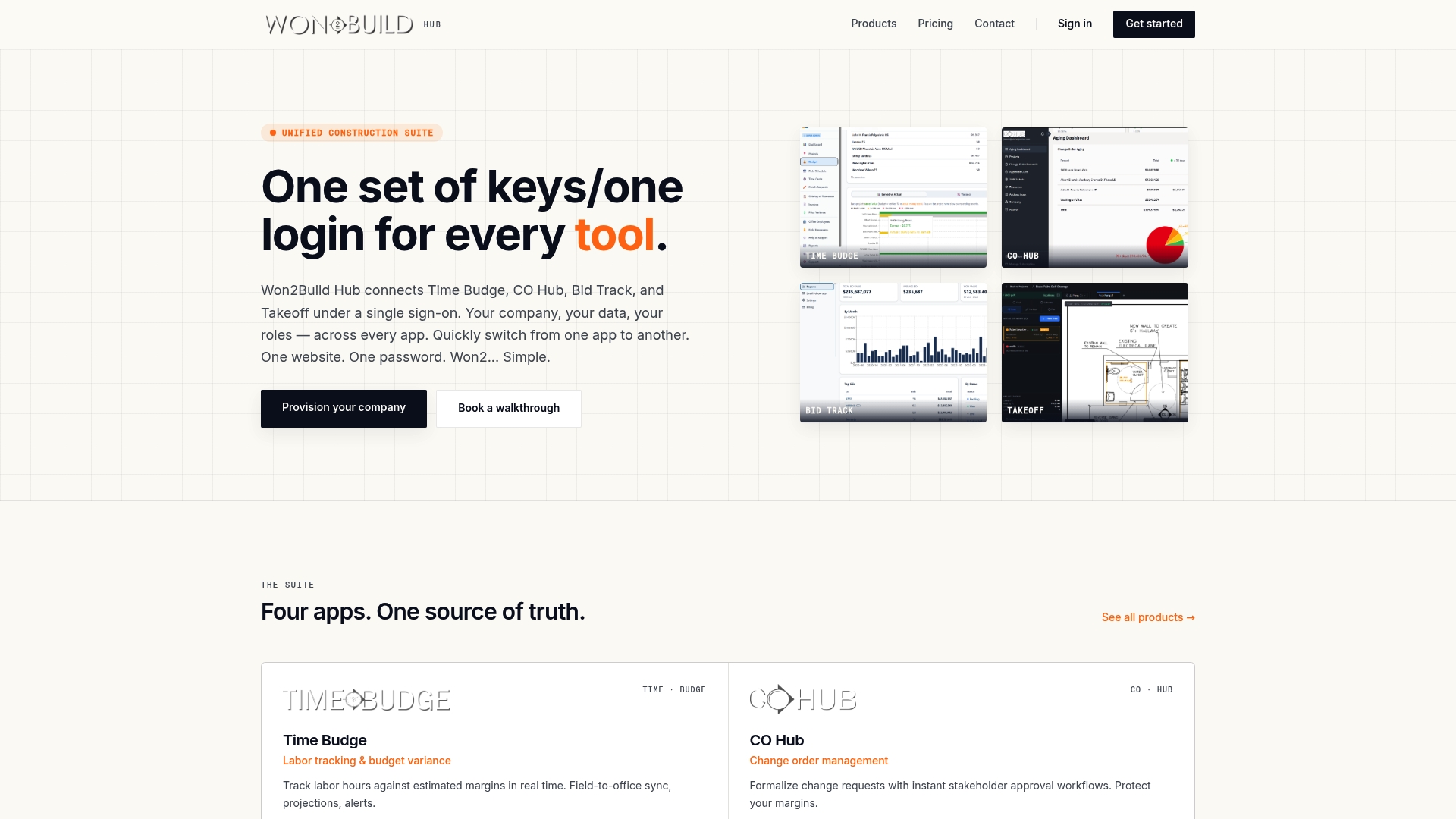
The practical result: your estimate becomes the baseline your job-cost reports measure against from day one, your committed costs are visible before invoices arrive, and your weekly variance report takes minutes instead of a morning. Start a free trial at won2build.com and see how the four modules work together on your next bid.
Selected sources and further reading
- AACE International — Estimate Classification System (18R-97): the industry standard for estimate types and accuracy bands
- CSI MasterFormat: the standard cost-code structure for construction estimating and job costing
- RSMeans — Construction Cost Estimating Guide: regional unit-cost data and estimating best practices
- Beancount.io — Job Costing for Contractors: practical guidance on labor burden, cost codes, and committed-cost tracking
- ConstructionCostAccounting — Cost-to-Complete Projections: CTC methodology and profit-fade prevention
- PlanUpPro — How to Estimate Construction Costs: step-by-step estimating process and estimate type accuracy ranges
- Shopify — Job Costing Explained: job-cost formula and overhead allocation methods
- Won2Build Hub Blog: articles on estimating, takeoff, time tracking, and cost control for subcontractors
Recommended
One login for estimating, bid tracking, change orders, and labor.
The Hub is free. Pay only for the apps you turn on.
Create your free Hub account- 7 Concrete Takeoff Steps Estimators Use to Avoid Ordering ShortfallsFollow seven concrete takeoff steps to calculate cubic yards, size rebar and formwork, convert volumes to supplier units, and verify quantities before bid...
- Are E-Signature Change Orders Legal and Worth the Switch?E-signature change orders streamline your workflow, ensuring faster approvals, fewer disputes, and quicker invoicing—discover the benefits now!
- How to Link Takeoff to Estimate for Accurate BidsLink your takeoff quantities to your estimate for accurate bids. Discover the seamless integration method that reduces errors and saves time.