
Subcontractors: Audit to Stop App Sprawl in Construction, 6–12 Months
Roadmap for subcontractors to cut app sprawl with a short audit and identity first controls. Reclaim licenses and close data gaps in 6–12 months.

App sprawl is draining field crews and reports, and the fix starts small: run a quick inventory, then add an identity-first governance layer built on single sign-on and a lifecycle policy. Do that first and you reclaim wasted licenses and hours within weeks, not quarters. Skip straight to a company-wide standardization push and you will spend months fighting adoption instead of fixing the actual problem.
TL;DR:
- Conduct a quick inventory using SSO logs and expense data to identify duplicate or unused apps, focusing on those with low impact and frequency.
- Enforce identity-first governance with single sign-on, role-based access control, and clear ownership to prevent new sprawl and facilitate license reclamation.
- Prioritize consolidating workflow-critical tools like estimation and takeoff software before considering standalone or minimally integrated applications.
- Implement phased reduction efforts over 6 to 12 months, starting with license reclaiming, then removing duplicates, enforcing procurement rules, and automating license management.
- Recognize that app sprawl begins with field habits and requires involving crew leads in audits and governance to ensure sustainable, effective control.
Table of Contents
- What app sprawl looks like for construction teams
- Why app sprawl matters: productivity, cost, and compliance impacts
- Root causes and 2026 drivers behind the growth
- How to run a focused app audit for construction projects
- Governance framework: procurement, lifecycle, and identity rules
- Consolidation versus integration: a decision guide by category
- A practical roadmap to reduce app sprawl in 6 to 12 months
- Technical patterns that make governance practical
- Measuring success: KPIs that prove the cleanup worked
- Won2Build perspective: an integrated suite built for subcontractors
- What field leads keep getting wrong about this problem
- Fewer logins, more control with Won2Build Hub
- Sources
- FAQ
What app sprawl looks like for construction teams
App sprawl happens when a company ends up running more software tools than its workflows actually need, usually because each one was bought to solve a single problem without anyone checking what already existed. In construction, that usually means the gap between field and office data grows wider every month.
A few patterns show up again and again:
- Two or three timesheet apps running at once because different superintendents picked their own.
- Estimators maintaining a takeoff in one tool and re-entering quantities into a separate bid spreadsheet.
- Safety and compliance logs kept in a standalone app that never syncs with the project management system.
The BetterCloud 2026 State of SaaS report found that after two years of deliberate consolidation, the average number of apps per organization is climbing again, with AI-powered SaaS tools a major driver. Construction is not exempt from that trend, and the overlap tends to hide in plain sight until someone compares invoices.
Why app sprawl matters: productivity, cost, and compliance impacts
Every duplicate entry point costs real time, and it compounds across a crew. A foreman who logs hours in one app, then re-enters them for payroll, then again for a client report, is doing the same job three times.
The financial waste shows up in places nobody budgets for:
- Multiple subscriptions covering the same function, often approved by different site leads who never compared notes.
- Integration costs paid out to connect systems that could have been consolidated instead.
- License seats left active for former employees or completed projects, quietly billed every month.
One operational risk is harder to see until it causes a problem: fragmented data makes safety and compliance reporting unreliable. The Occupational Safety and Health Administration maintains the jobsite safety standards and emphasis programs that depend on consistent, trustworthy reporting, and a scattered app estate makes it easy for incident data or training records to fall through the cracks between systems.
Root causes and 2026 drivers behind the growth
Sprawl rarely comes from one bad decision. It builds up from a handful of habits that reinforce each other, and most construction companies have at least two of them active right now.
- Line-of-business buying, where a project manager or estimator signs up for a tool without routing it through IT or ownership.
- Field-driven adoption and bring-your-own-device habits that bring in apps nobody vetted for security or data residency.
- A surge in AI and SaaS tools that each solve one narrow task, adding niche apps faster than teams can retire old ones.
- Integration gaps and the absence of a lifecycle process, so nothing ever gets formally retired even after it stops being used.
The BetterCloud 2026 report ties much of the renewed growth directly to AI-powered SaaS adoption, noting that many organizations still lack real cross-app orchestration to manage it.
How to run a focused app audit for construction projects
A useful audit does not need a consultant or a six-month timeline. It needs a short, structured pass through your existing records.
- Pull your sources of truth first: SSO logs if you have them, billing and expense statements, mobile device inventories, and short interviews with two or three field leads.
- For every app you find, record the owner, active user count, monthly cost, overlapping function, existing integrations, and where the data lives.
- Score each app on an impact by frequency matrix: how much it affects project outcomes against how often it is actually used.
- Flag anything with low frequency and low impact as an immediate quick win for cancellation.
- Produce three deliverables: a full inventory spreadsheet, an overlap report showing duplicate functions, and a short list of consolidation candidates.
ConTechDigest notes that an audit pulling from SSO logs and expense data typically surfaces the biggest license-reclaim opportunities fastest, since both sources show exactly who is paying for what and who is actually logging in.
Pro Tip: Ask field leads what they actually open every day before you ask what they were issued. The gap between the two lists is usually where sprawl hides.
Governance framework: procurement, lifecycle, and identity rules
An audit fixes today’s mess. Governance keeps it from coming back. The core of that governance is a short set of rules applied consistently rather than a thick policy document nobody reads.
- Require a business case, a check for existing overlap, and a defined trial end date before any new app gets approved.
- Enforce single sign-on and role-based access control on every tool that touches project or payroll data.
- Set a review cadence (quarterly works for most subcontractors) with a clear gate for retiring unused licenses.
- Name one owner per app who is accountable for its cost, its users, and its eventual retirement.
Identity-first controls do most of the heavy lifting here. Once an app sits behind single sign-on, you get a running inventory for free, along with a clean way to cut access the day someone leaves. Won2Build’s own breakdown of single sign-on for construction teams walks through how that visibility works in practice.
Pro Tip: Attach the procurement checklist to your purchasing card approval process, not a separate policy page. Rules only stick when they sit inside the workflow people already use.
Consolidation versus integration: a decision guide by category
Not every overlapping app needs to disappear. Some deserve a single replacement, others just need a connector. The right call depends on a few consistent questions.
- Is the function genuinely unique, or does another tool in your stack already do it adequately?
- How many people actively depend on it, and how painful would switching be for them?
- What would integration cost compared to the price of retiring one tool entirely?
- Does the tool touch compliance or safety data that requires a documented chain of custody?
Estimating and takeoff tools are frequently strong consolidation candidates because the workflow from quantities to bid is linear and benefits from staying in one system, a point ForConstructionPros makes when it recommends focusing decisions on workflow rather than product features. Reality capture or drone mapping tools, by contrast, often work fine as standalone systems feeding data into a project management platform through an integration. Document whichever path you choose in a short one-page rationale so stakeholders see the reasoning, not just the outcome.
A practical roadmap to reduce app sprawl in 6 to 12 months
Turning an audit into results works better as phases than as one big rollout.
- Phase 0 (weeks 1 to 4): reclaim unused licenses and cancel abandoned trials, an immediate cost recovery with no disruption.
- Phase 1 (months 2 to 3): retire or integrate the highest-impact duplicates identified in the overlap report.
- Phase 2 (months 3 to 6): roll out procurement rules and enforce SSO and mobile device management across remaining apps.
- Phase 3 (months 6 to 12): automate lifecycle tasks like deprovisioning and renewal reviews so governance runs without manual chasing.
Assign one owner per phase and track a KPI tied to that phase’s goal: licenses reclaimed in Phase 0, duplicate-entry incidents in Phase 1, SSO coverage percentage in Phase 2, and automated deprovisioning rate in Phase 3.
Pro Tip: Report Phase 0 savings to leadership before starting Phase 1. A quick, visible win buys the patience needed for the slower governance work later.

Technical patterns that make governance practical
Governance only works if the technical plumbing supports it, and a few patterns carry most of the weight.
- Single sign-on doubles as an inventory tool: every login attempt through the identity provider becomes a record of who uses what, which is exactly the data an audit needs.
- Mobile device management secures field devices and lets IT enforce which apps are allowed, especially important where crews bring their own phones and tablets.
- Lightweight APIs and connectors keep one system as the source of truth instead of letting data copies drift out of sync across tools.
- Orchestration handles the boring but critical work: automatically deprovisioning accounts and reclaiming licenses the moment someone leaves a project or the company.
Won2Build’s own guidance on benefits of single sign-on for IT teams covers how these pieces fit together for smaller IT teams that cannot dedicate a full-time administrator to the job.
Measuring success: KPIs that prove the cleanup worked
A handful of numbers tell leadership whether the work paid off.
- Licenses reclaimed per quarter, tracked against the baseline from your first audit.
- Hours saved per week on data entry, measured through field lead interviews or time tracking comparisons.
- Reduction in duplicate entries, counted by comparing records across systems before and after consolidation.
- Adoption rate for approved apps, since a tool nobody uses is still sprawl even if it is the official one.
One industry source puts a number on the upside of getting this right: ConTechDigest notes that reducing sprawl is less about cutting tool count and more about measurable alignment and integration, meaning your dashboard should track business outcomes, not just app counts. Set a baseline in month one and revisit targets every quarter.
Won2Build perspective: an integrated suite built for subcontractors
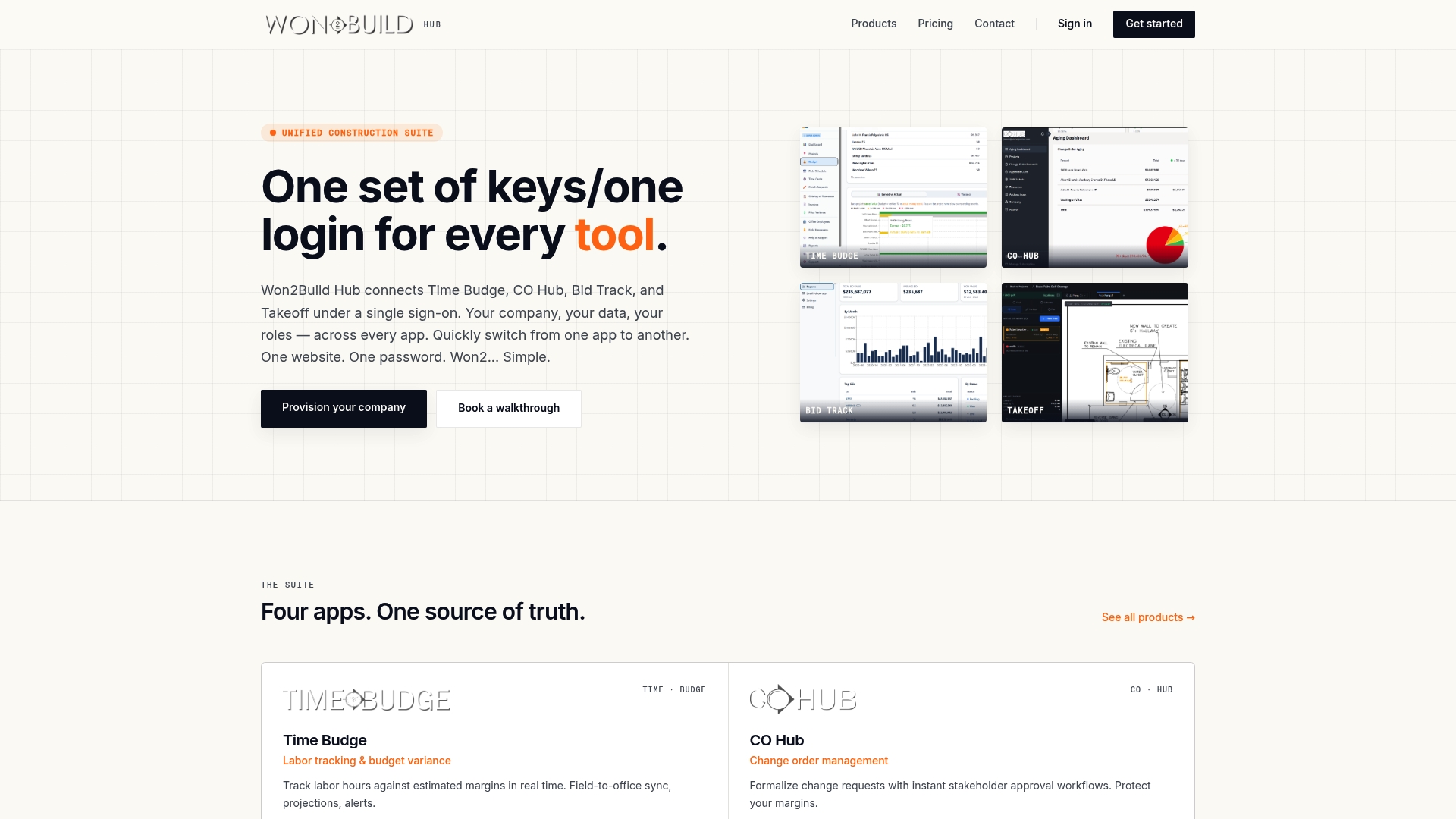
Won2Build Hub was built around the same principle: fewer logins, less duplicate entry, more trustworthy data. Its four applications, Time Budge, CO Hub, Bid Track, and Takeoff, share a single sign-on so field and office data sync in real time instead of living in separate silos. That structure reflects the identity-first governance this guide recommends, not as a workaround but as the starting design.
What field leads keep getting wrong about this problem

Most construction teams treat app sprawl as an IT problem to clean up later. It is actually a field problem first. Every extra login a foreman has to juggle on a job site is a chance for data to get lost or skipped entirely, and that gap shows up in the numbers long before anyone notices it in a budget review.
The fix is not a top-down mandate to use one system for everything. It is a short audit, done with input from the people actually using these tools every day, followed by identity controls that make the right behavior the easy behavior. Involve your field leads in the inventory stage. They already know which apps they ignore.
— Jen Reese
Fewer logins, more control with Won2Build Hub
A software suite gives subcontractors one login across multiple job-critical tools for labor tracking, change orders, estimating, and digital plan quantification. That single sign-on structure is the same governance pattern this guide recommends, built in rather than added on.
If you are mid-audit and finding duplicate timesheet or estimating tools, a module-level fit might make more sense than replacing everything at once. Check Time Budge for labor tracking alone, or Bid Track if estimating overlap is your biggest pain point. For the full picture, including flat per-company pricing, visit the Won2Build pricing page.
Sources
The BetterCloud 2026 State of SaaS report tracks the broader SaaS growth trend. ForConstructionPros and ConTechDigest cover construction-specific audits. OSHA sets the compliance standards fragmented data can jeopardize. For workforce compliance tool categories, see this overview from Petra Talent.
- The 2026 State of SaaS report | BetterCloud
- Technology Overload In Construction: Less Can Be More | For Construction Pros
- How Contractors Can Reduce Software Sprawl - Construction Technology Digest
- Occupational Safety and Health Administration (OSHA)
FAQ
What is app sprawl?
App sprawl is the buildup of more software tools than a team’s workflows actually need, usually because each one was adopted separately without checking for overlap. It leads to duplicate data entry, higher costs, and inconsistent records across systems.
What are the best construction apps?
There is no single best app for every subcontractor, since the right choice depends on whether you need labor tracking, estimating, change order management, or plan takeoff. Integrated suites like Won2Build Hub combine several of these functions under one login to reduce duplicate entry between them.
What is AR in construction?
Augmented reality (AR) in construction overlays digital plans or models onto a physical job site through a phone, tablet, or headset, helping crews visualize designs before building them. It is typically used alongside, not instead of, core project management and estimating tools.
What are some good mobile apps for construction?
Useful mobile apps for construction generally fall into a few categories: labor and time tracking, change order management, estimating and bid tracking, and digital takeoff. Choosing apps that share a single login, as with Won2Build Hub’s four integrated tools, cuts down on the double entry that causes most field-to-office data problems.
Recommended
One login for estimating, bid tracking, change orders, and labor.
The Hub is free. Pay only for the apps you turn on.
Create your free Hub account- Managers: Make Mobile Field Workflows Resilient for 72 Hour OutagesPlaybook for field managers: offline first mobile workflows, resilient sync and conflict handling, compliance first AI guardrails, and practical pilot steps.
- Daily Signed Records: Force Account Tracking for Managers & InspectorsField checklist for project managers and inspectors to keep force account tracking audit-ready: use daily signed records for labor, equipment, and...
- Stop Timecard to Report Drift: Labor Cost Codes for SubcontractorsFix the timecard to report chain with labor cost codes that tie crews to budgets. Includes a 6 code starter and a burdened rate example.