
Bid Management Software Cost: What Subcontractors Pay
What bid management software costs a U.S. subcontractor in 2026: price ranges by tier, fees that add up, and a simple way to work out your annual cost.

Bid management software for a U.S. subcontractor costs anywhere from $0 to well over $1,000 a month. The tier you land in depends on how the vendor charges (per company, per user or per market) and on what is bundled in. Published prices put entry-level tools at roughly $49 to $75 a month, mid-range platforms at $149 to $499 and enterprise suites above $1,000. A flat per-company price, like the $199 a month we charge for Bid Track, is usually easier to budget than per-seat pricing once more than one person touches your bids.
TL;DR
- Expect three tiers: about $49 to $75 a month for light tools, $149 to $499 for mid-range platforms, and $1,000 or more for enterprise suites.
- Per-seat and per-market pricing multiplies fast. Three estimators on a $299-per-user plan cost $10,764 a year.
- Add-ons decide the real bill: takeoff, extra markets, onboarding, training and a separate tool for change orders or labor.
- Bid Track is $199 per month per company, Takeoff is $0 per month, and the Hub login that ties the apps together is $0 per month.
- To compare quotes, price your own setup for 12 months, then divide by the number of bids you win.
Table of Contents
- What bid management software actually does
- Price ranges you will see in 2026
- The four ways vendors charge
- What drives the price up or down
- Costs that do not show on the pricing page
- What free plans and trials really cover
- How to estimate your annual cost
- Where the money is made back
- What Won2Build costs
- Bid Track and Takeoff for subcontractors
- Perspective
- FAQ
- Sources
What bid management software actually does
Bid management software is the system where a subcontractor keeps every invitation to bid, plan set, addendum, quote and follow-up in one place. Instead of a spreadsheet and a crowded inbox, you see which bids are due this week, who is pricing what, and which bids are waiting on a GC decision.
That definition matters for cost, because vendors use the term for very different products. Some are lead-finding bid boards. Some are estimating and takeoff tools. Some are pipeline trackers. A $49 tool and a $1,750 tool may both be called bid management, and they do not do the same job. If you want the full workflow behind the category, our bid management guide for subcontractors walks through it.
Price ranges you will see in 2026
A 2026 roundup of bid management tools from ConstructionPlacements sorts the market into four bands:
| Tier | Typical monthly price | What you usually get |
|---|---|---|
| Free | $0 | Access to project listings, basic bid submission, limited features |
| Entry level | About $49 to $75 | Basic tracking, simple proposals, few users |
| Mid-range | About $149 to $499 | Bid boards, invitation management, more users and projects |
| Enterprise | $1,000 to $1,750 or more | Full preconstruction suites with bidding modules |
A few published examples show how the bands play out in practice, without naming vendors:
- One bid-network provider lists a starter plan at $129 a month per market per seat, with a professional tier from $199 a month on an annual contract and a premium tier from $10,000 a year.
- The same page lists a standalone takeoff starter at $100 a month per seat, or $1,200 a year.
- Another vendor’s homepage, as summarized by Construction Industry AI, puts a basic leads bid board at $119 a month and full bid management at $299 a month, while subcontractors can view planrooms and submit bids for free.
These are published list prices at the time of those sources and vendors change them. Treat them as a map of the market, not a quote, and check each vendor’s pricing page before you decide.
The four ways vendors charge
The monthly number only means something once you know what it is multiplied by.

Per company (flat fee)
One price covers the business, and adding an estimator or a project manager does not change the bill. This is the easiest model to forecast. Our own approach works this way: Bid Track is $199 per month per company, and our pricing is built around flat per-company fees with unlimited team members.
Per user or per seat
You pay for every login. It looks cheap for a one-person shop and gets expensive when the owner, two estimators and a PM all need access. At $299 per user per month, three users are $897 a month, or $10,764 a year.
Per market or per region
Some bid networks charge by the territory you want to see projects in. A sub working in two metro areas pays twice. That is how a $129 starter plan becomes $258 before anyone has opened a plan set.
Per project or per bid
Less common for subcontractors, but it appears in procurement-style tools. It is cheap in a slow quarter and painful in a busy one, and it penalizes exactly the behavior you want, which is bidding more.
Our breakdown of how construction software pricing models compare goes deeper on the trade-offs between these structures.
What drives the price up or down
Five factors explain most of the gap between a $49 tool and a $1,750 one.
- Number of users. On per-seat plans this is the biggest multiplier. On flat plans it barely matters.
- Lead access. Bid boards that feed you new invitations cost more than tools that only organize bids you already have.
- Takeoff and estimating. Some platforms bundle quantity takeoff, some sell it separately at $100 or more per seat per month, and some give it away.
- Contract length. Annual billing is often discounted by around 10%, but you commit for 12 months. The pricing page above lists a 10% annual discount on its starter tier.
- Scope. An enterprise suite for a general contractor has estimating, procurement and vendor prequalification. A subcontractor rarely needs the whole thing.
Costs that do not show on the pricing page
The sticker price is the floor. Watch for these before you sign.
- Onboarding and training. Some desktop estimating tools bundle a few hours of training into the license, and others charge separately. A published license price near $2,000 a year for one takeoff tool includes support, updates and two hours of training, which shows how this gets packaged.
- Extra markets or regions. Common on bid-network plans.
- Separate takeoff. If takeoff is a second subscription, add it to the bid tool’s price.
- Separate tools for the rest of the job. A bid tracker that does not connect to change orders or labor tracking means retyping the awarded bid into other systems. That is double entry, and it costs hours every month.
- Field worker fees. Tools that reach into the field may charge per active worker. Ours is $2 per month per active field worker, listed on our pricing page.
A useful rule: when you request a quote, ask for the 12-month total with every module, market and seat you actually need, not the headline monthly price.
What free plans and trials really cover
Free tiers exist, and for a subcontractor who only wants to see invitations and submit a number, they can be enough. Free access typically covers viewing projects and submitting bids. It typically does not cover pipeline reporting, win-rate tracking, multi-user workflows or takeoff.
The point where a paid plan earns its fee is when bids stop living in one person’s head. Once two or more people touch each bid, or you are chasing a dozen GCs for decisions, a tracker that shows status, values and deadlines in one view starts paying for itself. A free trial is the right place to run one real bid through the system before committing to a year.

How to estimate your annual cost
You can price this in ten minutes.
- List who needs access. Count owners, estimators and PMs who touch bids.
- List what you need. Pipeline tracking, takeoff, change orders, labor tracking.
- Multiply by the pricing model. Per seat: users times price times 12. Flat: price times 12.
- Add extras. Markets, training, any per-worker fees.
- Compare with your bid volume. Divide the annual cost by the number of bids you win a year.
Worked example
A commercial drywall sub has one owner and two estimators bidding about 15 jobs a month.
- Per-seat plan at $299 per user per month: 3 x $299 x 12 = $10,764 a year.
- Flat company plan at $199 per month: $199 x 12 = $2,388 a year, no matter how many staff are added.
The difference is $8,376 a year. A single mid-sized job that you win because a follow-up was not missed usually covers either number. The point of the exercise is to know which structure you are signing up for, not to guess.
Where the money is made back
Bid software pays for itself in three places. The first is time: fewer hours spent hunting for the latest addendum or retyping quantities into a proposal. The second is consistency: every bid goes out with the same scope notes, exclusions and follow-up. The third is knowledge: once bids live in one system, you can see which GCs, project types and bid sizes actually win for you and stop spending estimating hours on the ones that do not.
Takeoff is part of that. If quantities come from the plans in the same system that holds your bid, you do not re-enter them, and the number you send is the number you counted. Our posts on integrated takeoff estimating and why commercial bids need detailed takeoffs cover this in more detail. For commercial work specifically, our shortlist for commercial construction bids lays out what to track on each one.
What Won2Build costs
We publish our prices, so you can budget before you talk to anyone. As listed on our pricing page:
| Product | Price |
|---|---|
| Bid Track (bid management and estimating pipeline) | $199 per month per company |
| Time Budge (labor tracking) | $199 per month per company |
| CO Hub (change orders and T&M tickets) | $59 per month per company |
| Active field worker fee | $2 per month per active field worker |
| Takeoff (digital plan takeoff) | $0 per month |
| The Hub (single login across the apps) | $0 per month |
You can subscribe to the whole bundle or to a single application. Billing is monthly per company, after a free trial.
Bid Track and Takeoff for subcontractors
If your cost problem is bids scattered across email and spreadsheets, Bid Track is the tool built for it: Bid Track is $199 per month for the company, with takeoff available at $0 per month so quantities and bids sit together. Everything runs through the Won2Build Hub with one login, so awarded bids do not have to be re-entered when the job moves into change orders or labor tracking.
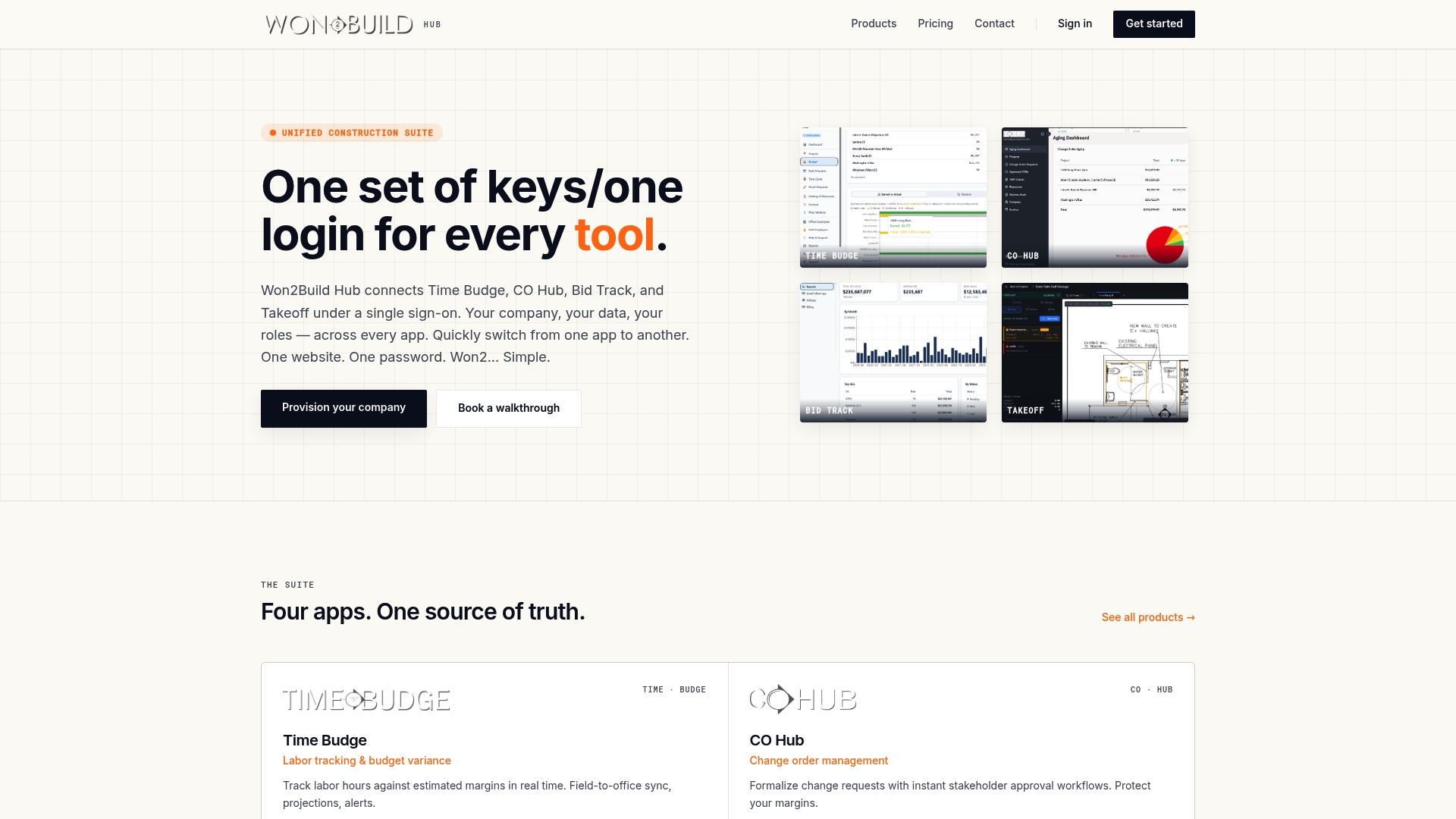
See the full list of tools on our products page, or start from the pricing page to build your own monthly total.
Perspective
Subcontractors tend to ask us what the software costs. The better question is what a bid costs you before you ever submit it. Every hour spent re-keying a quantity, chasing an addendum or rebuilding a proposal is margin you never see on a pricing page.
We built Won2Build as working subcontractors. That is why we price per company instead of per seat: your estimator, your PM and your owner should all see the same pipeline without anyone doing math about who gets a login. Our suite connects bids, takeoff, change orders and labor tracking behind one sign-on, so the number you bid is the number the field is held to.
Our advice is to price the whole workflow, not one screen. A tool that wins you back a few hours a week and keeps your bid history in one place is cheaper than it looks, and a flat monthly fee keeps it that way as your team grows.
Jen Reese
FAQ
How much does bid management software cost for a subcontractor?
Published prices run from free tiers to about $49 to $75 a month for light tools, $149 to $499 for mid-range platforms, and $1,000 or more for enterprise suites. Our Bid Track is $199 per month per company. Per-seat plans cost more as soon as several people need access.
Is there free bid management software?
Yes. Free tiers generally let you see projects and submit bids, but they usually leave out pipeline reporting, multi-user tracking and takeoff. Our Takeoff app and the Hub login are $0 per month, and our paid tools start after a free trial.
Why do some plans charge per user or per market?
Vendors choose a unit that scales with your usage. Per-seat plans grow with headcount, and per-market plans grow with the territories you bid in. A flat per-company fee stays the same as you add people.
What extra fees should I plan for?
Ask about onboarding, training, extra markets, separate takeoff and any per-user or per-worker charges. On our side, the one extra fee is $2 per month per active field worker, listed on the pricing page.
How do I know if the software is worth the cost?
Work out the 12-month total for your actual users and modules, then divide by the bids you win in a year. If one additional win, or a few saved hours each week, covers that total, it pays for itself.
Sources
- Best Construction Bid Management Software: 14 Options
- Construction software pricing: free plans, trials and more
- Bid management software pricing summary, October 2026
Recommended
One login for estimating, bid tracking, change orders, and labor.
The Hub is free. Pay only for the apps you turn on.
Create your free Hub account- Sheet Set Organization for Subcontractors: A Plan Set SystemHow commercial subcontractors can organize a construction sheet set: sort by discipline, track revisions, name files, and keep takeoff, bids and change orders tied to it.
- Addenda Tracking in Construction: A Sub's PlaybookHow commercial subcontractors track addenda: build a log, read each change against your scope, update takeoffs and quotes, and confirm acknowledgment before bid day.
- Data Security for Construction Subcontractors: A Practical GuideWhat data a commercial subcontractor must protect, where it leaks between field and office, and the controls that cut the risk: MFA, access, backups, contracts.