
Win 10 More Bids, Subcontractors: Integrated Takeoff Estimating
Subcontractors: use integrated takeoff estimating to speed bids, cut errors, and run a 4–8 week pilot that proves ROI. See a BIM case where MAPE fell to 3.1%.

Integrated takeoff estimating connects quantity extraction directly to cost pricing in a single workflow, cutting the handoffs where numbers get lost or retyped. For subcontractors, that connection speeds up bid turnaround and shrinks the kind of errors that eat margin. Platforms like Won2Build Hub build this integration directly into daily field and office work, and research on BIM-driven estimating backs up the time and accuracy gains below.
TL;DR:
- Integrated takeoff estimating eliminates manual reentry by connecting digital measurements directly to a shared cost database and bid pipeline.
- The key features include support for BIM, CAD, and PDF extracts, version-controlled assemblies, and real-time field-to-office synchronization.
- Automation reduces estimation errors to around 3.1% compared to 12.2% in manual methods, significantly improving accuracy.
- A pilot project with a tight scope and proper data migration can demonstrate time savings, bid capacity increase, and margin protection.
- Using tools like Won2Build Hub with single sign-on streamlines workflows and prevents common errors caused by disjointed systems.
Table of Contents
- What integrated takeoff estimating actually means
- Core benefits: accuracy, speed, and protected margins
- Must-have features when evaluating a platform
- What the research shows about BIM, AI, and takeoff accuracy
- Running a pilot: data, roles, and training before rollout
- Building a simple ROI case for integration
- Signs your current tools are holding you back
- A subcontractor’s honest take on making the switch
- Won2Build Hub: built around how subcontractors actually work
- FAQ
- Sources
What integrated takeoff estimating actually means
Integrated takeoff estimating ties digital quantity takeoff directly to a centralized cost database and bid pipeline, so a measurement taken from a plan flows straight into a priced line item without anyone retyping it. That is a different world from the common alternative: PDFs printed or marked up, quantities copied into a spreadsheet, then prices pulled from a separate file or someone’s memory. Every transfer in that chain is a chance for a number to change or disappear.
A workflow only counts as truly integrated when it includes a few specific connections, not just two tools that happen to export compatible files.
- A shared cost library that both takeoff and estimating draw from, so a price update shows up everywhere at once.
- Assembly templates that bundle labor, material, and equipment so a single quantity generates a full priced item.
- Version control that locks which plan set and which price list produced a given bid.
- Field-to-office sync that reflects job-site changes in the estimate without a separate reconciliation step.
Without those four, you have two programs sitting next to each other, not an integrated system.
Core benefits: accuracy, speed, and protected margins
The biggest payoff of integration is fewer places for a number to go wrong. When a quantity moves from takeoff to pricing without manual reentry, you eliminate the transcription step where a decimal point or unit of measure most often slips, and you avoid the version drift that happens when someone prices against an outdated plan set.

Speed compounds that benefit. Reporting from a Togal.AI case study found that automating takeoffs helped one contractor produce roughly 10 more bids per month per office, a capacity gain that comes directly from cutting manual measurement time.
Integration also protects margin during the bid itself. A centralized assembly library keeps pricing consistent across every estimate a team produces, so one estimator’s shortcut doesn’t undercut another’s careful work.
- Fewer transcription errors because quantities move automatically into priced line items.
- Faster bid cycles from eliminating manual measurement and reentry.
- Consistent pricing across projects and change orders.
- Real-time field-to-office sync that captures change orders as they happen instead of weeks later.
Must-have features when evaluating a platform
Not every “estimating software” claims the same level of integration, so it helps to check for specific capabilities rather than a general pitch.
- Support for PDFs, CAD files, and BIM extracts, with auto-recognition of areas and objects to speed up raw measurement.
- A central cost database and assembly library with version history and the ability to push price updates across every open estimate.
- Direct links from takeoff into the bid pipeline, including change-order capture and project-level reporting.
- Mobile field sync paired with single sign-on, so a foreman and an estimator work from the same data without a separate login or a manual upload.
- Open APIs or built-in integrations with accounting and scheduling tools, so labor and cost data don’t require a second round of data entry.
Our guide to material takeoff practices walks through how these pieces fit together in a working MTO process.
Pro Tip: Ask any vendor to show a single quantity moving from takeoff into a priced bid line in real time, not in two separate screens.
What the research shows about BIM, AI, and takeoff accuracy
The accuracy case for integration isn’t just a sales claim. A study on automating 4D/5D project control through a BIM-to-BI data pipeline found that the pipeline reduced overall mean absolute percentage error to 3.1%, compared to 12.2% for traditional manual methods, in a validated concrete-phase case study. Quantity takeoff accuracy in that same case was extremely high. That is a single-validated case, not a universal benchmark, but it shows what automated extract-transform-load logic can do when quantities flow straight from a model into cost and schedule tracking.
On-site workflows that rely on manual entry and fragmented tools suffer from transcription errors, data duplication, and information latency, as detailed in construction tool tracking studies from EquipTrack.
The RSMeans guide to cost estimating reinforces why the quantity side matters so much: accurate material takeoff, built by breaking a project into smaller pieces and aligning with standard MasterFormat divisions, is the foundation any defensible estimate rests on. The CMU Project Management for Construction guide adds that bid, control, and monitoring estimates each use different decomposition approaches, but quantity takeoffs feed all of them.
- BIM-to-cost automation substantially reduced estimation error in a tested case.
- Automated takeoff freed estimator time for value engineering and bid leveling rather than manual measurement.
- Trusted cost data paired with digital takeoff reduces disputes during owner reviews.
Running a pilot: data, roles, and training before rollout
A pilot works best when it’s scoped tightly enough to measure and short enough to act on quickly.
- Pick one or two representative projects and set a 4 to 8 week trial window rather than rolling out company-wide at once.
- Migrate your existing cost libraries, assembly templates, and contract templates before the pilot starts, not during it.
- Define user roles, turn on single sign-on, and set permissions so field and office staff see only what their job requires.
- Run targeted training for the estimators and foremen directly involved, rather than a single all-hands session.
- Track bid turnaround time, estimate variance against actuals, and change-order capture rate as your core success metrics.
Our digital quantity takeoff guide breaks down the data migration step in more detail if that part feels like the biggest lift.
Building a simple ROI case for integration
A defensible business case rests on a handful of inputs: estimator hours saved per bid, the number of additional bids that capacity enables per month, your average job value, and any uplift in win rate from faster, tighter pricing. Margin protection from fewer pricing errors and better change-order capture adds a second, harder-to-quantify layer, but it shows up directly in job profitability reports over a few months.
As an illustrative example only: say an estimator saves 4 hours per bid across 8 bids a month, a worker at $50 an hour, that’s $1,600 a month in estimator time redirected toward more bids rather than retyping quantities.
- Estimator hours saved per bid, multiplied by bids per month.
- Additional bidding capacity and any resulting win-rate change.
- Reduced pricing errors and improved change-order capture as margin protection.
Our piece on integrated estimating and cost predictability walks through how project managers use these same metrics for reporting.
Signs your current tools are holding you back
A few patterns tend to show up before a team realizes its workflow has outgrown disconnected tools.
- Estimators rekey the same quantities into multiple spreadsheets or systems for every bid.
- Change orders go missing or arrive too late to bill accurately.
- Bid turnaround slows down as project volume grows.
- Pricing on similar scopes varies noticeably between estimators or projects.
- The preconstruction team hits a capacity wall, or estimate variance against actual costs keeps climbing.
Any one of these on its own might be a training issue. Several together usually point to a workflow problem no amount of individual effort will fix.
A subcontractor’s honest take on making the switch
Single sign-on and field-to-office sync aren’t nice extras, they’re the difference between a system your crews actually use and one they route around. The real trade-off isn’t speed versus accuracy, it’s upfront migration effort against months of rekeying. Get buy-in from one estimator and one foreman first, run a real pilot, and let their results sell the rollout to everyone else.
— Jen Reese
Won2Build Hub: built around how subcontractors actually work
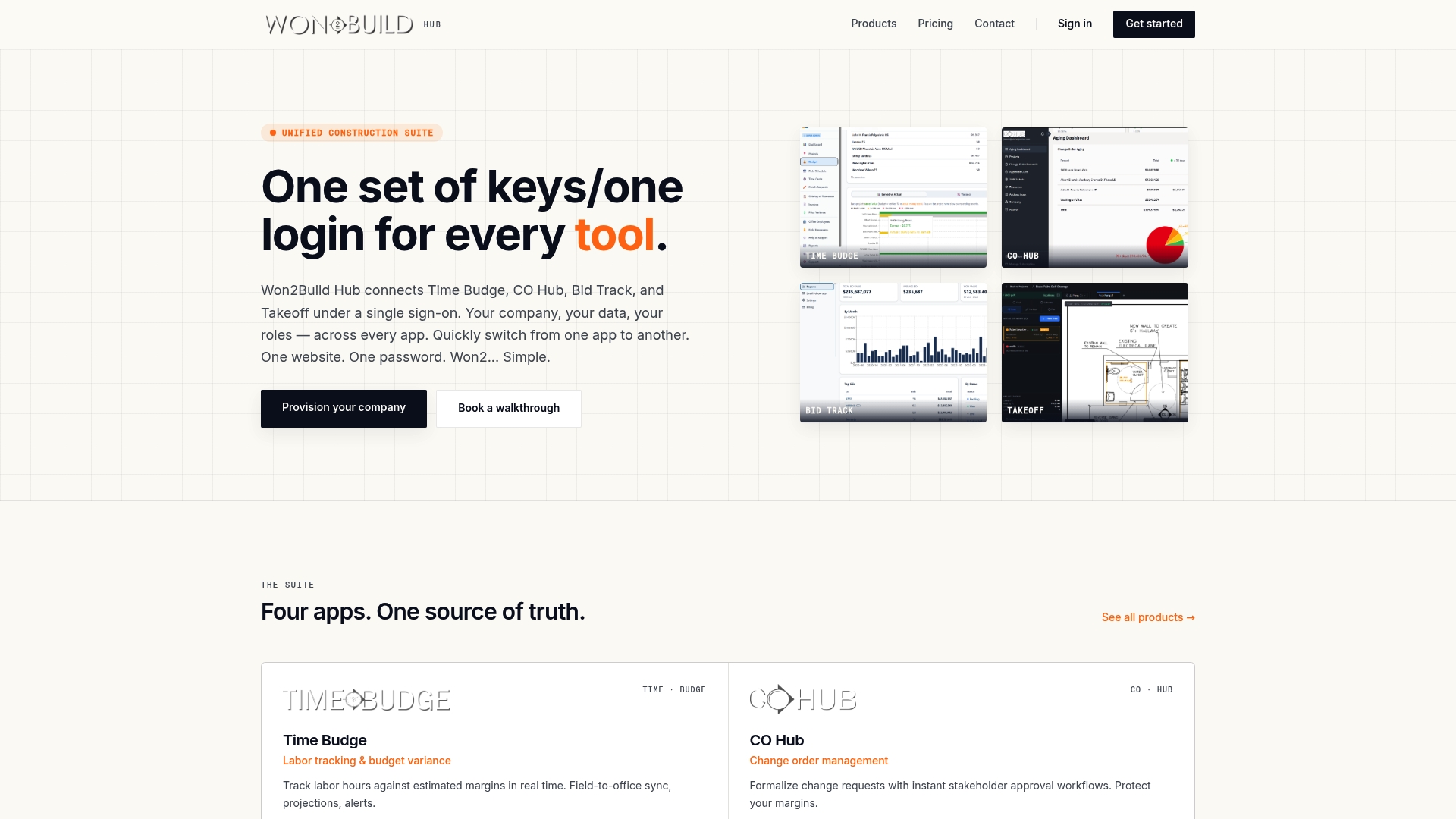
We built Won2Build Hub around the exact gap this guide describes: a single login connecting Takeoff, Bid Track, CO Hub, and Time Budge, so a quantity pulled from a plan flows into a priced bid without a second data entry step. Field changes sync to the office in real time, which means change orders get captured when they happen instead of weeks later during reconciliation.
- Single sign-on across all four apps eliminates the double entry that slows down a disconnected toolset.
- A shared cost database keeps pricing consistent whether a bid comes from Takeoff or gets built manually in Bid Track.
- Flat per-company pricing on Time Budge and Bid Track at $199 a month each, and CO Hub at $59 a month, with unlimited team members per company.
If the red flags above sound familiar, our pricing and plans page is the place to start a pilot on your own projects.
FAQ
What is the best software for estimating takeoff in construction?
The best choice depends on your trade and workflow, but the strongest options connect takeoff directly to a shared cost database and bid pipeline rather than running as a standalone measuring tool. For subcontractors specifically, a suite like Won2Build Hub ties takeoff into bidding, change orders, and labor tracking under one login.
What are the four types of estimating?
Common decomposition approaches described in the CMU Project Management for Construction guide include unit cost estimating, assembly-based estimating, stick estimating, and model-based estimating. Bid, control, and monitoring estimates each draw on these methods depending on the project stage and how much design information is available.
Which software is most commonly used for estimating?
There’s no single tool used industry-wide, since estimating software varies heavily by trade, project size, and whether a team needs standalone takeoff or a connected bid pipeline. Many teams still rely on cost data sources like RSMeans for pricing validation regardless of which takeoff or estimating platform they use.
What is the best AI estimating software for general contractors?
AI-assisted takeoff tools speed up quantity extraction from plans, and a Togal.AI case study found this kind of automation helped one contractor generate roughly 10 more bids per month per office. The bigger gain comes from pairing that automation with a centralized cost library and bid pipeline rather than using it in isolation.
How much does integrated takeoff and estimating software cost for subcontractors?
Pricing varies by platform and by which modules you need. Won2Build’s Bid Track module runs $199 a month per company, CO Hub runs $59 a month per company, and full pricing details for the suite are listed on the pricing page.
Sources
- Automating 4D/5D project control via a BIM-to-BI data pipeline (ASCE)
- Using artificial intelligence to streamline and simplify project takeoffs (Togal.AI case study)
- Mastering construction cost estimating | RSMeans comprehensive guide
- Project Management for Construction: Cost Estimation (CMU PMbook)
Recommended
One login for estimating, bid tracking, change orders, and labor.
The Hub is free. Pay only for the apps you turn on.
Create your free Hub account- Managers: Make Mobile Field Workflows Resilient for 72 Hour OutagesPlaybook for field managers: offline first mobile workflows, resilient sync and conflict handling, compliance first AI guardrails, and practical pilot steps.
- Daily Signed Records: Force Account Tracking for Managers & InspectorsField checklist for project managers and inspectors to keep force account tracking audit-ready: use daily signed records for labor, equipment, and...
- Stop Timecard to Report Drift: Labor Cost Codes for SubcontractorsFix the timecard to report chain with labor cost codes that tie crews to budgets. Includes a 6 code starter and a burdened rate example.