
Cut Vendor Count 20%: Construction Stack Consolidation for Subcontractors
A subcontractor-focused playbook for consolidating your construction software stack. Learn a hub and spoke pilot approach, phased migration steps, and...

Consolidation is usually the right call once duplicate data entry, low field adoption, and conflicting reports start eating into your margins. The fix is not a single new app. Start with a tool audit and a short stakeholder survey, then move toward a hub-and-spoke platform that reduces risk through phased rollout instead of a single risky cutover.
TL;DR:
- Most firms have accumulated multiple disconnected tools, leading to duplicate data entry, low field adoption, and conflicting reports that increase costs.
- Consolidation should start with a clear scope, stakeholder surveys, a full tools audit, and phased migration to minimize risks like data loss and adoption resistance.
- Choosing a core platform requires evaluating data governance, integration capabilities, cost, usability, vendor stability, and support quality, not just features.
- Ongoing review and monitoring of integrations, user adoption, and tool requests are essential to maintain a streamlined, effective software stack post-migration.
- Reducing the number of systems lowers security risks and simplifies compliance with sensitive data requirements like employee wages, project documents, and legal records.
Table of Contents
- Why Construction Software Stack Consolidation Matters
- How Do You Actually Consolidate a Construction Software Stack?
- How Do You Choose the Right Core Platform?
- What Should Your Rollout Checklist and Timeline Look Like?
- What Are the Biggest Risks and How Do You Mitigate Them?
- How Won2build Approaches Consolidation for Subcontractors
- What Exactly Is a Construction Tech Stack?
- What Does a Successful Consolidation Actually Look Like?
- How Do You Keep the Stack Optimized After Migration?
- What Compliance Issues Come With Construction Software Data?
- A Subcontractor-First Take on Consolidation
- Ready to Consolidate? Start With a Won2build Pilot
- Sources
Why Construction Software Stack Consolidation Matters
Most subcontractors did not choose their current software mess on purpose. It grew one point solution at a time: a scheduling app here, a separate estimating tool there, a change order tracker bought during a busy quarter three years ago. Nobody planned the “frankenstack.” It just accumulated.
The costs show up in specific, measurable ways. Field crews enter hours in one app, and the office re-keys them into payroll. A change order gets approved in email, then someone manually updates three separate spreadsheets. Reports pull from different systems and never agree, so the PM and the estimator show up to the same meeting with different numbers.
This kind of fragmentation causes real, repeatable problems:
- Duplicate entry. The same labor hours, quantities, or change order details get typed into two or three systems, and every extra entry point is a chance for a transcription error.
- Low field adoption. Crews skip apps that are slow, confusing, or require a second login, so data either arrives late or does not arrive at all.
- Conflicting reports. When estimating, labor tracking, and billing live in separate tools with no shared source of truth, the numbers in each system drift apart.
- Security gaps. Every additional login and vendor relationship widens your exposure, especially when former employees retain access to tools nobody remembered to offboard.
The benefits of fixing this translate directly into dollars and time. Firms that consolidate around fewer, better-integrated systems report lower total cost of ownership and stronger field adoption than firms running a patchwork of disconnected point tools. Onboarding a new hire on one login is faster than training them on five. Reporting becomes trustworthy again because there is one dataset instead of four competing ones.
The pattern that keeps showing up in successful consolidations is hub-and-spoke: one core platform holds the shared data and identity layer, while a smaller number of specialized tools plug into it rather than operating as isolated silos. Industry reporting on tech stack strategy frames this as a continuity issue as much as an efficiency one: firms that protect a single source of truth scale more predictably than firms that keep bolting on disconnected software.
How Do You Actually Consolidate a Construction Software Stack?
A consolidation project fails most often because nobody defined what “done” looks like before touching a single vendor contract. Fix that first.
1. Define scope, outcomes, and governance upfront. Name a project sponsor with budget authority, and write a one-page RACI so everyone knows who approves the shortlist, who signs off on migration, and who owns data quality afterward. Decide what success looks like in concrete terms: fewer logins, faster payroll runs, one change order source of truth. Vague goals produce vague results.
2. Run a full tools audit. List every application currently in use, department by department, and capture five things for each: cost, active user count, integration points with other tools, contract terms and renewal dates, and actual frequency of use. You will almost always find at least one tool the company is paying for that almost nobody opens. Step-by-step consolidation frameworks treat this audit as the foundation the rest of the project rests on, and skipping it means negotiating with vendors before you know what you actually need.
3. Survey stakeholders and talk to the field. A five-minute survey to office staff and a handful of short interviews with foremen and crew leads will surface more real friction than any executive workshop. Ask what they avoid using and why. Ask what they re-enter by hand. The answers usually point straight at your worst integration gaps.
4. Map workflows and integration dependencies. Draw out how data actually moves today: from field time entry to payroll, from a bid to a signed contract, from a T&M ticket to an invoice. Mark which interfaces are mission-critical (labor-to-payroll almost always is) versus nice-to-have. This map becomes your test plan later.
5. Build a shortlist and a pilot plan. Narrow your options to two or three core-platform candidates based on the audit and the workflow map, not on the vendor with the best sales deck. Every pilot plan needs a rollback path and a data-reconciliation plan in writing before you migrate a single project. Enterprise-scale examples make this concrete: teams inside large builders have targeted roughly a 20% reduction in vendor count by requiring any new tool request to prove it replaces something rather than simply adding a feature.
6. Migrate in phases: pilot, expand, cutover, measure. Run the new platform on one or two live projects first, ideally ones with a cooperative PM and a manageable scope. Expand to a broader group once the pilot clears its checkpoints. Only then schedule the full cutover, with a defined support window and clear fallback steps if something breaks.
Pro Tip: Run payroll and change order reconciliation as a dedicated sprint right after your pilot migration, not as an afterthought. Timekeeping and payroll schemas rarely match perfectly on the first pass, and catching the mismatch on one pilot project is far cheaper than catching it after a company-wide cutover.
Resources like Won2build’s guide to construction software solutions walk through how subcontractors specifically structure this audit, since the workflow dependencies for a sub (labor, change orders, bids, takeoff) differ from what a general contractor needs to track.
How Do You Choose the Right Core Platform?
The platform you pick becomes the hub everything else plugs into, so the evaluation bar should be higher than “does it have the features we need.” Six criteria matter more than any feature checklist.
- Data governance. Who owns the data once it is in the system, what export formats are available, and what happens to your historical records if you leave? Portability protects you from being trapped later.
- Integration capability. Ask specifically about APIs, webhooks, and prebuilt connectors, and whether sync runs one-way or bidirectional. Integration hubs can automate a lot of this reconciliation work, but they carry their own ongoing maintenance burden, so factor that into the real cost of any integration-heavy approach.
- Total cost of ownership. Add up implementation fees, per-user or per-field-worker charges, integration maintenance, and training time, not just the sticker price on the sales page.
- Field usability. A platform your office team loves and your crews ignore has not solved anything. Test the mobile experience yourself: does it work offline on a job site with no signal, does it support the languages your crews actually speak, and does it load fast on an older phone?
- Vendor stability and roadmap. A platform built specifically for your trade and company size tends to outlast one built for a broader market that may deprioritize your use case.
- Pilot support and SLAs. Ask what support looks like during the pilot phase specifically, not just after you sign a full contract.
Pro Tip: Before any demo, write down the exact questions you want answered: “Can we export all historical data in a standard format if we leave?” “What is the average field adoption rate among customers our size?” “What does your support response time look like during a pilot versus a live contract?” Vendors answer vague questions vaguely and specific questions specifically.
A procurement checklist built from this list, alongside the bid tracking evaluation criteria subcontractors already use for estimating tools, gives you a repeatable framework for judging any core-platform candidate rather than relying on a single sales pitch.
What Should Your Rollout Checklist and Timeline Look Like?
A realistic timeline runs longer than most teams expect, and that is fine. Rushing the migration is the single most common cause of a failed rollout.
Pre-migration (weeks 1 through 4):
- Review every current vendor contract for exit terms, data export rights, and renewal dates.
- Back up all existing data before touching anything.
- Map data fields between the old systems and the new platform.
- Get written signoff from your project sponsor and department leads before scheduling the pilot.
Pilot phase (weeks 5 through 10):
- Select one or two active projects with a cooperative PM and moderate complexity.
- Validate that every mission-critical integration actually works with live data, not just test data.
- Train the pilot users directly, in person if possible, rather than through a recorded video.
- Collect structured feedback weekly, not just at the end of the pilot.
Rollout phase (weeks 11 through 16):
- Stagger cutovers by department or region rather than flipping every project at once.
- Staff a dedicated support window during each cutover, with someone reachable by phone.
- Keep the old systems accessible in read-only mode for a defined grace period as a fallback.
Post-rollout (ongoing):
- Reconcile old and new data sets line by line on at least a sample of records.
- Track adoption metrics by department, not just company-wide averages.
- Hold a 30-day and 90-day review checkpoint to catch problems before they compound.
This sequence mirrors the audit-to-migration structure recommended in industry step-by-step consolidation guides, adjusted for the reality that most subcontractor teams cannot afford a full week of downtime mid-project.
What Are the Biggest Risks and How Do You Mitigate Them?
Every consolidation project carries the same four risks, and each one has a specific, tactical fix.
- Data migration errors. Export everything into a staging environment first, and write reconciliation scripts that flag mismatches before they hit your live payroll or billing runs.
- Vendor lock-in. Negotiate exit and data-export clauses into the contract before you sign, and insist on standard file formats (CSV, standard API exports) rather than a proprietary format only that vendor can read.
- Adoption resistance. Roll out in phases, recruit a handful of respected foremen or PMs as champions, and consider a small training incentive for early, consistent use.
- Integration drift. APIs break quietly when a vendor pushes an update on their end. Assign one specific person to own integration health checks and set up monitoring alerts rather than discovering a broken sync three weeks later.
The safety net that ties all four together is the same one from your pilot plan: a documented rollback path. If a migration script corrupts a data field or a critical integration silently fails, you need a known-good backup and a clear “go back” procedure, not an improvised scramble.
How Won2build Approaches Consolidation for Subcontractors
Won2build’s Hub was built around the specific workflow a commercial subcontractor runs every day: track labor, manage change orders, build bids, and quantify takeoffs, all without re-entering the same numbers four times. The suite bundles four modules, Time Budge, CO Hub, Bid Track, and Takeoff, behind a single sign-on, so a project manager moves between labor tracking and change order approval without logging into a separate system or re-keying a single field.

Real-time sync between field and office is the piece that actually solves the frankenstack problem described earlier: a foreman logging hours on a phone updates the same dataset the office sees, instead of a spreadsheet that gets reconciled once a week. That single dataset is also what protects data ownership, since everything lives in one governed system instead of scattered across four vendor accounts with four different export policies. Multi-app platforms built specifically for subcontractors solve a narrower, more specific problem than general contractor software, which is exactly why the hub-and-spoke model fits this trade so well.
What Exactly Is a Construction Tech Stack?
A construction tech stack is the full collection of software tools a company relies on to run its projects, from bidding through closeout. That typically includes estimating and takeoff software, project management platforms, labor and time tracking tools, change order and billing systems, document control, and often a separate accounting package that everything else has to feed into.
For a subcontractor specifically, the stack usually breaks into a handful of functional layers: pre-construction (bidding, estimating, takeoff), field operations (time tracking, daily logs, change orders), and back-office (payroll, invoicing, accounting). The problem is not that these categories exist. It is that most companies end up running a separate, disconnected tool for each layer, purchased at different times from different vendors with no shared data model.
A “healthy” stack does not mean the fewest possible tools. It means every tool in use has a clear job, talks to the tools around it, and does not require a human to manually copy numbers between systems. A three-tool stack where each app dumps clean data into the next is healthier than a one-tool setup that forces your estimators to work around missing features. The goal of consolidation is not minimalism for its own sake. It is eliminating the gaps where data gets lost, duplicated, or contradicted between systems, which is exactly the hub-and-spoke model addresses by giving every specialized tool one shared source of truth to plug into.
What Does a Successful Consolidation Actually Look Like?
The clearest large-scale example of disciplined consolidation comes from inside a major builder managing roughly 27,000 employees across hundreds of software tools. Rather than adding more point solutions as new needs came up, the team shifted to a “subtraction” mindset: every new tool request had to demonstrate it would replace an existing system rather than simply adding another feature layer on top. That single policy change, tracked through a central system for evaluating every tool in the portfolio, drove the vendor count down by roughly 20 percent without cutting any actual capability.
The subcontractor version of this story looks smaller but follows the same logic. A trade contractor running separate apps for time tracking, change orders, and estimating typically finds, once they run the audit described earlier, that at least one of those tools duplicates a function the others already cover. The pattern that shows up most often: change order approvals tracked in email or a shared spreadsheet, disconnected from both the labor system and the billing system, which means margin-eroding scope creep goes unnoticed until the invoice stage.
The consolidation outcome that actually moves the needle is not a smaller software bill on its own. It is a PM catching a change order discrepancy the same week it happens instead of the same month the final invoice goes out, because labor hours, change orders, and billing all draw from one dataset instead of three. That is the practical payoff hub-and-spoke consolidation is built to deliver, and it is the same reasoning behind why subcontractors increasingly prioritize real-time data access over adding another standalone app to the stack.
How Do You Keep the Stack Optimized After Migration?
Consolidation is not a project with a finish line. It is a maintenance habit, and the companies that let it slide end up right back in frankenstack territory within a couple of years.
Set a recurring review cadence, quarterly is reasonable for most subcontractors, where someone actually checks adoption metrics by department instead of assuming things are fine because nobody complained. Low usage in one crew or region usually means either a training gap or a workflow that does not fit how that team actually works, and both are fixable if you catch them early.
Watch for integration drift specifically. APIs and connectors between your core platform and any remaining spoke tools can break quietly when a vendor pushes an update, and integration layers require their own ongoing health checks rather than a “set it and forget it” assumption. Assign one person the explicit job of monitoring sync health, even if it is a small part of a broader IT role.
Treat every new tool request the same way the audit treated your old tools: does this genuinely replace something, or is it just another point solution stacking on top of what you already consolidated? That single discipline question, asked consistently, is what keeps a clean stack clean instead of drifting back into the mess you just spent months fixing.
What Compliance Issues Come With Construction Software Data?
Construction software now holds sensitive data well beyond project schedules: employee time and wage records, subcontractor financial terms, insurance and bonding documents, and sometimes payment card information for billing. Consolidating that data into fewer systems changes your compliance exposure, usually for the better, but only if governance is part of the plan.

Fewer systems means fewer places wage and hour records live, which matters because labor tracking data often has to satisfy state-specific wage record retention rules. It also means fewer login credentials to manage, which directly reduces the risk of a former employee retaining access to sensitive project or payroll data after they leave, a gap that fragmented stacks create constantly.
Data residency and export rights deserve specific attention during vendor selection. Ask where the platform physically stores your data, what happens to it if you cancel, and whether you can pull a complete export in a standard format on demand. A platform that treats your historical project data as something you can access anytime is fundamentally different from one that treats it as a hostage.
Insurance certificates, lien waivers, and contract documents tied to change orders also carry their own retention requirements depending on your state and project type. Centralizing these in one governed system, rather than scattered across email threads and personal drives, makes audits and disputes far easier to resolve when they come up.
A Subcontractor-First Take on Consolidation
Most consolidation advice gets written for general contractors managing dozens of subs, not for the subs themselves. That framing misses what actually matters at the subcontractor level: protecting margin on every change order and every labor hour, not managing enterprise complexity. Realistic savings show up in months, not years, and adoption sticks fastest when it starts with one pilot crew, not a company-wide mandate. Keep a point tool only when it does something your core platform genuinely cannot.
— Jen Reese
Ready to Consolidate? Start With a Won2build Pilot
Won2build is built specifically for subcontractors running into the exact frankenstack problems this article walked through: labor hours re-typed into payroll, change orders tracked in a separate spreadsheet from billing, bids built in a tool that never talks to the field. Instead of stitching four vendor logins together, Time Budge, CO Hub, Bid Track, and Takeoff sit behind one sign-on with real-time sync between field and office.
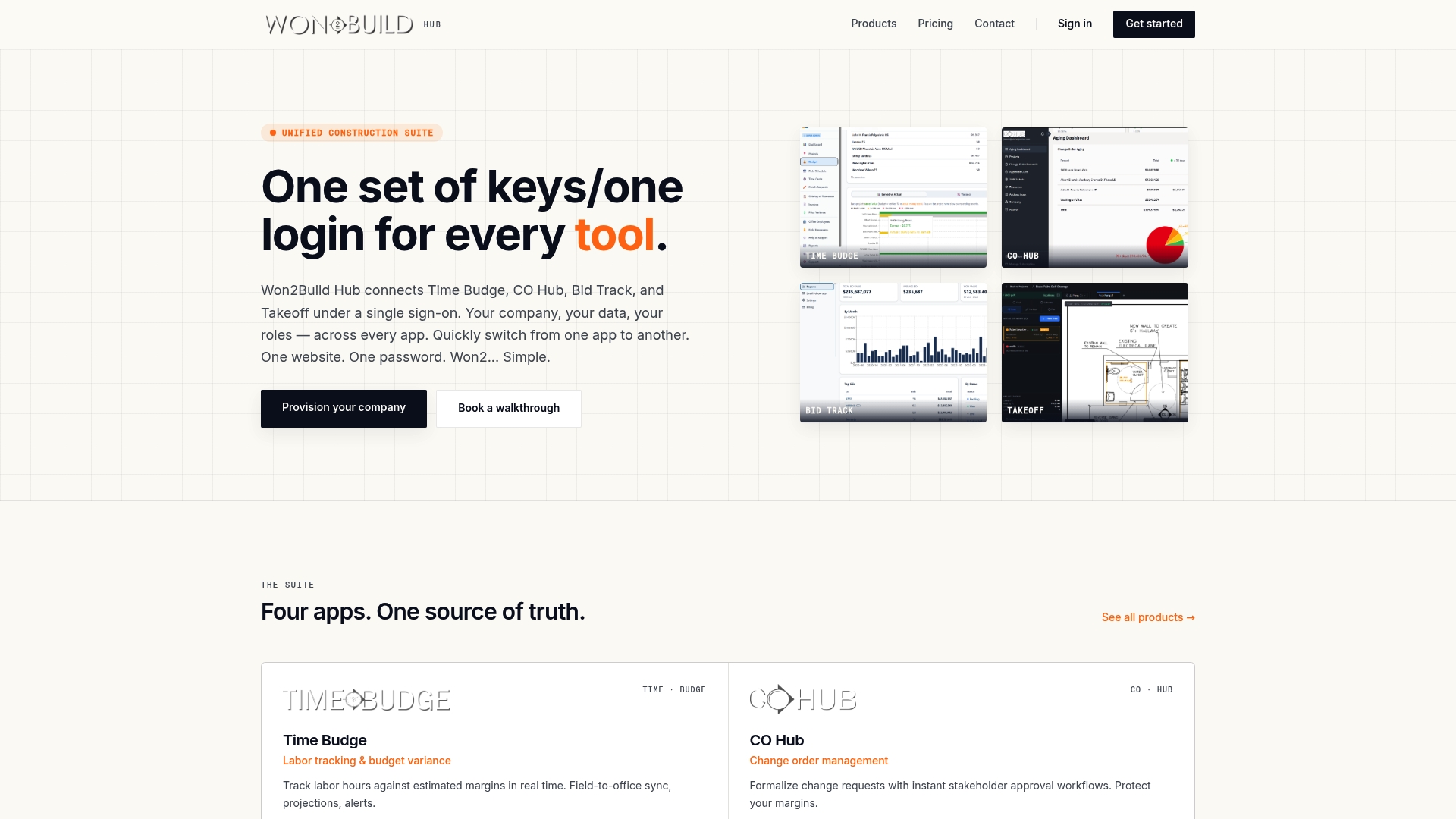
A standard pilot starts small and on purpose: pick one or two active projects, run CO Hub alongside your existing change order process for a few weeks, and compare how fast a change order gets approved and billed versus your current method. If takeoff quantities feed your estimates, add the Takeoff module to the pilot and check whether quantities carry through to Bid Track without manual re-entry. Request a demo through Won2build to see which modules fit your current gaps before committing to the full suite.
Sources
- The scalability secret: unlocking business continuity through tech stacks — ENR
- Tech stack consolidation in construction: a step-by-step guide — The Access Group
- Why contractors are consolidating their construction tech stack — Tenna (blog)
- Inside Skanska’s tech stack problem — Bricks & Bytes
- Space Connectors – Integration Hub for Construction Software — Space AI
Recommended
One login for estimating, bid tracking, change orders, and labor.
The Hub is free. Pay only for the apps you turn on.
Create your free Hub account- Managers: Make Mobile Field Workflows Resilient for 72 Hour OutagesPlaybook for field managers: offline first mobile workflows, resilient sync and conflict handling, compliance first AI guardrails, and practical pilot steps.
- Daily Signed Records: Force Account Tracking for Managers & InspectorsField checklist for project managers and inspectors to keep force account tracking audit-ready: use daily signed records for labor, equipment, and...
- Stop Timecard to Report Drift: Labor Cost Codes for SubcontractorsFix the timecard to report chain with labor cost codes that tie crews to budgets. Includes a 6 code starter and a burdened rate example.