
Bid/No-Bid Criteria for Commercial Subcontractors
The bid/no-bid criteria commercial subcontractors can score before takeoff: fit, capacity, GC and contract risk, and expected profit, with a simple matrix to use.

A good bid/no-bid decision is made before takeoff, with a short list of criteria you score the same way every time: trade and project fit, capacity, the general contractor and contract terms, document quality, and expected profit. Every bid you chase uses estimating hours you cannot spend on a better one. Written criteria, a score and a record of the call keep that decision from depending on who is feeling optimistic that week. Bid Track, our bid management app, keeps the invitations, due dates and decisions in one place so the screen happens at the start of the pursuit, not halfway through it.
TL;DR
- Decide before takeoff. The point of a bid/no-bid screen is to protect estimating time, crew hours and cash for the jobs you can win and build profitably.
- Score five areas: fit, capacity, GC and contract risk, document quality, and expected profit. Any single dealbreaker can override the total.
- A high estimated margin does not make a bid good. A job that strains crews, bonding or mobilization cash can sink a company even at a healthy markup.
- Keep a one-page record of every call, bids and no-bids alike, and review it quarterly against what you actually won.
- Decline early and politely. A short no-bid note keeps the GC relationship open.
Table of Contents
- What a bid/no-bid decision really decides
- The five criteria worth scoring
- A scoring matrix you can use tomorrow
- Red flags that should end the review early
- How to run the decision so it holds up
- Where your own numbers make the decision better
- Perspective
- Run the screen with Bid Track
- FAQ
- Sources
What a bid/no-bid decision really decides
When an invitation to bid arrives, you are not deciding whether you can do the work. You are deciding whether to spend scarce resources chasing it. Estimating hours, a senior person’s attention, mobilization cash, bonding capacity and field labor are all committed, in part or in full, the moment you say yes.
Construction CFO Josh Luebker makes this point in his analysis of a 26% margin bid that still sinks a company: resources spent on the wrong job are not available for the right one next month. That makes the decision as much a balance-sheet question as an estimating one.
The outcome is one of three: bid, no-bid, or a conditional bid. A conditional bid means you pursue only if specific gaps close before the due date, for example a missing addendum or a clarification on payment terms, and someone is named to close them.
The five criteria worth scoring
Published checklists run from four factors to ten. They overlap heavily. For a commercial subcontractor, they collapse into five areas.
1. Fit: trade, scope, size and delivery method
Start with whether the work looks like the work you do well. The Canadian Construction Association’s trade contractor council lists pre-bid considerations that apply just as well south of the border: experience with the delivery model, normal project size and scope, geographic territory, and schedule fit.
In practice, ask:
- Is the scope inside our trade and our usual dollar range, or are we stretching?
- Have we worked under this delivery method (design-bid-build, CM at risk, design-build) before?
- Can we staff and supply the job from where our crews and suppliers already are?
- Does the start date and duration fit around work we have already booked?
Be honest about adjacent work. The most expensive estimates are often for scope that is mostly familiar with a small piece you will be learning on the owner’s dime. If a method is new to you, price the unknown or pass.
2. Capacity: estimating, field labor and cash
Capacity is where optimism does the most damage. Practitioners interviewed by Construction Executive describe starting with contracted backlog, then checking whether a new job would hurt quality or safety on the work already underway. One contractor also screens for team availability and fit with the estimating schedule.
Three questions cover it:
- Estimating: Do we have the hours to produce a careful number by the due date without shortchanging bids we are already working?
- Field: If we win, who runs it, and which crews and foremen come from where?
- Money: Can we carry the mobilization and the wait for the first payment, and what share of our bonding capacity does the job use?
Luebker’s example makes the stakes concrete. A $2 million project that pulls crews from two profitable $600,000 jobs, uses 40% of bonding capacity and needs 90 days of mobilization capital the company lacks is a bad bid even at a 26% estimated margin.
3. The GC and the contract
Your margin depends on getting paid on time and on not absorbing risk that belongs to someone else. Screen the general contractor and the contract language before you price.
On the GC side, look at:
- Your history with them: how fast they paid, how they handled change orders, how they treated back-charges.
- Reputation among other subs in your market.
- One contractor in the Construction Executive piece goes as far as running case searches to see how litigious a new client is.
On the contract side, read the subcontract or the draft terms, not just the bid invitation. The terms that most often turn a fair price into a bad job:
- Pay-if-paid or pay-when-paid clauses, which tie your payment to the GC being paid by the owner. Enforceability varies by state, so know your own state’s rules.
- Liquidated damages without a cap.
- Indemnity or defense obligations your insurance will not cover.
- No-damages-for-delay clauses on a schedule you already doubt.
- Heavy retainage, or flow-down terms you have not seen.
For a state-specific question, such as what your state allows on payment clauses or lien rights, ask your construction attorney. That review is worth doing before you commit to a job, not after.
4. Document quality and schedule realism
Thin drawings turn into unpriced risk. Before you open a takeoff, check whether the drawing and spec set covers your scope, how many addenda have already landed, whether there is an RFI history, and whether geotechnical or other reports are included for your work.
Gaps in documents become contingency in your number or claims after you win. If you would be pricing mostly assumptions, you are guessing, and a competitor who guesses lower will take the job.
Also look at the schedule. A bid deadline that gives you too little time often foreshadows a compressed schedule on the job itself. A realistic look at the calendar should be part of the screen, not a surprise at buyout.
5. Profit and probability of winning
A job has to clear a minimum margin after all labor, materials, equipment, insurance, workers’ comp, benefits and overhead. If it cannot clear that margin at a price you think can win, it is a no-bid.
Then add the odds. Estimating costs money whether you win or not, so a better question than “What margin could this job earn?” is “What is the margin worth after the chance of winning?” Luebker suggests expected value, win probability times estimated margin, should clear the cost of the estimate plus the opportunity cost of the estimator’s time. He cites win rates of 25 to 35% for competitive bids in a trade where you have strong relationships, and 10 to 15% for a type of bid you have won only once.
The academic version of the same idea is probabilistic bidding. HSM University’s estimating course explains the Friedman approach: use a history of competitors’ bid-to-cost ratios to estimate the chance of winning at each markup. Expected profit equals markup times cost times probability of winning. In its example for a $12 million cost, expected profit peaks at a 4% markup, at $257,600, because a higher markup cuts the odds of winning faster than it adds margin.
You do not need the full model to use the lesson. Higher markup means fewer wins. The most profitable price is rarely the lowest, and rarely the highest.

A scoring matrix you can use tomorrow
A matrix turns the five areas into a number so two people looking at the same job reach the same conclusion. Here is a simple version. Adjust the weights to your trade.
| Criterion | Weight | Score 0 to 5 | What a 5 looks like |
|---|---|---|---|
| Trade and project fit | 20% | Our core scope, normal size, familiar delivery method | |
| Capacity (estimating, field, cash) | 25% | Estimator free, crew available, cash and bonding comfortable | |
| GC and contract terms | 25% | Paid on time before, fair terms, no uncapped risk | |
| Document quality and schedule | 15% | Complete set, few addenda, realistic dates | |
| Profit and win probability | 15% | Margin clears target and we have a real path to win |
Multiply each score by its weight, add them up and convert to a percentage of the maximum. Then set bands before you start scoring, so nobody moves the goalposts for a job they like:
- 75% and up: pursue.
- 60 to 74%: conditional bid. Name the one or two things that must improve, who fixes them, and by when.
- Below 60%: no-bid.
Add one rule: a zero on any criterion is an automatic no-bid, whatever the total says. A zero on capacity or on contract terms is the job telling you to walk.
Score honestly. If your answer on capacity is “we could figure it out,” that is a 2, not a 4. Capacity is the area where teams most often shade the score to justify a job they already want.

A worked example
Say a GC you have never worked with invites you to bid a $900,000 scope. It is your trade and the right size. The set has two addenda and no geotech report. Your best estimator is committed on two other bids through the due date, and the draft subcontract includes pay-if-paid language and uncapped liquidated damages.
Scores: fit 4, capacity 2, GC and contract 1, documents 3, profit and probability 2. Weighted, that is 0.8 + 0.5 + 0.25 + 0.45 + 0.3 = 2.3 out of 5, or 46%. That is a no-bid, and the contract score alone would have been enough to raise a flag. The right move is a short, friendly decline that mentions you would like to see future work that fits your schedule.
Red flags that should end the review early
Some signals are strong enough to skip the matrix:
- Payment terms that leave you funding the job for months with no recourse.
- Uncapped liquidated damages paired with a schedule you cannot control.
- Indemnity or defense obligations beyond what your insurance covers.
- A bid deadline that leaves no time for a real takeoff or for sub and supplier quotes.
- Missing or contradictory documents for your scope, with no willingness from the GC to answer RFIs.
- A GC with a track record of slow payment or disputes with subs.
One mixed signal is a conditional bid. A cluster of them is a no-bid.
How to run the decision so it holds up
A criteria list does little if it lives in someone’s head. A few habits make it stick:
- Screen at intake. Run the first pass within a day of the invitation, before anyone opens plans. Five minutes on fit, GC and capacity eliminates a lot of work.
- Give one person the call. Estimators usually want to bid. The owner, a project executive or whoever answers for margin should approve the decision.
- Record the reason. Write down the score, the deciding factor, any conditions and who owns them. Someone who missed the meeting should be able to read the record and see what was decided and why.
- Close the loop. Track which bids you won, lost or declined, and at what score. After a few months you will see which criteria actually predict wins and profit for your company.
- Decline well. A brief no-bid note that thanks the GC, states a short reason and invites future work keeps the door open.
If you want the surrounding process, our guides on bid management for subcontractors, a bid calendar that works and a bid submission checklist cover what happens after you say yes.
Where your own numbers make the decision better
The most useful criteria are the ones based on your history: what your crews actually produce, how your past bids compared with final job cost, and which GCs paid when. Guesses about those numbers are what make scorecards unreliable.
That is why the estimate side matters. Accurate quantities and cost data feed the profit and probability score, and our guides on building accurate job cost estimates and improving commercial bid accuracy show how to tighten them. A digital takeoff gives you quantities quickly enough to price the jobs that pass the screen.
Perspective
We built Won2Build as a working subcontractor’s toolset, and the bid/no-bid decision is where its four apps meet. The call you make on Monday about an invitation depends on what happened on last year’s jobs: what the labor really cost, what the change orders really recovered, and which bids you won or lost.
In most shops that history lives in separate places. Labor is in one system, change orders in another, bids in a spreadsheet, and the estimator’s memory fills the gaps. That is how a bid gets approved on a feeling.
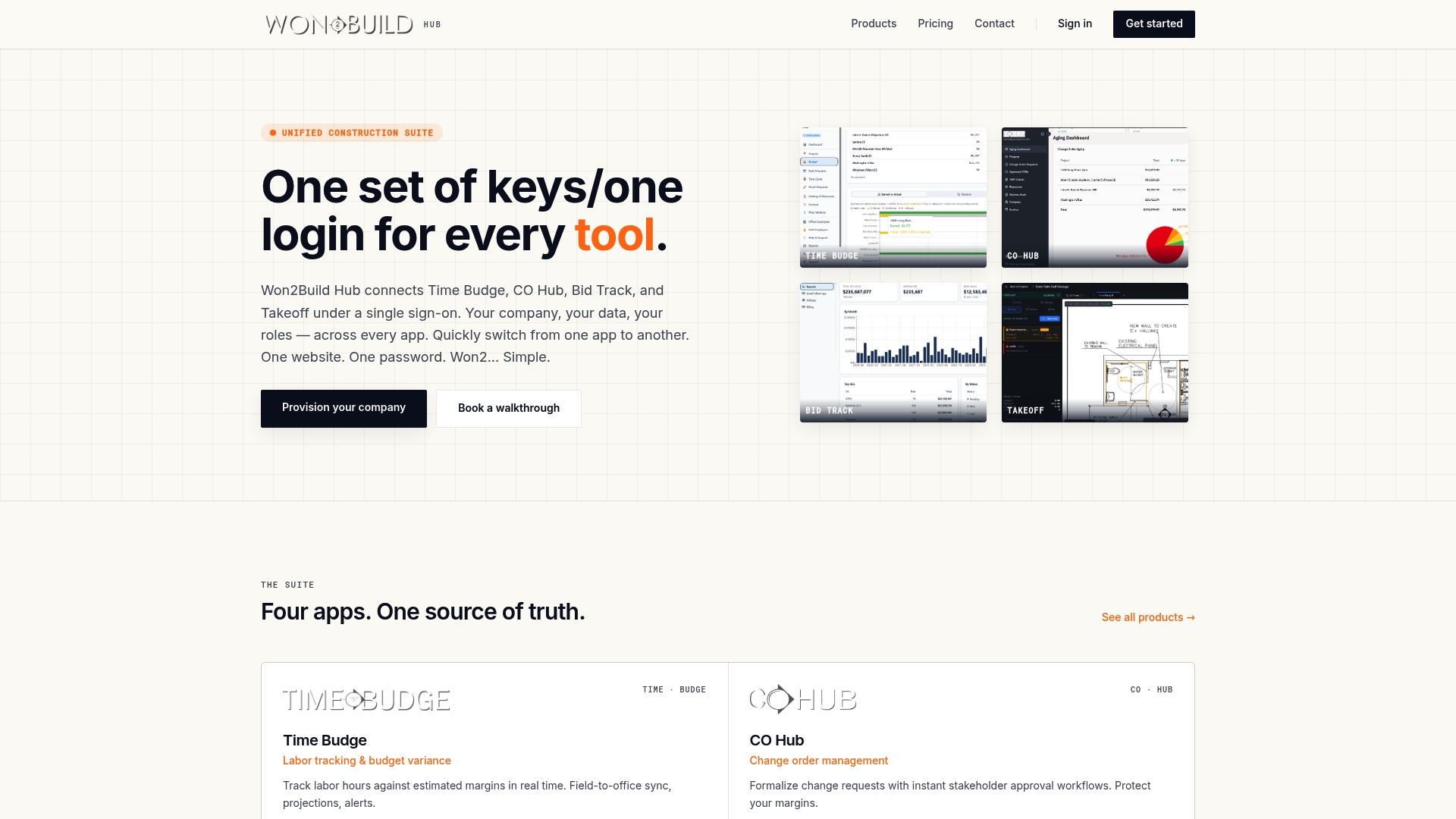
Our Hub puts Time Budge, CO Hub, Bid Track and Takeoff behind a single login, so field and office work from the same data and nobody keys the same number twice. When the bid pipeline, the takeoff and the labor history sit together, the criteria in this article stop being a checklist and become a habit you can see in your own numbers.
Our advice: write your criteria down, score every invitation the same way, and keep the record. The jobs you decline are part of your margin.
Jen Reese
Run the screen with Bid Track
Bid Track is our digital bid management and estimating app for subcontractors. It keeps your bid pipeline organized so each invitation gets screened and recorded alongside the estimate. It costs $199 per month per company, and the price is flat for the company, with unlimited team members. Takeoff, our digital plan quantification app, and the Hub login are listed at $0 per month. Time Budge for labor tracking is $199 per month per company plus $2 per month per active field worker, and CO Hub for change orders is $59 per month per company. You can subscribe to the full bundle or to individual apps, and there is a free trial before billing starts.
See Bid Track for what it does, or the pricing page for the full list.
FAQ
What does a no-bid mean?
A no-bid is a deliberate decision not to submit a price on an opportunity because fit, profit, risk or capacity is wrong. It is a business decision, not a failure. Send the GC a short, positive note so they keep inviting you.
What are the criteria for bid evaluation?
For a subcontractor, the core criteria are trade and project fit, capacity for estimating, field work and cash, the GC’s payment record and contract terms, document quality and schedule, and expected profit given your odds of winning. Score each one and set a threshold before you look at any job.
Who should make the final bid/no-bid call?
The person accountable for company margin, usually an owner or senior project executive, should approve it with input from the estimator and the field lead. Estimators tend to favor bidding, so a separate approver keeps the decision balanced.
Should I always bid when the score is borderline?
Only if you can name what would raise the score, who will fix it and by when. If the gaps are in contract terms or capacity and cannot be closed before the due date, pass and save the estimating hours for a better fit.
Sources
- Construction CFO: A 26% Margin Bid That Still Sinks the Company
- Canadian Construction Association: Bid Go or No-Go bulletin
- Construction Executive: How do you decide when it’s best to turn down work?
- HSM University: Bid strategy and risk pricing, CON-300 Lesson 11
Recommended
One login for estimating, bid tracking, change orders, and labor.
The Hub is free. Pay only for the apps you turn on.
Create your free Hub account- Labor Allocation Planning for Commercial SubcontractorsHow commercial subcontractors plan labor allocation: build hours from the estimate, load crews by week, track actuals and fix gaps before they cost margin.
- Sheet Set Organization for Subcontractors: A Plan Set SystemHow commercial subcontractors can organize a construction sheet set: sort by discipline, track revisions, name files, and keep takeoff, bids and change orders tied to it.
- Addenda Tracking in Construction: A Sub's PlaybookHow commercial subcontractors track addenda: build a log, read each change against your scope, update takeoffs and quotes, and confirm acknowledgment before bid day.