
Estimate Review Checklist for Commercial Subcontractors
A practical estimate review checklist for commercial subcontractors: scope, takeoff, pricing, markups, risks and sign-off, so errors are caught before you submit.

An estimate review checklist is a fixed list of questions someone asks of a finished estimate before the bid goes out: is the scope complete, do the quantities match the plans, are the prices current, are markups and exclusions stated, and is the whole thing documented. The strongest version is a second look by a person other than the estimator, using the same list on every bid. Below is a checklist built for commercial subcontractors, with what to check, where each check usually fails and how to record the result.
TL;DR
- Review every estimate on the same list, in the same order, by someone other than the person who built it whenever you can.
- Check scope first. A missing activity leaves no arithmetic error, so the math can be perfect and the bid still loses money.
- Re-verify quantities, labor, and every quote’s date and validity, because inputs go stale between entry and submission.
- State markups, exclusions, allowances, and assumptions in writing, then sign off and keep the record.
- When review finds a gap, fix your standard estimate template as well as the current bid.
Table of Contents
- Why a review step pays for itself
- Estimating checklist vs. estimate review checklist
- The checklist, pass by pass
- What to do with the findings
- Making the review habit stick
- Where Bid Track and Takeoff fit
- Perspective
- FAQ
- Sources
Why a review step pays for itself
Government owners treat estimate review as a required stage, not a courtesy. New Jersey DOT’s Cost Estimating Guideline says estimates should be reviewed for the validity of their basis. Reviews examine the assumptions behind the estimate, its internal logic, completeness of scope and methodology. They also confirm that quantities, unit prices and percentages reflect the scope, the site conditions and the market.
That is a public-agency document, but the logic carries straight over to a subcontractor’s bid. The Construction Institute’s Improving Early Estimates Best Practices Guide makes two points worth keeping on the wall. Effective use of estimate checklists minimizes omissions and duplications, and no estimate should be released without internal reviews. The level and number of reviews should depend on the size and purpose of the estimate.
For a subcontractor, that last point is practical. A $15,000 punch-list proposal does not need the same review as a $2 million mechanical package. Set two or three tiers by bid size and decide in advance who reviews each.
Estimating checklist vs. estimate review checklist
The two lists are easy to confuse, and the search results mix them.
- An estimating checklist is built before and during pricing. It lists the cost items a trade usually carries so nothing is forgotten: labor, material, equipment, subcontractors, overhead, profit, contingency. Our construction estimate components list covers that side.
- An estimate review checklist is used after the number exists. It tests whether the finished estimate holds up: whether it matches the documents, whether the inputs are current, whether the assumptions are visible.
A good estimate is also more than a column of costs. Idaho Transportation Department’s Construction Cost Estimating Guide says it includes a Basis of Estimate describing assumptions, inclusions, exclusions, accuracy and whatever else is needed to interpret the total. That total covers the base estimate, allowances, contingency, escalation and inflation. If your estimate cannot answer “what exactly did we price and what did we assume,” the reviewer has nothing to review.
The checklist, pass by pass
Run the review as separate passes rather than one read-through. Each pass asks one kind of question, so the reviewer’s attention is not split. Tick each item or write the correction beside it.
Pass 1: Scope and documents
Start here, because scope errors are the most expensive and the hardest to see. A missing activity produces no wrong figure. The estimate simply looks finished.
- Do you have the complete bid set: every drawing discipline, the specifications, Division 01 requirements and every addendum?
- Does your estimate list match your trade’s spec sections line by line, including the related sections (for example, a drywall sub checking fire-rated assemblies, firestopping and insulation sections)?
- Does the estimate reflect the latest drawing issue, and have you logged which addenda changed your scope?
- Where two trades touch, is it clear who provides what? Blocking, sleeves, patching, firestopping at penetrations, access panels and temporary protection are the usual disputes.
- Does the scope on drawings, in the specs and in the bid form agree? When they do not, which governs, and what did you price?
Where it goes wrong: you price from the plans and skip the specs, or you price a prior addendum set. Cross-reference every document in the package against your scope sheet. A gap you leave undefined tends to be argued as included once a dispute starts.
Pass 2: Quantities and takeoff
The question for this pass is whether the quantities on the estimate are the quantities on the plans.
- Spot-check at least a few high-dollar line items by re-measuring them independently, not by re-reading the original takeoff.
- Confirm units are consistent (linear feet vs. square feet vs. each) and that unit prices use the same unit as the quantity.
- Check for double counts where drawings overlap, such as a detail shown on both a plan and a section, and for items counted in two trades’ scopes.
- Check that waste, overage and cut-down factors are applied once, and are appropriate for the material and layout.
- Compare against a rule-of-thumb: cost per square foot, per fixture, per linear foot, from your own completed jobs. The Construction Institute guide recommends using key cost indicators for reality checks. A line that is far from your history is not necessarily wrong, but it needs an explanation.
Where it goes wrong: a sheet is missed, a scale is misread, or a revision cloud is not reflected in the count. Our takeoff checklist goes through the measurement side in detail, and the material takeoff guide explains the method.
Pass 3: Labor
- Are productivity rates based on your own field history for this type of work, floor height, access and schedule?
- Does the labor rate include burden: taxes, insurance, benefits and any prevailing-wage requirement for the project?
- Have you allowed for supervision, layout, mobilization, cleanup, and rework in a realistic proportion?
- Does the labor total divide into a crew size and duration that fits the schedule in the documents? If the math needs eight people for six weeks and the schedule gives you three, something has to give.
Where it goes wrong: labor is priced from the last job’s hours without checking whether that job actually came in on budget. Review is easier when your actual hours are tracked per project against the estimate, which is the reason we built Time Budge to feed labor data back from the field.
Pass 4: Material, equipment and subcontractor quotes
This is where stale information hides. NASCLA’s Bidding and Estimating guide describes the quantity take-off method as estimating units of materials and labor for each task, then adding subcontractor fees, project overhead, equipment, contingencies, allowances, company overhead and profit. Every one of those inputs needs a check.

The American Society of Professional Estimators’ publication The Essentials of Successful Estimating says each bid used on the spreadsheet must be analyzed and must pass two tests. First, is the bid per the plans and specifications, with no unauthorized substitutions? Second, does it cover its section completely?
Apply that to every quote on your sheet:
| Check | What to confirm |
|---|---|
| Quote date and validity | Is it still valid on the day you submit, and for how long after award? |
| Drawing and addendum basis | Was it priced on the current issue? |
| Scope match | Does it cover your whole section, or only part? |
| Exclusions and allowances | Are they listed, and do they match what you assumed? |
| Delivery and mobilization | Is freight, lead time, or minimum charge included? |
| Substitutions | Is anything priced “or equal” that the specs do not allow? |
A quote can be right when you entered it and stale when you submit. That is a source-information problem, not a formula error, so a spreadsheet audit will not catch it. Re-confirm the time-sensitive inputs in the final 24 to 48 hours.
Where it goes wrong: a supplier price is carried forward from an earlier bid, or a sub’s number covers only the base scope while your estimate treats it as complete.
Pass 5: Markups, overhead and profit
- Are overhead, profit, bond, insurance, permits and taxes each applied once, to the right base?
- Is every markup and add-on stated and justified? The National Park Service’s estimating QA review checklist requires exactly that, along with identifying major changes from earlier estimate versions.
- Does the math foot? Re-add the summary from the detail, and trace any total back to its backup.
- Is the margin one you chose on purpose for this bid, not one that is left over after cuts?
NASCLA’s guide notes that the standard industry markup is 15 percent but advises considering the market and competition. Treat that as a reference point, not a rule: your overhead recovery needs come from your own books. Our guide on why subcontractors overbid covers how markups get stacked in the wrong places.
Pass 6: Risks, exclusions, allowances and schedule
- Are exclusions and clarifications written into the proposal, not only noted on the estimate?
- Does contingency reflect actual uncertainty: incomplete design, long-lead items, tight access, price volatility?
- Are escalation and material price risk dealt with, by an allowance, a price-validity limit or an escalation clause?
- Does the schedule in the documents match your assumptions about phasing, overtime, off-hours work and site access?
- Is any allowance in the documents priced as stated, and is anything you assumed outside the allowance noted?
The useful trick here is to finish the sentence “this estimate could be badly wrong if…” and write down every honest answer. Then, for each fragile assumption, decide whether to firm it up, clarify it in the proposal, make it visible, or accept and record it.
Pass 7: Documentation and sign-off
The Idaho guide says the review should make sure the estimate is complete and readable, that the methods are noted for individual work items, and that the documentation traces from detailed backup to summary. The NPS checklist goes further: the Basis of Estimate should identify data sources, fully explain assumptions and allowances, and be reviewed and signed off by a reviewer or estimating supervisor.
For a subcontractor, a lightweight version works:
- One page stating the bid name, date, estimator, reviewer, drawing and addendum set, and quote list.
- A list of assumptions, exclusions and allowances.
- Corrections found in review, what changed and the dollar effect.
- A named approver and a date.
Keep it with the bid. When a job turns out differently from the estimate, this is what lets you learn why.
What to do with the findings
Treat every review finding as one of two kinds. A one-off error gets fixed on this bid. A missing activity is a pattern, so add a line or prompt to your standard estimate template so the omission is less likely next time. Over a year, the template improves faster than any single estimator.
A short log of findings by category (scope, quantity, labor, quote, markup, documentation) shows where your process is weakest. If most corrections are scope, spend your effort on Pass 1. If they are stale quotes, move the quote re-check to the end of the schedule.
When the final bid goes out, run the bid submission checklist so the form, addenda acknowledgments and attachments are complete too.
Making the review habit stick
The checklist fails when it lives in someone’s head or on a stale spreadsheet tab. Four habits make it work:
- Schedule the review. Block time before the deadline. A review done at 4:50 p.m. for a 5:00 p.m. deadline is a glance. Our bid calendar guide shows how to work backward from the due date.
- Use the same list every time. Consistency is the point. A standard list means every estimate gets the same scrutiny, regardless of who built it or how busy the week is.
- Separate the roles. The person who built the estimate is the worst person to find its blind spots. In a small shop, the owner or project manager can review, or the estimator can review a colleague’s bid in exchange.
- Tie the estimate to the job. Compare estimated labor and quantities to actuals after the job. That is how rates and templates improve. See our estimating best practices and accuracy guide.
Where Bid Track and Takeoff fit
Our bid management software, Bid Track, is a digital tool for bid management and estimating, and Takeoff handles digital plan quantification. They sit in the same suite behind a single login, which means the quantities you measure and the bids you track do not have to be re-entered between tools. Less re-keying means fewer of the transcription errors that Pass 2 and Pass 5 are looking for.
Pricing is published on our pricing page: Bid Track is $199 per month per company, Takeoff is $0 per month, and the Hub itself is $0 per month. Time Budge is $199 per month per company, CO Hub is $59 per month per company, and active field workers are $2 per month each where a module charges per worker. There is a free trial before you subscribe.
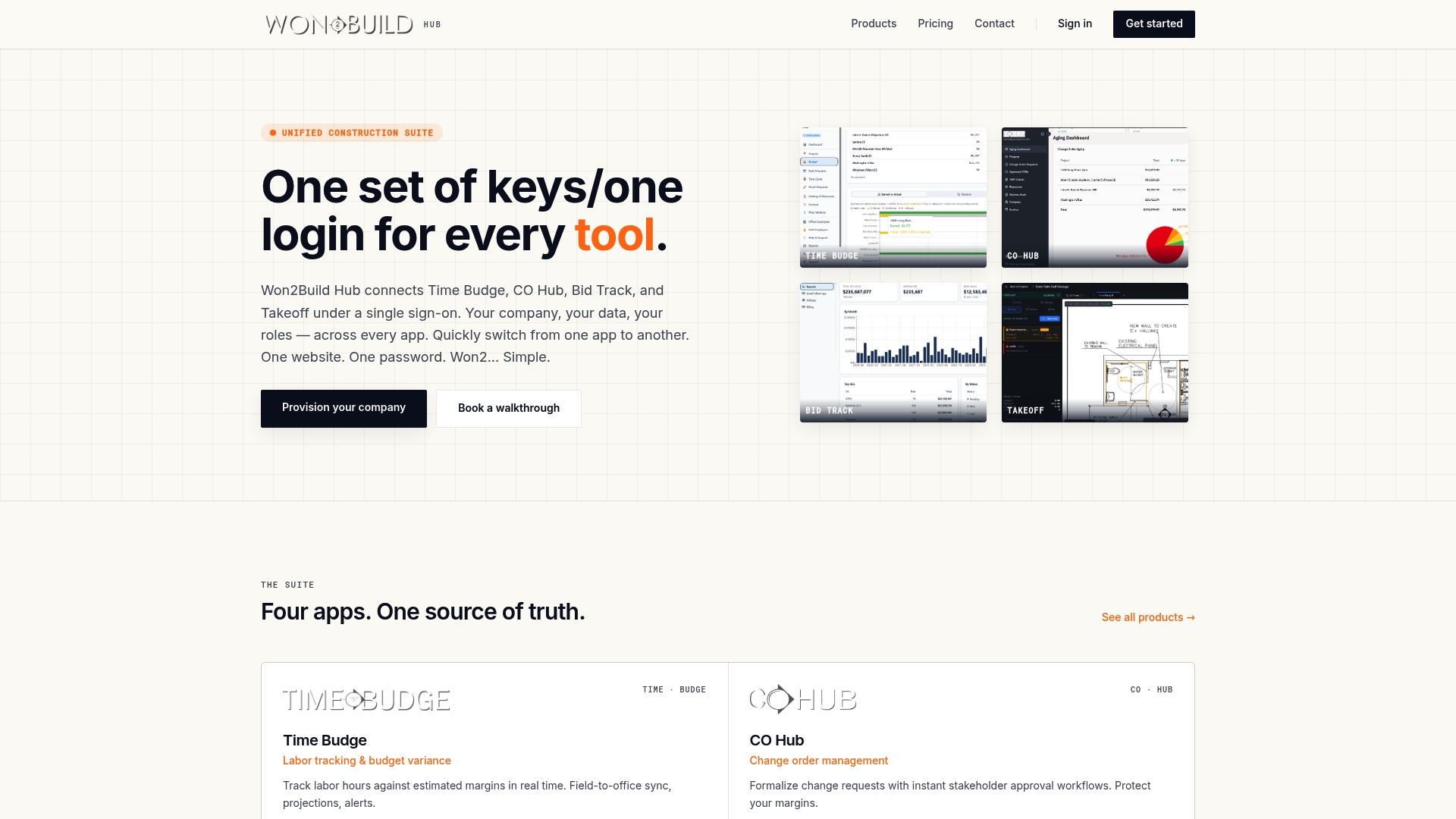
You can run the checklist above on paper or a spreadsheet today. If you want the bid pipeline, takeoff and labor history connected so each review has the data in one place, look at the Won2Build Hub.
Perspective
Most of the bids that hurt a subcontractor are not lost on price. They are won at a price that was missing something. In our experience building tools for subcontractors, the missing thing is rarely a math mistake. It is a scope item nobody owned, a quote that went stale, or a labor rate nobody compared with the last job.
That is why we think a review checklist is only half the answer. The other half is that the data it checks should live in one place. When takeoff quantities, bid status and field labor hours are connected, the reviewer can compare an estimate with what the crew actually did, instead of with memory.
We designed the Hub so a subcontractor can move between takeoff, bids, change orders and labor with one login and without double entry. The review step then becomes faster and more consistent, because everything the reviewer needs is already there.
Jen Reese
FAQ
What should an estimate review checklist include?
At minimum: scope and document completeness, quantity and takeoff checks, labor rates and productivity, material and subcontractor quote verification, markups and overhead, risks and exclusions, and documentation with a named sign-off. Run them as separate passes so each question gets full attention.
Who should review a construction estimate?
Ideally someone other than the estimator, since the author tends to repeat their own assumptions. In a small company that can be the owner, a project manager or another estimator. The depth of review should scale with the size and risk of the bid.
How is an estimate review different from an estimating checklist?
An estimating checklist lists the cost items to include while you price. A review checklist tests the finished estimate against the documents, current prices and stated assumptions. You need both, in that order.
How long should an estimate review take?
There is no fixed standard. A small proposal may need 20 to 30 minutes on the high-dollar items, while a large package can take several hours across scope, quantities and quotes. Set review tiers by bid size and schedule the time before the deadline.
Sources
- NJDOT Cost Estimating Guideline
- Improving Early Estimates Best Practices Guide, Construction Institute
- Construction Cost Estimating Guide, Idaho Transportation Department
- Bidding and Estimating, NASCLA
- The Essentials of Successful Estimating, ASPE
- Cost Engineering & Estimating QA Review Checklist, National Park Service
Recommended
One login for estimating, bid tracking, change orders, and labor.
The Hub is free. Pay only for the apps you turn on.
Create your free Hub account- Timecard Rounding Rules for Subcontractors: What's LegalFederal timecard rounding rules in plain English for US subcontractors: the 7-minute rule, the neutrality test, California limits, and a worked payroll example.
- Construction Software Implementation: A Plan for SubcontractorsA step-by-step plan for rolling out construction software at a commercial subcontractor: goals, data cleanup, phasing, field buy-in, training and go-live.
- Field Change Request: What Subcontractors Need to KnowWhat a field change request (FCR) is, what to put in it, who approves it, and how subcontractors protect cost and schedule when the field changes first.