
Construction Estimating Best Practices 2026: Field Guide
Discover essential construction estimating best practices 2026 to boost accuracy. Implement strategies that close the field-to-office loop effectively.

The single change that most improves estimating accuracy in 2026 is maintaining a living, regionally calibrated cost database and closing the field-to-office loop so that actual crew productivity feeds back into your unit rates before the next bid. Everything else in this guide builds on that foundation.
Here are the five highest-impact actions to implement now:
- Document assumptions and exclusions at bid time with drawing revision numbers, owner-furnished items, and provisional tolerances recorded in a structured log.
- Run a digital quantity takeoff (QTO) against current local cost lines from sources like RSMeans or regional supplier quotes rather than last year’s cost book.
- Break contingency by risk category (site conditions, escalation, weather, design completeness) rather than applying a single blanket percentage.
- Calibrate unit rates quarterly, or more often for steel, aluminum, and copper, which remain elevated due to tariff pressure in 2026.
- Sync field labor actuals back to your estimating database after each project close-out so recurring bid errors stop repeating.
Won2Build’s integrated suite maps directly to each of these steps, from digital takeoff through change-order capture and field labor tracking.
Table of Contents
- Why do estimating errors destroy margin and client trust?
- How should you document project assumptions before you estimate?
- How do you run a digital quantity takeoff that minimizes errors?
- Which estimating method fits each stage of your project?
- Where do you get reliable cost data, and how often should you update it?
- How does closing the field-to-office loop improve your next bid?
- How should you structure contingency and escalation in 2026?
- What software capabilities actually move the needle on estimating accuracy?
- How early should you engage subcontractors and suppliers?
- What does a structured estimate review look like before bid submission?
- What estimate types should you produce at each project milestone?
- What checklists and templates make these practices repeatable?
- How do you adjust estimates for supply chain volatility in 2026?
- How is AI changing construction cost estimating accuracy?
- How do you price green building and sustainability requirements?
- How do you manage scope changes and estimate revisions without losing control?
- How do you connect your estimate to the project schedule and cash flow?
- Key Takeaways
- The part of estimating reform that nobody talks about
- Won2Build connects every step of the estimating workflow
- Useful sources and further reading
Why do estimating errors destroy margin and client trust?
A missed line item does not just reduce profit on one job. It triggers a chain reaction. Schedule slips when crews run short on materials. Change orders spike. The owner’s trust erodes. And if the project closes in the red, the relationship rarely survives to a second contract.

General conditions typically represent 8–15% of direct costs and are chronically underestimated by newer firms. On a multi-million dollar subcontract, that gap can be substantial, often exceeding most firms’ net margin on the job. The math is unforgiving.
The downstream effects compound quickly:
- Schedule slippage from under-resourced supervision or site logistics forces overtime and premium material deliveries.
- Rework caused by scope ambiguity that a clear assumptions log would have prevented.
- Lost repeat business when an owner associates your name with cost overruns, even when the root cause was a documentation failure, not a performance failure.
A common failure mode: a subcontractor bids a 14-month mechanical fit-out using material prices locked at bid day, with no escalation allowance. Steel and copper prices rise during procurement. The firm absorbs the delta and finishes the year below break-even. The fix is not a bigger contingency number — it is a structured escalation clause tied to specific commodity indices, applied at bid time. For practical guidance on improving commercial bid accuracy, the process starts before the first quantity is measured.
How should you document project assumptions before you estimate?
Most estimating failures are process failures, not arithmetic errors. Missing scope, stale productivity rates, and superseded drawings are the real culprits. The fix is a structured documentation habit that starts the moment you receive bid documents.
Essential documents to collect and control:
- Current drawings with revision numbers and issue dates confirmed
- Project specifications (Division 01 through the relevant trade divisions)
- Geotechnical report and existing conditions survey
- Permit requirements and known lead times
- Supplier quotes with validity periods noted
- Subcontractor confirmations with scope inclusions and exclusions stated
Record every assumption in a log that captures: what was assumed, why, which drawing or spec section it references, and who made the call. When a scope dispute surfaces six months into construction, that log is your defense.
Pro Tip: Timestamp every assumption entry and tie it to a specific drawing revision. If the owner issues a revised set after bid, your log immediately flags which assumptions need revisiting — no hunting through email threads.
Store the assumptions log in the same folder as the estimate file, not in a separate system. Version-control both together so the estimate and its assumptions are always in sync.
How do you run a digital quantity takeoff that minimizes errors?
A digital QTO is faster than manual scaling, but speed creates its own risk. The estimator who moves too quickly through plan layers misses items just as easily as one working with a paper set. The discipline is in the controls, not the software.
A practical digital QTO workflow:
- Ingest PDFs or CAD files into your takeoff tool and confirm the scale on at least two dimensions before measuring anything.
- Organize measurements by CSI cost code or trade division from the start — retrofitting organization after the fact wastes time and introduces errors.
- Use assemblies for repetitive elements (a typical wall assembly, a standard MEP rough-in unit) to speed takeoff while keeping quantities auditable.
- Cross-check linear, area, and volume quantities against plan dimensions and schedules as you go, not at the end.
- Reconcile quantities across trades: if your structural steel tonnage does not align with the structural drawings’ member schedule, find out why before pricing.
Common QTO pitfalls include measuring from an unscaled PDF, double-counting items that appear on both architectural and structural sheets, and forgetting to account for waste factors on cut materials. For a detailed breakdown of common takeoff measurement errors, the patterns repeat across trades.
Pro Tip: Set a tolerance rule: any quantity that differs from a plan schedule by more than 5% triggers a mandatory recheck before pricing. That threshold catches most errors without slowing down routine takeoffs.
Which estimating method fits each stage of your project?
No single method works across the full project lifecycle. Using a detailed unit-cost estimate for a pre-feasibility study wastes time. Using a conceptual order-of-magnitude for a bid submission loses the job or loses money. Match the method to the information available.
| Method | Speed | Typical Accuracy | Best Use Case |
|---|---|---|---|
| Conceptual / order-of-magnitude | Very fast | ±30–50% | Pre-feasibility, program budgeting |
| Parametric | Fast | ±15% | Schematic design, early owner budgets |
| Assembly / systems | Moderate | ±10–20% | Design development, GMP negotiations |
| Unit cost (detailed) | Slow | ±10% or better | Bid estimates, control budgets |
| Analogous | Fast | Typical accuracy varies | Repeat building types with historical data |
Unit cost estimating with a detailed takeoff typically achieves ±10% accuracy or better when unit costs are current and validated against local data. Parametric methods are faster but depend entirely on the quality of the historical cost data and benchmarks you use.
A few practical notes on method selection:
- Analogous estimating works well for repeat clients with similar building programs (a chain of retail fit-outs, for example), but only when you track actuals rigorously enough to trust the historical data.
- Assembly estimating is underused in subcontractor bids. Pricing a standard MEP rough-in assembly rather than individual components speeds the estimate and reduces omission risk.
- Parametric estimates need regional calibration. A national cost-per-bed figure for healthcare construction can be 20–30% off in high-cost metros like San Francisco or New York.
Where do you get reliable cost data, and how often should you update it?
A cost database is only as good as its last update. Static cost books from two years ago are not a baseline — they are a liability, especially for metals and labor in 2026.
National construction costs rose modestly year-over-year in early 2026, but that headline number masks significant regional variation. The RLB Construction Cost Index for Q2 2026 shows stronger annual growth in metros like Honolulu, Phoenix, and Miami. A national average applied to a Phoenix project will underestimate costs.
Recommended baseline sources:
- RSMeans for national unit costs with city cost index adjustments by metro
- Regional supplier quotes locked within 30 days of bid submission for long-lead items
- Union wage reports from the relevant local (updated at each contract cycle)
- Historical job costs from your own closed projects, tagged by trade, region, and project type
Update the database quarterly at minimum. For steel, aluminum, and copper, monthly checks are warranted given current tariff exposure. Tag every cost line with its source and the date it was confirmed. When a line item is more than 90 days old, flag it for revalidation before use.
Pro Tip: When a supplier quote expires before bid day, do not use the old number. Call for a refresh. A 10-minute phone call is cheaper than carrying a stale price into a contract.

For long-lead items on projects with 12-month-plus schedules, material escalation needs an explicit allowance rather than relying on bid-day prices alone. Lock pricing where possible; where you cannot, apply a commodity-specific escalation factor tied to a published index.
How does closing the field-to-office loop improve your next bid?
The estimating database is only as accurate as the field data feeding it. Firms that close the field-to-office loop consistently outperform peers on margin preservation because they stop repeating the same bid errors.
What to capture in the field:
- Actual crew hours by activity, broken down to the cost-code level
- Production rates (linear feet of conduit per crew-hour, for example) compared against the estimated rate
- Change-order triggers: what caused the deviation and whether it was foreseeable at bid time
The feedback process:
Assign a data owner — typically the project manager or lead foreman — who submits a weekly field report against the estimate’s cost codes. At project close-out, the estimating lead reconciles actual unit rates against bid rates and updates the database. That reconciliation is what makes the next bid more accurate.
Pro Tip: Do not wait for project close-out to start the reconciliation. A mid-project review at 50% complete catches productivity drift early enough to adjust crew mix or procurement timing before the damage is done.
Real-time field reporting that syncs directly to office systems eliminates the lag between what happens on site and what the estimating team knows. That lag is where margin disappears.
How should you structure contingency and escalation in 2026?
A single blanket contingency percentage tells you nothing about where your risk actually lives. Replace it with category-level contingency so you can track consumption deliberately.
Recommended contingency categories:
- Site conditions: Unknown subsurface, existing structure conflicts, utility relocations
- Design completeness: Allowances for details not yet issued, owner-directed changes
- Material escalation: Commodity-specific exposure, especially steel, aluminum, and copper
- Weather and schedule compression: Regional weather exposure, liquidated damages risk
- Owner behavior: Scope additions, approval delays, payment timing
A worked example: on a $1.5 million electrical subcontract with a 16-month schedule, you might allocate 2% for site conditions ($30,000), 1.5% for design completeness ($22,500), 3% for material escalation on copper and aluminum ($45,000), and 1% for schedule compression ($15,000). Total contingency is $112,500, or 7.5%, but each dollar is traceable to a specific exposure.
Tariff and geopolitical channels continue to push steel, aluminum, and copper costs above baseline in 2026, with some metals showing outsized year-over-year increases. Build escalation clauses into subcontracts and supplier agreements that reference published commodity indices. If the owner will not accept a clause, price the escalation risk explicitly into the bid rather than hoping prices hold.
For projects with 12-month-plus procurement windows, consider splitting the material estimate into a locked portion (items you can purchase early) and a floating portion (items subject to market movement), then apply escalation allowances only to the floating portion.
What software capabilities actually move the needle on estimating accuracy?
The gap between top-tier estimating firms and the rest is widening as integrated, real-time cost databases and AI-assisted tools become standard practice. The firms still running estimates in disconnected spreadsheets are carrying a structural disadvantage.
Feature checklist for a modern estimating platform:
- Cloud-based digital takeoff with version control and audit trail
- Living cost database with source and date tags on every line item
- Change-order integration that updates the cost forecast automatically
- Field labor sync that feeds actual hours back to unit rates
- Bid versioning so you can compare alternates without overwriting the base estimate
- Reporting that shows cost-to-complete against the original estimate in real time
Practical setup steps:
- Structure your cost library by CSI division with sub-codes for labor, material, equipment, and subcontracted work.
- Tag line items with escalation exposure flags (metals, lumber, specialized equipment) so they surface automatically for revalidation.
- Connect field labor inputs to estimate rates through a defined data pathway, not a manual copy-paste process.
- Set a weekly reconciliation schedule: actual costs versus estimated costs, by cost code, every Friday.
Pro Tip: Start with one trade or one project type when building your cost library. A well-calibrated library for mechanical work is worth more than a half-built library covering every trade.
The benefits of cloud-based takeoff software extend beyond speed. A single source of truth for cost lines means every estimator on the team is working from the same data, which eliminates the version-conflict problem that plagues firms running multiple local spreadsheets.
How early should you engage subcontractors and suppliers?
Early sub engagement is not just courtesy. It is a pricing control. A sub who receives your inquiry three days before bid day gives you a number. A sub who has been in the conversation for three weeks gives you a number they have thought through, with scope inclusions documented.
Best-practice timeline:
- 4–6 weeks before bid: Issue preliminary scope packages to key subs and suppliers; confirm schedule windows and crew availability.
- 2 weeks before bid: Follow up on pricing status; flag any subs who have not responded and identify backups.
- 5 days before bid: Collect preliminary numbers; begin qualifying outliers.
- 48 hours before bid: Lock sub pricing; confirm scope inclusions and exclusions in writing.
Qualifying a low or outlier sub bid:
- Ask for a written scope breakdown, not just a lump sum.
- Confirm labor sourcing: are they using their own crews or brokering to a lower-tier sub?
- Verify availability: do they have the crew capacity for your schedule window?
- Check for exclusions that shift risk back to you (material escalation, permit fees, testing).
A brief email template for scope confirmation: “Please confirm your [date] quote of $[amount] includes [list key scope items] and excludes [list known exclusions]. Confirm your crew availability for a [start date] mobilization.” That one email, sent to every sub, creates a paper trail that protects you when scope disputes arise.
What does a structured estimate review look like before bid submission?
A senior review by a fresh pair of eyes is one of the highest-leverage controls in the estimating process. A formal senior review catches scope gaps, quantity errors, and rate inconsistencies that the primary estimator misses because they are too close to the work.
Senior review checklist:
- Quantities: spot-check 10–15% of line items against the takeoff; flag any that look out of range.
- Rates: confirm unit costs are from the current database, not carried forward from a prior estimate.
- Assumptions: verify the assumptions log is complete and that every major assumption has a drawing or spec reference.
- Omissions: walk the scope narrative against the estimate line by line; anything in the scope that has no cost line is a red flag.
- General conditions: confirm the GC budget is itemized, not a flat percentage applied at the end.
Sensitivity testing:
Run two scenarios before submission: material costs +10% and labor productivity -10%. If either scenario pushes the project into a loss, you need either a higher bid or a contingency conversation with the principal. These tests take 30 minutes and can prevent a six-figure mistake.
Pre-submission sign-off:
No estimate leaves the office without a dated sign-off from the senior reviewer confirming the checklist is complete. That discipline, applied consistently, is what separates firms with repeatable bid accuracy from those that win jobs they later regret.
What estimate types should you produce at each project milestone?
The estimate is not a one-time document. It evolves with the project, and each version serves a different decision. Producing the wrong estimate type at the wrong milestone misleads the owner and exposes the firm.
| Project Stage | Estimate Type | Typical Accuracy | Update Trigger |
|---|---|---|---|
| Pre-feasibility / program | Conceptual / order-of-magnitude | ±30–50% | Major program change |
| Schematic design | Parametric / square-foot | ±15% | Design development kickoff |
| Design development | Assembly / systems | ±10–20% | GMP negotiation, 50% CD |
| Bid / construction documents | Detailed unit cost | ±5–10% | Addenda, scope changes |
| Construction / control | Cost-to-complete forecast | ±5% | Monthly, or after any change order |
Re-run the estimate when: a tariff shock moves a key commodity more than 5% after bid, the schedule shifts by more than 30 days, or the owner issues a major design revision. Treating the bid estimate as a static document through construction is how firms end up surprised at close-out.
For digital bid tracking across the project lifecycle, maintaining a version history of each estimate type lets you trace exactly when and why the budget changed.
What checklists and templates make these practices repeatable?
Process discipline only scales when it is written down and stored where the team can find it. Here are compact templates to copy and adapt.
Assumptions/exclusions log (minimum fields):
- Item description
- Assumption or exclusion (circle one)
- Drawing/spec reference
- Date recorded
- Recorded by
- Status at award (confirmed / revised / voided)
Pre-bid sign-off checklist:
- [ ] Drawing revision confirmed (current set)
- [ ] Assumptions log complete and dated
- [ ] QTO cross-checked against plan schedules
- [ ] All cost lines sourced within 90 days
- [ ] General conditions itemized (not a flat %)
- [ ] Contingency broken by category
- [ ] Sub scope inclusions/exclusions documented
- [ ] Senior review completed and signed
Post-mobilization reconciliation checklist:
- [ ] Actual quantities versus estimated quantities reviewed by cost code
- [ ] Labor productivity actuals entered into the database
- [ ] Any scope changes logged as change orders (not absorbed into the base estimate)
- [ ] Supplier pricing confirmed against contract values
Store these templates in a shared cloud folder linked to your estimating platform. Every estimator on the team uses the same version. When a template is updated, the old version is archived with a date stamp, not deleted.
How do you adjust estimates for supply chain volatility in 2026?
Supply chain volatility in 2026 is not a temporary condition to wait out. Tariffs on steel, aluminum, and copper imports remain in effect, and geopolitical channels continue to push certain commodity costs above baseline. Estimators who treat commodity pricing as stable are building risk into every bid without naming it.
Three practical adjustments for 2026:
Tag tariff-exposed materials explicitly. Every line item involving steel, aluminum, copper, or imported electrical gear should carry a flag in your cost database. When you build the estimate, those items surface automatically for a pricing check against current supplier quotes rather than database defaults.
Use procurement timing as a cost lever. For projects with long schedules, buying structural steel or copper wire early locks the price and removes escalation risk from the estimate. Model the carrying cost of early procurement against the escalation exposure of waiting. On a large mechanical or electrical subcontract, that calculation often favors early purchase by a meaningful margin.
Write escalation clauses into your subcontracts. Reference a published index (the Producer Price Index for metals, for example) and define a threshold above which the contract price adjusts. Owners are more receptive to these clauses now than they were three years ago because the volatility is visible to everyone at the table. For project planning in 2026, managing commodity exposure is a front-of-mind concern across the industry.
How is AI changing construction cost estimating accuracy?
AI and machine learning are moving from pilot projects to production workflows in estimating, and the practical gains are real. Pattern matching against historical project data, automated quantity extraction from drawings, and anomaly detection in cost databases are the three areas where AI is delivering measurable value today.
Where AI adds the most value:
- Historical pattern matching: AI tools can scan a library of closed projects and surface the closest analogues to a new bid, including actual unit rates and productivity factors, in minutes rather than hours.
- Automated quantity extraction: Machine learning models trained on construction drawings can extract quantities from PDFs with accuracy that rivals a junior estimator’s first pass, freeing senior estimators for judgment-intensive work.
- Anomaly detection: An AI layer on top of your cost database flags line items that deviate significantly from historical ranges, catching data-entry errors and stale rates before they reach the bid.
The limitation is context. AI cannot resolve scope ambiguity in a set of incomplete drawings, and it cannot account for a specific owner’s known behavior patterns or a local labor market’s current availability. The best use of AI in estimating is as a first-pass accelerator and a consistency check, with human judgment applied to the outputs. Firms that treat AI estimates as final answers without review are trading one type of error for another.
How do you price green building and sustainability requirements?
Sustainability requirements are no longer optional add-ons on most commercial projects. LEED certification targets, energy code upgrades, and owner-driven ESG commitments are showing up in bid documents with increasing frequency, and each carries real cost implications that need explicit line items.
Cost categories to price explicitly:
- Enhanced commissioning: LEED and ASHRAE 202 commissioning requirements add labor hours that are easy to miss if you treat commissioning as a standard line item.
- Material documentation: Tracking Environmental Product Declarations (EPDs) and Health Product Declarations (HPDs) for LEED Materials and Resources credits requires administrative time that belongs in general conditions.
- Energy-efficient systems: High-efficiency mechanical and electrical systems carry a premium over standard-spec equipment. Price the delta against the base spec, not just the efficient system in isolation.
- Waste diversion: LEED construction waste management targets require sorting, hauling, and documentation. Budget for the additional dumpsters, the sorting labor, and the recycling facility fees.
The practical approach is to create a sustainability cost code in your estimate structure that captures all green-related premiums in one place. That makes it easy to show the owner the cost of each sustainability target and, when value engineering is needed, to model the impact of dropping a specific credit without rebuilding the whole estimate.
How do you manage scope changes and estimate revisions without losing control?
Scope changes are inevitable. The firms that protect margin through changes are the ones with a documented process, not the ones that are fastest at absorbing the work.
The core discipline: every scope change gets a change order number before any work starts. No exceptions. A change absorbed into the base estimate without documentation becomes an invisible cost that erodes margin and creates disputes at close-out.
A practical revision workflow:
- Owner or GC issues a change directive or RFI response that alters scope.
- The estimator prices the change using current cost data, not the original bid rates if time has passed.
- The change order is submitted with a scope narrative, quantity backup, and unit rates shown.
- The approved change order updates the control budget and the cost-to-complete forecast.
- The assumptions log is updated to reflect the new scope baseline.
Track revision history on the estimate itself. Every version gets a date stamp and a brief note explaining what changed. When a dispute arises about what was included in the original bid, the version history is the record.
Won2Build’s CO Hub is built for exactly this workflow: T&M ticket capture in the field, change-order pricing in the office, and a complete audit trail from directive to approved change order.
How do you connect your estimate to the project schedule and cash flow?
An estimate that lives in isolation from the schedule is a budget without a timeline. Connecting the two lets you forecast cash flow, identify procurement deadlines, and flag schedule-driven cost risks before they materialize.
Practical integration steps:
- Phase the estimate to match the schedule: Break the cost-code structure to align with major schedule milestones (mobilization, rough-in, above-ceiling, closeout). That alignment makes cost-to-complete forecasting straightforward.
- Build a procurement schedule from the estimate: Long-lead items identified in the estimate (switchgear, custom HVAC equipment, structural steel) need purchase order dates that work backward from the installation milestone in the schedule.
- Model cash flow from phased costs: Once the estimate is phased, apply the payment terms from the contract to project monthly cash in and out. A project that looks profitable at close-out can still create a cash flow problem in months 3 through 6 if billings lag costs.
The real-time budget tracking that connects field costs to the estimate also feeds the cash flow model. When actual labor hours run ahead of the estimate in a given phase, the cash flow forecast updates automatically rather than waiting for a monthly reconciliation.
Key Takeaways
Accurate construction estimating in 2026 requires a living, regionally calibrated cost database, category-level contingency, and a closed field-to-office feedback loop working together on every bid.
| Point | Details |
|---|---|
| Maintain a living cost database | Update cost lines quarterly; tag steel, aluminum, and copper for monthly revalidation given 2026 tariff pressure. |
| Break contingency by category | Allocate separate contingency for site conditions, design completeness, material escalation, and schedule risk instead of a single percentage. |
| Close the field-to-office loop | Feed actual crew hours and production rates back into unit rates after each project to stop repeating the same bid errors. |
| Match the method to the milestone | Use conceptual estimates at pre-feasibility (±30–50%) and detailed unit-cost estimates at bid stage (±5–10%); never apply the wrong method to the wrong decision. |
| Won2Build for integrated workflows | Won2Build’s Takeoff, Bid Track, CO Hub, and Time Budge connect QTO through change-order capture and field labor sync in a single platform. |
The part of estimating reform that nobody talks about
Most articles on estimating best practices focus on tools and techniques. The harder problem is organizational: getting an experienced estimating team to change habits they have refined over 15 years.
The resistance is not stubbornness. It is rational. A senior estimator who has been winning work with a particular process has evidence that the process works, at least well enough. The case for change has to be built on data from their own projects, not on vendor promises or industry benchmarks. Show them the variance between their bid rates and actual close-out rates, by cost code, over the last three years. That conversation changes the dynamic.
The adoption approach that works is a pilot, not a mandate. Pick one estimator, one project type, and one new practice (category-level contingency, for example). Run it alongside the existing process for two or three bids. Measure the variance. If the new approach produces a tighter estimate, the team sees it. If it does not, you learn something useful without disrupting the whole operation.
Scaling across multiple offices follows the same logic: pilot in one location, document the metrics, then roll out with a trained internal champion at each site rather than a top-down directive. The champion matters more than the software.
Won2Build connects every step of the estimating workflow
Subcontractors who implement the practices in this guide need a platform that keeps up with them. Won2Build’s integrated suite does exactly that: Takeoff handles digital plan quantification with a full audit trail, so every measured quantity is traceable to a specific drawing version. Bid Track centralizes bid management and stores historical cost data so your living cost database grows with every project you close. CO Hub captures change orders and T&M tickets the moment scope shifts, keeping the control budget current without a manual update cycle. Time Budge pulls actual field labor hours into the system so your unit rates reflect what crews actually produce, not what a cost book says they should.
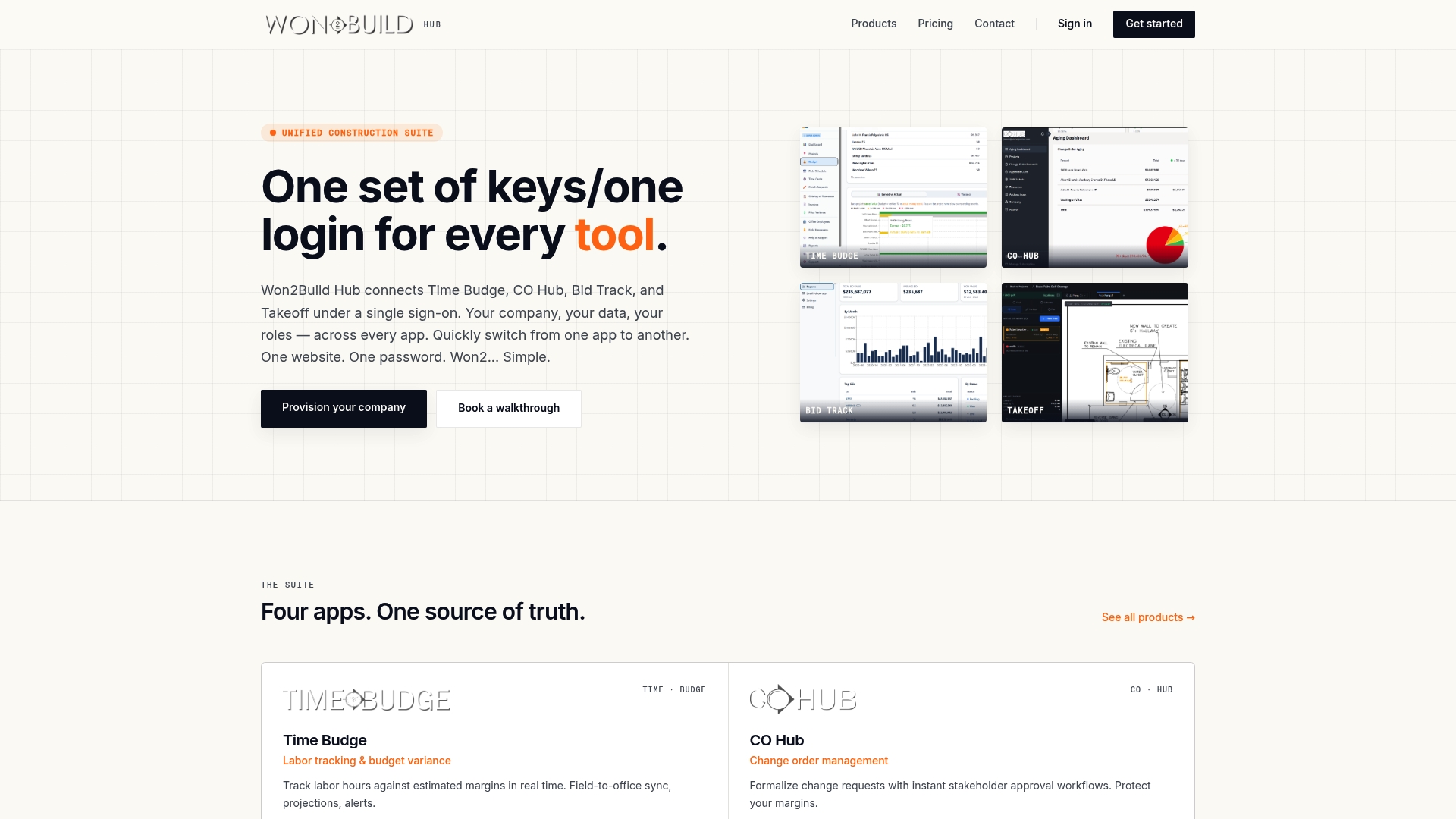
The result is a single source of truth from first takeoff to final change order, with field-to-office sync built in. No double entry, no version conflicts, no margin lost to a data gap between the field and the estimate. Start a free trial at Won2Build’s Takeoff or explore Bid Track to see how historical bid data can sharpen your next estimate.
Useful sources and further reading
RSMeans (Gordian): The industry standard for U.S. unit cost data, organized by CSI division with city cost index multipliers for regional calibration. Update your database against RSMeans at least annually; check metals quarterly.
CFMA Financial Benchmarker: The Construction Financial Management Association’s benchmarking tool provides margin, overhead, and working capital data by contractor type and revenue band. Use it to sanity-check your general conditions percentage against industry peers.
RLB Construction Cost Report (North America, quarterly): Rider Levett Bucknall’s quarterly index tracks cost movement by metro market. Essential for regional calibration, particularly in high-growth markets like Phoenix, Miami, and Honolulu.
JLL 2026 Construction Perspective: JLL’s annual construction outlook covers commodity trends, labor market conditions, and demand drivers by sector. Useful for escalation scenario planning and understanding which project types are driving cost pressure.
Buildermuse Construction Cost Estimating Guide 2026: A practitioner-oriented guide covering method selection, contingency sizing, and common failure modes. Cross-reference its accuracy ranges against your own historical data before adopting them as targets.
Charter Estimating — 2026 Key Trends & Strategies: Covers 2026 cost trends including tariff impacts and the field-to-office loop, with practical workflow recommendations for subcontractors and specialty contractors.
James Moore & Co. (JMCO) — Construction Estimating Best Practices: A concise, process-focused guide that emphasizes documentation discipline, senior review workflows, and assumption logging. Useful as a reference for building internal QA checklists.
Recommended
One login for estimating, bid tracking, change orders, and labor.
The Hub is free. Pay only for the apps you turn on.
Create your free Hub account- 7 Concrete Takeoff Steps Estimators Use to Avoid Ordering ShortfallsFollow seven concrete takeoff steps to calculate cubic yards, size rebar and formwork, convert volumes to supplier units, and verify quantities before bid...
- Are E-Signature Change Orders Legal and Worth the Switch?E-signature change orders streamline your workflow, ensuring faster approvals, fewer disputes, and quicker invoicing—discover the benefits now!
- How to Link Takeoff to Estimate for Accurate BidsLink your takeoff quantities to your estimate for accurate bids. Discover the seamless integration method that reduces errors and saves time.