
Pilot Plan for Subcontractors to Replace Construction Spreadsheets
Run a one-project pilot that stops margin loss, syncs field and office data, and retires error-prone spreadsheets. A practical, subcontractor-first...

The fastest fix for estimating errors, lost change orders, and payroll headaches is to move off spreadsheets and into an integrated suite that covers estimating, takeoff, labor tracking, and change-order management in one place. This cuts the manual reconciliation that eats into margins and removes the formula errors that spreadsheets never catch on their own. Won2Build Hub is one purpose-built option worth evaluating if you run commercial subcontracting work and want field and office data to match.
TL;DR:
- Moving from spreadsheets to an integrated construction software suite eliminates version drift, silent formula errors, manual rekeying, and field-office data lag.
- Effective replacement software should offer a single data source, mobile field access, built-in takeoff, change order support, data export options, and comprehensive onboarding.
- Implementing a phased migration—starting with core data, running a pilot, validating results, and retiring spreadsheets—reduces risk and maintains data integrity.
- A subcontractor-focused suite like Won2Build Hub streamlines estimating, takeoff, labor tracking, and change-order management under one login, improving workflow consistency.
- Early benefits include less rework and faster bid delivery, with cultural shifts in field data logging accelerated by pilot projects and measurable hours saved.
- ✓Bid estimates with Bid Track
- ✓Digital plan quantification with Takeoff
- ✓Labor tracking with Time Budge
- ✓Change order management with CO Hub
Table of Contents
- Why spreadsheets break down for estimating, cost tracking, and project control
- What replaces spreadsheets: the software categories that solve these problems
- Checklist: how to evaluate software that replaces construction spreadsheets
- Practical migration steps: audit, pilot, migrate, validate, retire
- Why a subcontractor-focused suite holds up under real use
- What realistic outcomes look like after retiring spreadsheets
- Won2Build Hub: built around the workflow subcontractors actually run
- FAQ
Why spreadsheets break down for estimating, cost tracking, and project control
Spreadsheets work fine for a single estimate or a quick punch list. They start to fail once multiple people touch the same file, because version drift sets in fast: someone emails “Estimate_Final_v3” while the field is still working from v2, and nobody notices until the numbers do not add up.
The bigger risk is quieter. A broken formula or a dragged cell reference can throw off a bid by thousands of dollars without triggering any warning, and the error often surfaces only after the job is won. Add in manual rekeying between estimating, payroll, and job-cost files, plus the fact that most spreadsheets have no real mobile interface for crews in the field, and you get a system that looks organized but is quietly leaking margin.
- Version drift: multiple copies of the same estimate circulate with no single source of truth.
- Silent formula errors: broken references change bid totals without any alert.
- Manual rekeying: the same labor hours or costs get typed into three different files.
- No field sync: crews cannot update time or quantities in real time, so office data lags.
That lag turns into reconciliation work at the end of every pay period, and reconciliation time is margin you cannot bill. Spreadsheets still earn their keep for one-off calculations or a quick what-if scenario, but once a workflow repeats across projects, it belongs in dedicated software.
Pro Tip: If you are spending more than an hour a week reconciling numbers between files, that is your signal to replace the spreadsheet, not patch it.
What replaces spreadsheets: the software categories that solve these problems
A spreadsheet tries to do five jobs at once: estimating, takeoff, labor tracking, change orders, and cost control. Replacing it well means recognizing those as five distinct problems that modern software solves with purpose-built tools, not one more universal template.
- Estimating and bid management replaces manual pricing sheets with structured estimates, reusable pricing libraries, and a bid pipeline you can actually track, an approach commercial estimating software is built around.
- Digital takeoff replaces printed plans and a highlighter with on-screen quantification, speeding up measurements and cutting the manual counting errors that creep into takeoff work.
- Labor and job-cost tracking replaces paper timesheets with field time capture that feeds directly into payroll and work-in-progress reports.
- Change order and T&M management replaces a change-order tab buried in a master spreadsheet with a system that tracks approvals, cost-to-complete, and documentation in one place.
- Project cost control replaces static budget-versus-actual tabs with live reporting that updates as costs come in.
The real gain is not any single tool, it is integration. A subcontractor running five disconnected spreadsheets plus two point tools still has to reconcile everything by hand. A unified suite that shares one set of data across estimating, takeoff, labor, and change orders removes that reconciliation step entirely, because there is only one record to update.
Checklist: how to evaluate software that replaces construction spreadsheets
Shortlisting replacement software goes faster with a short, prioritized list rather than a long feature comparison. Start with what breaks your current spreadsheets and work outward from there.
- Single source of truth: data entered in the field should update estimates, labor, and cost reports without a second entry.
- Mobile field access: crews need a real mobile interface, not a shrunk-down desktop view, to log time and change orders on site.
- Built-in takeoff: digital plan quantification should live inside the same system as your estimates, not in a separate app you re-key from.
- Change order and T&M support: look for structured CO tracking with approval history, not a notes field.
- Data portability: confirm CSV or XLSX export and, ideally, an API, so your data is never locked in.
- Onboarding and support: ask what training looks like for field crews specifically, and what support response times are.
- Pricing shape: compare flat per-company pricing against per-active-field-worker fees to see which fits your crew size and how your costs scale as you grow.
Before committing, run a short pilot on one active project in parallel with your current spreadsheets and compare the outputs line by line.
Pro Tip: Treat any vendor that cannot show you a clean data export as a red flag. If you cannot get your own data out, you have just traded one kind of lock-in for another.

Practical migration steps: audit, pilot, migrate, validate, retire
Migration fails most often when a subcontractor tries to move every historical file at once. A phased approach keeps the switch manageable and gives the field time to adjust.
- Audit first. Identify the recurring line items, current unit pricing, and the columns in your spreadsheets that nobody actually uses anymore.
- Pilot on one project. Run the new system alongside your spreadsheets on a single active job before touching anything else.
- Migrate core data first. Bring over pricing libraries, line-item templates, and current takeoff quantities, not years of archived files.
- Validate against your old numbers. Compare estimate totals, measured quantities, and payroll entries between the two systems before trusting the new one fully.
- Set a cutover date and retire the spreadsheets. Communicate the cutoff clearly to the field so nobody keeps two systems running out of habit.
A few things make this smoother:
- Keep the pilot project’s spreadsheet version untouched as your comparison baseline.
- Assign one person to own validation so discrepancies get caught and explained, not ignored.
- Expect the field to need a short adjustment period before mobile capture becomes routine.
Pro Tip: Build your clean pricing library before you migrate anything else. It is the piece every other module depends on, and getting it right once saves repeated cleanup later.
Why a subcontractor-focused suite holds up under real use
Jen Reese covers construction technology and workflow design for subcontractors, with a focus on how estimating and field data actually move through a project. The practical case for a unified suite rests on how it handles the handoffs that spreadsheets mishandle.
- Single sign-on across Time Budge, Bid Track, CO Hub, and Takeoff removes the need to log into separate systems and re-enter the same job information.
- Real-time field-to-office sync means a change order logged on site shows up in cost reports the same day, not after someone manually transcribes it.
- Shared data across modules reduces the double entry that causes most of the reconciliation errors described earlier.
- Per-module design means a subcontractor can start with one tool, such as estimating, and add others as workflows demand it.
These are structural advantages tied to how the suite is built, and they map directly to the failure modes spreadsheets create: version drift, rekeying, and lagging field data.
What realistic outcomes look like after retiring spreadsheets
The early wins I hear about most often are unglamorous: fewer rework hours because change orders are documented instead of buried in an email thread, and bids that go out faster because pricing libraries do not need rebuilding each time. The harder part is cultural, getting field crews to log time and quantities on a phone instead of a paper sheet handed to the office on Friday. That shift sticks faster when you start with one project, measure the hours saved during the pilot, and let that number make the case to the rest of the crew.
— Jen Reese
Won2Build Hub: built around the workflow subcontractors actually run
We built Won2Build Hub around the four jobs that spreadsheets handle worst for subcontractors: estimating, takeoff, labor tracking, and change-order management, all under one login so field updates reach the office the same day.
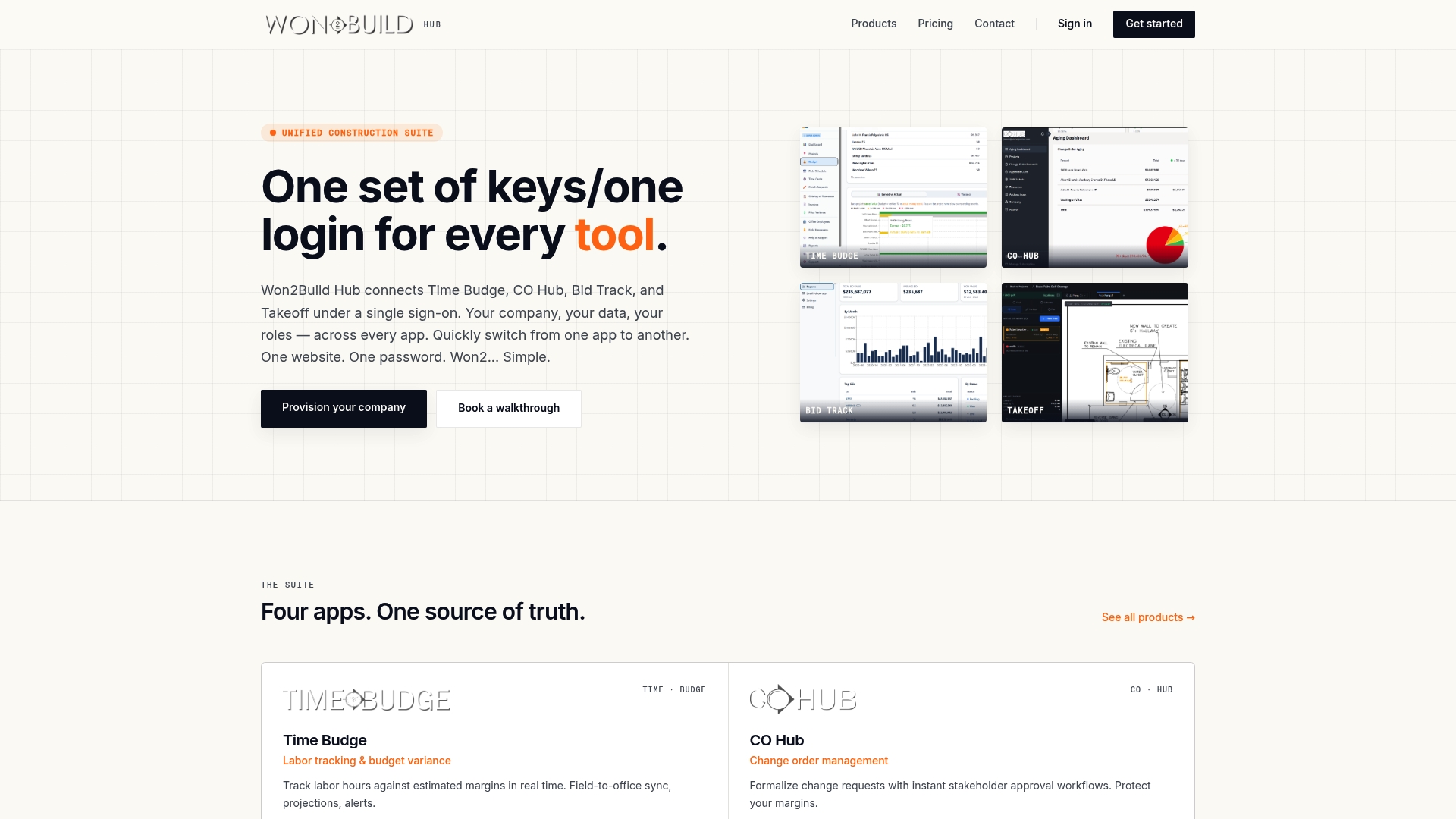
- Add Time Budge for labor and job-cost tracking tied to the same project data; current pricing details are on the pricing page.
- Layer in CO Hub for change order and T&M tracking; current pricing details are on the pricing page.
Compare plan options or view the full suite to see which modules fit your current workflow, then run a pilot on one project before you commit further.
FAQ
How much does it cost to replace spreadsheets with construction software?
Costs depend on which modules you need: Won2Build’s Bid Track and Time Budge are each $199 per month per company, CO Hub is $59 per month per company, and field worker fees add $2 per month per active field worker. Pricing for Takeoff and the full Hub bundle is available on request.
How long does it take to migrate off spreadsheets?
A focused pilot on one active project, rather than a full historical migration, is the fastest way to validate a new system without disrupting ongoing work. Most of the time investment goes into building a clean pricing library upfront, which then speeds up every project that follows.
Do I need to keep my old spreadsheets after migrating?
Keep your pilot project’s spreadsheet version as a comparison baseline until you have validated totals, quantities, and payroll entries against the new system. Once validation is complete and the field has shifted to the new workflow, most subcontractors retire the spreadsheets rather than maintain both.
Can I replace just one part of my spreadsheet workflow, like estimating?
Yes, modular software lets you start with a single workflow, such as estimating and bid tracking, and add takeoff, labor tracking, or change-order management as needed. Starting narrow keeps the pilot manageable and makes it easier to measure results before expanding.
What should I look for when comparing software to replace Excel?
Prioritize a single source of truth across estimating, takeoff, and labor data, real mobile field access, and clear data export options such as CSV or XLSX. Several alternatives to spreadsheet-based tools exist for subcontractors, so compare pricing shape and onboarding support alongside core features before choosing one.
Recommended
One login for estimating, bid tracking, change orders, and labor.
The Hub is free. Pay only for the apps you turn on.
Create your free Hub account- Managers: Make Mobile Field Workflows Resilient for 72 Hour OutagesPlaybook for field managers: offline first mobile workflows, resilient sync and conflict handling, compliance first AI guardrails, and practical pilot steps.
- Daily Signed Records: Force Account Tracking for Managers & InspectorsField checklist for project managers and inspectors to keep force account tracking audit-ready: use daily signed records for labor, equipment, and...
- Stop Timecard to Report Drift: Labor Cost Codes for SubcontractorsFix the timecard to report chain with labor cost codes that tie crews to budgets. Includes a 6 code starter and a burdened rate example.