
Construction Spanish Phrases for U.S. Subcontractors
Spanish phrases for the jobsite: greetings, safety warnings, comprehension checks, tools, materials and regional variations, plus how to keep paperwork clear for your crew.

The Spanish you need on a jobsite is a short list: start-of-day phrases, safety warnings, a few instructions, a way to check that someone understood, and the names of your tools and materials. Learn those 40 to 50 phrases in the dialect your crew speaks, and say them the same way every day. Then make sure the paperwork your crew touches, such as hours and extra-work tickets, is just as clear. We build for that second half at Won2Build, because a good phrase on the slab does not help if the time card behind it is confusing.
TL;DR
- Start with the 40 to 50 phrases you would use daily: greetings, safety, the work itself and a check that people understood. Add more later.
- Use Mexican and Central American Spanish unless your crew says otherwise. Most U.S. construction workers who speak Spanish come from there, and Spain-style Spanish can cause confusion.
- Safety phrases come first: “¡Alto!”, “¡Cuidado!”, “Póngase su casco, por favor” and “¿Entiende?”.
- Words vary by region. Ask what your lead calls a tool or material and use that word.
- Phrases cover talk. Hours, change orders and bids also need to be readable by your crew, which is where a bilingual interface helps.
Table of Contents
- Why Spanish matters on a commercial jobsite
- Which Spanish to learn
- Start-of-day phrases and basic instructions
- Safety warnings and understanding checks
- Tools, materials and trade vocabulary
- Regional differences: use your crew’s word
- How to learn it without losing a month
- Where phrases stop and the paperwork starts
- Our perspective
- Put your crew’s language into your time and change-order records
- FAQ
- Sources
Why Spanish matters on a commercial jobsite
In 2025, 35.4% of U.S. construction workers were Hispanic or Latino, compared with 20.0% of the overall workforce. The industry employed about 12.1 million people. The same source says contractors in drywall, roofing, concrete, masonry and painting often have crews that are mostly more comfortable in Spanish than English. That is field experience reported by contractors, not a statistic, but any sub in those trades will recognize it.
The stakes are practical. A Clemson University thesis on bridging language barriers reports that many Hispanic construction workers in the U.S. speak only Spanish while most supervisors speak only English. It also links higher accident rates among Hispanic workers to safety instructions that are not always understood. When common safety phrases were put in a field-tested translation app, supervisors and workers both reported fewer misunderstandings and more confidence.
You do not need to become fluent. A Southwest Florida course for builders, reported by the Herald Tribune, had instructors encourage gestures and aim to be understood rather than grammatically perfect. That is the right standard for a foreman with ten minutes before the morning huddle.
Which Spanish to learn
The dialect matters more than most phrase lists admit. The Clemson thesis by Alexis Saborio found that the majority of the U.S. Hispanic construction workforce comes from Mexico and Central America. It also found that using European Spanish instead of that dialect causes more confusion, raises stress and delays the project. Workers also use Spanglish terms that are not in a standard dictionary, such as a loanword like “shingles” for roofing shingles.
The thesis built 136 phrases for U.S. construction supervisors: 43 on safety, 61 on general communication, 15 on climate, time and inspections, and 14 on utilities and services. Surveyed practitioners said they use all 136 frequently or always. You do not need all 136. The split shows where the volume is: safety and day-to-day communication.
Start-of-day phrases and basic instructions
These are the phrases that open a shift and direct the work. The wording follows common jobsite guides such as Jobble’s jobsite Spanish list.
| English | Spanish | Say it like |
|---|---|---|
| Good morning | Buenos días | BWAY-nohs DEE-ahs |
| Are you ready? | ¿Está listo? | es-TAH LEES-toh |
| Do this | Haga esto | AH-gah ES-toh |
| Not like that | Así no | ah-SEE noh |
| Come with me | Venga conmigo | BEN-gah kon-MEE-goh |
| Faster / Slower | Más rápido / Más despacio | mahs RAH-pee-doh / mahs des-PAH-see-oh |
| Break time | Es hora del descanso | es OH-rah del des-KAHN-soh |
| Lunch time | Es hora del almuerzo | es OH-rah del al-MWEHR-soh |
Two habits make these work. First, give the instruction and then show it. “Haga esto” with a hand demonstration lands better than a perfectly pronounced sentence with no gesture. Second, use the polite “usted” form (“Haga esto”, “Póngase su casco”) with workers you do not know well. It is the default for supervisors in the Clemson phrase list.
Safety warnings and understanding checks
If you learn only one group, learn this one. Split it into three kinds of phrase.
Emergency warnings, said fast and loud:
- ¡Alto! (Stop!)
- ¡Cuidado! (Watch out!)
- Salga del sitio ya (Leave the site right now)
- No te pares debajo de la carga (Don’t stand under the load)
- Llama al 911 (Call 911)
These come from Field Lessons’ phrase sheet and the Herald Tribune course. Practice them until they come out without thinking.
Daily safety instructions, said at the start of the shift or when you see a problem:
- Póngase su casco, por favor (Put on your hard hat)
- Póngase sus anteojos de seguridad (Put on your safety glasses)
- Se requiere EPP en todo momento (PPE is required at all times)
- Por favor, recoja su basura (Please pick up your trash)
- Reunión de seguridad (Safety meeting)
- ¿Está lesionado? (Are you injured?)
- ¿Necesita ayuda? (Do you need help?)
The first five are among the top phrases supervisors should learn according to the Saborio thesis. “EPP” stands for equipo de protección personal, the Spanish term for PPE.
Comprehension checks, the phrases most people skip:
- ¿Entiende? or ¿Entiendes? (Do you understand?)
- Enséñeme primero (Show me first)
- Pregúnteme si no está seguro (Ask me if you’re not sure)
A “sí” to “¿Entiende?” is not proof. Asking the worker to show you the task first, the way Field Lessons’ phrase sheet suggests, gives you something you can see. Use the informal “tú” versions (“¿Entiendes?”) only with people you know well.
The official safety vocabulary
OSHA publishes an English and Spanish list of frequently used construction terms. It is the best neutral reference for toolbox talks and signage. It includes:
| English | Spanish (OSHA) |
|---|---|
| Scaffold | andamio |
| Helmet | casco |
| Safety harness | arnés de seguridad |
| Confined space | espacio restringido |
| Cave-in | derrumbe |
| Rebar | acero de refuerzo |
| PPE | equipo de protección personal |
| Concrete | concreto, hormigón |
When a safety term is on your site-specific plan or a sign, use the OSHA wording so that what you say matches what the worker reads.
Tools, materials and trade vocabulary
Once the basics are covered, learn the nouns of your own trade. Start with words that are almost the same in both languages. Bradley Hartmann’s Pro Builder article on “Spanish twins” points out words such as metal, material, vertical, horizontal and diagonal that are spelled and mean the same in both languages. Near-twins include cemento, concreto, ducto, contrato and pavimento. Those give you a dozen words for free.
Here is a general jobsite starter list from Field Lessons’ U.S. vocabulary, with additions from Jobble:
| English | Spanish |
|---|---|
| Jobsite | la obra |
| Foreman | el mayordomo (also el capataz, el jefe) |
| Rebar | la varilla |
| Forms | la cimbra |
| Slab | la losa |
| Trench | la zanja |
| Scaffold | el andamio |
| Tape measure | la cinta de medir |
| Drill | el taladro |
| Wheelbarrow | la carretilla |
| Plywood | el triplay |
| Drywall | la tablaroca |
| Hammer | el martillo |
| Nail | el clavo |
| Saw | la sierra |
For measurements, crews in the U.S. work in the same units you do: pulgadas (inches), pies (feet) and libras (pounds), plus la altura, el largo and el ancho for height, length and width. Those words matter when you hand off a layout or a cut list. If unit mix-ups have cost you material, our guide to unit of measure standards lays out the conventions, and our list of construction measurement tools covers the tools themselves.
Building materials
For materials, Lingua Linkup’s construction list gives brick (ladrillo), mortar (mortero), steel (acero), PVC pipes (tubos de PVC), copper pipes (tuberías de cobre), wire mesh (malla de alambre) and sealant (sellador). OSHA gives insulation as aislamiento and plywood as madera contrachapada, though many crews say “triplay” for plywood.

The people on the job
For “construction worker”, WordReference gives obrero de la construcción, obrero and trabajador de la construcción. “Building” as a finished structure is edificio, while construcción refers to the process or the business, per the Cambridge Dictionary. So “office building” is edificio de oficinas, and “building costs” is costos de construcción in U.S. usage.
Regional differences: use your crew’s word
No single list is right for every crew. Andre Moskowitz’s 2005 ATA dialectology study shows that tool names vary across the 20 Spanish-speaking countries. A sledgehammer is “almágana” for most Salvadoran respondents but “comba” for most Peruvians. Within a country, a speaker’s occupation is the strongest factor in whether they know a given trade word at all.
A few examples common on U.S. crews:
- Tape measure: la cinta métrica is standard; el flexómetro is common in Mexico and Central America, per Momentum Spanish.
- Pliers: los alicates is standard; las pinzas is used in Mexico.
- Concrete: el concreto is what you will hear most on U.S. jobs; el hormigón is more common in Spain and Argentina.
- Pickup: la camioneta or la troca.
- Toilet: inodoro in Mexico, excusado in much of the Southwest, per ConstructionSpanish.app’s plumbing guide.
- Drip edge: goterón on some roofing crews, vierteaguas on others; both are correct, per the same site’s roofing guide.
The working rule: ask your lead or your most experienced hand what they call the item, then use that word. Nobody is wrong, and matching the worker’s word is faster than correcting it.
How to learn it without losing a month
- Pick 10 phrases per week, not 100. Start with greetings, then safety, then your trade’s tools.
- Say one phrase a day in the morning huddle. Field Lessons recommends this routine, and it works because it puts the phrase in front of the people who will correct you.
- Write the phrases on a card in your pocket. Include the pronunciation in plain English letters, as in the tables above.
- Pair every instruction with a gesture or a demonstration. Understanding beats grammar.
- Ask a bilingual lead to check your list. One pass from the person on your crew who knows the local words will fix regional mismatches.
- Use the same phrase every time. Consistency helps a worker who is learning your voice and your accent.
A common mistake is relying on a dictionary app for full sentences. Machine translations tend to produce textbook Spanish, not the jobsite version, and the Clemson research shows why that costs you on a real project.
Where phrases stop and the paperwork starts
Spoken phrases solve the problem at the point of work. They do not solve what happens after: the crew member who clocks in on a screen in a language they read less comfortably, the foreman who writes a time-and-materials ticket from memory at the end of a day, or the extra work that never reaches the office because the paperwork was hard to fill out.
Those gaps matter to your margin. A missed ticket is unbilled work, and a clock-in error becomes a payroll correction. Our article on cutting clock-in errors with bilingual time tracking goes through how those mistakes happen, and our 30/60/90 plan for field-to-office communication shows how to close the gap step by step. For a broader look at how subs keep field and office aligned, see our guide to construction collaboration.
Our perspective
We run a software company for commercial subcontractors, and the pattern we care about is simple: the jobsite speaks more than one language, and the systems behind it usually speak one.
A foreman who learns “¡Cuidado!” and “¿Entiendes?” has made the crew safer. That same foreman then hands the crew a time card, a change order form or a sign-in screen in English only. The talk was bilingual and the record was not.
That is why Won2Build Hub has a bilingual interface and works from the phone in the field, with data that syncs to the office in real time. When the people doing the work can read the tool, hours and extra-work tickets get recorded as they happen, and the office is not re-keying notes at the end of the week.
Learn the phrases. Then give your crew tools in the language they are most comfortable in, so that what is said on the slab ends up in the job cost report.
Jen Reese
Put your crew’s language into your time and change-order records
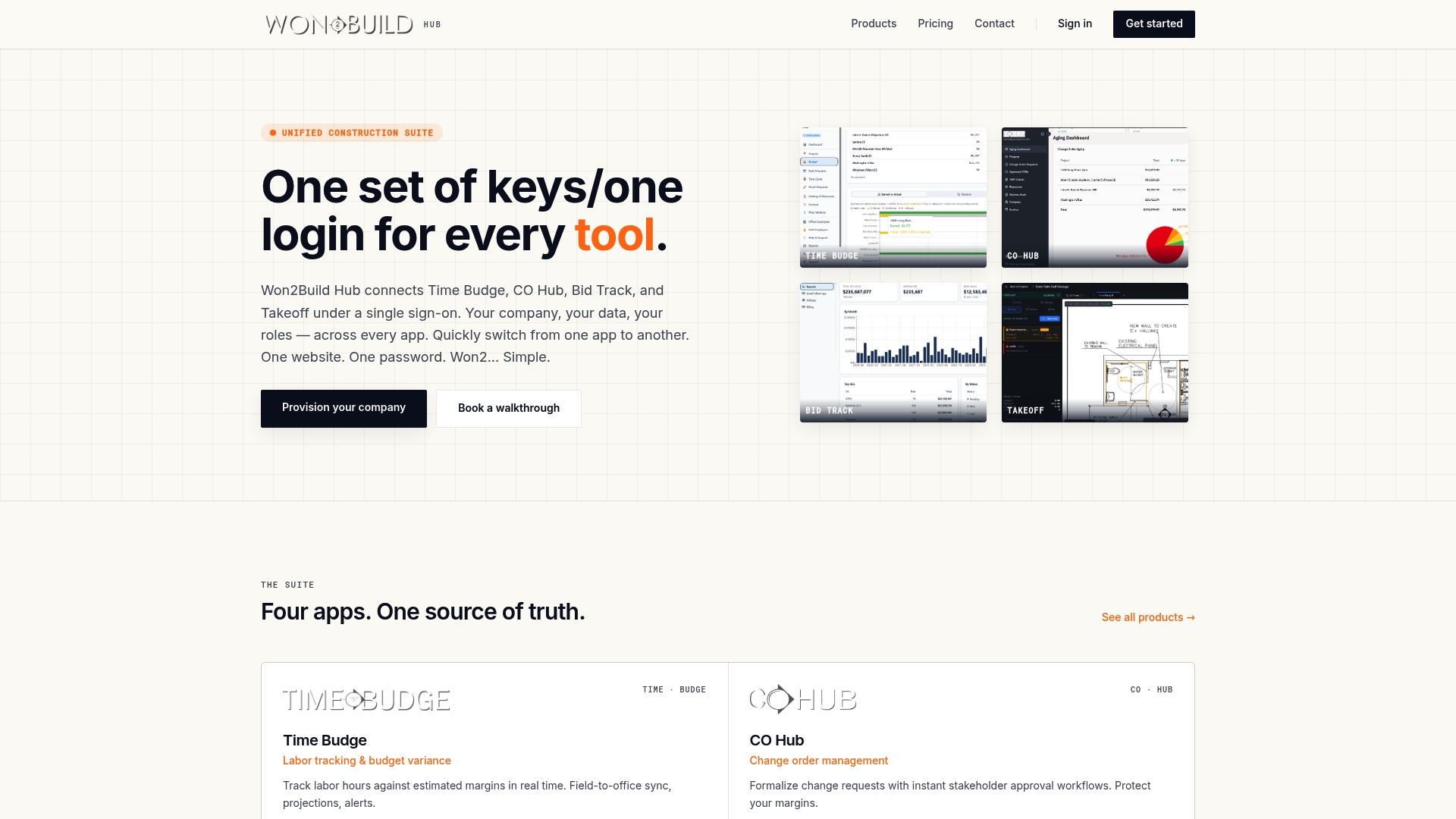
Won2Build Hub brings four apps together under one login: Time Budge for time and labor tracking, CO Hub for change orders and T&M tickets, Bid Track for bids and estimating, and Takeoff for digital plan quantification. The interface is bilingual, it works on mobile, and it syncs between field and office.
Pricing is published: Time Budge is $199 per month per company, Bid Track is $199 per month per company, and CO Hub is $59 per month per company. Active field workers are $2 per month each. Takeoff and the Hub itself are listed at $0 per month. See the current details on the pricing page, or look at Time Budge first if labor tracking is where your crew’s language gap shows up.
If you are also measuring from plans, Takeoff covers digital quantification, and our guide to material takeoff explains how the quantities feed your estimate.
FAQ
How do you say “construction worker” in Spanish?
The usual terms are obrero de la construcción, obrero and trabajador de la construcción. On a U.S. jobsite you will also hear the trade name, such as albañil for a bricklayer or mason. Use the word your crew uses for itself.
What are the first Spanish phrases a foreman should learn?
Start with greetings, then safety: “¡Alto!”, “¡Cuidado!”, “Póngase su casco, por favor” and “¿Entiende?”. Add the names of your main tools and materials next. Roughly 40 to 50 phrases cover daily use for most crews.
Should I learn Mexican Spanish or Spain Spanish for construction?
Learn Mexican and Central American Spanish. Clemson research found that most of the U.S. Hispanic construction workforce comes from those regions, and that using European Spanish adds confusion and delays. Then adjust individual words to what your own crew says.
Is “concreto” or “hormigón” correct?
Both are correct. OSHA’s list gives both, but “el concreto” is the one you will meet most often on U.S. jobs, while “hormigón” is more common in Spain and Argentina.
How do I know a worker understood a safety instruction?
Ask “¿Entiendes?” and then ask them to show you the task first. A yes alone is not a reliable check, so watch the step being done before work continues.
Sources
- Frequently Used Construction Industry Terms (OSHA)
- Developing Mexican and Central American Spanish Phrases for Construction Supervisors (Clemson University)
- Digital Solutions for Bridging Language Barriers (Clemson University)
- Bilingual Foremen: Pay and Safety on a 35% Hispanic Workforce
- Spanish Twins: The fastest way to learn construction Spanish (Pro Builder)
- Building in Spanish (Cambridge Dictionary)
- Construction worker (WordReference)
- 2005 ATA Annual Conference Proceedings: Topics in Spanish Lexical Dialectology
- Jobsite Spanish: 100+ Phrases and Terms for Construction
- Construction Spanish: How to Learn It
- Spanish for Construction Workers
- Spanish Vocabulary for Construction Tools
- Plumbing Spanish: 35 Phrases
- Roofing Spanish: 40 Phrases
Recommended
One login for estimating, bid tracking, change orders, and labor.
The Hub is free. Pay only for the apps you turn on.
Create your free Hub account- Timecard Rounding Rules for Subcontractors: What's LegalFederal timecard rounding rules in plain English for US subcontractors: the 7-minute rule, the neutrality test, California limits, and a worked payroll example.
- Construction Software Implementation: A Plan for SubcontractorsA step-by-step plan for rolling out construction software at a commercial subcontractor: goals, data cleanup, phasing, field buy-in, training and go-live.
- Estimate Review Checklist for Commercial SubcontractorsA practical estimate review checklist for commercial subcontractors: scope, takeoff, pricing, markups, risks and sign-off, so errors are caught before you submit.