
Unit of Measure Standards: SI, U.S. Customary and Construction UOM Codes
Which unit of measure standards apply in the U.S.? SI base units, customary units, conversion rules and the UOM codes (SF, LF, CY, EA) subs use in takeoffs and bids.

A unit of measure standard is an agreed definition of a quantity, such as a meter, a pound or a gallon, so that everyone who uses the number means the same thing. In the U.S. two layers matter: the formal standards (the SI, or modern metric system, and the U.S. customary system) and the working UOM codes (SF, LF, CY, EA) that estimators and purchasing teams put on takeoffs, bids and change orders. This guide covers both, then shows how a subcontractor keeps them consistent.
TL;DR
- The SI has seven base units: meter, kilogram, second, ampere, kelvin, mole and candela. Every other SI unit is derived from them.
- The U.S. runs on two systems side by side. Congress has named the metric system the preferred system for trade and commerce, yet inch-pound units remain the everyday language of U.S. construction.
- Construction UOM codes are shorthand, not a single national standard: SF, LF, CY and EA are common, but agencies and owners publish their own lists.
- Most quantity errors come from mixed units, wrong conversions and unlabeled scale, not from math. Fix the unit before you count.
- Set one UOM list per company and use it in takeoff, bid and change order records.
Table of Contents
- What a standard unit of measure is
- The seven SI base units
- U.S. customary units and why they still dominate construction
- Converting between systems without losing accuracy
- Construction UOM codes
- Where unit mistakes cost subcontractors money
- Setting a UOM standard for your own company
- Our perspective
- Keeping units consistent with Won2Build
- FAQ
- Sources
What a standard unit of measure is
A unit of measure is a fixed quantity used to express other quantities of the same kind. A foot measures length. A gallon measures liquid volume. A standard means the definition is the same for every user, which is what lets a supplier in one state quote against a drawing from another.
The system most standards bodies build on is the International System of Units. NIST describes it as the modern metric system, and says that Congress has designated the metric system as the preferred system of weights and measures for U.S. trade and commerce. The treaty behind it is old: seventeen countries, including the United States, signed the Treaty of the Meter in Paris on May 20, 1875.
One design feature explains why engineers like it. NIST Technical Note 938 explains that because SI is coherent, with only one unit for any physical quantity, there is no need to convert within the system from one unit to another. Customary units have no such property: a length can be inches, feet, yards or miles, and each needs its own factor.

The seven SI base units
NIST lists the seven base units as follows. The set also supports 22 derived units with special names and symbols, which together with the base units make up twenty-nine core units.
| Quantity | Base unit | Symbol |
|---|---|---|
| Length | meter | m |
| Mass | kilogram | kg |
| Time | second | s |
| Electric current | ampere | A |
| Thermodynamic temperature | kelvin | K |
| Amount of substance | mole | mol |
| Luminous intensity | candela | cd |
ASHRAE, whose handbooks serve mechanical and HVAC trades, states the same structure: seven base units plus numerous derived units, with each physical quantity having only one unit that prefixes may modify. That is why you see millimeters and kilometers rather than a separate unit for each size.
For most subs, only a few of these show up on a job: meter (length), kilogram (mass), second (time, for rates) and the derived units for area, volume, force and pressure. Electrical subs also deal with the ampere, and temperature shows up in curing and HVAC specs.
U.S. customary units and why they still dominate construction
NIST Miscellaneous Publication 286 notes that two systems of weights and measures exist side by side in the United States: the U.S. Customary System and the International (Metric) System. It adds that the metric system is the only one that has received specific legislative sanction by Congress.
In practice, drawings, specs and supplier catalogs for most commercial work in the U.S. use inches, feet, yards, pounds, gallons and tons. Federal highway work shows the same split. The FHWA FP-03 specifications explain that customary units, formerly called English units, are the units customarily used in the U.S. today, and the agency issues a separate U.S. customary version for roads and bridges.
Customary units are tied to metric definitions. The same NIST publication defines a yard as 0.9144 meter, an avoirdupois pound as 0.45359237 kilogram, and a gallon as 231 cubic inches for measuring liquids only. So a foot in your takeoff is not a loose idea. It is exactly defined in terms of the meter.

Where each system applies
NIST SP 811 sets the rule for scientific and technical publications: customary units must be avoided and SI units used instead. That is guidance for technical writing, not a rule about what your drawings use. For a commercial sub the practical rule is simpler: use the unit system of the contract documents, and convert only when a supplier, a manufacturer or an owner requires it.
Converting between systems without losing accuracy
Conversion is where quantity errors enter. NIST describes unit conversion as a multi-step process: multiplying or dividing by a numerical factor, choosing the right number of significant digits, and rounding. It points to exact factors in SP 811 Appendix B and to conversion tables for length, area, volume and mass in NIST Handbook 44 Appendix C.
FHWA’s specification adds a rounding instruction for conversions between SI and customary units: round according to Section 4 of ASTM E 380.
A few habits keep conversions clean:
- Convert once, at the end. Carry full precision through the calculation and round only the final figure.
- Use exact factors. Pull them from NIST rather than from memory. A rounded 0.45 for the pound-to-kilogram factor will drift on a large order.
- Convert squares and cubes correctly. A square foot is not 0.3048 square meters. You square the factor: 0.3048 times 0.3048. Volume cubes it.
- Label the result. A bare number with no unit is how a 40 turns into 40 of the wrong thing.
Construction UOM codes
Beyond the formal standards, construction runs on short codes. There is no single national list that every owner follows, but the same handful appears across estimating forms and agency documents.
A Georgia Tech Uniformat bid form, for example, uses CY for excavation, SF for wall construction, LF for trenches and EA for pits and bases. Those codes map neatly to how quantities behave:
| Code | Meaning | Typical use |
|---|---|---|
| LF | Linear feet | Trenches, conduit, pipe, edge forms, base trim |
| SF | Square feet | Drywall, flooring, roofing, wall area |
| SY | Square yards | Paving, carpet |
| CY | Cubic yards | Concrete, excavation, backfill |
| EA | Each | Fixtures, devices, doors, anchors |
| LS | Lump sum | Allowances, mobilization |
| TON | Tons | Aggregate, structural steel |
Treat the table as a common working convention, not an official list. Agencies publish their own. The Minnesota DOT’s quantities chapter, for instance, lists pay item abbreviations that pair metric codes such as m, m2, m3, kg and t with their customary equivalents, such as linear feet, square yards, cubic yards, pounds and tons. Its list also includes MBM for thousand board feet, a reminder that lumber has its own convention.
Classification formats and the unit that goes with them
Cost classification formats tie units to building systems. The NPS Cost Estimating Requirements Handbook explains that UNIFORMAT II is a twelve-part cost classification format established by GSA with AIA and corresponds to major building systems. It suits project planning and early design estimating. Detailed trade bids usually use finer line items, but the principle holds: each line carries one unit, and that unit should match how the item is bought or installed.
Where unit mistakes cost subcontractors money
Unit mistakes rarely look like unit mistakes. They look like a short concrete order, a bid that is high against everyone else, or a change order the GC disputes. The usual causes:
- Mixed units in one estimate. Linear feet of conduit added to meters from a metric detail sheet.
- A wrong scale. A drawing set to the wrong scale makes every area and length wrong by the same ratio. Our guide to calibrating PDF scale walks through verifying it before you measure anything.
- Cubic and square confusion. Slab quantities in square feet priced against a cubic yard unit price without the thickness conversion. The concrete takeoff steps show where that conversion belongs.
- Bid comparison across unlike units. Two suppliers quote the same material, one per EA and one per LF. Without normalizing, the lower number is not necessarily the lower price. This is the core of bid leveling.
- Unit drift between office and field. The estimate says SF, the field reports in sheets, the change order says EA.
More patterns are in our write-up of common takeoff measurement errors, and the PDF takeoff accuracy steps cover a repeatable check.
Setting a UOM standard for your own company
You cannot change the codes on someone else’s bid form, but you can control your own records. A one-page internal standard is enough.
- Pick the unit system per project. Default to the contract documents. Write it on the job setup sheet.
- Publish a short UOM list. Use the codes in the table above, add the ones your trade needs (sheets, bags, MBF), and retire duplicates such as SQFT, SF and sq ft.
- Assign one unit per cost item. Each item is measured, priced and billed in the same unit, or has a documented conversion.
- Record the conversion factor beside the item. If you measure in LF and the supplier sells in 10-foot sticks, store both the factor and the rounding rule (round up to full pieces for ordering).
- Match field and office terms. Time entries, T&M tickets and estimates should use the same names for the same work.
- Review at closeout. Compare estimated quantities with installed quantities by unit. Differences point to either a measuring habit or a conversion that needs fixing.
The broader estimating context is in our estimating best practices and estimate components list. For how units sit within contract documents, see what a Section 01 specification is. If you want a view on tools, measurement tools examples for contractors covers the physical and digital side, and the accuracy ranges guide explains how much error an estimate at each stage should expect.
Our perspective
Subcontractors rarely lose money because they do not know what a cubic yard is. They lose it because the same quantity gets typed three times, in three units, by three people.
That is the reason we built Won2Build Hub as one suite with a single login. Takeoff quantities, bid estimates, change orders and labor hours live in connected apps, so a number measured once does not have to be re-keyed somewhere else. Fewer re-entries means fewer places for a unit to change quietly.
Our advice is the same whatever software you use: settle the unit for each cost item before the estimate starts, calibrate the plan scale before the first measurement, and make sure the field and the office use the same words. A small standard, applied every time, protects margin better than a clever spreadsheet.
Jen Reese
Keeping units consistent with Won2Build
Won2Build Hub brings four apps together under one sign-on: Time Budge for labor tracking, CO Hub for change orders and T&M tickets, Bid Track for bids and estimates, and Takeoff for digital plan quantification. Our design goal is real-time sync between field and office, so quantities and hours move through the project without double entry.
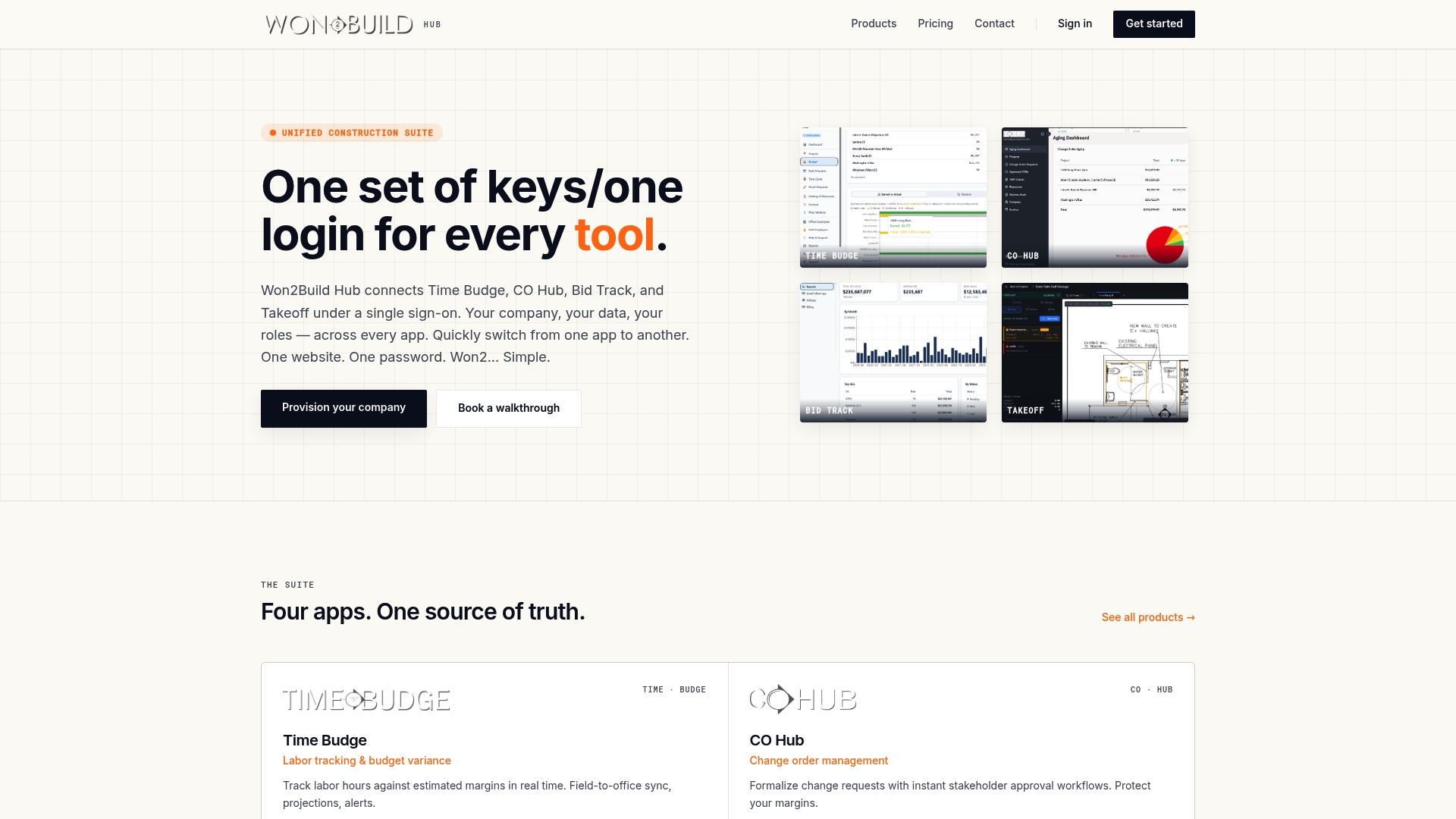
Published pricing, from our pricing page: Time Budge is $199 per month per company, Bid Track is $199 per month per company, CO Hub is $59 per month per company, and an active field worker fee of $2 per month applies per active field worker. Takeoff and The Hub are $0 per month. You can look at the Bid Track estimating tool or the Time Budge labor tracking tool, or start from the Won2Build Hub itself.
FAQ
What are the 7 standard units of measurement?
They are the seven SI base units: meter for length, kilogram for mass, second for time, ampere for electric current, kelvin for temperature, mole for amount of substance and candela for luminous intensity, as listed by NIST. All other SI units are derived from these. U.S. customary units such as the foot and pound are defined from them as well.
Does the U.S. use metric or customary units?
Both. Congress has designated metric as the preferred system for trade and commerce, but customary units remain the working language of most U.S. construction drawings and supplier catalogs. Follow the unit system your contract documents specify.
What are the standard UOM codes in construction?
There is no single national list, but SF, LF, SY, CY, EA, LS and TON appear on most estimating and bid forms. Agencies and owners publish their own abbreviations, so check the bid form for each project and map your codes to it.
How do I convert between U.S. customary and metric units?
Multiply or divide by an exact factor, keep full precision until the final step, then round to a sensible number of digits. NIST publishes exact factors in SP 811 Appendix B, and its unit conversion page explains the method. Remember to square or cube the factor for areas and volumes.
Sources
- SI Units | NIST
- The International System of Units (SI), 2019 Edition, NIST SP 330
- Recommended practice for the use of metric (SI) units, NIST Technical Note 938
- Guide for the Use of the International System of Units (SI), NIST SP 811
- Units of weight and measure, NIST Miscellaneous Publication 286
- Unit Conversion | NIST
- The SI Guide | ASHRAE
- FHWA FP-03 Standard Specifications for Construction of Roads and Bridges
- Georgia Tech Uniformat bid form
- Minnesota DOT, Chapter 2: Quantities
- NPS Cost Estimating Requirements Handbook
Recommended
One login for estimating, bid tracking, change orders, and labor.
The Hub is free. Pay only for the apps you turn on.
Create your free Hub account- Construction Spanish Phrases for U.S. SubcontractorsSpanish phrases for the jobsite: greetings, safety warnings, comprehension checks, tools, materials and regional variations, plus how to keep paperwork clear for your crew.
- Timecard Rounding Rules for Subcontractors: What's LegalFederal timecard rounding rules in plain English for US subcontractors: the 7-minute rule, the neutrality test, California limits, and a worked payroll example.
- Construction Software Implementation: A Plan for SubcontractorsA step-by-step plan for rolling out construction software at a commercial subcontractor: goals, data cleanup, phasing, field buy-in, training and go-live.